Guide to Asbestos Trust Fund Claims - (800) 291-0963

Illinois Asbestos Products

Illinois Asbestos Products - Mesothelioma

🧱 Illinois Asbestos Products

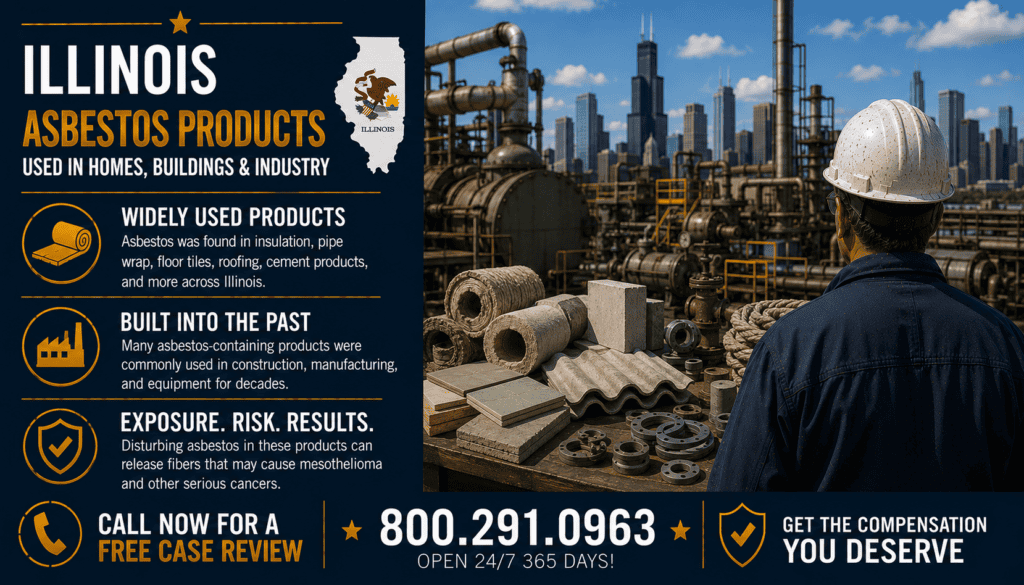
Illinois workers, contractors, mechanics, building trades, maintenance crews, and residents historically encountered asbestos-containing products in factories, power plants, construction projects, transportation systems, commercial buildings, public facilities, and homes throughout the state.

For much of the twentieth century, asbestos was incorporated into certain products because it resisted heat, fire, friction, chemicals, and deterioration. These materials could be found around boilers and steam systems, inside industrial machinery, in automotive friction components, and throughout older buildings.

The presence of an asbestos-containing product did not automatically mean meaningful exposure occurred. Risk generally increased when materials were cut, drilled, sanded, scraped, broken, removed, repaired, replaced, deteriorated, or otherwise disturbed, allowing fibers to become airborne.

Workers researching where exposure may have occurred can also review Illinois Asbestos Exposure Sites & Industries and Illinois Workers & Occupational Asbestos Exposure.


🏭 Where Asbestos Products Were Used in Illinois

Illinois developed around major manufacturing, transportation, construction, power generation, steel, petroleum, chemical, and agricultural industries.

Historical asbestos-containing products could be encountered in:

  • Power plants
  • Steel mills
  • Foundries
  • Manufacturing plants
  • Oil refineries
  • Chemical plants
  • Railroad facilities
  • Automotive repair shops
  • Construction sites
  • Machine shops
  • Boiler rooms
  • Schools
  • Universities
  • Hospitals
  • Government buildings
  • Commercial properties
  • Apartment buildings
  • Homes

Workers did not need to manufacture asbestos products themselves to encounter them. Electricians, mechanics, pipefitters, insulators, millwrights, custodians, construction workers, and many other trades could disturb installed materials during ordinary work.


🧱 Illinois Asbestos Products Used in Construction

Older Illinois buildings could contain asbestos products installed during original construction or later remodeling.

Potential historical applications included certain:

  • Cement board
  • Asbestos-cement products
  • Roofing materials
  • Siding
  • Floor tile
  • Flooring backing
  • Ceiling materials
  • Joint compounds
  • Plasters
  • Textured coatings
  • Fire-resistant panels
  • Pipe insulation
  • Boiler insulation
  • HVAC insulation
  • Fireproofing materials

Construction-related exposure could occur when workers drilled, cut, sanded, removed, demolished, or renovated older materials.

Demolition and renovation can be especially important because workers may disturb products installed decades before they entered the building.

See Illinois Asbestos Products Used in Construction.


🔥 Illinois Asbestos Insulation Products

Insulation was one of the most significant historical asbestos applications because industrial facilities needed materials capable of tolerating high temperatures.

Potential applications included certain:

  • Pipe covering
  • Boiler insulation
  • Block insulation
  • Insulating cement
  • Turbine insulation
  • Furnace insulation
  • Duct insulation
  • Tank insulation
  • Thermal blankets
  • Cloth
  • Wrapping materials

Insulators could have direct contact, but exposure could also affect pipefitters, boilermakers, electricians, millwrights, mechanics, maintenance workers, and nearby employees when older insulation was disturbed.

See Illinois Asbestos Insulation Products.


🚗 Illinois Automotive Asbestos Products

Asbestos was historically used in certain vehicle components because of its ability to withstand heat and friction.

Potential products included certain:

  • Brake linings
  • Brake shoes
  • Brake pads
  • Clutch facings
  • Gaskets
  • Heat-resistant components
  • Friction materials

Mechanics and brake technicians could disturb these materials during removal, replacement, sanding, grinding, machining, and cleaning.

Older vehicles and aftermarket replacement components can therefore be important when reconstructing an Illinois mechanic’s occupational history.

See Illinois Automotive Asbestos Products and Illinois Automotive Brake Equipment Asbestos Exposure.


⚙️ Illinois Industrial Asbestos Products

Illinois factories, steel mills, power plants, refineries, chemical facilities, and other industrial operations relied on complex mechanical and thermal systems.

Potential historical asbestos-containing products associated with these environments included certain:

  • Gaskets
  • Valve packing
  • Pump packing
  • Mechanical seals
  • Thermal insulation
  • Refractory products
  • Heat-resistant cloth
  • Fireproofing
  • Electrical insulation
  • Boiler materials
  • Furnace materials
  • High-temperature cement

The particular product depended on the equipment, manufacturer, application, facility, and period of use.

See Illinois Industrial Asbestos Products.


🔩 Asbestos Gaskets, Packing & Sealing Products

Gaskets and packing were used extensively in industrial mechanical systems.

Potential applications included:

  • Pumps
  • Valves
  • Boilers
  • Turbines
  • Compressors
  • Steam lines
  • Flanges
  • Process piping
  • Heat exchangers
  • Industrial machinery

Exposure could occur when workers removed deteriorated gaskets or packing and prepared equipment for replacement materials.

Workers sometimes scraped gasket residue from metal sealing surfaces, creating additional dust.

Useful exposure details include:

  • Equipment manufacturer
  • Component type
  • Gasket or packing material
  • Worksite
  • Department
  • Approximate year
  • Repair task

The source page specifically emphasizes these equipment and component details for historical exposure research.


⚡ Electrical & Heat-Resistant Asbestos Products

Asbestos was historically incorporated into some electrical and heat-resistant products.

Potential applications included certain:

  • Electrical panels
  • Arc-resistant barriers
  • Insulating boards
  • Heat shields
  • Electrical insulation
  • Fire-resistant cloth
  • High-temperature barriers
  • Equipment insulation

Electricians, utility workers, maintenance personnel, and equipment technicians could encounter these materials during repair or modernization.

Not every historical electrical product contained asbestos.

Manufacturer, model, date, and product-specific evidence are more useful than assuming asbestos was present solely because electrical equipment was old.

Workers can also review Illinois Electricians Asbestos Exposure & Mesothelioma.


🛡️ Asbestos Fireproofing Products

Fire resistance was one reason asbestos was incorporated into certain industrial and building products.

Historical fireproofing materials could be used around:

  • Structural steel
  • Boiler rooms
  • Mechanical spaces
  • Industrial equipment
  • Walls
  • Ceilings
  • Utility areas
  • High-temperature processing equipment

Fireproofing becomes particularly relevant when it deteriorates or is disturbed during renovation, demolition, maintenance, or equipment replacement.


🔥 Refractory & High-Temperature Asbestos Materials

Steel mills, foundries, power plants, manufacturing facilities, and other high-temperature operations relied on refractory and heat-resistant materials.

Depending on product and period, asbestos could historically be incorporated into certain:

  • Refractory cements
  • Insulating cements
  • Furnace materials
  • Boiler materials
  • High-temperature insulation
  • Heat-resistant boards
  • Protective textiles

Potential exposure could occur during maintenance, boiler rebuilding, furnace repair, shutdowns, demolition, and refractory removal.


🔥 Boiler & Power Generation Products

Boilers, turbines, generators, steam systems, pumps, and valves brought several asbestos-product categories together within the same facility.

Potential products included certain:

  • Boiler insulation
  • Pipe covering
  • Insulating cement
  • Refractory materials
  • Gaskets
  • Packing
  • Thermal blankets
  • Turbine insulation
  • Fire-resistant barriers
  • Electrical insulation

Workers can research the equipment itself through Illinois Boiler Equipment Asbestos Exposure and Illinois Power Generation Equipment Asbestos Exposure.


🏭 Products Associated With Industrial Machinery

Asbestos-containing products were often components of larger machines, not stand-alone equipment.

Examples include:

  • Pump → gasket or packing
  • Valve → packing or flange gasket
  • Boiler → insulation, refractory, gasket
  • Turbine → insulation or gasket
  • Compressor → gasket, packing, seal
  • Furnace → refractory or insulation
  • Automobile → brake or clutch material
  • Steam piping → pipe covering or flange gasket

This distinction matters because a worker may remember the equipment manufacturer but not the manufacturer of the asbestos-containing replacement component.

For equipment-level research, see Illinois Equipment & Machinery Asbestos Exposure and Illinois Industrial Machinery Asbestos Exposure.


👷 Illinois Workers Who May Have Encountered Asbestos Products

Occupation can help identify which products should be investigated.

Potentially exposed workers included:

  • Insulators
  • Pipefitters
  • Steamfitters
  • Boilermakers
  • Millwrights
  • Electricians
  • Mechanics
  • Machinists
  • Welders
  • Maintenance workers
  • Construction workers
  • Carpenters
  • Plumbers
  • HVAC workers
  • Automotive mechanics
  • Railroad workers
  • Power plant workers
  • Steelworkers
  • Refinery workers
  • Chemical-plant workers
  • Custodians
  • Building-maintenance workers

The occupation alone does not establish exposure..

See Illinois Workers & Occupational Asbestos Exposure.


🔧 How Workers Could Be Exposed During Maintenance

Many asbestos-containing products were designed to remain installed for years.

Exposure could increase when workers:

  • Removed insulation
  • Replaced gaskets
  • Removed valve packing
  • Repaired boilers
  • Overhauled turbines
  • Rebuilt pumps
  • Serviced industrial machinery
  • Cut construction products
  • Sanded flooring
  • Repaired brakes
  • Replaced clutches
  • Demolished walls or ceilings
  • Renovated older buildings

These tasks could disturb asbestos-containing material and release fibers into the surrounding work area.

Nearby workers could also experience bystander exposure.


🛑 Plant Shutdowns, Outages & Major Overhauls

Scheduled shutdowns can be particularly important in asbestos-product research because many systems may be opened or rebuilt simultaneously.

Workers could encounter:

  • Pipe insulation
  • Boiler insulation
  • Gaskets
  • Packing
  • Turbine insulation
  • Refractory materials
  • Pump components
  • Valve components
  • Electrical insulation
  • Fireproofing

Repeated annual shutdowns can represent multiple distinct exposure periods over a long career.


🏗️ Renovation & Demolition of Older Buildings

Construction products can remain installed for decades.

Renovation and demolition could disturb historical:

  • Flooring
  • Ceiling materials
  • Joint compound
  • Cement products
  • Roofing
  • Siding
  • Fireproofing
  • Pipe insulation
  • Boiler insulation
  • HVAC materials

Workers should document the building, project, trade, contractor, dates, and specific materials disturbed.

See Illinois Construction Asbestos Exposure and Illinois Construction Workers Asbestos Exposure & Mesothelioma.


🏭 Connecting an Illinois Asbestos Product to a Worksite

Product identification becomes far more useful when connected to an actual facility.

These relationships can narrow research from thousands of possible asbestos products to materials that fit a worker’s actual history.

Research Illinois workplaces through Illinois Asbestos Exposure Sites & Industries.


⚙️ Connecting Products to Equipment & Machinery

Some workers remember the machine more easily than the product installed inside it.

Useful connections include:

  • Pump → gasket or packing
  • Valve → packing or flange gasket
  • Boiler → insulation, refractory or gasket
  • Turbine → thermal insulation or gasket
  • Automobile → brake or clutch material
  • Steam piping → insulation or flange gasket

The source page specifically identifies this equipment-to-product relationship as important for historical exposure research.


🏷️ Equipment Manufacturer vs. Asbestos Product Manufacturer

A worker may remember the manufacturer of a pump, boiler, valve, turbine, compressor, vehicle, or industrial machine.

That does not automatically mean the same company manufactured the asbestos-containing gasket, packing, insulation, brake lining, refractory product, or replacement component used with it.

Replacement components could come from separate manufacturers and suppliers.


🔎 Identifying an Asbestos Product When the Brand Is Unknown

Many workers understandably cannot remember product brands decades after exposure.

Historical research may use:

  • Employment records
  • Union records
  • Coworker recollections
  • Equipment manufacturers
  • Maintenance records
  • Plant specifications
  • Construction documents
  • Purchase records
  • Procurement records
  • Contractor records
  • Product catalogs
  • Photographs
  • Equipment manuals
  • Historical testimony

Even small details can matter.

A worker may remember that insulation arrived in bags, that mechanics repeatedly replaced a particular type of gasket, or that a boiler was rebuilt during annual outages. Those facts can help narrow product research.


👨‍👩‍👧 Secondhand Exposure From Asbestos Products

Asbestos fibers could historically leave workplaces on:

  • Work clothing
  • Shoes
  • Tools
  • Equipment
  • Personal belongings
  • Vehicles

Family members could potentially encounter dust while handling or laundering contaminated work clothing.


🫁 Illinois Asbestos Products & Mesothelioma

Mesothelioma is strongly associated with asbestos exposure, but diagnosis can occur decades after the exposure happened.

A person diagnosed today may therefore need to reconstruct work and product exposure dating to the 1960s, 1970s, 1980s, or earlier.

The goal is not to create a list of every asbestos product ever sold in Illinois.

The goal is to identify products that reasonably fit the person’s actual worksite, occupation, equipment, tasks, and time period.


🫁 Asbestos-Related Lung Cancer

Occupational asbestos exposure is an established cause of lung cancer.

Workers could potentially inhale asbestos fibers while disturbing insulation, repairing boilers, scraping gaskets, removing packing, working on brakes, cutting construction products, or performing many other maintenance tasks.

Smoking and asbestos exposure together substantially increase lung-cancer risk.

See Illinois Asbestos Lung Cancer Lawsuits.


🌬️ Asbestosis & Other Asbestos-Related Conditions

Asbestos exposure can also cause:

  • Asbestosis
  • Pleural plaques
  • Pleural thickening
  • Other nonmalignant asbestos-related abnormalities

Workers concerned about past asbestos-product exposure should provide healthcare professionals with a detailed occupational history, including the products and work tasks they remember.


📋 Building an Illinois Asbestos Product Exposure History

Document as much information as possible about:

  • Employer
  • Illinois facility
  • City
  • County
  • Employment dates
  • Occupation
  • Department
  • Equipment
  • Maintenance responsibilities
  • Contractors
  • Products remembered
  • Packaging
  • Manufacturers
  • Coworkers
  • Shutdowns
  • Overhauls
  • Renovation projects
  • Demolition projects

Even incomplete information can help narrow the investigation.


🗺️ Connecting Products to Illinois Counties

Workers who remember where they worked but not the specific product can also begin with geographic research.

Current county resources include:

See Illinois Counties Asbestos Exposure & Lawsuits for broader geographic research.


⚖️ Why Product Identification Can Matter in Illinois Asbestos Claims

Asbestos litigation generally requires more than showing that a worker once worked in an industry where asbestos was historically used.

Important questions may include:

  • Which asbestos-containing product was involved?
  • Who manufactured or supplied it?
  • Where was it encountered?
  • When was it used?
  • What task disturbed it?
  • How frequently did exposure occur?
  • What evidence supports the history?

Different products can also lead to different potential compensation sources.

One manufacturer may remain financially responsible, while another may have entered bankruptcy and established an asbestos trust.

For Illinois legal information, see Illinois Mesothelioma Lawsuits & Claims.


💰 Illinois Asbestos Trust Fund Claims

Some companies that historically manufactured asbestos-containing insulation, gaskets, packing, friction materials, refractory products, construction products, and other materials later entered bankruptcy and established asbestos trusts.

Potential trust eligibility can depend on:

  • Medical diagnosis
  • Product
  • Manufacturer
  • Worksite
  • Occupation
  • Exposure period
  • Trust-specific evidence requirements

See Illinois Asbestos Trust Fund Claims.


👨‍👩‍👧 Wrongful Death & Historical Product Identification

When a former Illinois worker dies from an asbestos-related disease, family members may need to reconstruct product exposure without the worker available to answer questions.

Potential sources include:

  • Employment records
  • Social Security records
  • Union files
  • Coworker testimony
  • Equipment records
  • Plant records
  • Construction records
  • Product catalogs
  • Photographs
  • Maintenance documents
  • Medical records

See Illinois Wrongful Death Mesothelioma Lawsuits.


⏱️ Illinois Filing Deadlines

Asbestos-related lawsuits and other claims are subject to filing deadlines.

The applicable period can depend on:

  • Diagnosis
  • Date of death
  • Type of claim
  • Applicable law
  • Jurisdiction
  • Individual circumstances

Do not assume that the age of the asbestos product or the date it was originally installed determines every filing deadline.

See Illinois Mesothelioma Statute of Limitations.


❓ Frequently Asked Questions About Illinois Asbestos Products

Did every older Illinois industrial product contain asbestos?

No. Asbestos use varied by manufacturer, product, formulation, application, and year. Individual products should be researched rather than assuming everything at an older industrial facility contained asbestos.

Were asbestos products used only in factories?

No. Historical asbestos-containing products were used in industrial facilities, power plants, transportation equipment, commercial buildings, schools, hospitals, public buildings, homes, and many other settings.

Can asbestos products be identified decades later?

Sometimes. Employment records, coworkers, equipment information, maintenance documents, procurement records, product catalogs, construction files, and other historical evidence may help reconstruct exposure.

What if the worker remembers the machine but not the asbestos brand?

The equipment can provide an important starting point. Manufacturer, model, components, maintenance requirements, replacement parts, and facility history may help narrow potential products.

Can one worker encounter several asbestos products?

Yes. A long career may involve different facilities, equipment systems, contractors, manufacturers, and product categories.

Are asbestos trust funds connected to particular products and manufacturers?

Potentially. Individual bankruptcy trusts have their own exposure, medical, procedural, and evidentiary requirements, making accurate manufacturer and product identification important.

Does remembering a manufacturer prove exposure?

No. Manufacturer identification is an important research lead, but the actual product, workplace, task, and period still need to fit the worker’s history.

Can a worker have both occupational and take-home exposure in the same family?

Yes. One family member may experience direct workplace exposure while another household member experiences secondary exposure from contaminated clothing or work items.


🔗 Illinois Asbestos Product & Exposure Resources


☎️ Call 800.291.0963 — Open 24/7, 365 Days

If you or a family member worked in Illinois and later developed mesothelioma, asbestos-related lung cancer, or another asbestos-related disease, documenting the worksite, occupation, equipment, asbestos products, manufacturers, coworkers, tasks, and exposure dates can help reconstruct possible historical exposure.

MesotheliomaHelp.Center provides information about asbestos exposure, mesothelioma, asbestos claims, trust funds, filing deadlines, wrongful death claims, and related options.


Find Out If You Qualify Today!

25 Years Working With Diagnosed Mesothelioma Victims!

Our Mesothelioma lawyers work on a contingency fee basis.

This means NO MONEY OUT OF POCKET EXPENSES by the asbestos victims or their families. You will find the contingency fees to be among the lowest in the country.

Talk to a real live person!
Contact a mesothelioma lawyer today for a free, no-obligation case evaluation. 

Call (800) 291-0963 to find out if you have a valid claim.

Free Mesothelioma Case Evaluation

Get Answers From Expert Mesothelioma Attorneys