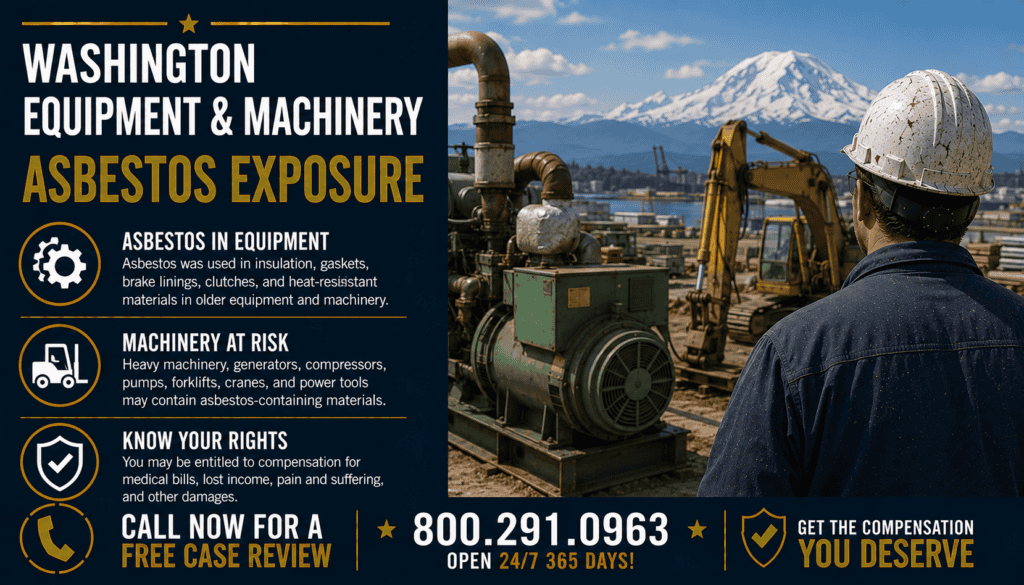
Washington Equipment & Machinery Asbestos Exposure
Washington workers in shipyards, power plants, factories, railroad facilities, industrial plants, construction projects, utilities, automotive repair shops, and other workplaces may have encountered asbestos-containing components used in machinery and mechanical systems.
The Washington Equipment & Machinery Asbestos Exposure hub organizes historical exposure research by equipment type. It helps workers, retirees, veterans, and families move from a remembered boiler, turbine, pump, valve, industrial machine, generator, or automotive brake system to the products, maintenance tasks, occupations, worksites, and manufacturers that may have been involved.
This page should serve as the primary equipment and machinery hub beneath the Washington asbestos exposure silo.
Washington Equipment and Machinery Asbestos Exposure
Industrial equipment often operated under demanding conditions involving:
- High temperatures
- Steam
- Pressure
- Friction
- Vibration
- Electrical heat
- Heavy mechanical loads
Historically, certain asbestos-containing materials could be used because of their resistance to heat, fire, friction, and deterioration.
Potential components could include certain:
- Gaskets
- Packing
- Thermal insulation
- Refractory materials
- Heat shields
- Friction materials
- Electrical insulation
- Fireproofing
- Cement products
- Seals
Not every machine or component contained asbestos.
Equipment research should consider the manufacturer, model, application, facility, time period, maintenance history, and replacement components whenever possible.
Why Equipment Matters in Washington Asbestos Research
A worker may remember repairing a particular machine even when the asbestos-containing product used with it is no longer remembered.
That makes equipment a valuable starting point.
For example, someone may remember:
- Repairing boilers
- Rebuilding pumps
- Repacking valves
- Overhauling turbines
- Maintaining generators
- Servicing compressors
- Repairing industrial machinery
- Working on shipboard equipment
- Maintaining railroad machinery
- Replacing automotive brakes
The investigation can then move from the machine to the components and products associated with it.
A useful sequence is:
Employer → Facility → Occupation → Equipment → Maintenance Task → Component → Product → Manufacturer
Washington Boiler Equipment Asbestos Exposure
Boilers were used throughout Washington in:
- Power plants
- Shipyards
- Manufacturing facilities
- Industrial plants
- Public buildings
- Hospitals
- Schools
- Utility systems
- Marine facilities
Historical boiler systems could involve certain:
- Boiler insulation
- Refractory materials
- Gaskets
- Packing
- Insulating cement
- Steam pipe insulation
- Valve packing
- Pump packing
- Heat-resistant products
Potential exposure could occur during:
- Boiler installation
- Routine maintenance
- Shutdowns
- Insulation removal
- Refractory replacement
- Gasket scraping
- Valve repair
- Pipe repair
- Boiler demolition
Workers potentially involved could include boilermakers, pipefitters, mechanics, insulators, electricians, maintenance employees, shipyard workers, and power plant workers.
Washington Industrial Machinery Asbestos Exposure
Washington manufacturing, shipbuilding, processing, utility, and industrial facilities relied on extensive machinery.
Potential equipment includes:
- Pumps
- Compressors
- Presses
- Conveyors
- Industrial motors
- Production machinery
- Furnaces
- Ovens
- Process equipment
- Mechanical drives
- Hydraulic systems
Historical components could include certain:
- Gaskets
- Packing
- Seals
- Insulation
- Friction materials
- Electrical materials
- Heat-resistant components
Maintenance workers could encounter these materials while dismantling, rebuilding, repairing, aligning, or replacing machinery.
Washington Power Generation Equipment Asbestos Exposure
Power generation facilities relied on complex mechanical and electrical systems.
Potentially relevant equipment includes:
- Boilers
- Turbines
- Generators
- Pumps
- Valves
- Steam piping
- Condensers
- Heat exchangers
- Transformers
- Switchgear
- Electrical panels
- Auxiliary equipment
Exposure research should consider both the primary machine and the systems surrounding it.
For example, a turbine area could involve:
- Insulation
- Gaskets
- Packing
- Steam piping
- Valves
- Pumps
- Heat-resistant materials
- Electrical systems
Workers performing outages, overhauls, shutdown maintenance, and equipment replacement could encounter older materials disturbed during repair work.
Washington Automotive Brake Equipment Asbestos Exposure
Historical automotive brake systems could contain asbestos-based friction materials.
Potentially relevant components could include certain:
- Brake linings
- Brake shoes
- Brake pads
- Clutch facings
- Gaskets
- Friction products
- Heat-resistant components
Automotive mechanics could encounter dust while:
- Removing brake drums
- Cleaning brake assemblies
- Replacing brakes
- Sanding friction materials
- Grinding brake linings
- Servicing clutches
Vehicle age, component manufacturer, replacement history, and work activity can all matter.
Shipyard and Marine Equipment
Washington’s maritime and naval history makes shipboard machinery especially important.
Potential shipyard and marine equipment includes:
- Boilers
- Pumps
- Valves
- Turbines
- Steam systems
- Engine-room machinery
- Generators
- Compressors
- Electrical equipment
- Auxiliary machinery
Potential historical materials could include certain:
- Pipe insulation
- Boiler insulation
- Gaskets
- Packing
- Fireproofing
- Electrical insulation
- Heat-resistant products
Shipyard mechanics, machinists, pipefitters, insulators, electricians, boilermakers, and maintenance workers could encounter these components during repair or overhaul work.
Washington Pumps and Asbestos Exposure
Pumps were used throughout:
- Power plants
- Shipyards
- Factories
- Utilities
- Industrial facilities
- Railroad operations
- Public mechanical systems
Potential historical components could include certain:
- Pump packing
- Gaskets
- Seals
- Flange materials
- Nearby insulation
Maintenance workers could disturb older packing or gaskets while rebuilding pumps.
The pump manufacturer should not automatically be assumed to have manufactured every gasket or packing product used with the equipment.
Washington Valves and Asbestos Exposure
Valves were installed throughout steam, industrial, marine, utility, and process piping systems.
Potential exposure research can involve:
- Valve packing
- Gaskets
- Flange materials
- Pipe insulation
- Nearby boiler insulation
- Steam-system insulation
Pipefitters, mechanics, maintenance workers, boilermakers, and shipyard workers could encounter these materials during valve repair or replacement.
Washington Turbines and Asbestos Exposure
Steam turbines operated under extreme heat and pressure.
Potential exposure research can involve:
- Turbine insulation
- Steam piping
- Gaskets
- Packing
- Pumps
- Valves
- Auxiliary equipment
Turbine maintenance could involve:
- Removing insulation
- Opening turbine casings
- Replacing gaskets
- Servicing valves
- Repairing piping
- Overhauling equipment
Major shutdowns could bring several trades into the same turbine area.
Washington Generators and Electrical Equipment
Generators, transformers, switchgear, motors, and other electrical equipment could use or operate near heat- or fire-resistant materials.
Potential research areas include:
- Electrical insulation
- Fireproofing
- Heat-resistant barriers
- Panel materials
- Insulated wiring systems
- Mechanical-room materials
- Nearby piping insulation
Electricians could also encounter dust generated during mechanical maintenance performed nearby.
Compressors and Industrial Equipment
Compressors were widely used in manufacturing, shipyards, utilities, and industrial systems.
Potential components could include certain:
- Gaskets
- Packing
- Seals
- Insulation
- Flange materials
Maintenance tasks could involve opening equipment, scraping gasket surfaces, replacing seals, and disturbing nearby pipe insulation.
Furnaces and High-Temperature Equipment
Washington manufacturing and industrial facilities could use furnaces, ovens, and other high-temperature systems.
Potential historical materials could include certain:
- Refractory products
- Insulating cement
- Fire-resistant materials
- Gaskets
- Thermal insulation
- Heat shields
Workers could encounter these products during:
- Furnace repair
- Refractory replacement
- Lining removal
- Equipment rebuilding
- Maintenance
- Demolition
Railroad Equipment and Machinery
Washington’s railroad history makes railroad equipment another important exposure category.
Potential equipment includes:
- Locomotives
- Railcars
- Boilers
- Brake systems
- Electrical systems
- Motors
- Mechanical equipment
- Shop machinery
Potential historical materials could include certain:
- Brake friction products
- Gaskets
- Packing
- Insulation
- Electrical materials
- Heat-resistant components
Mechanics, machinists, electricians, pipefitters, brake workers, and railroad maintenance employees could encounter these materials during repair work.
HVAC and Mechanical Systems
Older HVAC and mechanical systems in commercial, institutional, industrial, and public buildings could involve:
- Duct insulation
- Pipe insulation
- Boilers
- Pumps
- Valves
- Gaskets
- Mechanical rooms
- Fireproofing
HVAC technicians, maintenance workers, electricians, contractors, and pipefitters could encounter older materials during repair or replacement.
Washington Workers Who Maintained Equipment
Equipment-related exposure is closely tied to occupation.
Workers who may have serviced or worked around machinery include:
- Boilermakers
- Pipefitters
- Electricians
- Millwrights
- Machinists
- Mechanics
- Welders
- Insulators
- Shipyard workers
- Maintenance employees
- Power plant workers
- Factory workers
- Railroad workers
- Automotive mechanics
- HVAC technicians
A job title alone does not establish exposure.
The actual equipment, maintenance tasks, materials disturbed, and surrounding work should be identified whenever possible.
Washington Shipyard Workers and Equipment
Shipyard workers could work directly around:
- Boilers
- Pumps
- Valves
- Turbines
- Steam systems
- Engine-room equipment
- Electrical systems
- Auxiliary machinery
Equipment exposure could occur during:
- Ship construction
- Vessel repair
- Overhauls
- Equipment replacement
- Insulation removal
- Mechanical maintenance
Washington Power Plant Workers and Equipment
Power plant workers could work directly around:
- Boilers
- Turbines
- Generators
- Pumps
- Valves
- Steam piping
- Electrical equipment
- Condensers
- Heat exchangers
Equipment exposure could occur during routine maintenance, shutdowns, overhauls, modernization, or demolition.
Washington Factory Workers and Machinery
Factory workers could encounter equipment asbestos through:
- Production machinery
- Boilers
- Furnaces
- Compressors
- Pumps
- Valves
- Motors
- Conveyors
Maintenance employees could have more direct contact with hidden gaskets, packing, insulation, and seals.
Production employees could potentially encounter dust generated by maintenance performed nearby.
Washington Pipefitters and Mechanical Systems
Pipefitters could work around:
- Boilers
- Pumps
- Valves
- Steam lines
- Flanges
- Gaskets
- Packing
- Thermal insulation
Equipment identification can help connect a worker’s piping duties to potential products and manufacturers.
Washington Electricians and Machinery
Electricians could work around:
- Generators
- Motors
- Transformers
- Switchgear
- Control systems
- Industrial machinery
- Shipboard electrical systems
- Boiler rooms
- Mechanical spaces
Their exposure history could involve both electrical materials and dust generated by nearby mechanical trades.
Equipment and Asbestos Products
Equipment research should eventually lead to product research.
Potential historical product categories include certain:
- Gaskets
- Packing
- Thermal insulation
- Refractory materials
- Fireproofing
- Electrical insulation
- Friction materials
- Cement products
- Heat shields
Not every component within these categories contained asbestos.
Manufacturer, product line, application, model, time period, and replacement history should be investigated.
Equipment Manufacturer vs. Component Manufacturer
This distinction is important in equipment-related exposure research.
The company that manufactured a boiler, pump, valve, turbine, generator, compressor, furnace, or industrial machine may not have manufactured every asbestos-containing component used with it.
Different companies could supply:
- Gaskets
- Packing
- Insulation
- Refractory products
- Seals
- Cement materials
- Friction products
- Replacement components
Research should therefore distinguish the equipment manufacturer from companies that made or supplied the products used with the machine.
Original Equipment vs. Replacement Components
Industrial machines could remain in service for decades.
During that period, workers might repeatedly replace:
- Gaskets
- Packing
- Seals
- Insulation
- Valves
- Brake materials
- Refractory products
Replacement components might come from different manufacturers than the original equipment.
This means equipment installation date alone does not identify every product a worker may have encountered.
Equipment Modernization and Retrofitting
Older Washington industrial facilities often modernized equipment rather than replacing entire plants.
Modernization projects could involve:
- New motors
- New piping
- Turbine upgrades
- Boiler modifications
- Electrical upgrades
- Valve replacement
- Pump replacement
- Removal of old insulation
- Machinery replacement
These projects could disturb older materials that had remained in place for years.
Maintenance and Repair Tasks
Equipment-related asbestos exposure often depends on the task performed.
Potentially relevant activities include:
- Scraping gaskets
- Removing packing
- Cutting insulation
- Opening boilers
- Rebuilding pumps
- Repairing valves
- Overhauling turbines
- Servicing generators
- Removing refractory materials
- Repairing furnaces
- Cleaning brake systems
- Demolishing machinery
Maintenance history can therefore be as important as equipment identification.
Shutdowns and Industrial Outages
Washington shipyards, factories, industrial facilities, and power plants could conduct major shutdowns or repair periods.
During an outage, workers might simultaneously:
- Remove insulation
- Open boilers
- Replace valves
- Rebuild pumps
- Overhaul turbines
- Replace piping
- Service generators
- Repair electrical equipment
- Remove refractory materials
Workers who normally performed unrelated duties could temporarily work near maintenance or demolition activities.
Washington Equipment Exposure by Industry
Equipment can help identify the industry where exposure occurred.
Shipyards
Boilers, pumps, valves, steam systems, turbines, generators, compressors, and engine-room machinery.
Power Plants
Boilers, turbines, generators, pumps, valves, condensers, heat exchangers, and electrical equipment.
Manufacturing
Production machinery, industrial ovens, furnaces, compressors, pumps, motors, and conveyors.
Railroads
Locomotives, brake equipment, electrical systems, mechanical equipment, boilers, and shop machinery.
Construction
Boilers, HVAC systems, electrical equipment, mechanical systems, and building machinery.
Public Buildings
Boilers, HVAC equipment, piping, pumps, valves, and electrical systems.
Automotive Repair
Brake systems, clutch systems, gaskets, and related vehicle equipment.
Washington Equipment Exposure by County
County information can help connect remembered machinery to a particular employer or facility.
Current Washington county resources include:
- King County
- Spokane County
- Snohomish County
A worker may remember servicing shipboard machinery in the Puget Sound region, industrial equipment in Spokane County, or manufacturing systems in Snohomish County.
County, employer, occupation, and equipment information can be combined to narrow the investigation.
Records That May Help Identify Equipment
Potential records include:
- Maintenance records
- Work orders
- Equipment manuals
- Engineering drawings
- Equipment inventories
- Purchasing records
- Product catalogs
- Contractor records
- Manufacturer literature
- Historical photographs
- Employment records
- Union records
- Coworker statements
Even when machinery has been removed, historical records may identify what equipment was installed at a facility.
Building a Washington Equipment Exposure History
A useful research sequence is:
Employer → Facility → Department → Occupation → Equipment → Maintenance Task → Component → Product → Manufacturer
For example, a worker may remember rebuilding pumps at a Washington shipyard.
Research can then ask:
- Which shipyard or facility?
- What years?
- Which department?
- What pump systems?
- What maintenance tasks?
- Was packing removed?
- Were gaskets scraped?
- Was nearby pipe insulation disturbed?
- Which products or suppliers were involved?
- Which coworkers performed the same work?
This provides a more useful exposure history than simply identifying the pump manufacturer.
Washington Equipment and Mesothelioma
A mesothelioma diagnosis may lead a worker or family to investigate equipment used at historical Washington workplaces.
Potential exposure research can involve:
- Equipment
- Components
- Worksites
- Occupations
- Products
- Manufacturers
- Suppliers
- Contractors
- Maintenance activity
- Employment periods
Equipment identification alone does not establish asbestos exposure.
The worker should be connected to a plausible product and exposure pathway whenever possible.
Washington Asbestos Lung Cancer
Equipment-related exposure can also be relevant to certain lung cancer histories.
Research can involve the same:
- Employers
- Facilities
- Machinery
- Components
- Products
- Manufacturers
- Occupations
Smoking history and other lung cancer risk factors should also be documented rather than ignored.
Washington Equipment and Mesothelioma Lawsuits
A mesothelioma or other asbestos-related diagnosis may lead a person or family to investigate machinery used at historical Washington jobsites.
Potential legal research can involve:
- Equipment manufacturers
- Product manufacturers
- Component suppliers
- Contractors
- Facility owners
- Worksite evidence
- Bankruptcy trusts
- Filing deadlines
Equipment identification alone does not establish legal responsibility.
The evidence should connect the worker to a plausible exposure pathway and be evaluated under applicable law.
Washington Asbestos Trust Fund Claims
Some companies historically associated with asbestos-containing products later entered bankruptcy proceedings and established asbestos trusts.
Equipment information can help identify products or manufacturers that should be investigated.
A worker does not qualify for a trust simply because a particular machine was present.
Trust eligibility generally requires satisfying the medical, exposure, product, and documentation requirements of the applicable trust.
Washington Mesothelioma Statute of Limitations
Washington asbestos-related legal claims are subject to filing deadlines.
The applicable deadline can depend on:
- Claim type
- Diagnosis
- Discovery or accrual circumstances
- Date of death when applicable
- Applicable law
- Jurisdiction
- Other procedural facts
The age of the equipment or original date of asbestos exposure does not by itself determine the filing period.
Washington Wrongful Death Mesothelioma Lawsuits
When a worker dies from mesothelioma or another asbestos-related disease, equipment information can remain useful.
Family members may remember:
- Employer
- Occupation
- Machinery repaired
- Worksite
- Coworkers
- Maintenance duties
Historical records may then help identify products and manufacturers associated with the equipment.
Frequently Asked Questions About Washington Equipment & Machinery Asbestos Exposure
What Washington equipment historically could involve asbestos-containing components?
Potential categories include boilers, turbines, generators, pumps, valves, compressors, furnaces, industrial machinery, electrical equipment, railroad equipment, shipboard machinery, and automotive brake systems.
Does identifying an old machine prove asbestos exposure?
No.
Equipment identification is a starting point. The specific components, maintenance tasks, products, time period, and worker’s proximity should also be investigated.
What if the worker remembers the machine but not the product?
Equipment manuals, maintenance records, product catalogs, replacement histories, and coworker statements may help narrow product research.
Did the equipment manufacturer make the asbestos-containing components?
Not necessarily.
Gaskets, packing, insulation, refractory materials, seals, and replacement components could be supplied by other companies.
Can replacement components matter?
Yes.
A machine could remain in service for decades while components were replaced many times.
Are shipboard and shipyard machines important in Washington exposure research?
Yes.
Washington’s maritime and naval history makes boilers, pumps, valves, steam systems, turbines, generators, and other shipboard equipment important research categories.
Can nearby workers be exposed during machine maintenance?
Potentially.
Removing insulation, scraping gaskets, rebuilding machinery, or removing refractory materials could generate dust affecting workers nearby.
Can machinery from several jobsites matter?
Yes.
A worker with a long career may have serviced similar machinery at multiple Washington facilities.
Can equipment research help identify asbestos trusts?
Potentially.
Equipment information can help narrow product and manufacturer research, but each trust’s individual requirements must still be satisfied.
Explore Washington Equipment & Machinery Asbestos Exposure
Use these current child pages to continue equipment-specific research:
Washington Boiler Equipment Asbestos Exposure
Washington Industrial Machinery Asbestos Exposure
Washington Power Generation Equipment Asbestos Exposure
Washington Automotive Brake Equipment Asbestos Exposure
These pages form the primary equipment and machinery branch of the Washington asbestos silo.
Future expansion could include equipment-specific pages for:
Washington Pump Asbestos Exposure
Washington Valve Asbestos Exposure
Washington Turbine Asbestos Exposure
Washington Shipboard Equipment Asbestos Exposure
These can be added later without changing the overall hub architecture.
Related Washington Asbestos Resources
Continue Washington research through the other major state hubs:
Washington Mesothelioma Lawsuits & Asbestos Exposure
Washington Counties Asbestos Exposure & Lawsuits
Washington Asbestos Exposure Sites & Industries
Washington Workers & Occupational Asbestos Exposure
Washington Asbestos Products
Washington Mesothelioma Lawsuits & Claims
Together, these sections allow a reader to move from machinery and equipment to the Washington occupation, worksite, county, product, industry, or legal topic most relevant to the exposure history.
Call 800.291.0963 — Open 24/7, 365 Days
MesotheliomaHelp.Center provides legal and medical information to help Washington workers, retirees, veterans, and families understand equipment and machinery asbestos exposure, worksites, occupations, products, mesothelioma claims, filing deadlines, and possible next steps.