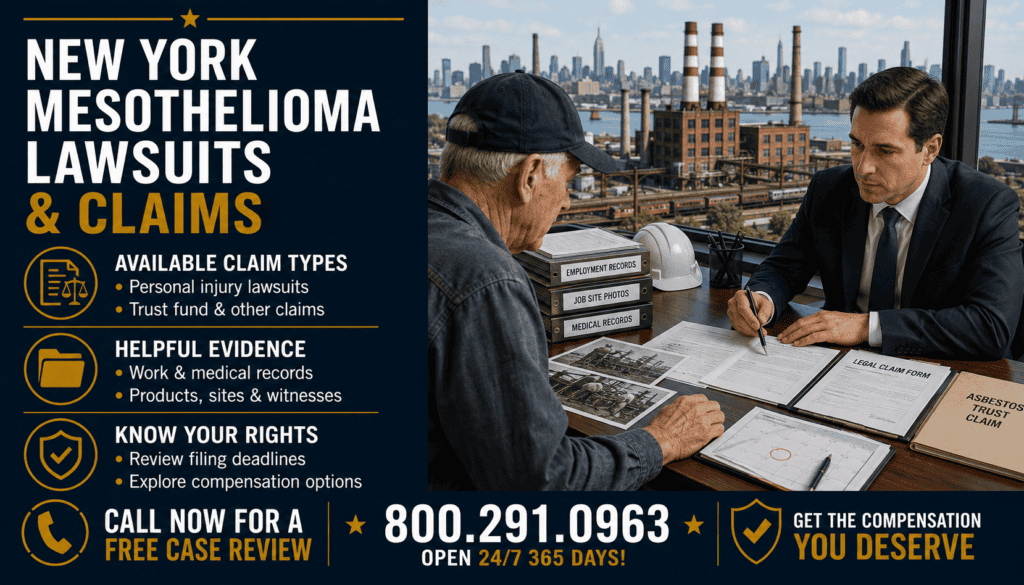
New York Mesothelioma Lawsuits & Claims
A mesothelioma diagnosis can raise immediate questions about where asbestos exposure occurred, which companies or products may have been involved, what types of compensation may be available, and how New York filing deadlines apply. Because mesothelioma often develops decades after asbestos exposure, investigating a claim may require reconstructing employment, military service, worksites, equipment, products, and exposure that occurred many years earlier.
New York has a long history of asbestos use across construction, shipyards, power generation, manufacturing, transit and railroad operations, industrial facilities, mechanical trades, and public buildings. Workers could also carry asbestos dust home on clothing, potentially exposing family members.
The New York Mesothelioma Lawsuits & Claims hub organizes the major legal topics for people diagnosed with mesothelioma and other asbestos-related diseases in New York.
This hub should organize New York legal content involving mesothelioma personal injury lawsuits, asbestos lung cancer lawsuits, wrongful death claims, asbestos trust funds, and New York filing deadlines.
New York Mesothelioma Lawsuits
A mesothelioma lawsuit generally begins with investigating the person’s history of asbestos exposure.
That investigation may involve:
- Employment history
- Job titles and occupations
- Worksites
- Military service
- Asbestos-containing products
- Industrial equipment
- Machinery
- Contractors
- Product manufacturers
- Equipment manufacturers
- Suppliers
- Coworkers
- Medical records
- Exposure dates
The goal is to determine where asbestos exposure may have occurred and identify potentially responsible parties under applicable law.
Because exposure frequently occurred decades before diagnosis, historical documentation can be especially important.
New York Mesothelioma Personal Injury Lawsuits
A person diagnosed with mesothelioma may investigate whether a personal injury lawsuit is available based on previous asbestos exposure.
Potential evidence can include:
- Medical documentation
- Pathology records
- Employment records
- Social Security earnings records
- Union records
- Military records
- Worksite records
- Product information
- Equipment records
- Coworker testimony
- Historical company records
A personal injury claim should be evaluated according to the person’s individual diagnosis, exposure history, potentially responsible parties, jurisdiction, and applicable filing requirements.
How a New York Mesothelioma Claim Is Investigated
A useful starting sequence is:
Diagnosis → Employment → Worksite → Occupation → Equipment → Product → Manufacturer → Exposure Period
For example, someone may remember working as a pipefitter at a New York industrial facility.
Further investigation might identify:
- The employer.
- Specific facility.
- Years worked there.
- Department or work area.
- Boilers, pumps, valves, or piping serviced.
- Insulation disturbed nearby.
- Gaskets or packing handled.
- Contractors working at the facility.
- Product or equipment manufacturers.
- Coworkers who performed similar work.
This creates a more detailed exposure history than simply identifying an occupation.
New York Asbestos Exposure and Mesothelioma Claims
New York asbestos exposure histories can involve many different industries and worksites.
Potential settings include:
- Shipyards
- Power plants
- Powerhouses
- Utility facilities
- Manufacturing plants
- Factories
- Steel and metal facilities
- Construction sites
- Railroad facilities
- Subway and transit facilities
- Commercial buildings
- Public buildings
- Mechanical rooms
- Maintenance facilities
The location alone does not establish exposure.
The specific work activity, equipment, materials, products, and time period should be investigated.
New York Occupational Asbestos Exposure Claims
Occupational exposure can involve workers who directly handled asbestos-containing products or worked near other trades disturbing them.
Potentially relevant occupations include:
- Construction workers
- Factory workers
- Shipyard workers
- Railroad workers
- Subway workers
- Electricians
- Pipefitters
- Boilermakers
- Insulators
- Millwrights
- Mechanics
- Machinists
- Maintenance workers
- Utility workers
- Power plant workers
- Steel workers
Job title alone does not prove exposure.
A stronger investigation identifies what the person actually did and which materials were present.
New York Industrial Asbestos Exposure Claims
Industrial facilities frequently contained equipment operating under high temperatures, pressure, steam, electricity, and mechanical stress.
Potential equipment included:
- Boilers
- Turbines
- Pumps
- Valves
- Compressors
- Furnaces
- Generators
- Motors
- Heat exchangers
- Industrial machinery
Certain historical asbestos-containing materials could be associated with these systems, including some:
- Insulation
- Gaskets
- Packing
- Refractory materials
- Electrical materials
- Fireproofing
Not every product or component contained asbestos.
New York Construction Asbestos Exposure Claims
Construction workers could encounter asbestos-containing building products during original installation and later renovation or demolition.
Potential historical product categories include certain:
- Insulation
- Floor tile
- Ceiling materials
- Roofing
- Cement products
- Fireproofing
- Joint compounds
- Mechanical insulation
- Electrical materials
Exposure circumstances can vary significantly between new construction, maintenance, renovation, and demolition.
New York Shipyard Mesothelioma Claims
New York’s maritime history can be important in asbestos exposure investigations.
Shipyard and vessel work could involve:
- Boilers
- Steam piping
- Pumps
- Valves
- Turbines
- Engine-room machinery
- Electrical systems
- Insulation
- Gaskets
- Packing
Potentially relevant workers include:
- Shipyard workers
- Pipefitters
- Boilermakers
- Insulators
- Electricians
- Machinists
- Mechanics
- Welders
- Millwrights
The shipyard, vessel, employer, occupation, equipment, and dates should be reconstructed whenever possible.
New York Power Plant and Utility Mesothelioma Claims
Power plants, powerhouses, and utility facilities contained extensive high-temperature mechanical systems.
Potential exposure research can involve:
- Boilers
- Turbines
- Generators
- Steam piping
- Pumps
- Valves
- Gaskets
- Packing
- Thermal insulation
- Electrical equipment
Scheduled outages and major equipment overhauls can be particularly relevant because multiple trades could work simultaneously while older materials were removed or replaced.
New York Railroad and Transit Asbestos Claims
Railroad and transit workers could encounter historical asbestos-containing materials associated with:
- Locomotives
- Railcars
- Subway cars
- Brake systems
- Electrical systems
- Mechanical equipment
- Maintenance shops
- Power facilities
- Stations
- Utility systems
The equipment, maintenance facility, occupation, component, and period of employment should be investigated rather than assuming exposure based solely on railroad or transit employment.
New York Asbestos Product Claims
Historical exposure investigations often move from a worksite or occupation to the particular products used there.
Potential product categories can include certain:
- Pipe insulation
- Boiler insulation
- Industrial insulation
- Gaskets
- Packing
- Brake friction materials
- Fireproofing
- Refractory materials
- Cement products
- Flooring materials
- Electrical products
Not every product in these categories contained asbestos.
Product identification can depend on manufacturer, brand, application, worksite, and time period.
New York Equipment & Machinery Asbestos Claims
Exposure research can also involve equipment used with asbestos-containing replacement or insulating materials.
Potential equipment includes:
- Boilers
- Pumps
- Valves
- Turbines
- Compressors
- Generators
- Motors
- Furnaces
- Industrial machinery
- Power-generation equipment
An important distinction is that the company manufacturing the machine may not have manufactured the insulation, gasket, packing, or other asbestos-containing product used with it.
Original Equipment and Replacement Components
Industrial and mechanical equipment could remain operational for decades.
During that time, workers might repeatedly replace:
- Gaskets
- Packing
- Insulation
- Seals
- Brake materials
- Refractory products
- Electrical components
Replacement products could come from manufacturers different from those associated with the original equipment.
Maintenance history can therefore be important when reconstructing exposure.
New York Asbestos Lung Cancer Lawsuits
Asbestos exposure can also be relevant to some lung cancer claims.
An investigation may consider:
- Occupational asbestos exposure
- Worksites
- Equipment
- Products
- Exposure duration
- Medical history
- Smoking history
- Other occupational exposures
Smoking and asbestos exposure are separate lung cancer risk factors, and a complete claim investigation should document both rather than ignoring either.
New York Wrongful Death Mesothelioma Lawsuits
When someone dies from mesothelioma or another asbestos-related disease, surviving family members or the appropriate estate representative may need to investigate whether a wrongful death or related claim is available.
Historical exposure reconstruction can involve:
- Medical records
- Employment records
- Social Security history
- Union records
- Military records
- Worksite records
- Product evidence
- Equipment information
- Contractor records
- Coworker statements
Because the person who experienced the exposure may no longer be available to describe it, documentation and witness information can become especially important.
Reconstructing Exposure After a Death
Families may know only part of a loved one’s employment history.
A useful reconstruction can begin with:
Employer → Years → Occupation → Worksite → Department → Equipment → Products → Coworkers
Potential records can then help fill gaps.
These may include:
- Social Security earnings records
- Pension records
- Union membership
- Military service records
- Employment files
- Historical directories
- Worksite documents
- Equipment records
A complete history may require combining several different sources.
New York Asbestos Trust Fund Claims
Some companies that manufactured, supplied, or used asbestos-containing products later entered bankruptcy proceedings and established asbestos trusts.
These trusts are separate from traditional lawsuits.
Eligibility generally depends on the rules of the particular trust and may require evidence concerning:
- Diagnosis
- Exposure
- Qualifying products
- Qualifying worksites
- Employment
- Exposure dates
- Supporting documentation
Working at an asbestos-related site does not automatically establish eligibility for a particular trust.
Trust Fund Claims and Mesothelioma Lawsuits
Depending on the circumstances, asbestos trust fund claims and other legal claims may involve different companies and different procedures.
A person’s exposure history could involve:
- Companies still operating
- Companies that reorganized
- Bankrupt companies with asbestos trusts
- Multiple product manufacturers
- Multiple worksites
- Multiple periods of exposure
This is one reason a detailed exposure timeline can be important.
Identifying Companies Associated With Historical Exposure
A person diagnosed today may have worked around asbestos decades ago and remember equipment or job duties better than product names.
Research can therefore begin with:
- Employer
- Worksite
- Occupation
- Equipment
- Department
- Coworkers
- Contractors
- Approximate dates
Historical records may then help identify products or companies associated with the work.
New York Mesothelioma Statute of Limitations
Mesothelioma and asbestos-related legal claims are subject to filing deadlines.
The applicable New York deadline can depend on factors such as:
- Type of claim
- Date of diagnosis
- Discovery or accrual circumstances
- Date of death when applicable
- Defendant
- Jurisdiction
- Applicable procedural rules
- Other case-specific facts
The date of asbestos exposure should not automatically be treated as the date the filing period begins.
Because deadline issues can be fact-specific, they should be evaluated promptly after diagnosis or death.
Claims Potentially Involving Public Entities
Some New York exposure histories can involve:
- Transit authorities
- Municipal facilities
- Government buildings
- Public utilities
- Public construction projects
- Other governmental entities
Claims involving public entities can raise procedural issues different from ordinary claims against private companies, potentially including separate notice or filing requirements.
The identity of the employer and potentially responsible entities should therefore be established early in the investigation.
New York Veterans and Mesothelioma Claims
Some New York residents diagnosed with mesothelioma may have both military and civilian asbestos exposure histories.
Potential military environments can include:
- Ships
- Shipyards
- Bases
- Boiler rooms
- Mechanical spaces
- Aircraft
- Vehicles
- Military buildings
Military exposure and civilian occupational exposure should be documented separately.
Different compensation systems can involve different eligibility requirements.
Secondary and Household Asbestos Exposure Claims
Some people diagnosed with mesothelioma did not personally work in an asbestos-related occupation.
Historical workplace dust could potentially be carried home on:
- Work clothing
- Shoes
- Jackets
- Tools
- Personal belongings
When household exposure is suspected, research should begin with the occupationally exposed person’s:
- Employer
- Worksite
- Occupation
- Duties
- Products
- Employment dates
The household relationship and circumstances of exposure should also be documented.
Environmental and Building Exposure
Some exposure histories involve older buildings rather than traditional industrial employment.
Potential environments can include:
- Schools
- Government buildings
- Apartment buildings
- Commercial properties
- Hospitals
- Industrial buildings
- Public facilities
The presence of asbestos-containing material alone does not necessarily establish significant exposure.
Research should focus on whether materials were disturbed and how the person could have encountered released fibers.
Evidence That May Help Support a New York Mesothelioma Claim
Potential evidence can include:
- Pathology reports
- Medical records
- Employment records
- Social Security earnings records
- Union records
- Pension records
- Military records
- Worksite records
- Equipment manuals
- Product catalogs
- Purchase records
- Contractor records
- Historical photographs
- Coworker statements
Not every claim will require every type of evidence.
The useful documentation depends on the individual exposure history.
Social Security Employment Records
Social Security earnings records can be particularly useful when someone worked for many employers over several decades.
They may help establish:
- Employer names
- Approximate employment periods
- Employment chronology
These records generally do not establish asbestos exposure by themselves.
They can instead provide the framework for more detailed worksite and product research.
Union Records
Union information may help identify:
- Trade
- Employers
- Job assignments
- Work periods
- Geographic areas
- Potential coworkers
Union records can be especially useful for workers who moved among many construction or industrial jobsites.
Military Records
Military documentation can help establish:
- Service branch
- Service dates
- Duty stations
- Ships
- Bases
- Occupational specialty
- Assignments
These records can help reconstruct a veteran’s exposure history when military service occurred decades earlier.
Coworker Evidence
Former coworkers may help identify:
- Work practices
- Equipment
- Products
- Contractors
- Maintenance procedures
- Insulation work
- Product names
- Working conditions
Coworker information can become especially useful when historical company records are incomplete.
Product Identification
A person may remember working with “pipe covering,” “gaskets,” or “boiler insulation” without remembering a manufacturer.
Product research may use:
- Product catalogs
- Invoices
- Purchasing records
- Equipment manuals
- Contractor records
- Historical photographs
- Coworker testimony
The goal is to move from a general product category to more specific evidence whenever possible.
Identifying the Worksite
New York exposure investigations can involve sites throughout the state.
Potential worksite categories include:
- Industrial plants
- Shipyards
- Power plants
- Utility facilities
- Construction sites
- Factories
- Railroad shops
- Subway facilities
- Steel facilities
- Government buildings
- Commercial properties
County pages can help narrow research geographically, while industry and occupational pages can help narrow it by work environment.
New York County Mesothelioma Research
Current New York county resources include:
- New York County
- Bronx County
- Queens County
- Richmond County
- Westchester County
- Nassau County
- Suffolk County
- Erie County
- Monroe County
A county page can provide geographic context, but exposure research should continue to the specific employer, facility, occupation, equipment, or product whenever possible.
New York City Mesothelioma Claims
New York City exposure histories can involve:
- Construction
- Shipyards
- Subway systems
- Railroads
- Powerhouses
- Utilities
- Manufacturing
- Commercial buildings
- Public buildings
- Mechanical trades
Workers could also move among several boroughs and jobsites during long careers.
Exposure research should therefore follow the worker’s employment history rather than being limited to the county where the person lived.
Upstate New York Mesothelioma Claims
Upstate exposure histories can involve:
- Manufacturing
- Power generation
- Steel and metal work
- Industrial machinery
- Railroads
- Construction
- Utilities
- Public facilities
Facilities in areas such as Buffalo, Rochester, and surrounding industrial regions can require worksite-specific research.
How Long Can Mesothelioma Take to Develop?
Mesothelioma can develop many years after asbestos exposure.
This long latency means a person diagnosed today may need to investigate employment or military service from decades earlier.
Important questions include:
- Where did the person work?
- What was the occupation?
- Which departments were involved?
- What machinery was present?
- Which products were handled?
- Which trades worked nearby?
- When did the exposure occur?
A detailed chronological history can help answer these questions.
What If You Do Not Know Where Asbestos Exposure Occurred?
Not remembering the exact asbestos product or exposure site does not necessarily end the investigation.
A useful starting point is to document:
- Every employer.
- Approximate employment dates.
- Every occupation.
- Major worksites.
- Military service.
- Equipment repaired or operated.
- Maintenance activities.
- Construction or renovation work.
- Coworkers.
- Known industrial environments.
Research can then move from known information toward possible exposure sources.
What If the Company No Longer Exists?
Historical asbestos exposure can involve employers or manufacturers that:
- Closed
- Merged
- Were acquired
- Changed names
- Reorganized
- Entered bankruptcy
Historical records may still help identify the company and its relationship to products or worksites.
Some bankrupt asbestos companies also established trusts, although eligibility depends on the requirements of the individual trust.
What If Exposure Occurred in Several States?
Some workers lived in New York but worked in other states, while others moved to New York after exposure elsewhere.
Potential legal issues can depend on:
- Where exposure occurred
- Where companies operated
- Where the person lived
- Where the diagnosis occurred
- Which defendants are involved
- Applicable jurisdictional rules
A multistate exposure history should therefore document every relevant worksite rather than limiting research to New York.
Frequently Asked Questions About New York Mesothelioma Lawsuits & Claims
Can a person diagnosed with mesothelioma investigate a New York lawsuit?
Potentially. Whether a claim is available depends on the individual’s diagnosis, asbestos exposure history, potentially responsible parties, filing deadlines, jurisdiction, and other facts.
Do I need to remember the exact asbestos product?
Not necessarily.
Investigations can begin with employers, worksites, occupations, equipment, contractors, and employment dates before attempting more specific product identification.
What if asbestos exposure happened decades ago?
That is common in mesothelioma investigations because the disease can develop many years after exposure.
Can several employers or worksites be relevant?
Yes.
Some workers experienced potential asbestos exposure at multiple jobsites over a long career.
Can several companies be involved in one exposure history?
Potentially.
A worker could encounter products, machinery, replacement components, insulation, and materials supplied by different companies.
Can family members investigate a wrongful death claim?
Potentially. The availability of a claim depends on New York law and the individual circumstances.
Are asbestos trust fund claims the same as lawsuits?
No.
Asbestos bankruptcy trusts use their own eligibility, documentation, and filing procedures.
Does working at a known industrial site automatically prove asbestos exposure?
No.
The person’s occupation, work area, equipment, products, duties, and exposure circumstances should be investigated.
Can veterans have both military and civilian exposure histories?
Yes.
Each period should be documented separately.
Can household asbestos exposure be relevant?
Potentially.
A household exposure investigation generally begins by documenting the occupational exposure of the person who may have carried asbestos dust into the home.
Does smoking prevent an asbestos lung cancer claim?
Smoking history should be documented as part of the medical and exposure history. Whether a legal claim exists depends on the individual facts and applicable law.
Is the original asbestos exposure date automatically the lawsuit deadline date?
No.
Asbestos-related filing deadlines involve legal rules that can depend on diagnosis, discovery or accrual, death, claim type, jurisdiction, and other circumstances.
New York Mesothelioma Lawsuits & Claims Topics
This hub should organize the primary New York legal child pages:
New York Mesothelioma Personal Injury Lawsuit
For people diagnosed with mesothelioma who are investigating whether a personal injury claim may be available.
New York Asbestos Lung Cancer Lawsuits
For asbestos exposure histories involving a lung cancer diagnosis.
New York Mesothelioma Statute of Limitations
For information about New York filing deadlines and factors that can affect when a claim must be brought.
New York Asbestos Trust Fund Claims
For claims involving bankrupt asbestos companies that established compensation trusts.
New York Wrongful Death Mesothelioma Lawsuits
For families investigating legal options following the death of someone with mesothelioma or another asbestos-related disease.
Keeping these pages beneath one legal hub gives each child page a distinct search intent while allowing this page to serve as the central New York claims resource.
Explore New York Asbestos Exposure by County
The New York Counties Asbestos Exposure & Lawsuits section organizes geographic research for:
New York County
Bronx County
Queens County
Richmond County
Westchester County
Nassau County
Suffolk County
Erie County
Monroe County
County research can then lead to the industries, occupations, equipment, and products potentially associated with an individual’s exposure history.
Explore New York Asbestos Exposure Sites & Industries
The New York Asbestos Exposure Sites & Industries section can help investigate where exposure occurred.
Major topics include:
New York Asbestos Exposure Sites
New York Industrial Asbestos Exposure
New York Power Plant Asbestos Exposure
New York Construction Asbestos Exposure
New York Transit & Railroad Asbestos Exposure
New York Shipyard Asbestos Exposure
New York Public & Government Buildings Asbestos Exposure
New York Powerhouse & Utility Asbestos Exposure
These pages focus on the work environment rather than the legal claim itself.
Explore New York Workers & Occupational Asbestos Exposure
Occupational pages help answer how the individual may have encountered asbestos.
Relevant worker resources include:
New York Construction Workers Mesothelioma
New York Factory Workers Asbestos Exposure
New York Electricians Asbestos Exposure
New York Pipefitters Mesothelioma
New York Transit Workers Asbestos Exposure
New York Shipyard Workers Asbestos Exposure
New York Subway Workers Asbestos Exposure
New York Boilermakers Asbestos Exposure
New York Insulators Asbestos Exposure
New York Millwrights Asbestos Exposure
Worker pages should support the exposure investigation without duplicating the legal focus of this hub.
Explore New York Equipment & Machinery Asbestos Exposure
Equipment research can help identify how asbestos-containing components may have been used in an industrial or mechanical environment.
Relevant topics include:
New York Boiler Equipment Asbestos Exposure
New York Industrial Machinery Asbestos Exposure
New York Power Generation Equipment Asbestos Exposure
New York Automotive Brake Equipment Asbestos Exposure
Equipment pages can then connect conceptually to specific product categories and occupations.
Explore New York Asbestos Products
Potential product research includes:
New York Asbestos Products Used in Construction
New York Asbestos Insulation Products
New York Industrial Asbestos Products
These pages help move an investigation from a general workplace history toward the materials that may have been present.
Related New York Asbestos Resources
Continue New York research through the major state sections:
New York Mesothelioma Lawsuits & Asbestos Exposure
New York Counties Asbestos Exposure & Lawsuits
New York Asbestos Exposure Sites & Industries
New York Workers & Occupational Asbestos Exposure
New York Equipment & Machinery Asbestos Exposure
New York Asbestos Products Asbestos Exposure
Together, these sections create a research path from:
County → Worksite → Industry → Worker → Equipment → Product → Legal Claim
That structure helps keep individual pages focused while allowing readers to investigate different parts of a New York asbestos exposure history.
Call 800.291.0963 — Open 24/7, 365 Days
MesotheliomaHelp.Center provides legal and medical information to help New York patients and families understand historical asbestos exposure, mesothelioma lawsuits, asbestos trust fund claims, wrongful death claims, filing deadlines, and possible next steps.