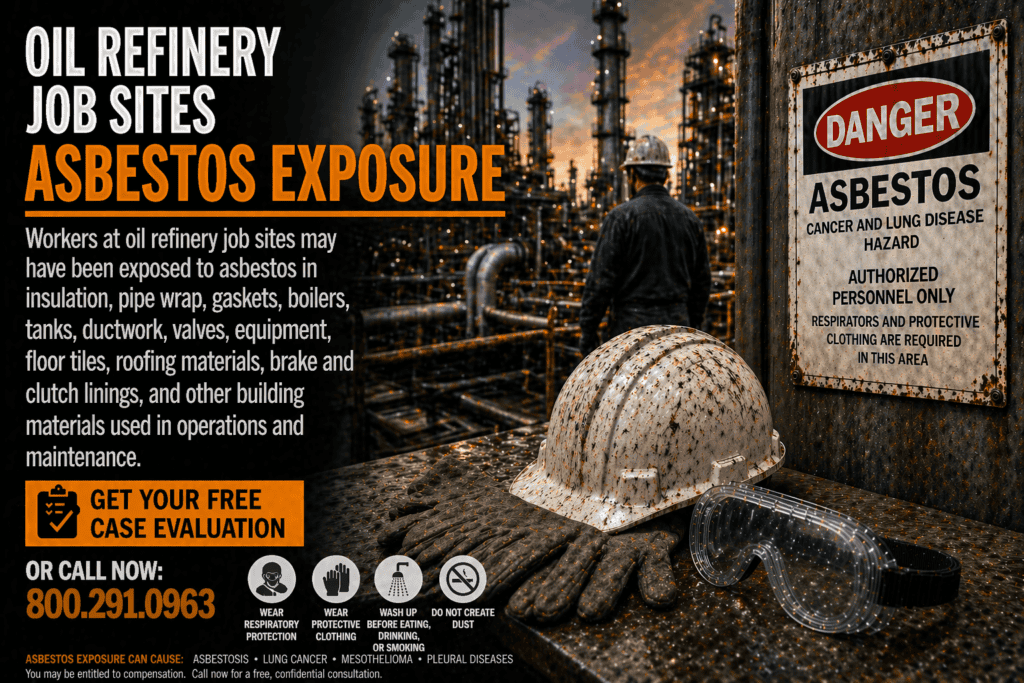
Oil Refineries Asbestos Exposure Lawsuit
Throughout most of the 20th century, oil refineries across the United States made widespread use of asbestos in equipment, piping systems, and insulation. Asbestos was considered ideal for managing the extreme heat and flammable conditions common in petroleum refining—but it came at a deadly cost.
Workers who built, maintained, or repaired refinery units—especially in high-temperature zones—were regularly exposed to airborne asbestos fibers. Cutting pipe insulation, replacing gaskets, or working near deteriorating materials released toxic dust into the air. Even those who didn’t handle asbestos directly were often exposed.
🛢️ Oil Refinery Job Sites – What You’ll Learn From This Page:
⚙️ Oil refineries relied on asbestos insulation for high-temperature equipment, including reactors, pumps, valves, and pipelines.
🔩 Repairs to aging thermal systems disturbed insulation, releasing fibers into the air during valve replacements, welding, or shutdowns.
🔥 Boilers, exchangers, and furnaces were wrapped in asbestos lagging, which deteriorated with time and heat exposure.
🚧 Confined refinery zones lacked ventilation, trapping dust during daily maintenance operations.
💰 Workers at oil refineries with asbestos disease may qualify for settlements or trust fund payouts.
Read more articles about Oil Refinery Asbestos Exposure.
Number of People Exposed to Asbestos in Oil Refineries in the U.S.
Refineries were one of the heaviest industrial users of asbestos materials.
| Exposure Category | Estimated Number of People Exposed |
|---|---|
| Occupational Exposure (Operators, pipefitters, repair crews) | Approximately 600,000 workers exposed |
| Secondary Exposure (Family members exposed via uniforms) | Estimated 85,000 exposed |
| Environmental Exposure (Hot zones and repair areas) | Around 130,000 people exposed |
👉 Total Estimated Exposure:
Over 815,000 people in the U.S. were exposed through oil refinery job sites.
🧰 Facts About Oil Refinery Workers
• Over 117,000 people currently work in U.S. oil refining (as of 2023), with hundreds of thousands more employed during peak industrial decades.
• Asbestos Exposure: Heavy from 1940s–1980s; risk persists in older units and shutdown facilities.
• Asbestos-Related Disease Risk: Very High due to confined spaces, thermal systems, and heavy maintenance demands.
• Multiple studies show elevated mesothelioma rates among refinery workers, especially those in mechanical and maintenance roles.
• Similar Occupations: Pipefitters, boilermakers, pump operators, insulators, scaffolders
🏭 History of Asbestos Use on Job Sites
From the 1930s to the late 1980s, asbestos was used extensively in petroleum infrastructure. It lined thermal systems, coated distillation towers, and insulated miles of piping and machinery. Repair crews frequently disturbed these materials—often without masks or ventilation.
Even decades later, many older facilities still contain asbestos in insulation, fireproofing, and mechanical components. Today, retired refinery workers continue to face late-stage diagnoses tied to exposures from 30 to 50 years ago.
⚠️ Mesothelioma Risk for Oil Refinery Workers
Medical evidence strongly links oil refinery work to an increased risk of asbestos-related disease:
• A NIOSH study found that refinery maintenance workers had significantly higher rates of mesothelioma and lung cancer.
• Research in Canada and Europe confirmed that petroleum workers were 4 to 7 times more likely to develop fatal asbestos-related illnesses.
• U.S. data showed pipefitters, boiler tenders, and insulators were among the highest-risk refinery roles.
Heat, vibration, and routine equipment stress caused asbestos to crumble—turning working environments into toxic zones, especially during turnarounds and outages.
🔩 Asbestos Products Used in Oil Refineries
Oil refineries depended on asbestos to control heat, prevent fires, and insulate hazardous systems. Unfortunately, regular use and repairs caused these materials to deteriorate and release fibers into the air.
🔥 Furnace and Boiler Insulation
Lined refining furnaces, boilers, and reboilers; relining or damage sent fibers airborne.
🚿 Pipe Insulation
Wrapped around high-temperature oil and steam lines; cutting and removal released fibers.
🧱 Refractory Cement and Blocks
Used in fluid catalytic cracking units and heaters; maintenance dislodged asbestos particles.
🧰 Gaskets and Valve Packing
Used in pumps, valves, and compressors; worn seals emitted dust during replacement.
🧤 Protective Gear
Asbestos gloves, aprons, and hoods shed fibers with wear and handling.
🚿 Spray-Applied Fireproofing
Coated structural steel and towers; vibration or drilling dislodged toxic fibers.
⚡ Electrical Boards and Panels
Backed with asbestos insulation; repairs disturbed fibers inside panel enclosures.
♨️ Tank and Vessel Insulation
Tanks and heat exchangers were covered with asbestos wrap; damage released dust.
🧵 Heat-Resistant Tape and Cloth
Used on flanges and joints; frayed or aged cloth exposed nearby workers.
🚜 Brake Linings
Used in vehicles and cranes across refinery sites; friction released asbestos particles.
🩹 Sealants and Coatings
Used to seal pipes and vessels; weathered or cracked coatings broke into fibers.
🧱 Wall and Ceiling Panels
Installed in older control rooms and labs; cutting and drilling released airborne debris.
🛠️ How Oil Refinery Workers Were Exposed
Asbestos exposure occurred daily in oil refineries—from routine inspections to emergency shutdowns. Workers in nearly every department encountered fibers while on the job.
🔧 Insulators and Laggers
Removed or installed asbestos around pipes, boilers, and vessels; direct handling released fibers.
♨️ Boiler Operators
Worked on boilers lined with asbestos insulation; exposure occurred during cleaning or repairs.
🛠️ Maintenance Crews
Repaired pumps, gaskets, and turbines wrapped in asbestos; dust released during part removal.
🔩 Pipefitters
Cut and replaced asbestos-lined steam lines; frequent exposure during joint sealing.
🏗️ Scaffolders and Welders
Worked near insulation during firewatch, welding, and mechanical prep; disturbed loose material.
⚡ Electricians
Drilled or rewired asbestos-backed panels; airborne particles released during modifications.
🌀 Machinists
Used lathes and tools on asbestos-insulated equipment; fibers settled on nearby surfaces.
🔥 Turnaround Specialists
Handled high-risk shutdown work near degraded insulation and gaskets.
⚙️ Boilermakers and Mechanics
Replaced worn internal components of asbestos-lined pressure systems.
🌬️ HVAC Technicians
Worked on ventilation and duct systems insulated with asbestos wrap.
🧍 Supervisors and Safety Inspectors
Entered zones during maintenance or active repairs; secondhand exposure common.
📦 Contractors and Laborers
Cleaned around asbestos-coated materials; swept up dust and debris without PPE.
🛢️ Types of Oil Refineries With Asbestos Exposure
🔥 Crude Oil Distillation Units
Heated crude oil to separate components. Asbestos lined columns, heaters, and piping; fibers released during shutdowns, cleanouts, and insulation maintenance.
⚗️ Catalytic Cracking Units
Broke down heavy hydrocarbons into gasoline. High-heat vessels and regenerators were lined with asbestos; exposure common during catalyst changes and refractory brick replacement.
💨 Hydrocracking Units
Used hydrogen and pressure to refine diesel and jet fuel. Boilers, reactors, and steam systems were asbestos-insulated—dust released during upgrades and leak repairs.
🧪 Alkylation Units
Created high-octane fuel by combining hydrocarbons. Workers were exposed while repairing piping and acid tanks wrapped in aging asbestos insulation.
🛠️ Coking Units
Converted heavy crude into petroleum coke. Massive furnaces and drum structures used asbestos materials; fiber release occurred during maintenance and coke drum cutting.
🚰 Desalting Plants
Removed water and salts from crude oil. Steam lines and pressure vessels were asbestos-wrapped; exposure happened during valve changes and filter repairs.
🧯 Fire Protection & Safety Systems
Included asbestos blankets, gloves, and shields. Safety crews faced exposure while using worn gear and inspecting damaged insulation after fires or leaks.
🏗️ Lube Oil Processing Units
Refined motor and industrial oils. High-temperature processing tanks and exchangers used asbestos insulation; maintenance tasks disturbed dust in tight mechanical areas.
🔩 Asphalt & Tar Processing Units
Produced roofing and road materials. Heated mixing tanks, pumps, and dryers were wrapped in asbestos; exposure common during clog removals and line cleanouts.
💡 Power Generation Units
Generated steam and electricity for refinery operations. Boilers, turbines, and high-voltage switchgear were asbestos-lined; technicians inhaled fibers during repairs and outages.
❓ Common Questions About Oil Refinery Asbestos Claims
Can I still file if the refinery closed?
✅ Yes — lawsuits target product manufacturers, not the refinery.
What if I was exposed 40 years ago?
✅ Most states allow 1–3 years to file a claim after diagnosis, even decades later.
I don’t remember specific asbestos brands. Can I still file?
✅ Yes — lawyers use refinery blueprints, job logs, and equipment records.
What if I was a contractor?
✅ Contractors and subcontractors frequently qualify for claims.
What kind of settlement could I receive?
✅ Claims often reach six figures, depending on illness severity and work history.
Can family members file on behalf of deceased workers?
✅ Yes — wrongful death and trust fund claims can be filed by next of kin.
⚖️ How a Mesothelioma Attorney Can Help Oil Refinery Workers
Asbestos lawsuits are complex. An experienced mesothelioma attorney can help by:
• Investigating your refinery work and identifying asbestos exposure
• Collecting employment records, medical evidence, and union logs
• Filing asbestos trust fund claims and/or lawsuits
• Naming all responsible manufacturers
• Securing financial help for families and dependents
• Meeting your state’s legal deadlines
Most firms charge nothing unless your case is successful.
📞 Free Legal Help for Oil Refinery Workers & Families
If you or a loved one worked in an oil refinery and were later diagnosed with mesothelioma, lung cancer, or asbestosis, you may qualify for compensation. We help refinery operators, maintenance crews, and family members impacted by exposure.
Call Now: 800.291.0963
• No upfront costs
• No fees unless we win
• In-depth exposure investigation
• Lawsuits and trust fund claims filed
• Help for retirees, contractors & surviving spouses
Or request help online 24/7