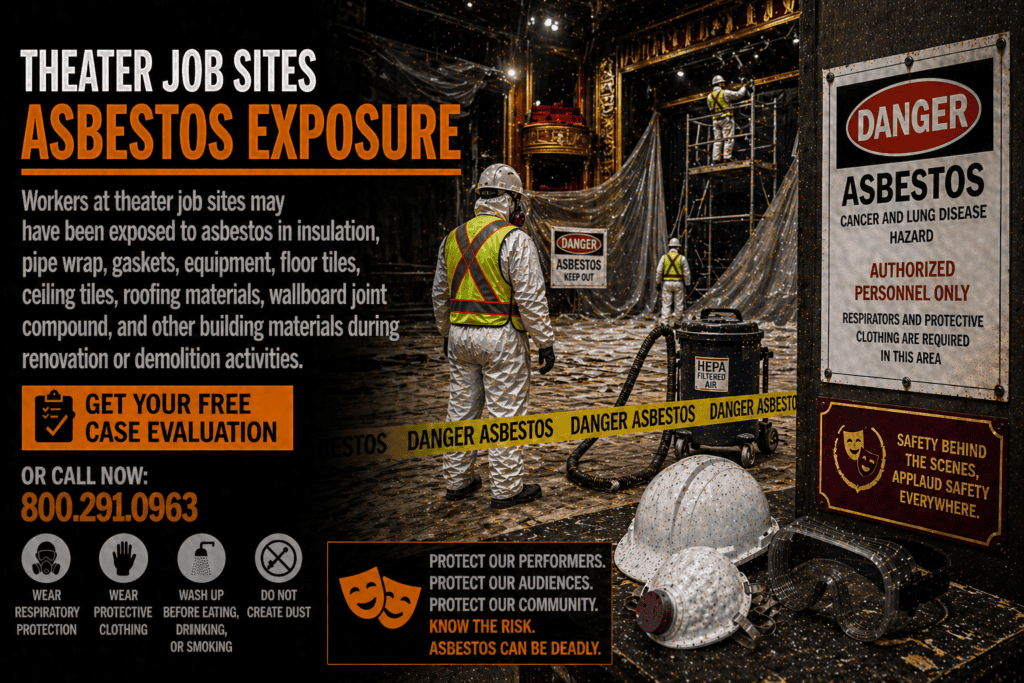
🎭 Theaters Asbestos Exposure
If you worked in theaters, cinemas, performing-arts venues and backstage workshops and have been diagnosed with mesothelioma or asbestos-related lung cancer, your work history deserves attention. Certain older buildings and machines used asbestos-containing insulation, fire-resistant materials, gaskets and other components. Repair and removal work sometimes released fibers that workers breathed.
This article explains the tasks, places and products worth remembering, along with steps that can help you understand possible compensation options. You can begin with approximate years, job duties and coworkers even when old equipment labels are no longer available.
🏭 Where Asbestos Was Found
Asbestos exposure at theaters, cinemas, performing-arts venues and backstage workshops was tied to particular products and activities, not simply to having a job at the site. Older construction dates, major repairs and the materials actually removed are important when reviewing a work history.
Stage and Lighting Areas
Older theatrical lighting and electrical equipment generated substantial heat. Some historic fire-resistant curtains, boards and wire coverings contained asbestos; crews faced risk when these materials were handled or damaged.
For work in stage and lighting areas, remember whether a crew was cutting, scraping, replacing or cleaning old material. Write down the approximate dates, the building or room, and whether your own tasks brought you close to the work. These details can help distinguish asbestos-related work from ordinary workplace dust.
Projection Booths
Film projectors and associated electrical equipment operated at high temperatures. Certain older insulation and electrical components required servicing, and actual material identification is essential.
For work in projection booths, remember whether a crew was cutting, scraping, replacing or cleaning old material. Write down the approximate dates, the building or room, and whether your own tasks brought you close to the work. These details can help distinguish asbestos-related work from ordinary workplace dust.
Backstage Mechanical Rooms
Theaters used heating boilers, steam piping and ventilation machinery. Repairs to older insulation and gaskets were a more direct exposure route than ordinary attendance.
For work in backstage mechanical rooms, remember whether a crew was cutting, scraping, replacing or cleaning old material. Write down the approximate dates, the building or room, and whether your own tasks brought you close to the work. These details can help distinguish asbestos-related work from ordinary workplace dust.
Auditorium Renovations
Refurbishment of seats, walls, ceilings and flooring disturbed some asbestos-containing building materials in older theaters. Dust could spread into adjacent backstage and public areas.
For work in auditorium renovations, remember whether a crew was cutting, scraping, replacing or cleaning old material. Write down the approximate dates, the building or room, and whether your own tasks brought you close to the work. These details can help distinguish asbestos-related work from ordinary workplace dust.
Scene Shops and Storage
Carpenters and stagehands worked near legacy fire-resistant materials and old equipment. Handling, cutting and disposal tasks matter when reconstructing an exposure history.
For work in scene shops and storage, remember whether a crew was cutting, scraping, replacing or cleaning old material. Write down the approximate dates, the building or room, and whether your own tasks brought you close to the work. These details can help distinguish asbestos-related work from ordinary workplace dust.
For a related workplace topic, see Museums Asbestos Exposure. Compare the specific materials and job tasks with your own history rather than assuming the same exposure occurred at every location.
For a related workplace topic, see Hotel Job Sites Asbestos Exposure. Compare the specific materials and job tasks with your own history rather than assuming the same exposure occurred at every location.
👷 Workers and Daily Jobs
People working in theaters, cinemas, performing-arts venues and backstage workshops had different assignments. Direct contact with an asbestos-containing component, assisting a repair crew and cleaning a work area afterward are distinct experiences. A job title alone cannot establish what material was present.
| Occupation | Questions to ask about the work |
|---|---|
| Stage Technicians | Which equipment or rooms did you service? |
| Lighting Electricians | Were you present during renovations or shutdowns? |
| Projectionists | Did you remove, scrape or cut old components? |
| Building Engineers | Did you work near plumbers, insulators or contractors? |
| Renovation Workers | What dust or debris did you clean after repairs? |
| Custodians | Can former coworkers identify products or machines? |
Contractors, employees and temporary workers often shared rooms while work was underway. A person who did not handle a component could still have been nearby when it was disturbed. Record what you witnessed rather than assuming every repair released asbestos.
For a related workplace topic, see Schools Asbestos Exposure. Compare the specific materials and job tasks with your own history rather than assuming the same exposure occurred at every location.
For a related workplace topic, see Ship Building Job Sites Asbestos Exposure. Compare the specific materials and job tasks with your own history rather than assuming the same exposure occurred at every location.
⚙️ Products and Equipment
Asbestos was used in particular older products because of its heat resistance and other properties. Not every version of a product contained asbestos, and modern replacement materials may be asbestos-free. Identifying the age, manufacturer and repair method helps avoid unsupported assumptions.
| Material | Exposure-relevant work |
|---|---|
| Fire-Resistant Curtains And Boards | Removing, cutting, scraping or cleaning up an asbestos-containing version of fire-resistant curtains and boards could disturb fibers. Check the product and time period. |
| Electrical Insulation | Removing, cutting, scraping or cleaning up an asbestos-containing version of electrical insulation could disturb fibers. Check the product and time period. |
| Pipe Lagging | Removing, cutting, scraping or cleaning up an asbestos-containing version of pipe lagging could disturb fibers. Check the product and time period. |
| Older Ceiling Materials | Removing, cutting, scraping or cleaning up an asbestos-containing version of older ceiling materials could disturb fibers. Check the product and time period. |
| Flooring And Adhesives | Removing, cutting, scraping or cleaning up an asbestos-containing version of flooring and adhesives could disturb fibers. Check the product and time period. |
Old invoices, equipment manuals, architectural plans, maintenance logs and product packaging can sometimes identify the materials used. If records are unavailable, a detailed firsthand account of the work is still useful. Avoid guessing at a manufacturer or product composition.
For a related workplace topic, see Hotels Asbestos Exposure. Compare the specific materials and job tasks with your own history rather than assuming the same exposure occurred at every location.
For a related workplace topic, see Home Building Job Sites Asbestos Exposure. Compare the specific materials and job tasks with your own history rather than assuming the same exposure occurred at every location.
🌬️ How Exposure Occurred
In theaters, cinemas, performing-arts venues and backstage workshops, asbestos fibers could become airborne when workers stripped insulation, replaced old seals, disturbed building materials or cleaned debris from those activities. Dry sweeping and compressed-air cleaning could re-suspend settled fibers. Exposure varied with the material, duration, ventilation and work practices.
An important distinction is the difference between material that remains intact and material being broken, cut or removed. Describe what was happening in the room and whether debris collected on floors, tools, uniforms or equipment. Workers may remember the smell of machinery or a repair shutdown more clearly than a product label, but those memories can help locate relevant records.
A coworker who serviced the same equipment may remember names, suppliers or contractors. If you worked several jobs, keep a separate description for each workplace so exposure details are not mixed together.
For a related workplace topic, see Public School Buildings Asbestos Exposure. Compare the specific materials and job tasks with your own history rather than assuming the same exposure occurred at every location.
For a related workplace topic, see Construction Building Sites Asbestos Exposure. Compare the specific materials and job tasks with your own history rather than assuming the same exposure occurred at every location.
🩺 Mesothelioma After Workplace Exposure
Mesothelioma is a cancer strongly associated with asbestos exposure and often appears decades after exposure. An older job may remain relevant long after a person has retired or a building has changed owners. A diagnosis requires qualified medical evaluation; employment history alone does not establish a diagnosis.
Ask your care team for pathology reports, imaging results, treatment records and the date of diagnosis. Continue medical appointments while collecting work information. A specialist can discuss treatment options appropriate to your condition.
Write down employers, work locations, approximate years, departments and repair projects. Include military service or other workplaces if relevant. Many people held several jobs involving older buildings or machinery, and separating those jobs creates a clearer timeline.
Family members can help organize documents and record memories, especially when a former coworker or supervisor is still reachable. Save originals and make copies for medical and legal discussions.
For a related workplace topic, see Apartment Building Job Sites Asbestos Exposure. Compare the specific materials and job tasks with your own history rather than assuming the same exposure occurred at every location.
For a related workplace topic, see Government Building Job Sites Asbestos Exposure. Compare the specific materials and job tasks with your own history rather than assuming the same exposure occurred at every location.
🫁 Asbestos-Related Lung Cancer
Asbestos exposure is an established cause of lung cancer. Smoking is also a major cause, and smoking together with asbestos exposure increases risk substantially. A smoking history does not erase a documented occupational asbestos exposure, but a cancer diagnosis alone cannot identify the contributing cause in an individual case.
If you worked in theaters, cinemas, performing-arts venues and backstage workshops, tell your treating physician about older equipment repairs, renovations, dust-producing tasks and the years involved. Medical professionals can assess your full history, including other exposures and health factors.
Keep pathology and imaging reports together with your employment timeline. Do not delay treatment while trying to locate workplace records or pursue a claim.
For a related workplace topic, see Hotel Hvac Ventilation Systems Asbestos Exposure. Compare the specific materials and job tasks with your own history rather than assuming the same exposure occurred at every location.
📋 Work History and Evidence
Begin with a simple timeline showing each employer, address, job title, department, start and end years, and the names of coworkers. Approximate dates are acceptable when exact ones are not known. Describe firsthand observations separately from information you learned later.
| Document | What it can help establish |
|---|---|
| Pay stubs and Social Security earnings | Employer names and work years |
| Union and pension records | Trade and contractor assignments |
| Work orders and building plans | Repairs, equipment and construction materials |
| Photographs and coworker accounts | Locations, tasks and proximity |
| Medical records | Diagnosis and treatment timeline |
If the employer closed, former union locals, pension administrators, building owners and coworkers may have useful records. Keep copies of what you obtain, and protect sensitive medical and identifying information.
For a related workplace topic, see School Hvac Ventilation Systems Asbestos Exposure. Compare the specific materials and job tasks with your own history rather than assuming the same exposure occurred at every location.
⚖️ Compensation and Legal Options
People diagnosed with mesothelioma or asbestos-related lung cancer after occupational asbestos exposure may have options involving personal-injury lawsuits, asbestos bankruptcy trust claims or other benefits. Some claims concern manufacturers of asbestos-containing products rather than the owner of the workplace.
Trust funds have separate medical and exposure requirements. Families may have wrongful-death options depending on the law and circumstances. Veterans with qualifying service may have separate VA benefits. Eligibility is individual and compensation is not guaranteed.
Filing deadlines vary by jurisdiction and claim type. Seeking timely information can help you understand deadlines while you continue medical care. A clear work timeline is a practical starting point.
For a related workplace topic, see Museum Hvac Climate Control Systems Asbestos Exposure. Compare the specific materials and job tasks with your own history rather than assuming the same exposure occurred at every location.
📚 Confirmed Sources
❓ Frequently Asked Questions
Did every facility contain asbestos?
No. Products and installation dates varied. A particular material, task and period of work are important.
What if I worked nearby but never removed insulation?
Nearby workers and cleanup crews may have shared contaminated air. Describe what you witnessed and how often.
Can work from decades ago matter?
Yes. Mesothelioma often develops many years after asbestos exposure.
What if the employer no longer exists?
Employment, union, pension, contractor and coworker records may help document the work.
Does smoking rule out asbestos-related lung cancer?
No. Both smoking and asbestos are established lung cancer risk factors.
Do I need to know the brand of the material?
No. Begin with equipment, tasks, locations and years; records may help identify products later.
Are asbestos trust fund payments automatic?
No. Each trust has medical and exposure eligibility rules.
Can family members ask about compensation?
Sometimes. Survivor and wrongful-death rules vary by jurisdiction.
What should I do after a diagnosis?
Continue medical care, preserve records, write your work timeline and seek timely information about filing deadlines.
GET THE COMPENSATION YOU DESERVE
If you have been diagnosed with mesothelioma or asbestos-related lung cancer after working around asbestos, ask about your possible options. Your employment history, the materials you encountered and the date of diagnosis can help start the conversation.
Helping people for more than 25 years · Open 24/7, 365 days!
Call to discuss your work history:
800.291.0963Or submit your information online:
Mesothelioma Help Center is not a law firm or medical provider and does not determine legal or VA eligibility. This information is not individualized medical or legal advice.