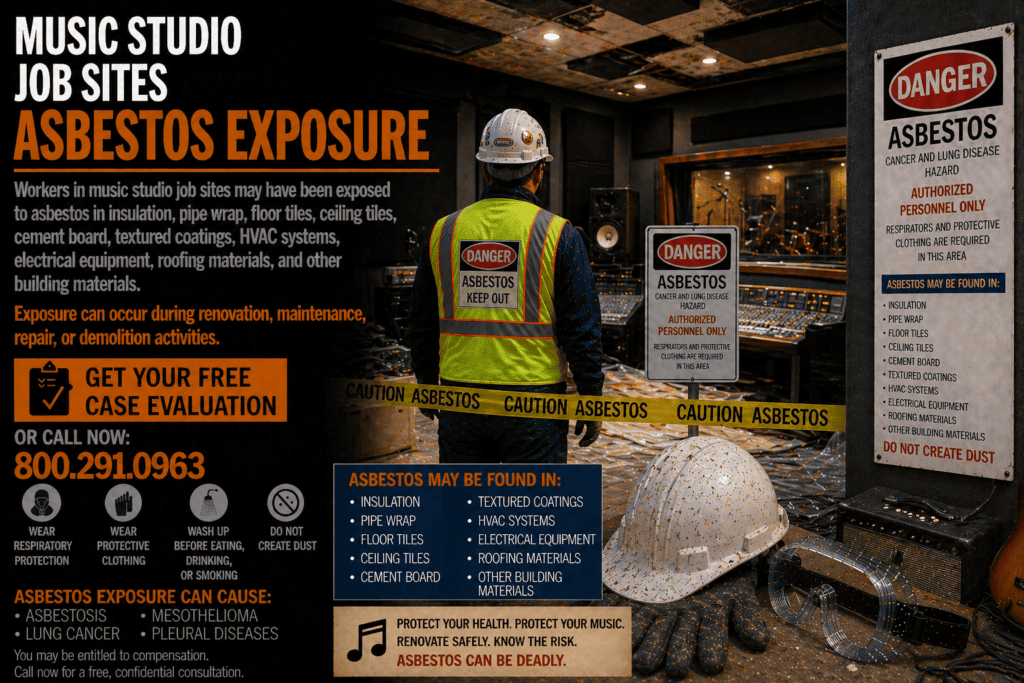
🎙️ Music Studios Asbestos Exposure
If you worked in recording studios, rehearsal buildings, broadcast rooms and music production facilities and have been diagnosed with mesothelioma or asbestos-related lung cancer, the equipment you serviced and the repairs you witnessed deserve careful attention. Asbestos-containing products were used in some older buildings and machinery, and disturbing those products could release dangerous fibers.
This article explains which tasks and materials are relevant, how to record a work history, and what questions to ask about possible claims. The workplace name alone cannot prove exposure: the materials, years, tasks and circumstances are what matter.
🏭 Where Asbestos Was Found
In recording studios, rehearsal buildings, broadcast rooms and music production facilities, exposure circumstances varied from one building and employer to another. The most useful distinction is between normal work and repair, renovation or cleanup that actually disturbed asbestos-containing products. These five work areas illustrate what to ask about.
Control Rooms and Soundproofing
Acoustic panels, ceiling treatments and wall assemblies were installed to control noise. Some older building materials contained asbestos; a panel’s appearance or acoustic purpose alone cannot establish its composition. Renovation records and material testing matter. For related job details, see Aircraft Electrical Systems Asbestos Exposure; compare those duties with the work you actually performed.
For control rooms and soundproofing, identify the location, approximate years, employer and the crew doing the work. Ask whether acoustic ceiling panels and wall assemblies were present, whether they were disturbed, and how the debris was handled. Product records or coworkers may help resolve details you do not remember.
Equipment and Amplifier Repair
Technicians serviced older amplifiers, power supplies and electrical equipment. Some historical heat-resistant components and insulating boards contained asbestos, while many ordinary electronics did not. Identify the equipment and component before attributing exposure. For related job details, see aircraft manufacturing plants; compare those duties with the work you actually performed.
For equipment and amplifier repair, identify the location, approximate years, employer and the crew doing the work. Ask whether electrical insulation and heat-resistant boards were present, whether they were disturbed, and how the debris was handled. Product records or coworkers may help resolve details you do not remember.
HVAC and Mechanical Rooms
Recording rooms often depended on quiet air-handling systems. Older duct insulation, boiler coverings and pipe lagging were disturbed when maintenance crews opened ceilings or replaced mechanical systems. For related job details, see Manufacturing Plants Asbestos Exposure; compare those duties with the work you actually performed.
For hvac and mechanical rooms, identify the location, approximate years, employer and the crew doing the work. Ask whether duct insulation and boiler lagging were present, whether they were disturbed, and how the debris was handled. Product records or coworkers may help resolve details you do not remember.
Live Rooms and Renovation Projects
Studio remodels involved removing older ceilings, floors, fireproofing and wall materials. Carpenters, electricians and studio employees could share enclosed areas with contractors performing dusty demolition. For related job details, see Theaters Asbestos Exposure; compare those duties with the work you actually performed.
For live rooms and renovation projects, identify the location, approximate years, employer and the crew doing the work. Ask whether flooring, ceiling and fireproofing materials were present, whether they were disturbed, and how the debris was handled. Product records or coworkers may help resolve details you do not remember.
Adjacent Performance and Rehearsal Spaces
Rehearsal facilities, converted warehouses and older theaters sometimes shared utility systems with studios. Exposure depends on the building and the actual renovation or maintenance work, not simply making music there. For related job details, see Hotel Hvac Ventilation Systems Asbestos Exposure; compare those duties with the work you actually performed.
For adjacent performance and rehearsal spaces, identify the location, approximate years, employer and the crew doing the work. Ask whether older building materials were present, whether they were disturbed, and how the debris was handled. Product records or coworkers may help resolve details you do not remember.
👷 Workers and Daily Jobs
People working in recording studios, rehearsal buildings, broadcast rooms and music production facilities had different duties. A repair mechanic removing insulation had a different exposure history from a worker who merely passed through the same building. Consider the work performed, the proximity to repairs and the number of times a task happened. For related job details, see School Hvac Ventilation Systems Asbestos Exposure; compare those duties with the work you actually performed.
| Occupation | Exposure-history questions |
|---|---|
| Studio Maintenance Technicians | Which components did you replace, scrape or rebuild? |
| Electricians | Did you work near contractors stripping insulation or renovating rooms? |
| Hvac Mechanics | Were boilers, motors, brakes, valves or pumps serviced on your shift? |
| Renovation Contractors | What dust-cleanup methods were used after repairs? |
| Audio-Equipment Repair Technicians | Can coworkers identify equipment manufacturers or product packaging? |
| Custodians | Which years and work areas can you document? |
Supervisors, temporary workers, contractors and cleanup staff may have shared workspaces with maintenance crews. Record firsthand observations separately from later recollections. A job title does not, by itself, establish that a particular worker handled asbestos. For related job details, see Cement Manufacturing Plants Asbestos Exposure; compare those duties with the work you actually performed.
⚙️ Products and Equipment
The following material categories are worth checking against maintenance records. Some historical versions contained asbestos and others did not. Do not assume that an entire product category was asbestos-containing. For related job details, see airplane manufacturing workers asbestos exposure; compare those duties with the work you actually performed.
| Material or system | Relevant work |
|---|---|
| Acoustic Ceiling Panels And Wall Assemblies | Installation, cutting, replacement, scraping or cleanup during work around control rooms and soundproofing; identify the actual product and date. |
| Electrical Insulation And Heat-Resistant Boards | Installation, cutting, replacement, scraping or cleanup during work around equipment and amplifier repair; identify the actual product and date. |
| Duct Insulation And Boiler Lagging | Installation, cutting, replacement, scraping or cleanup during work around hvac and mechanical rooms; identify the actual product and date. |
| Flooring, Ceiling And Fireproofing Materials | Installation, cutting, replacement, scraping or cleanup during work around live rooms and renovation projects; identify the actual product and date. |
| Older Building Materials | Installation, cutting, replacement, scraping or cleanup during work around adjacent performance and rehearsal spaces; identify the actual product and date. |
Purchase orders, service manuals, specifications, product labels and old photographs may clarify which brands and replacement materials were used. A visible cloud of dust could have come from many sources; asbestos must be identified from the material and context. For related job details, see Automotive Manufacturing Plants; compare those duties with the work you actually performed.
🌬️ How Exposure Occurred
Asbestos fibers can become airborne when an asbestos-containing product is sawed, drilled, abraded, torn out or scraped. Dry sweeping and compressed-air cleaning can disturb settled material again. The highest-concern tasks generally involve direct disturbance of the material or working nearby while that disturbance occurs. For related job details, see aircraft manufacturing asbestos exposure articles; compare those duties with the work you actually performed.
In recording studios, rehearsal buildings, broadcast rooms and music production facilities, repairs and renovations often involved several trades in the same room. A worker might remember a shutdown, a replacement boiler, a machine rebuild or a contractor removing older ceiling material more clearly than a product name. Describe the event as specifically as you can.
Dust carried on work clothing, tools and shoes also matters when evaluating possible household contact. However, ordinary dust, coal dust, crop dust and acoustic materials are not automatically asbestos. The specific substance should not be inferred from the setting alone. For related job details, see Hotel Electrical Systems Fireproofing Asbestos Exposure; compare those duties with the work you actually performed.
🩺 Mesothelioma After Workplace Exposure
Mesothelioma is a cancer strongly linked to asbestos exposure and may be diagnosed decades after a person worked with or near asbestos-containing products. Earlier jobs can be important even when a facility has changed owners or closed. Record the employers, work areas, years, products and coworkers you remember. For related job details, see Aircraft Manufacturing Demolition Asbestos Exposure; compare those duties with the work you actually performed.
If you have received a mesothelioma diagnosis, request copies of pathology reports, imaging results and treatment summaries. Ask your medical team about specialist care and treatment options. Gathering old work records should not delay medical appointments or recommended treatment.
Exposure may have occurred at more than one job, including earlier construction, maintenance or military service. A complete chronological work history can help distinguish different possible sources instead of attributing everything to one workplace.
🫁 Asbestos-Related Lung Cancer
Asbestos is an established cause of lung cancer. Smoking also causes lung cancer, and combined smoking and asbestos exposure increases risk substantially. A history of smoking does not erase a genuine occupational exposure history. The cause of an individual cancer requires professional assessment. For related job details, see Aircraft Parts Component Manufacturing Asbestos Exposure; compare those duties with the work you actually performed.
Tell your physicians about the years and duties involving older insulation, gaskets, friction materials or building products. Save diagnostic imaging, pathology reports and treatment dates alongside your employment timeline. Not every lung cancer diagnosis is asbestos-related, and no single job title establishes causation.
Medical care and questions about possible legal options can proceed at the same time. A careful record is more helpful than guessing which product was present or promising that compensation will be available.
📋 Work History and Evidence
Start with a written timeline that lists each employer, location, approximate dates, department, tasks and coworkers. Add photographs, old equipment names and details of major repairs. If you were a contractor, identify both your employer and the facility where the work happened. For related job details, see Aircraft Manufacturing Plant Renovation Asbestos Exposure; compare those duties with the work you actually performed.
| Possible record | Why it matters |
|---|---|
| Pay records and Social Security earnings | Employment dates and employers |
| Union, pension or contractor records | Trade and assignments |
| Maintenance orders and equipment manuals | Products, machinery and repair dates |
| Photographs and coworker recollections | Work areas and dust-producing tasks |
| Pathology and treatment records | Diagnosis and medical chronology |
Keep originals and save copies. If a workplace closed, former coworkers, unions, contractors and pension administrators may still have information. Do not publish sensitive medical records or identifying details on public websites.
⚖️ Compensation and Legal Options
Some people diagnosed with mesothelioma or asbestos-related lung cancer after occupational exposure may qualify to pursue claims involving asbestos-product manufacturers, bankruptcy trust funds or other benefits. Eligibility depends on diagnosis, exposure evidence, applicable law and deadlines. For related job details, see Aircraft Engine Manufacturing Facilities Asbestos Exposure; compare those duties with the work you actually performed.
Different asbestos trusts have different medical and product-exposure criteria. Some families may have wrongful-death options, and qualifying veterans may have separate VA benefit questions. No payment is automatic. Seek timely, individualized advice because filing deadlines vary.
It is reasonable to ask questions before you have located every old document. Start with the work you actually performed and the diagnosis you received. The goal is an accurate account, not an assumption that every material at a site contained asbestos.
📚 Confirmed Sources
❓ Frequently Asked Questions
Did everyone at this workplace encounter asbestos?
No. Products, construction dates, work areas and job duties varied. Exposure depends on the material and the task.
What if I worked near repairs but did not perform them?
Describe your proximity, ventilation, frequency of work and cleanup. Nearby workers sometimes shared the same air.
Can an old job still matter?
Yes. Mesothelioma can develop decades after asbestos exposure. Work performed long before retirement may remain relevant.
What if I cannot remember a product brand?
Begin with the equipment, repair, location, coworkers and years. Manuals or records may help identify the product later.
What if the workplace has closed?
Pay records, unions, contractors, former coworkers and pension records may still help document the work.
Does smoking prevent an asbestos-related lung cancer claim?
No. Smoking and asbestos are separate risk factors. Eligibility and causation require individualized review.
Are asbestos trust payments guaranteed?
No. Trusts have specific eligibility and documentation requirements.
Can a family member ask about a claim?
Potentially. Survivor and wrongful-death options depend on applicable law and deadlines.
What should I do after a diagnosis?
Continue medical care, save medical documents, write your employment history and ask promptly about legal deadlines.
GET THE COMPENSATION YOU DESERVE
If you have been diagnosed with mesothelioma or asbestos-related lung cancer after working around asbestos, you deserve clear information about possible compensation and trust fund options. Tell us where you worked and when you were diagnosed.
Helping people for more than 25 years · Open 24/7, 365 days!
Call to discuss your work history:
800.291.0963Or send your information online:
Mesothelioma Help Center is not a law firm or medical provider and does not determine legal or VA eligibility. This information is not individualized medical or legal advice.