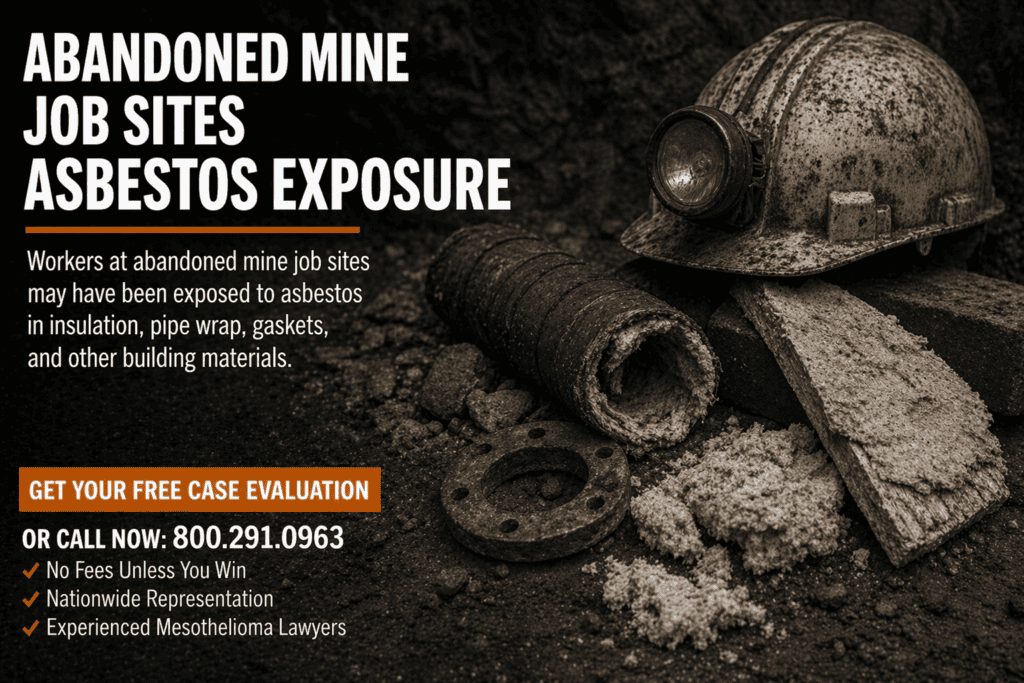
⛏️ Abandoned Mines Asbestos Exposure
Abandoned Mines Asbestos Exposure examines historical asbestos exposure during abandoned mine workings, waste-rock piles, mine structures and nearby disturbed ground. Possible sources include naturally occurring asbestos-bearing rock where geologically present, historical insulation, old machinery gaskets and abandoned processing structures. The specific material, work task and time period must be established; a job title alone does not prove exposure.
Workers including former miners, reclamation crews, contractors, inspectors and nearby residents may need to document past exposure after a mesothelioma or asbestos-related lung cancer diagnosis. An abandoned mine is not automatically an asbestos mine. Geological surveys and sampling are essential before characterizing mine waste as asbestos-containing. This article covers work areas, records, legal options and questions families commonly ask.
📑 On This Page
- Exposure Overview
- Where Exposure May Have Occurred
- Workers & Occupations
- Components & Exposure Pathways
- Records & Evidence
- Mesothelioma & Asbestos-Related Lung Cancer
- Lawsuits, Trust Funds & Compensation
- Frequently Asked Questions
- Summary & Confirmed Sources
⚙️ Exposure Overview
Industrial pumps may involve mechanical seals, friction products, thermal insulation, or surrounding plant materials that historically sometimes contained asbestos. Whether any particular product contained asbestos depends on its manufacturer, formulation, installation date, and replacement history.
The broader Mining Job Sites page explains related machinery categories, while Asbestos Exposure in Job Sites offers context about historical equipment suppliers. Neither page alone establishes a claim involving a particular manufacturer.
📍 Where Exposure May Have Occurred
| Work Area or Task | What to Examine |
|---|---|
| Equipment Casing And Shaft-Seal Work | Product specifications and installation history |
| Packing Extraction And Replacement | Maintenance and removal methods |
| Flange Gasket Scraping | Crew assignments, proximity, and ventilation |
| Equipment Rebuilds And Connected Piping | Contractor invoices and component changes |
| Industrial Equipment Work Orders | Work orders, dates, and supporting photographs |
A repair invoice can document that equipment was opened but may not identify the composition of every gasket or seal. A parts list can identify a material but may not show who handled it. The strongest reconstruction brings those different records together and acknowledges unresolved gaps.
In many facilities, thermal insulation on adjacent piping was installed and maintained by a different contractor than the machinery manufacturer. It is important to identify that insulation as a separate product and to avoid automatically assigning responsibility to the maker of a metal pump, valve, tank, or vehicle.
Relevant comparisons include Asbestos Exposure in Machinery, Industrial Facility Demolition, and Secondary Environmental Exposure Near Demolition Sites. These pages describe related sealing and process systems but do not establish that any specific machine used the same materials.
👷 Workers & Occupations
Jobs potentially relevant to this topic include former miners, reclamation crews, contractors, inspectors and nearby residents, millwrights, pipefitters, maintenance technicians. A job title by itself does not show that a person inhaled asbestos. Mechanics replacing components, operators nearby during shutdowns, and contractors removing insulation can have materially different work histories.
Ask what each worker actually did: operated controls, inspected machinery, removed packing, scraped gaskets, handled insulation, supervised a repair, or cleaned the work area. Note whether the work occurred in a confined room or an open yard and whether other trades were working nearby.
Shift logs, work permits, maintenance schedules, and first-hand witness accounts can establish whether a worker was present. Witness statements are more useful when they identify the equipment number, specific component, time frame, and task instead of simply describing a dusty factory.
A worker may have moved among employers or sites. The complete occupational history should include previous industrial, construction, shipyard, utility, or vehicle repair jobs. Distinguish asbestos from ordinary process dust, petroleum residues, welding fumes, and other hazards that have different exposure mechanisms.
For related work histories, compare Demolition Site Job Sites, Industrial Equipment Manufacturers, and Asbestos Companies. These provide context for machinery, facilities, and replacement products without treating all trades as interchangeable.
🛠️ Components & Exposure Pathways
Products and Materials Requiring Identification
For abandoned mine workings, waste-rock piles, mine structures and nearby disturbed ground, examine naturally occurring asbestos-bearing rock where geologically present, historical insulation, old machinery gaskets and abandoned processing structures. Composition varied by manufacturer, installation date and replacement history. Catalogs, surveys, laboratory analyses and purchasing records help distinguish asbestos-containing products from other materials.
Identify the task sequence and supporting records: who authorized the job, which component was removed, how surfaces were cleaned, and whether dust or debris was generated. The amount of dust visible to a worker does not reveal its asbestos content. Product identification and the circumstances of disturbance are both necessary.
A technical manual may describe one equipment configuration, while invoices and maintenance logs show later changes. Witness accounts can help describe work practices but may not reliably establish the material formulation. Corroboration is particularly important for exposures that occurred decades before diagnosis.
Thermal Insulation and Nearby Systems
Piping, vessels, heating equipment, and process utilities sometimes used asbestos-containing insulation. The insulation may have been supplied separately from the machinery and maintained by other trades.
Identify the task sequence and supporting records: who authorized the job, which component was removed, how surfaces were cleaned, and whether dust or debris was generated. The amount of dust visible to a worker does not reveal its asbestos content. Product identification and the circumstances of disturbance are both necessary.
A technical manual may describe one equipment configuration, while invoices and maintenance logs show later changes. Witness accounts can help describe work practices but may not reliably establish the material formulation. Corroboration is particularly important for exposures that occurred decades before diagnosis.
Maintenance, Shutdowns, and Overhauls
Repair work can involve disassembly, cutting, scraping, extraction, brushing, or removal. Potential fiber release depends on whether the material disturbed actually contained asbestos and how the task was performed.
Identify the task sequence and supporting records: who authorized the job, which component was removed, how surfaces were cleaned, and whether dust or debris was generated. The amount of dust visible to a worker does not reveal its asbestos content. Product identification and the circumstances of disturbance are both necessary.
A technical manual may describe one equipment configuration, while invoices and maintenance logs show later changes. Witness accounts can help describe work practices but may not reliably establish the material formulation. Corroboration is particularly important for exposures that occurred decades before diagnosis.
Original Equipment and Replacement Parts
Equipment can remain in service for decades. Original drawings may differ from parts used after rebuilds, and a later material safety sheet may not describe the product installed during earlier employment.
Identify the task sequence and supporting records: who authorized the job, which component was removed, how surfaces were cleaned, and whether dust or debris was generated. The amount of dust visible to a worker does not reveal its asbestos content. Product identification and the circumstances of disturbance are both necessary.
A technical manual may describe one equipment configuration, while invoices and maintenance logs show later changes. Witness accounts can help describe work practices but may not reliably establish the material formulation. Corroboration is particularly important for exposures that occurred decades before diagnosis.
Bystander Contact and Cleanup
A person working nearby during disturbance of asbestos-containing material may have a relevant history. Proximity, ventilation, duration, frequency, and cleanup procedures need individualized evidence.
Identify the task sequence and supporting records: who authorized the job, which component was removed, how surfaces were cleaned, and whether dust or debris was generated. The amount of dust visible to a worker does not reveal its asbestos content. Product identification and the circumstances of disturbance are both necessary.
A technical manual may describe one equipment configuration, while invoices and maintenance logs show later changes. Witness accounts can help describe work practices but may not reliably establish the material formulation. Corroboration is particularly important for exposures that occurred decades before diagnosis.
Other relevant machinery topics include Asbestos Manufacturers, Manufacturing Plants, Depots, and Tile Manufacturing Job Sites. They can help readers distinguish equipment categories and different maintenance tasks.
📁 Records & Evidence
Begin with a chronological list of plants, vessels, fleets, equipment numbers, and employers. Preserve the source and date of each document. Keep medical records separate from exposure documents so that a diagnosis is not mistaken for proof of a particular product.
| Record | What It Can Establish |
|---|---|
| Employment, payroll, and union records | Work dates, employer, department, and role |
| Equipment manuals and nameplate photographs | Manufacturer, model, and component configuration |
| Maintenance logs and repair orders | Specific repair tasks, timing, and assigned crews |
| Purchase orders and supplier invoices | Replacement parts and possible product identity |
| Plant drawings and turnaround permits | Work areas, neighboring systems, and contractors |
| Coworker accounts and historical photographs | Tasks, proximity, and contemporaneous details |
| Pathology and treatment records | Diagnosis and medical timeline |
Product-level context is also available in Secondary Asbestos Exposure From Tile Plants, Construction Material Manufacturing Plants, and Fire Stations. The distinction between a component manufacturer and the employer that installed it may be legally important.
🫁 Mesothelioma & Asbestos-Related Lung Cancer
Mesothelioma
Mesothelioma is a cancer of the mesothelium, often the lining surrounding the lungs. Asbestos exposure is its principal established cause. Symptoms may arise many years after exposure, so historical employment and repair records can be important. A medical diagnosis does not identify the responsible product or company on its own.
Asbestos-Related Lung Cancer
Asbestos exposure increases the risk of lung cancer. Smoking and asbestos can have combined effects, but smoking history does not eliminate the need to review occupational exposure. Not every lung cancer diagnosed in an industrial worker is attributable to asbestos. Medical evaluation and exposure reconstruction address different questions.
Preserve pathology reports, imaging, treatment notes, and a complete work history. Health decisions should be made with qualified clinicians. A legal assessment should not substitute for medical diagnosis or assume that every industrial dust exposure involved asbestos.
⚖️ Lawsuits, Trust Funds & Compensation
Civil Lawsuits
Depending on the facts and jurisdiction, a person diagnosed with an asbestos-related disease may have claims against responsible manufacturers, suppliers, or other entities. Product identification, exposure evidence, diagnosis, and applicable law all matter. A machine assignment or diagnosis does not guarantee compensation.
Asbestos Bankruptcy Trust Funds
Some companies established bankruptcy trusts with separate medical and exposure requirements. Each trust evaluates eligibility independently. Filing a trust claim should not be assumed to preserve a deadline for a civil lawsuit or another trust.
Family and Wrongful-Death Claims
Eligible survivors may have legal options after a worker dies, depending on jurisdiction, standing, and filing deadlines. Families may need medical records, death certificates, estate documentation, and evidence of historical employment and products. Seek prompt individualized legal guidance.
Some people also have questions about veterans benefits. Industrial or civilian employment does not automatically establish VA eligibility; qualifying military service and applicable program rules must be evaluated separately.
❓ Frequently Asked Questions
Did every abandoned mine workings, waste-rock piles, mine structures and nearby disturbed ground installation contain asbestos?
No. Materials varied by equipment type, supplier, service date, and repairs. A specific product must be identified.
Which components associated with abandoned mine workings, waste-rock piles, mine structures and nearby disturbed ground may have contained asbestos?
Possible sources include particular gaskets, packing, insulation, or friction materials, depending on the machinery. Each requires verification.
Can nearby workers have exposure without handling a component?
Possibly, if asbestos-containing material was disturbed nearby. Frequency, proximity, duration, and ventilation matter.
Does visible dust prove that asbestos was present?
No. Dust can contain many substances; its asbestos content cannot be determined from appearance alone.
Why do replacement parts and dates matter?
Parts installed decades after original manufacture may use different formulations. Dated records help identify the relevant material.
Which records are useful for a historical exposure claim?
Employment records, equipment manuals, purchase orders, maintenance logs, photographs, and credible witness statements can help.
Can a diagnosed worker pursue asbestos compensation?
Potentially, subject to diagnosis, actionable exposure, applicable law, trust criteria, and filing deadlines. No recovery is guaranteed.
Can families investigate exposure after a worker has died?
Yes. Surviving records and witness accounts may help, but who can file and when depend on the jurisdiction and claim type.
An abandoned mine is not automatically an asbestos mine. Geological surveys and sampling are essential before characterizing mine waste as asbestos-containing. Review product names, installation and removal dates, contractors, and contemporaneous workplace records before drawing conclusions about a specific exposure source.
📌 Summary & Confirmed Sources
Abandoned Mines Asbestos Exposure requires a product-specific review of work performed, materials installed, dates, and medical evidence. Historic asbestos use in an industry is not proof of exposure for every worker. Preserve records and distinguish confirmed facts from unresolved questions.
Related vehicle and facility context can be found in Fire Station Workers & Occupations and Fire Station Asbestos Exposure Articles. These are supporting topics rather than substitutes for case-specific evidence.
Confirmed Sources
OSHA — Asbestos in General Industry
National Cancer Institute — Asbestos Exposure and Cancer Risk
Find Out If You May Qualify for Asbestos Compensation Today
Call 800.291.0963 — help is available 24/7/365. 25+ years of experience.
Disclaimer: Mesothelioma Help Center is not a law firm or medical provider and does not determine legal or VA eligibility. This page provides general information and is not legal or medical advice.