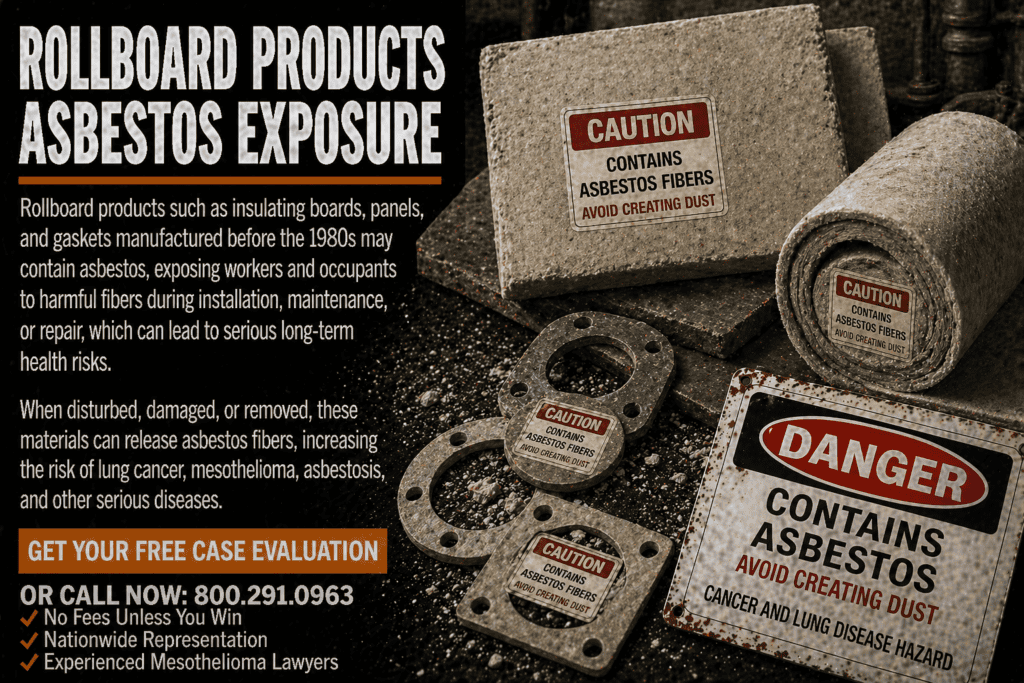
Rollboard Products Asbestos Exposure
Asbestos rollboard was a historical flexible paper-like product used for protection against heat, fire, corrosion and moisture. Unlike rigid insulation board, rollboard could be cut, folded, wrapped, rolled and formed around corners or equipment. Historical asbestos rollboard contained substantial amounts of asbestos fiber, although modern flexible insulating and protective sheet products should not be assumed to contain asbestos.
EPA historical regulatory records describe asbestos rollboard as a thin, flexible material manufactured in continuous sheets and commonly made from asbestos fibers combined with binders and fillers. EPA also identifies rollboard as one of the asbestos-containing product categories whose manufacture, importation, processing and distribution in commerce remained prohibited under the 1989 asbestos rule.
This page focuses specifically on asbestos rollboard. For broader information, see Insulation & Fireproofing Asbestos Exposure, Insulation Products Asbestos Exposure, and the main Asbestos Exposure in Products guide.
Rollboard Products and Historical Asbestos Use
Historical asbestos rollboard was designed to provide a flexible barrier where resistance to heat, flame, corrosion or moisture was useful. EPA’s regulatory analysis described it as a paper product made in thin continuous sheets that could be wrapped or molded around surfaces.
According to EPA’s historical analysis, asbestos was the primary constituent in asbestos rollboard, with binders and fillers making up the balance. Product formulations varied, so the exact asbestos content and composition depended on the manufacturer and product.
Because rollboard could be bent, folded and wrapped, it was useful in places where rigid insulation board would have been difficult to install.
How Asbestos Rollboard Was Made and Used
EPA historical records describe rollboard as a continuous-sheet product manufactured in a process similar to millboard production. Depending on the formulation, historical rollboard could include asbestos fibers, binders such as silicates or starches, and mineral fillers.
Potential historical uses included:
- heat-resistant wrapping around equipment or components;
- fire-resistant protective layers;
- flexible insulation or barrier material;
- corrosion-resistant protective wrapping;
- moisture-resistant protective layers;
- lining or wrapping around irregular shapes and sharp corners;
- industrial protective applications requiring flexible sheet material; and
- specialty thermal or fire-resistant assemblies.
Rollboard differed from blanket insulation, corrugated air cell insulation and sprayed or troweled fireproofing, although these materials could be present in the same industrial or mechanical setting.
How Asbestos Exposure Could Occur
A potential exposure pathway involves asbestos-containing rollboard and work that releases fibers into the air. Because rollboard could be cut, folded, fitted and removed, repeated handling could disturb edges and surfaces, particularly as material aged or deteriorated.
Potential disturbance could occur during tasks such as:
- cutting rollboard sheets to size;
- folding or forming material around corners or equipment;
- trimming edges during installation;
- drilling or fastening through rollboard;
- removing old wrapped or lined material;
- tearing deteriorated sheets from surfaces;
- scraping adhered material or residue;
- handling brittle or damaged rollboard;
- demolishing assemblies containing rollboard; and
- dry sweeping or blowing dust after removal.
OSHA recognizes asbestos as a regulated health hazard and notes that significant occupational exposures can occur during manufacture, renovation, repair and demolition involving asbestos-containing products. Actual exposure depends on asbestos content, product condition, work method, duration, frequency, proximity, ventilation and controls.
Worked with older rollboard, flexible asbestos sheet material or heat-resistant wrapping? If you are trying to identify a historical product or reconstruct a possible asbestos exposure, Call 800.291.0963. Live chat available 24/7, 365 days a year. Submit Your Case.
Workers and Job Sites That May Have Encountered Rollboard
Workers who manufactured, cut, installed, repaired, removed or worked near historical asbestos rollboard may have encountered airborne fibers. A job title alone does not establish exposure; the specific product and task matter.
Potentially relevant occupations may include insulators, maintenance workers, mechanics, pipefitters, boilermakers, electricians, industrial laborers, machine operators, construction workers, shipyard workers and demolition crews.
Possible settings include factories, power plants, refineries, mechanical rooms, industrial plants, shipyards, military facilities and other workplaces where heat-resistant or fire-resistant flexible sheet products were used.
Nearby workers may also have encountered dust if rollboard was cut, torn, scraped or removed in the same work area.
Handling, Cutting and Removal Risks
Cutting and fitting
Rollboard was specifically designed to be cut, folded, wrapped and formed. Cutting asbestos-containing rollboard could disturb fibers at the cut edge and generate dust.
Repeated flexing
Flexible sheet material may be bent or repositioned during installation or maintenance. Aging can make the material more brittle, increasing the chance of breakage or surface deterioration.
Fasteners and penetrations
Drilling, nailing or fastening through asbestos-containing rollboard could create localized dust and fiber release.
Removal
Old rollboard may have been wrapped, mechanically fastened or adhered to another surface. Tearing, scraping or pulling the material away can disturb both the sheet and any residue.
Demolition
Assemblies containing old rollboard may be broken apart during equipment replacement or building demolition. Identification before destructive work is important where historical asbestos-containing products may remain.
Evidence That May Identify Historical Rollboard
Exposure reconstruction is strongest when evidence identifies the exact rollboard product, manufacturer, installation period, location and work performed.
Useful evidence may include:
- manufacturer names, trade names and product numbers;
- roll labels, wrappers or original packaging;
- historic catalogs and product literature;
- industrial specifications and equipment drawings;
- purchase orders, invoices and supplier records;
- maintenance and repair records;
- plant, shipyard or military facility records;
- historic photographs showing flexible sheet material in use;
- asbestos surveys, abatement records and laboratory reports;
- employer, union or military records documenting assignments;
- coworker or supervisor statements identifying products and tasks; and
- qualified laboratory analysis of surviving material when appropriate.
Testing should distinguish rollboard from nearby paper, felt, gaskets, insulation blankets, millboard or other sheet materials whenever those components can be separately identified.
Medical and pathology records may document an asbestos-related diagnosis but do not establish which historical rollboard product was an exposure source.
Secondhand Exposure and Health Risks
If cutting or removing asbestos-containing rollboard generated dust that accumulated on clothing, shoes, tools or belongings, fibers could potentially have been carried away from the job site. This is a possible secondhand exposure pathway, but family relationship alone does not establish exposure.
Asbestos exposure is associated with mesothelioma, asbestos-related lung cancer, asbestosis and other asbestos-related disease. Working with historical rollboard does not diagnose disease and does not establish individual medical causation.
Anyone concerned about historical occupational asbestos exposure should discuss their work history and health with a qualified healthcare professional.
Legal and Compensation Considerations
Depending on the evidence and circumstances, legal options may be available to a person diagnosed with an asbestos-related disease after documented exposure to a specific asbestos-containing rollboard product.
A legal review may consider the manufacturer, product line, workplace or job site, installation period, tasks performed, frequency and duration of exposure, diagnosis, jurisdiction and applicable filing deadlines.
Identifying a manufacturer or supplier does not automatically establish legal responsibility. Liability is case-specific and depends on product evidence, exposure evidence and governing law.
Some matters may involve asbestos trust funds, but each trust has its own product, exposure and medical documentation requirements. Eligibility is not automatic, and compensation is not guaranteed.
Exposure that occurred decades ago does not by itself determine whether a claim is timely. Statutes of limitation and other deadlines vary by jurisdiction and circumstances and should be reviewed individually.
Rollboard Products Asbestos Exposure FAQs
What was asbestos rollboard?
It was a thin, flexible asbestos-containing paper-like product used historically for protection against heat, fire, corrosion and moisture.
Was asbestos the main ingredient in historical rollboard?
EPA’s historical regulatory analysis states that asbestos fiber was the primary constituent of asbestos rollboard, with binders and fillers making up the balance.
Could rollboard be wrapped around equipment?
Yes. Historical EPA records describe rollboard as material that could be cut, folded, wrapped, rolled and formed around corners.
Could cutting rollboard release asbestos fibers?
Potentially. Cutting, tearing, drilling or scraping asbestos-containing rollboard can disturb the material and release fibers.
Is asbestos rollboard still legally manufactured for U.S. commerce?
EPA identifies rollboard as one of the asbestos-containing product categories whose manufacture, importation, processing and distribution remained prohibited under the 1989 asbestos rule.
Can old rollboard be identified by appearance alone?
No. Flexible paper-like appearance is not reliable proof. Historical product records or qualified laboratory analysis may be needed.
What evidence can identify a historical rollboard product?
Useful evidence can include labels, packaging, catalogs, specifications, invoices, maintenance records, photographs, asbestos surveys, laboratory reports and coworker testimony.
Does working around old rollboard automatically qualify someone for compensation?
No. Legal eligibility depends on product identification, asbestos-content evidence, exposure history, diagnosis, jurisdiction and other case-specific facts. Compensation is not guaranteed.
Get Help Reviewing Historical Rollboard Exposure
If you or a family member has been diagnosed with mesothelioma, asbestos-related lung cancer or another asbestos-related disease and you are trying to identify older rollboard or flexible asbestos sheet material from a workplace, military facility, shipyard or industrial site, we can help organize the product and exposure history that may be relevant.
Call 800.291.0963 to discuss what you remember about the material, manufacturer, equipment, building or job site and work performed. Live chat is available 24/7, 365 days a year. Submit Your Case using the form below.
Prior exposure does not automatically establish a legal claim. Eligibility depends on the evidence, diagnosis, jurisdiction and other circumstances, and compensation is not guaranteed.
⚕️ Legal & Medical Information Disclaimer
This page provides general educational information and is not medical or legal advice. The information does not establish asbestos exposure, diagnosis, causation, liability, claim eligibility or compensation. Medical concerns should be discussed with a qualified healthcare professional, and legal questions should be reviewed with a qualified attorney.