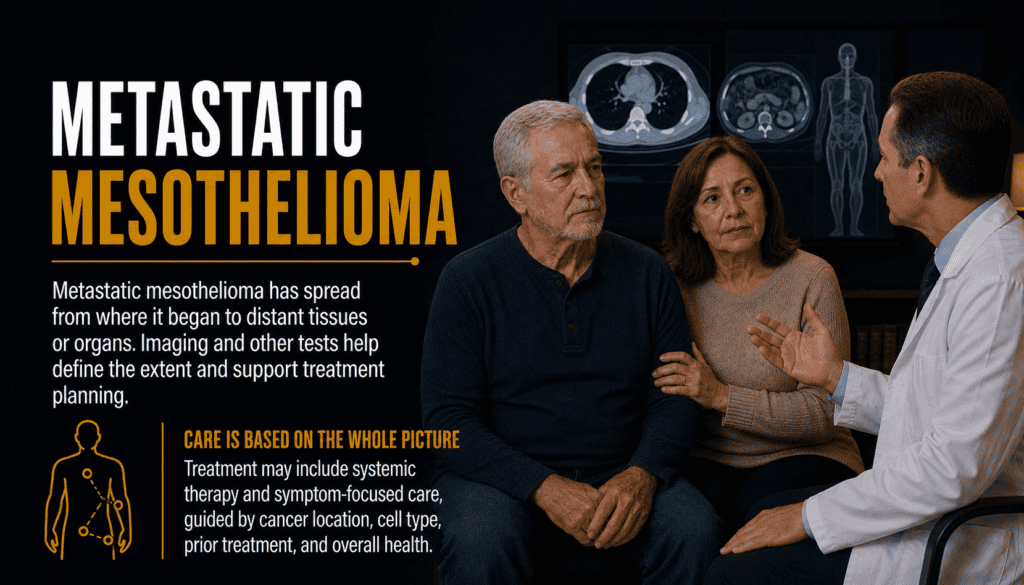
Metastatic Mesothelioma
How mesothelioma spreads, possible symptoms and treatment options
Metastatic mesothelioma means cancer cells have traveled from the place where mesothelioma began to a distant organ or tissue and formed new tumors. The metastatic tumors remain mesothelioma; they do not become a new type of cancer based on the organ where they are found.
A finding of distant spread changes staging and treatment planning, but it does not determine exactly how a person will respond or how long they will live. Imaging, pathology, previous treatment and overall health must be considered together by an experienced cancer team.
🧬 What Is Metastatic Mesothelioma?
Metastasis occurs when cancer cells separate from a primary tumor, enter lymphatic channels or the bloodstream, survive in another location and form a new tumor. If pleural mesothelioma spreads to the liver, for example, the liver tumor is metastatic mesothelioma—not liver cancer.
The term is often confused with local invasion, progression and recurrence. These words describe related but different clinical situations.
| Term | Meaning | Important Distinction |
|---|---|---|
| Local invasion | Tumor grows directly into nearby tissue or an adjacent structure | Locally advanced disease is not automatically distant metastasis |
| Regional lymph-node spread | Cancer reaches lymph nodes defined as regional for that primary site | Regional nodes can affect stage without meeting the definition of M1 disease |
| Metastasis | Cancer establishes disease at a distant organ, tissue or nonregional node | Distant spread is classified as M1 in pleural mesothelioma staging |
| Progression | Known cancer grows or spreads, including during treatment | Progression may be local, regional or metastatic |
| Recurrence | Cancer returns after a period following treatment | Recurrence can be local, regional or distant |
🔄 How Mesothelioma Spreads
Malignant mesothelioma often spreads across the surface where it began before distant metastases become apparent. The pattern varies with the primary location, cell type, disease biology and previous treatment.
Three Routes of Cancer Spread
- Direct extension: Tumor grows from a membrane into nearby muscle, chest wall, diaphragm, lung or another adjacent structure.
- Lymphatic spread: Cancer cells move through lymphatic vessels into regional or more distant lymph nodes.
- Blood-borne spread: Cells enter blood vessels and establish tumors in distant organs or bones.
In pleural mesothelioma, formal TNM staging separates local tumor extent, regional lymph-node involvement and distant metastasis. Direct growth through the diaphragm or into nearby chest structures can represent advanced local disease without being M1. Doctors must identify the actual route and location of spread rather than relying on the word “advanced” alone.
Peritoneal mesothelioma commonly distributes across surfaces inside the abdominal cavity. Disease on multiple abdominal surfaces is not necessarily the same as blood-borne metastasis to a distant organ. Peritoneal specialists assess tumor distribution, involvement outside the abdomen and whether complete cytoreduction appears possible.
📍 Possible Metastatic Locations, Symptoms and Emergencies
Mesothelioma can spread to different locations, and some metastases cause no symptoms. Published reports describe distant involvement of organs and tissues such as the liver, bones, brain, opposite lung or pleura, skin and nonregional lymph nodes. A person’s pattern cannot be predicted from a general list.
| Possible Location | Possible Symptoms | Urgent Warning Signs |
|---|---|---|
| Bone or spine | Persistent localized pain, tenderness, weakness or reduced movement | Sudden severe back pain, new leg weakness, numbness, loss of bladder or bowel control, or suspected fracture |
| Brain or nervous system | Headache, dizziness, confusion, balance problems, weakness or seizures | First seizure, sudden weakness, facial droop, speech difficulty, fainting or severe confusion |
| Liver or abdomen | Abdominal discomfort, swelling, appetite loss, nausea or jaundice | Severe pain, repeated vomiting, rapid swelling, confusion or significant bleeding |
| Lung, opposite pleura or chest | Increasing breathlessness, cough, chest pressure or pain | Sudden severe breathlessness, blue lips, coughing blood, fainting or crushing chest pain |
| Skin or soft tissue | A new or enlarging lump, tenderness, skin change or pain | Rapid swelling with breathing difficulty or uncontrolled bleeding |
These symptoms can have causes other than metastatic cancer. New or worsening mesothelioma symptoms should be reported promptly. Call emergency services for sudden neurologic changes, severe breathing difficulty, suspected spinal cord compression or another immediately dangerous condition.
🔬 How Doctors Diagnose Metastatic Mesothelioma
Doctors compare new findings with the original diagnosis, earlier scans, treatment history and current symptoms. The goal is to determine whether mesothelioma has spread, where it is located and whether the result would change treatment.
Imaging and Clinical Assessment
Contrast-enhanced CT commonly evaluates the chest, abdomen and pelvis. PET/CT may help identify metabolically active disease and guide biopsy, but inflammation can also appear active. MRI can provide additional detail for the brain, spine, chest wall or other soft tissues. Tests should be chosen for the clinical question rather than ordered automatically.
Biopsy and Pathology Review
A biopsy of a new lesion may be recommended when imaging is uncertain, another cancer is possible or the tissue could guide therapy. Pathologists compare the new sample with the original tumor and use morphology, immunohistochemistry and selected molecular tests. Learn more about the role of a mesothelioma biopsy.
Questions to Ask About a New Scan Finding
- Does the finding definitely represent cancer, or are other explanations possible?
- Is it local growth, a regional lymph node or distant metastasis?
- Would a biopsy change the recommended treatment?
- Do I need brain, spine or other site-specific imaging?
- How does this result affect the treatment goal?
Get Help Understanding the Next Steps
A metastatic mesothelioma diagnosis can bring urgent medical, practical and financial questions. Our team can help you find information and understand possible legal options related to asbestos exposure.
Call 800.291.0963 Submit Your Case
Live chat is available 24/7/365.
📊 Stage IV Mesothelioma and Prognosis
In the TNM system for diffuse malignant pleural mesothelioma, distant metastasis is recorded as M1. Any T and any N with M1 disease is stage IV mesothelioma. By contrast, some tumors are locally unresectable because of T4 invasion yet remain M0; those cases are advanced but not metastatic under the TNM definition.
The formal pleural TNM system should not be automatically applied to mesothelioma beginning in the abdomen, heart lining or tunica vaginalis. The oncology team should explain how disease extent is being classified for the specific primary site.
Prognosis depends on more than metastatic status. Doctors consider tumor location, cell type, organs involved, pace of change, symptoms, overall tumor burden, performance status, previous treatment and response to therapy.
Population statistics cannot predict an individual’s outcome. Some cancers progress quickly, while others respond or remain controlled for meaningful periods. Asking the oncologist for a range of realistic possibilities—and what could change that estimate—is more useful than relying on one average survival number.
💊 Metastatic Mesothelioma Treatment Options
Treatment is usually systemic because distant disease is present in more than one location or may include microscopic cancer not visible on scans. The plan depends on the primary mesothelioma site, histology, previous therapies, organ function, symptoms and personal goals.
| Treatment Approach | Potential Role | Key Considerations |
|---|---|---|
| Immunotherapy | Helps the immune system recognize and attack cancer | Approved regimens and supporting evidence differ by primary site, prior treatment and health status |
| Chemotherapy | May shrink or slow disease throughout the body | Platinum plus pemetrexed is an established option; selection depends on prior therapy and organ function |
| Radiation therapy | Controls pain or another problem at a specific metastatic site | Often used locally rather than to treat every site in the body |
| Procedures or selected surgery | Relieves fluid, stabilizes bone or addresses a specific complication | Major tumor-removing surgery is rarely appropriate for widespread disease |
| Clinical trial | Provides access to an investigational drug or combination | Eligibility, potential benefit, uncertainty and added visits should be reviewed carefully |
Systemic Treatment for Pleural Mesothelioma
For unresectable advanced or metastatic pleural mesothelioma, options can include nivolumab plus ipilimumab, platinum chemotherapy plus pemetrexed, or pembrolizumab combined with platinum and pemetrexed. These regimens have different side effects and eligibility considerations. An oncologist should explain why one approach is preferred and whether the evidence applies to the patient’s exact disease.
Evidence is more limited for metastatic mesothelioma arising outside the pleura. Treatment may be adapted from available studies and experience, but uncertainty should be stated clearly. Patients can review mesothelioma treatments and mesothelioma drugs before discussing choices with their care team.
🩹 Symptom Control and Palliative Care
Palliative care is specialized medical care focused on symptoms, function and quality of life. It can begin at diagnosis and continue alongside chemotherapy, immunotherapy, radiation or other cancer-directed treatment. It is not the same as stopping treatment.
A symptom-management plan may include:
- Medicines for pain, nausea, constipation, anxiety or breathlessness
- Drainage of pleural fluid or ascites when appropriate
- Short courses of radiation for painful bone or soft-tissue disease
- Procedures to stabilize a weakened bone or protect the spinal cord
- Oxygen when low blood oxygen is documented
- Nutrition, physical therapy, occupational therapy and mobility support
- Counseling, spiritual care and caregiver support
New pain should be assessed rather than automatically attributed to cancer. The location, timing and character of pain can help identify urgent complications. More detailed guidance is available on metastatic pain in mesothelioma.
Hospice is a separate service generally considered when a person is approaching the end of life and the plan focuses primarily on comfort rather than disease-directed therapy. Asking for a palliative-care consultation does not require entering hospice.
🤝 Care Planning, Second Opinions and Support
A second opinion from a mesothelioma-experienced center may help confirm pathology, interpret disease extent and identify clinical trials. It is particularly useful when the primary site is rare, a new lesion is uncertain or several treatment strategies appear reasonable.
Information to Gather
- Original pathology report, slides and tissue-block information
- Current and earlier imaging reports plus the actual image files
- Treatment dates, drug names, doses and response information
- Operative and radiation-treatment summaries
- Current medications, allergies and other health conditions
- A written symptom timeline and list of priorities
Shared Decision-Making Questions
- What is the goal of this treatment: shrinkage, slower growth, symptom relief or all three?
- How likely is the treatment to help someone in my situation?
- What side effects or hospital visits are most important to consider?
- How will we know whether treatment is working?
- What would we do if the cancer grows or side effects become unacceptable?
Families can find caregiver, emotional and practical resources through mesothelioma support. If disease returns after a treatment-free period, the page about recurrent mesothelioma explains how recurrence differs from ongoing progression.
Authoritative Medical Sources
- National Cancer Institute: Metastatic Cancer—When Cancer Spreads
- National Cancer Institute: Malignant Mesothelioma Treatment (PDQ)
- American Cancer Society: Stages of Mesothelioma
- American Cancer Society: Treating Mesothelioma
- Centers for Disease Control and Prevention: Mesothelioma Basics
- U.S. Food and Drug Administration: Pembrolizumab With Chemotherapy for Advanced or Metastatic Pleural Mesothelioma
- ClinicalTrials.gov: Mesothelioma Studies
❓ Frequently Asked Questions About Metastatic Mesothelioma
What does metastatic mesothelioma mean?
It means mesothelioma cells have spread from the primary tumor to a distant organ, tissue or nonregional lymph node and formed new cancer deposits.
Is metastatic mesothelioma always stage IV?
Distant M1 spread is stage IV in the TNM system for diffuse pleural mesothelioma. Other mesothelioma locations do not necessarily use the same formal staging system, so the treating specialist should explain how extent is classified.
Is locally advanced mesothelioma the same as metastatic disease?
No. A tumor may invade nearby structures and become locally unresectable without spreading to a distant site. Metastasis specifically refers to cancer established away from where it began.
Is recurrent mesothelioma always metastatic?
No. Recurrent cancer can return near the original tumor, in regional lymph nodes or at a distant site. Only distant recurrence is metastatic.
Can a scan confirm that mesothelioma has spread?
Imaging may provide strong evidence, but it is not always conclusive. Doctors compare multiple scans and clinical findings, and they may recommend a biopsy when another explanation or another cancer is possible.
Can metastatic mesothelioma be treated?
Yes. Treatment may slow cancer, shrink tumors or relieve symptoms. Options can include immunotherapy, chemotherapy, radiation, symptom-directed procedures and clinical trials. The recommended plan depends on the primary site, prior treatment and overall health.
Does palliative care mean cancer treatment has stopped?
No. Palliative care can be provided at the same time as active cancer treatment. It helps manage pain, breathing problems, fatigue, digestive symptoms, stress and caregiver needs.
When should someone with metastatic mesothelioma seek emergency care?
Seek emergency help for sudden severe breathing difficulty, new weakness or paralysis, loss of bladder or bowel control, a first seizure, severe confusion, fainting, uncontrolled bleeding or another rapidly developing dangerous symptom.
Talk With Our Mesothelioma Support Team
If you or a loved one has been diagnosed with metastatic mesothelioma, we can help you find information and understand possible legal options related to asbestos exposure. There is no obligation.
Call 800.291.0963 Submit Your Case
Live chat is available 24/7/365.
Medical and legal disclaimer: This page provides general educational information and is not a substitute for advice from a licensed physician or attorney. Diagnosis and treatment decisions must be made with qualified health professionals. Case eligibility and legal rights depend on individual facts and applicable law; contacting us does not create an attorney-client relationship.