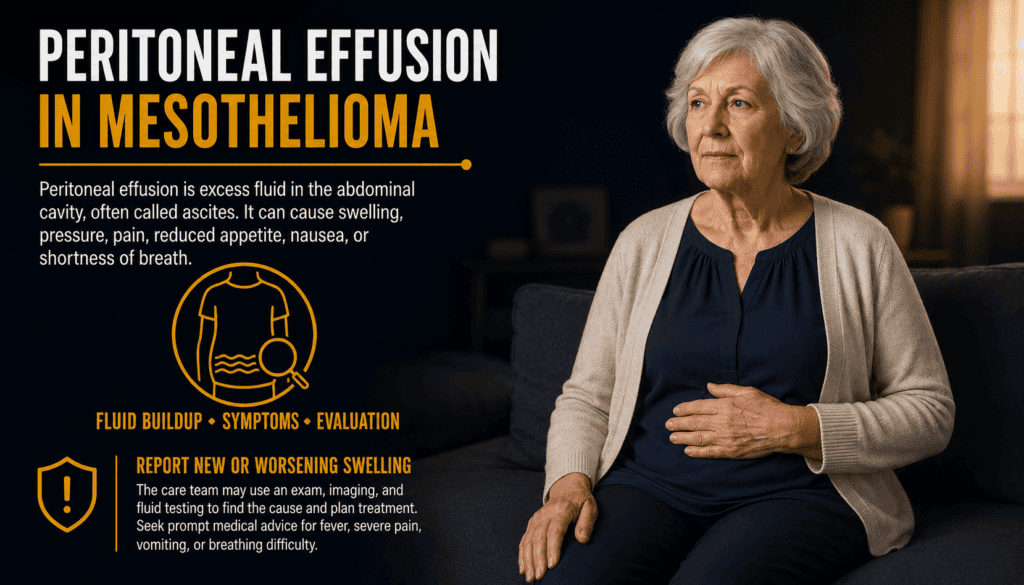
Peritoneal Effusion in Mesothelioma: Abdominal Fluid, Symptoms and Treatment
A patient and caregiver guide to ascites, fluid testing, drainage, recurrence and medical follow-up.
Peritoneal effusion means excess fluid collects in the space inside the abdomen. Doctors also call this ascites. Peritoneal mesothelioma can cause this buildup, but fluid in the abdomen has many possible causes. New swelling deserves a medical evaluation rather than an assumption that cancer is responsible.
This page explains what patients may experience, what tests can clarify the cause and how the care team can reduce discomfort. Fluid drainage treats a symptom; it does not by itself remove or cure mesothelioma.
What Is Peritoneal Effusion?
The peritoneum is a thin tissue lining the abdominal cavity and covering many abdominal organs. Normally, a small amount of fluid helps these surfaces move. When extra fluid accumulates, the abdomen may enlarge and feel tight. The term malignant ascites applies when cancer cells are found in the fluid; having ascites does not automatically establish malignant ascites or identify its cause.
Peritoneal effusion is different from pleural effusion around the lungs. Although both involve excess fluid, the affected body spaces and drainage procedures differ.
| Term | Meaning | Important distinction |
|---|---|---|
| Ascites / peritoneal effusion | Excess fluid in the abdominal cavity | Can have cancerous or noncancerous causes |
| Malignant ascites | Cancer cells identified in ascitic fluid | A fluid finding, not a complete mesothelioma subtype diagnosis |
| Pleural effusion | Fluid around a lung | Different anatomical space and procedure |
| Paracentesis | Needle/catheter procedure to sample or drain abdominal fluid | Can aid diagnosis or relieve symptoms |
Why Fluid Builds Up
Mesothelioma involving the peritoneum can irritate the lining and disrupt the balance between fluid production and removal. Cancer-related changes can increase leakage into the abdominal cavity or interfere with normal drainage. However, liver disease, heart or kidney problems, infection and other cancers can also cause ascites. Some patients have more than one contributing condition.
Doctors consider the person’s diagnosis, treatment history, medications, examination and laboratory results before attributing the fluid to mesothelioma. A prior asbestos exposure history alone cannot determine the cause.
| Potential contributor | What clinicians assess |
|---|---|
| Peritoneal tumor involvement | Imaging, pathology and clinical history |
| Liver disease or altered blood flow | Liver tests, imaging and fluid studies |
| Heart or kidney conditions | Symptoms, examination and relevant tests |
| Infection | Fever, abdominal tenderness and fluid testing |
| Other malignancy | Imaging, cytology and tissue diagnosis as indicated |
Symptoms and Warning Signs
Abdominal enlargement may develop gradually or more quickly. People describe pressure, bloating, pain, early fullness after a few bites, reduced appetite, nausea, constipation or difficulty bending. A large collection can push upward against the diaphragm and make breathing uncomfortable. A sudden change should be reported rather than waiting for a routine appointment.
| Symptom | What to tell the care team |
|---|---|
| Increasing belly size | When it started and how rapidly it changed |
| Pain or tenderness | Location, severity, fever and whether it is new |
| Early fullness or vomiting | How much food and fluid you can keep down |
| Breathlessness | Whether it occurs at rest or worsens rapidly |
| Rapid weight change | Recent weights and associated swelling |
Seek emergency care for severe breathing difficulty or chest pain, inability to urinate, or a severely unwell condition. Contact the cancer team promptly for fever, new abdominal pain, redness or leaking at a drainage site, or rapidly worsening swelling. Your team may give additional personalized emergency instructions.
How Doctors Diagnose It
The assessment begins with symptoms, a physical examination and a review of known illnesses. Ultrasound or CT can show the amount and distribution of fluid and may reveal abnormalities needing further investigation. Doctors may recommend diagnostic paracentesis to collect fluid for testing.
Depending on the question, fluid analysis may include cell counts, cultures, protein and albumin measurements, and cytology to look for cancer cells. The test panel varies by clinical situation. A negative fluid cytology result does not reliably exclude mesothelioma; tissue biopsy and expert pathology review may still be necessary when suspicion remains.
| Assessment | Purpose | Limitation |
|---|---|---|
| Physical examination | Identify distention, tenderness and overall condition | Cannot identify the cause alone |
| Ultrasound / CT | Confirm fluid and examine abdominal structures | Imaging alone does not prove tumor type |
| Fluid cell count and culture | Investigate infection when indicated | Results must be interpreted with symptoms |
| Fluid cytology | Look for malignant cells | Negative result does not rule out mesothelioma |
| Tissue biopsy / pathology | Establish or clarify tumor diagnosis when needed | Requires an appropriate tissue sample and expert interpretation |
Paracentesis and Fluid Drainage
For diagnostic paracentesis, a clinician removes a sample of fluid. For therapeutic paracentesis, more fluid may be removed to ease pressure and improve comfort. The skin is cleaned and numbed, and ultrasound may guide placement. The team decides how much to remove and what monitoring is needed based on the patient’s condition.
Possible complications include bleeding, infection, leakage, low blood pressure and accidental injury to nearby structures, although clinicians take precautions to reduce these risks. Tell the team about blood thinners, allergies, previous abdominal surgery and any new symptoms. Follow the specific instructions given for medications and aftercare; do not stop prescribed medicines independently.
| Before | During | After |
|---|---|---|
| Review medicines, allergies and prior procedures | Local anesthetic and careful needle/catheter placement | Observe for dizziness, bleeding or leaking |
| Discuss diagnostic versus symptom-relief goal | Fluid collected for ordered tests or drainage | Ask when results will be available |
| Ask about food, transportation and support | Staff monitor comfort and clinical status | Know who to call if symptoms recur |
When Fluid Returns
Fluid may accumulate again if the underlying cause persists. Some patients need repeat paracentesis; others may be considered for a longer-term abdominal drainage catheter. Catheters can reduce repeated hospital visits but require training and carry infection, blockage and leakage risks. The decision depends on how quickly fluid returns, prognosis, treatment goals, caregiver support and patient preferences.
Diuretics or dietary changes help selected patients, particularly when other conditions contribute, but are not effective for everyone with cancer-related ascites. Do not start water pills or impose strict fluid or salt restrictions without individualized advice, especially if appetite and hydration are already poor.
| Option | Potential role | Trade-off |
|---|---|---|
| Repeat paracentesis | Relieve recurrent uncomfortable pressure | Additional procedures and visits |
| Indwelling abdominal catheter | Planned drainage at home for selected patients | Training, maintenance and infection risk |
| Treat underlying condition | May reduce fluid formation in some cases | Response varies and can take time |
| Medication / nutrition plan | May help when clinically appropriate | Must account for kidney function and nutrition |
Treating Mesothelioma and Supporting Comfort
Managing ascites and treating cancer are related but separate goals. An experienced mesothelioma team may discuss systemic treatment, clinical trials or, for carefully selected people with peritoneal mesothelioma, cytoreductive surgery with heated intraperitoneal chemotherapy (HIPEC). Eligibility depends on disease extent, pathology, general health and the likelihood of safely achieving the intended surgical result. No treatment is appropriate for every patient.
Palliative care can be provided alongside cancer-directed therapy to address pain, nausea, breathing discomfort, appetite, emotional strain and caregiver needs. A nutrition professional may help if early fullness limits food intake. Review the broader mesothelioma treatment overview and discuss which options match your diagnosis.
| Care goal | Examples | Question to ask |
|---|---|---|
| Reduce fluid pressure | Therapeutic paracentesis or selected catheter | How soon might symptoms improve? |
| Address cancer | Specialist-directed systemic or surgical treatment | What is the goal and evidence for my disease? |
| Preserve nutrition | Dietitian assessment and symptom control | How can I eat when I feel full quickly? |
| Improve daily comfort | Palliative care and practical support | Who can help with symptoms between visits? |
Questions and Care Checklist
Bring a symptom timeline, current medication list, recent weight changes, scans and any prior fluid test results. A family member or caregiver can help record answers if the patient agrees. Ask for clear instructions about the next appointment, test results and urgent symptoms.
| Ask your team | Why it matters |
|---|---|
| What is the most likely cause of my fluid? | Distinguishes cancer-related and other causes |
| Will the fluid be tested, and for what? | Clarifies the diagnostic plan |
| Is drainage recommended now? | Balances relief with procedural risk |
| What happens if the fluid returns? | Plans follow-up before symptoms escalate |
| Do I need specialist pathology review? | Addresses diagnostic uncertainty |
| Who do I call after hours? | Creates a practical safety plan |
Frequently Asked Questions
Is peritoneal effusion the same as ascites?
Yes. Both terms describe excess fluid in the abdominal cavity. The cause still needs evaluation.
Does abdominal fluid mean mesothelioma has spread?
Not necessarily. Fluid can have several causes, and its presence alone cannot establish disease extent or stage.
Can a fluid sample diagnose mesothelioma?
Fluid testing can identify malignant cells in some cases, but a negative result does not rule out mesothelioma. Tissue biopsy and specialist pathology may be required.
Is paracentesis a cure for mesothelioma?
No. It removes abdominal fluid for testing or symptom relief; it does not remove the underlying cancer.
How quickly will fluid return after drainage?
It varies widely with the cause and response to treatment. Ask your team how to recognize recurrence and when to call.
Can an abdominal catheter be used at home?
Sometimes. Selected patients may use an indwelling catheter after training, with a plan to prevent and recognize complications.
Should I cut out salt or take water pills?
Only with guidance from your care team. The right approach depends on the cause of ascites, kidney function and nutritional needs.
When should I seek urgent help?
Severe breathing difficulty or chest pain needs emergency evaluation. Report fever, new severe pain, inability to urinate or rapidly worsening swelling promptly.
Medical Sources and Further Reading
- National Cancer Institute: Ascites and Cancer
- National Cancer Institute: Mesothelioma Treatment
- National Cancer Institute: Malignant Peritoneal Effusion Definition
- American Cancer Society: Ascites
- NCCN Peritoneal Mesothelioma Guideline Abstract (PubMed)
Sources explain general care principles; recommendations must be individualized by the treating team.
Get Help After a Mesothelioma Diagnosis
Call 800.291.0963 to discuss possible next steps. Live chat is available 24/7, 365 days a year. Submit Your Case to request information about legal options.
Eligibility, compensation and case outcomes depend on individual facts and applicable law. No recovery is guaranteed.
⚕️ Legal & Medical Information Disclaimer
This article provides general educational information, not a diagnosis, treatment plan or legal advice. Consult your medical team about symptoms and treatment and a qualified attorney about legal questions.