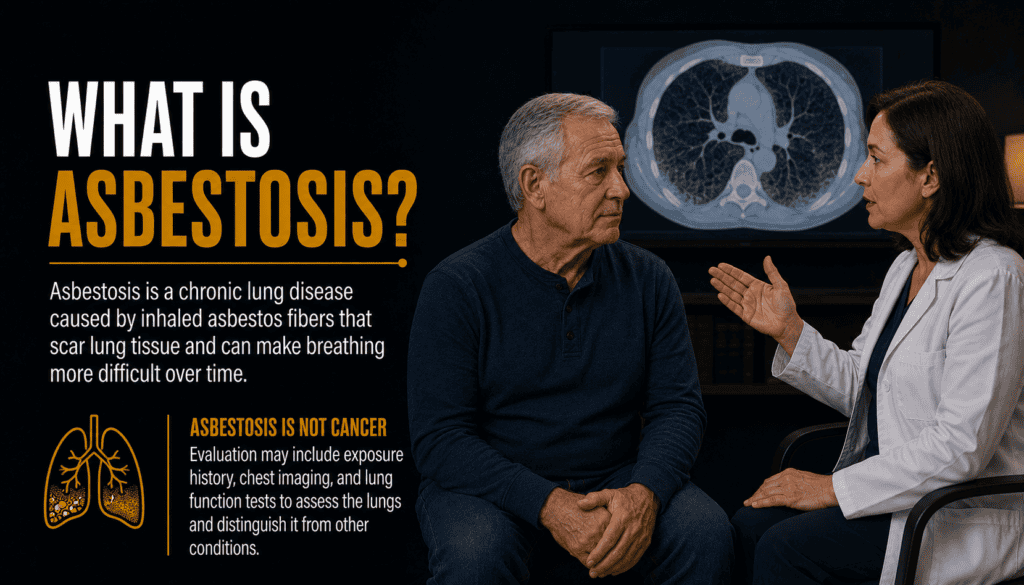
What Is Asbestosis? Causes, Symptoms, Diagnosis and Care
A practical guide to asbestos-related lung scarring and the next steps to discuss with a medical professional.
What is asbestosis?
Asbestosis is a chronic lung disease caused by breathing in asbestos fibers. Over time, the fibers can trigger inflammation and permanent scarring (fibrosis) in lung tissue. Scarring makes the lungs less flexible and can interfere with oxygen transfer. Asbestosis is not cancer, but a person with asbestos exposure may also be at risk for other asbestos-related conditions.
The disease typically follows substantial occupational exposure over years, although risk depends on exposure intensity and duration. Not everyone exposed to asbestos develops asbestosis. A diagnosis requires medical evaluation; symptoms or an exposure history alone are not enough.
| Key term | Plain-language meaning |
|---|---|
| Asbestos | A group of naturally occurring mineral fibers formerly used widely for heat resistance and insulation. |
| Fibrosis | Scarring of lung tissue that does not simply disappear when exposure ends. |
| Latency | Time between exposure and recognition of disease, often many years. |
| Pulmonologist | Physician specializing in lung conditions. |
Explore the broader related asbestos diseases overview to understand why the exact diagnosis matters.
How asbestos causes scarring and why symptoms can appear decades later
When asbestos-containing material is disturbed, tiny airborne fibers may be inhaled. Some fibers remain in the lungs and can provoke a prolonged tissue response. Repeated or heavy exposure increases risk. Historical work in insulation, shipyards, construction, industrial maintenance and similar settings may be relevant, but a job title alone cannot establish a diagnosis or prove a particular exposure.
Asbestosis may not be identified until decades after first exposure. Latency does not mean that new exposure is necessary for symptoms to emerge later. A clinician considers the timing, intensity and duration of exposure alongside examination and testing.
| Exposure-history detail | Why the clinician may ask |
|---|---|
| Work dates and tasks | Helps establish timing and potential intensity. |
| Materials handled | Identifies possible asbestos-containing products without assuming composition. |
| Dust controls and protective equipment | Adds context to likely airborne exposure. |
| Coworker or household exposure | May clarify other potential routes; household exposure does not by itself prove asbestosis. |
For more background, read why asbestos-related disease may appear long after exposure; the latency patterns and diseases are not identical.
Symptoms and signs that deserve medical attention
Symptoms can include gradually worsening shortness of breath, a persistent dry cough, reduced exercise tolerance and fatigue. A clinician may hear fine crackling sounds during examination; some people develop clubbing of the fingertips. These findings can have many causes, so they cannot confirm asbestosis on their own.
Seek emergency care for severe or sudden difficulty breathing, chest pain, fainting or blue/gray lips. Contact a clinician promptly about new or worsening breathlessness, fever, coughing blood, or a significant change from usual function. Do not assume a new symptom is simply part of known asbestosis.
| Observation | Suggested response |
|---|---|
| Gradual breathlessness | Arrange a clinical review and discuss lung function testing. |
| Sudden severe breathlessness or chest pain | Seek emergency evaluation. |
| Fever or new productive cough | Contact a clinician; infection and other causes need assessment. |
| Coughing blood | Seek prompt medical assessment; emergency evaluation may be needed depending on severity. |
Keep a short record of when symptoms began, what makes them worse, and how they affect walking or daily activities.
How doctors diagnose asbestosis
Diagnosis generally combines a credible exposure history, physical examination, lung-function testing and chest imaging. A chest X-ray may show changes, while high-resolution CT can better characterize patterns of fibrosis when clinically indicated. Pulmonary function tests may show a restrictive pattern or impaired gas transfer. Clinicians must consider other interstitial lung diseases and conditions that can produce similar findings.
No single blood test confirms asbestosis. Imaging findings alone also require clinical interpretation. A pulmonologist or occupational-medicine specialist can help evaluate uncertain cases; a biopsy is not routinely necessary simply to establish every suspected case.
| Assessment | What it contributes |
|---|---|
| Exposure and medical history | Establishes plausible exposure and competing explanations. |
| Physical examination | Checks breathing and other findings. |
| Chest imaging | Looks for lung scarring and related abnormalities. |
| Pulmonary function tests | Measures airflow, lung volumes and/or gas transfer. |
| Oxygen assessment | Determines whether oxygen levels fall at rest or with activity. |
Ask for copies of reports and the clinician’s exact diagnosis; a note describing pleural plaques is not the same as a diagnosis of asbestosis.
Treatment, symptom relief and living with asbestosis
Existing lung scarring generally cannot be reversed. Care focuses on preventing further exposure, assessing lung function, managing symptoms and addressing complications. Depending on individual findings, the care team may discuss smoking cessation, recommended vaccinations, pulmonary rehabilitation, prescribed oxygen for documented low oxygen, and treatment of coexisting conditions. Oxygen should be used only as prescribed; it is not appropriate for every person with breathlessness.
There is no universally established medication that cures asbestosis. Some patients with progressive fibrosis may need specialist assessment for other diagnoses or treatment approaches; medicines used for other fibrotic lung diseases should not be assumed to be approved or effective for asbestosis. Discuss any new medicine or supplement with the treating team.
| Care measure | Important qualification |
|---|---|
| Stop further asbestos exposure | Avoid disturbing suspected material; use qualified abatement professionals. |
| Pulmonary rehabilitation | May improve functional capacity when recommended and tailored to health status. |
| Supplemental oxygen | Only when assessment shows a need and a clinician prescribes it. |
| Smoking cessation | Reduces additional lung and cancer risks; it does not erase existing scarring. |
| Follow-up care | Schedule based on symptoms, tests and clinician recommendations. |
For symptom-management context, see breathing exercises and pulmonary rehabilitation; exercise plans must be individualized for the actual diagnosis.
Asbestosis versus mesothelioma, lung cancer and pleural plaques
Several conditions can follow asbestos exposure, but they affect different tissues and require different care. Asbestosis is diffuse scarring of lung tissue. Mesothelioma is a cancer of the lining around the lungs or other organs. Asbestos-related lung cancer arises within lung tissue and is not synonymous with asbestosis. Pleural plaques are localized areas of thickening in the lining of the lung and do not automatically indicate diffuse lung fibrosis.
| Condition | What it is | Key distinction |
|---|---|---|
| Asbestosis | Noncancerous fibrosis in lung tissue | Usually assessed with exposure history, imaging and lung function. |
| Pleural plaques | Localized pleural scarring | Exposure marker; not the same diagnosis as asbestosis. |
| Mesothelioma | Cancer of mesothelial lining | Requires cancer-specific diagnostic evaluation. |
| Lung cancer | Cancer arising in lung | Can occur with or without asbestosis; smoking and asbestos risks interact. |
Read what asbestos-related lung cancer is and the asbestos disease comparison. Ask your doctor which condition is actually documented in your records.
Preventing further exposure and documenting past exposure
Avoid cutting, sanding, drilling or removing suspected asbestos-containing materials yourself. Material that is intact and undisturbed may be managed differently from damaged material; obtain advice from appropriately licensed professionals and follow applicable local requirements. Respirators and protective procedures for occupational work require a formal safety program, not improvised household equipment.
If exposure may have occurred at work, write down job sites, employers, tasks, dates and possible materials while the details are available. Keep employment records and medical reports together. Exposure documentation may help a medical evaluation and may be relevant to benefits or legal questions, but does not establish disease or entitlement on its own.
| Record | Useful details |
|---|---|
| Employment history | Employer, job title, site and dates. |
| Work activities | Specific tasks and dust-producing circumstances. |
| Medical records | Imaging, pulmonary tests and diagnosis notes. |
| Questions for specialists | Uncertainty about exposure, alternative diagnoses and monitoring. |
For environmental and occupational safety information, consult the U.S. Environmental Protection Agency asbestos resources and NIOSH asbestos information.
A practical care plan and questions for your doctor
An individual care plan should reflect symptoms, oxygen assessment, other health conditions, activity goals and the patient’s preferences. Ask whether a pulmonologist or occupational-medicine specialist should review the case, which test results support the diagnosis, and what changes should prompt a call before the next visit.
Family members can help track appointments and symptom changes while respecting the patient’s choices. If walking, household tasks or transportation are becoming difficult, ask the care team about rehabilitation, social work and appropriate support services. Avoid buying oxygen equipment or beginning strenuous exercise without clinical guidance.
| At the next appointment | Write down the answer |
|---|---|
| What findings support asbestosis rather than another lung disease? | Diagnosis and differential diagnosis. |
| Which tests should be repeated, and when? | Personalized follow-up schedule. |
| Do I need oxygen testing during activity or sleep? | Clinical indication and next steps. |
| Which symptoms require urgent evaluation? | Specific escalation plan. |
| Would pulmonary rehabilitation help me? | Referral and activity limits. |
Need help now? Call 800.291.0963 / Chat 24/7 / Submit Your Case.
Frequently asked questions about asbestosis
Is asbestosis a type of cancer?
No. Asbestosis is noncancerous scarring of lung tissue. Asbestos exposure can also increase the risk of certain cancers, which require separate evaluation.
Can asbestosis be cured?
Existing fibrosis generally cannot be reversed. Treatment aims to reduce additional risks, manage symptoms and address complications.
How long after asbestos exposure can asbestosis appear?
It often becomes apparent many years or decades after exposure. Timing varies, and a clinician must evaluate the full history and test findings.
Can one exposure cause asbestosis?
Asbestosis is classically associated with substantial cumulative exposure, often occupational. A single reported event cannot establish whether someone has the disease; discuss the specific circumstances with a specialist.
Does a chest X-ray prove asbestosis?
No. Imaging is interpreted with exposure history, examination and often pulmonary function testing; other diseases may look similar.
Is asbestosis the same as pleural plaques?
No. Pleural plaques affect the lining of the lung; asbestosis is fibrosis of lung tissue.
Does everyone with asbestosis need oxygen?
No. Oxygen is prescribed when clinical testing shows a need, not solely because someone has a diagnosis or feels breathless.
What should I do if breathing suddenly worsens?
Seek emergency medical care for sudden severe breathlessness, chest pain, fainting or blue/gray lips. Other new or worsening symptoms warrant prompt clinician assessment.
Medical and public-health sources
These resources provide background information; they do not replace evaluation by a qualified clinician. Check each agency for updates.
Get help with asbestos-related disease questions
Call 800.291.0963. Live chat is available 24/7, 365 days a year. Submit Your Case to discuss available next steps. Contacting us does not guarantee a diagnosis, legal claim or compensation.
⚕️ Legal & Medical Information Disclaimer
This page is general information, not medical or legal advice. Consult a qualified clinician about symptoms, testing and treatment, and a qualified attorney about legal rights or deadlines.