Risks of Developing Mesothelioma
Who may be at higher risk and how asbestos exposure history matters
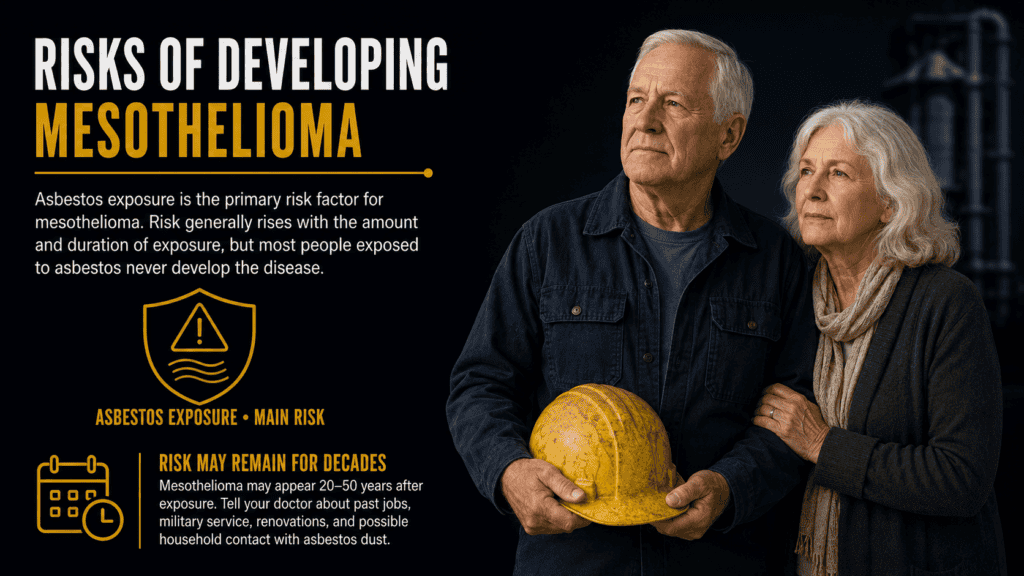
Asbestos exposure is the leading risk factor for mesothelioma, particularly pleural mesothelioma. Risk is generally greater after heavier, longer, or repeated exposure, but no exposure history can predict with certainty who will develop the disease. Most people exposed to asbestos do not develop mesothelioma.
Work history, secondhand exposure, disturbed asbestos in older buildings, environmental contact, age, genetics, and prior radiation may all be relevant. Because mesothelioma often appears decades after exposure, understanding past jobs, residences, military service, and family occupations can help patients and clinicians evaluate risk.
Understanding Mesothelioma Risk
A risk factor is something associated with a greater chance of developing a disease. It is not a diagnosis or a prediction. Some people with substantial asbestos exposure never develop mesothelioma, while some patients cannot identify a known exposure.
Risk assessments are based on patterns observed in groups, not a precise calculator for an individual. A clinician considers the type and intensity of exposure, how long it lasted, the time since first exposure, age, health history, and possible inherited susceptibility.
| Risk category | Examples | What it means |
|---|---|---|
| Established primary risk | Inhaling or swallowing asbestos fibers | Asbestos exposure causes most mesotheliomas |
| Exposure-related modifiers | Greater concentration, repeated contact, longer duration, earlier first exposure | These patterns can increase cumulative risk but do not predict an outcome |
| Personal susceptibility | Older age, rare inherited BAP1 variant | May affect vulnerability or reflect the long time needed for disease to develop |
| Rare associated factors | High-dose radiation to the chest or abdomen; erionite exposure | Associated with a small minority of cases |
Asbestos Is the Primary Risk Factor
Asbestos is a group of naturally occurring minerals made of durable microscopic fibers. When asbestos-containing products are damaged, cut, drilled, sanded, removed, or demolished, fibers may enter the air. Inhaled fibers can lodge in lung tissue and reach the pleura, while swallowed fibers may reach the abdominal lining.
Fibers retained in tissue can contribute to inflammation, scarring, oxidative stress, and DNA damage over time. These processes may lead to uncontrolled growth of mesothelial cells. Learn more about mesothelioma causes and the differences between pleural and peritoneal mesothelioma.
Occupational and Military Risk
Historically, the highest exposures occurred among people who manufactured asbestos products or worked where insulation, gaskets, cement products, friction materials, fireproofing, and other asbestos-containing materials were installed or disturbed. Bystanders working nearby could also inhale fibers.
| Work setting or role | Potential asbestos source | Typical exposure activity |
|---|---|---|
| Construction and demolition | Insulation, wallboard systems, flooring, roofing, cement products | Cutting, sanding, renovation, removal, or demolition |
| Shipyards and maritime work | Pipe insulation, boilers, turbines, pumps, valves, gaskets | Installation, maintenance, overhaul, and repair in confined areas |
| Industrial plants and utilities | High-temperature insulation, packing, gaskets, refractory materials | Maintenance and repair of machinery, piping, and furnaces |
| Automotive and railroad work | Brakes, clutches, gaskets, insulation | Grinding, blowing out, replacing, or repairing friction parts |
| Military service | Ships, bases, vehicles, aircraft, barracks, and mechanical systems | Construction, maintenance, repair, damage control, and equipment work |
Explore information about high-risk jobs, asbestos exposure at job sites, and military and veteran exposure.
Household, Building, and Environmental Risk
Mesothelioma risk is not limited to people who handled asbestos at work. Before modern controls, workers could carry fibers home on clothing, shoes, hair, tools, or vehicles. Family members may have been exposed while laundering dusty work clothes or through contaminated household areas.
Older homes, schools, public buildings, and workplaces may still contain asbestos. Material that is intact and left undisturbed generally presents less exposure risk than material that is damaged, deteriorating, or improperly removed. Naturally occurring asbestos deposits, mines, factories, and contaminated waste sites can also create community exposure.
| Pathway | Who may be affected | Risk-reduction principle |
|---|---|---|
| Take-home exposure | Spouses, children, and other household members | Use workplace decontamination and laundering controls; do not bring dusty clothing home |
| Older building materials | Residents, students, maintenance workers, renovators | Do not drill, sand, cut, scrape, or remove suspect material without professional evaluation |
| Environmental exposure | People near natural deposits, mines, plants, or contaminated sites | Follow health-agency advisories and avoid creating dust in known contaminated areas |
See detailed guidance about secondhand asbestos exposure and asbestos exposure in buildings.
Exposure Level, Duration, and Latency
Risk is loosely related to cumulative exposure—the combination of fiber concentration, frequency, and duration. People exposed at higher levels or for longer periods are generally more likely to develop mesothelioma. Fiber type, work practices, ventilation, protective equipment, and individual biology may also influence risk.
Mesothelioma usually has a long latency period. The American Cancer Society reports that asbestos-related mesothelioma is commonly diagnosed 20 to 50 years after first exposure. Risk does not simply disappear when exposure stops, which is why jobs or residences from decades ago may still matter.
Do You Have a Past Asbestos Exposure?
We can help you organize a work, military, household, and residential exposure history and identify useful resources.
Call 800.291.0963 Submit Your CaseLive chat is available 24/7/365.
Age, Sex, and Genetic Susceptibility
Mesothelioma is diagnosed more often in older adults, largely because the disease takes decades to develop after exposure. It has also been diagnosed more often in men, a pattern believed to reflect historically higher occupational asbestos exposure among men rather than sex alone causing the disease.
Rare inherited harmful variants in the BAP1 gene can cause BAP1 tumor predisposition syndrome and increase susceptibility to mesothelioma and several other cancers. Not everyone with a BAP1 variant develops cancer, and most mesotheliomas are not caused by an inherited syndrome.
| Factor | How it relates to risk | Important limitation |
|---|---|---|
| Older age | Allows time for a long-latency disease to develop | Mesothelioma can occur in younger people, although it is uncommon |
| Male sex | Historically associated with greater workplace exposure | Women can also develop mesothelioma through occupational, household, or environmental exposure |
| Inherited BAP1 variant | Raises susceptibility to mesothelioma and other tumors | It is rare and does not guarantee cancer |
| Tumor gene changes | Changes involving BAP1, CDKN2A, NF2, and other genes may be found in cancer cells | A tumor-only change is not necessarily inherited |
Radiation, Erionite, and Other Factors
Mesothelioma has occurred rarely in people who previously received high-dose radiation therapy to the chest or abdomen. This association does not mean radiation will cause mesothelioma, and patients should not avoid medically necessary treatment because of this uncommon possible late effect.
Erionite is a naturally occurring fibrous mineral chemically related to asbestos. Exposure has been associated with mesothelioma in certain areas. The mineral is not one of the six regulated asbestos minerals, but airborne erionite fibers can present a serious inhalation hazard.
Older studies raised questions about simian virus 40 (SV40), which contaminated some polio vaccines made from 1955 to 1963. Larger studies have not found an increased mesothelioma risk among people who received those vaccines. Smoking is also not an established cause of mesothelioma, although smoking combined with asbestos exposure greatly increases lung-cancer risk.
Reducing Risk and Planning Medical Follow-Up
The most effective prevention step is limiting further asbestos exposure. Follow workplace safety procedures, use required protective equipment, and never disturb suspect material without qualified evaluation. Homeowners should use trained asbestos inspectors and licensed contractors when testing or removal is appropriate.
There is no standard population-wide screening program proven to detect mesothelioma early. People with meaningful exposure histories should tell their healthcare providers and ask what follow-up is appropriate for their circumstances. New or persistent chest pain, shortness of breath, cough, abdominal swelling, abdominal pain, unexplained weight loss, or fatigue deserves medical evaluation.
Prepare an Exposure History
- List every employer, trade, job site, military assignment, and approximate date.
- Record products, machinery, insulation, dust-producing tasks, and nearby workers.
- Include older homes, renovations, environmental sources, and household members’ jobs.
- Share this history with your clinician and retain a copy with your records.
Review the mesothelioma symptoms guide, diagnosis overview, and information about preparing for a screening appointment.
Authoritative Sources
- National Cancer Institute: Asbestos Exposure and Cancer Risk
- Centers for Disease Control and Prevention: Mesothelioma Basics
- American Cancer Society: Causes, Risk Factors, and Prevention of Mesothelioma
- Agency for Toxic Substances and Disease Registry: About Asbestos
- MedlinePlus Genetics: BAP1 Tumor Predisposition Syndrome
- U.S. Environmental Protection Agency: Learn About Asbestos
Frequently Asked Questions
Who is most at risk of developing mesothelioma?
People with substantial occupational asbestos exposure are generally at greatest risk, including some shipyard, construction, industrial, insulation, automotive, railroad, and military workers. Household and environmental exposures can also matter.
Does everyone exposed to asbestos develop mesothelioma?
No. Most exposed people do not develop mesothelioma. Exposure level, duration, latency, fiber characteristics, age, genetics, and other factors may influence individual risk.
Can one-time asbestos exposure cause mesothelioma?
A single event can release asbestos fibers, but no one can calculate a person’s outcome from that event alone. Risk generally rises with greater cumulative exposure.
Can family members of asbestos workers be at risk?
Yes. Fibers historically carried home on work clothes, shoes, hair, tools, or vehicles could expose spouses, children, and other household members.
Does the risk disappear after asbestos exposure ends?
No. Mesothelioma may develop decades after the last exposure, so a remote work or household history can remain medically relevant.
Does smoking increase mesothelioma risk?
Smoking is not an established cause of mesothelioma. However, smoking and asbestos exposure together greatly increase the risk of lung cancer.
Is mesothelioma hereditary?
Most cases are not inherited. A rare harmful BAP1 variant can increase susceptibility, especially in some families with patterns of mesothelioma or other BAP1-associated tumors.
Should people exposed to asbestos be screened?
There is no universal mesothelioma screening schedule for everyone exposed. Discuss the intensity and timing of exposure with a clinician, who can recommend appropriate follow-up based on personal risk and symptoms.
Get Help Reviewing Mesothelioma Risk
Our team can help you identify possible exposure sources, organize your history, and connect with medical and support resources.
Call 800.291.0963 Submit Your CaseLive chat is available 24/7/365.
Medical disclaimer: This information is educational and is not a substitute for advice, diagnosis, screening recommendations, or treatment from a qualified healthcare professional.