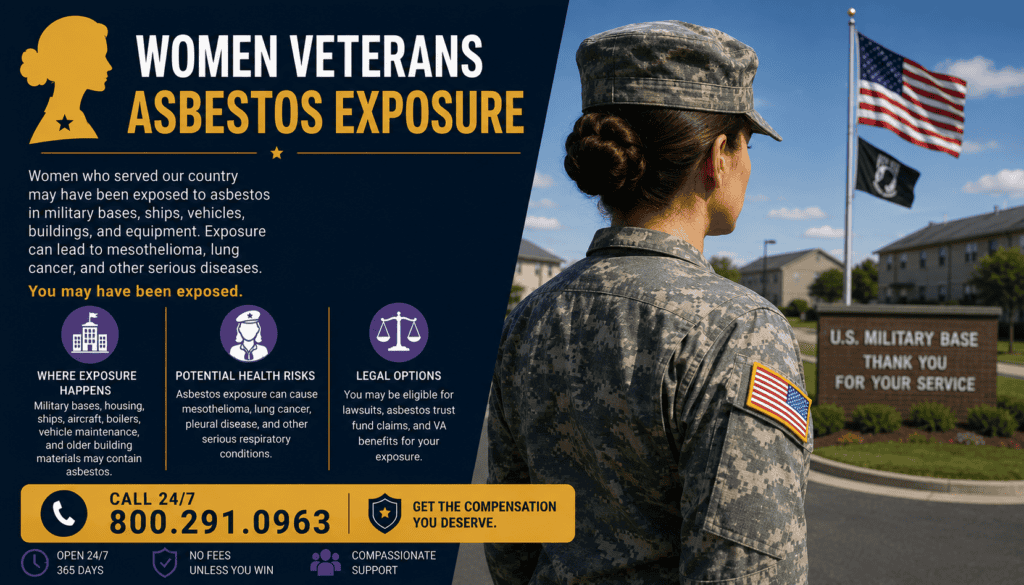
Women Veterans Asbestos Exposure
Women have served throughout U.S. military history in nursing, administration, communications, aviation, logistics, maintenance, construction, technical specialties and many other roles. Depending on the era, assignment and duties, women veterans may have worked in older military buildings, ships, shipyards, aircraft facilities, maintenance areas or around products that historically contained asbestos.
Asbestos exposure is determined by the work, location, material and time period—not by gender. VA recognizes asbestos as a military occupational hazard and evaluates asbestos-related disability claims case by case. A strong exposure history identifies where a woman served, what she did, which buildings or equipment she worked around and whether records document asbestos-containing materials that could have been disturbed.
This page is the Women Veterans resource within the U.S. Military & Veterans Asbestos Exposure silo.
🎖️ Women Veterans & Military Asbestos Exposure
VA identifies military asbestos exposure with occupations and activities such as shipyard work, insulation work, demolition, carpentry, construction and manufacturing or installation of flooring and roofing. VA also identifies historical asbestos use in brakes, gaskets, valves, cements, adhesives, floor coverings and pipe lagging.
Women veterans who performed these duties—or who worked in facilities where documented asbestos-containing material was disturbed—may have had an exposure opportunity. But service in an older building, ship or unit alone does not prove asbestos exposure.
📜 Women’s Military Service & Exposure Eras
Women’s military roles expanded substantially during the twentieth century. The Army Nurse Corps was established in 1901. During World War II, women served through organizations such as the Women’s Army Corps, Women Airforce Service Pilots and women’s reserve components of other services. The Army Center of Military History reports that about 210,000 women served in the WAC at home and abroad during World War II.
The Women’s Armed Services Integration Act of 1948 established a permanent place for women in the Regular Army and Army Reserve. The separate Women’s Army Corps continued until 1978, when its members were integrated into other Army branches. As career opportunities expanded, women served in a broader range of occupations and installations.
This history matters to asbestos research because the veteran’s service era helps narrow which buildings, ships, aircraft, equipment and products were in use during her assignment.
🏢 Jobs, Bases, Ships, Aircraft & Other Exposure Settings
| Setting | What to investigate | Related resource |
|---|---|---|
| Military bases | Older buildings, utility systems, maintenance and renovation | Military Bases Asbestos Exposure |
| Housing/support buildings | Flooring, roofing, pipe insulation and renovation records | Military Housing Exposure for Service Members |
| Ships/shipyards | Below-deck systems, piping, boilers, repair and overhaul | Military Ships Asbestos Exposure |
| Aircraft/aviation facilities | Historical friction components, gaskets, insulation and maintenance spaces | Military Aircraft Asbestos Exposure |
| Buildings/facilities | Thermal insulation, flooring, ceilings and mechanical systems | Military Buildings & Facilities Asbestos Exposure |
| Technical/maintenance work | Equipment components, repair tasks and disturbed materials | Military Occupations Asbestos Exposure |
VA’s current guidance specifically notes that veterans who worked in shipyards, construction, carpentry, demolition or with products such as flooring, roofing, cement sheet, pipes, insulation, clutch facings and brake linings may warrant evaluation for asbestos-related health conditions.
👩✈️ WAC, WAF, WAVES, SPARS, Marine Women & WASP
Women served through different organizations depending on branch and era. These pages help narrow exposure research to the correct historical group:
- Women’s Army Corps (WACs) Asbestos Exposure — Army women whose service can be researched by assignment, occupation and installation.
- Women in the Air Force (WAF) Asbestos Exposure — Air Force-era assignments, bases and technical roles.
- WAVES — Women Accepted for Volunteer Emergency Service — women’s Navy service and naval facilities.
- SPARS — U.S. Coast Guard Women’s Reserve Asbestos Exposure — Coast Guard women’s wartime service.
- Marine Corps Women’s Reserves Asbestos Exposure — women serving in Marine Corps assignments.
- Women Airforce Service Pilots (WASP) Asbestos Exposure — aviation-centered historical research.
These organizational labels should be used according to the veteran’s actual service era. For example, the Army’s separate WAC ended in 1978; later Army women served within the integrated force.
📂 Documenting a Woman Veteran’s Military Asbestos Exposure
VA states that an asbestos disability claim requires medical records identifying the health condition, service records listing the veteran’s job or specialty and medical evidence connecting military asbestos contact with the condition.
Start with Military Records & Documentation for Asbestos Exposure, Military Service Records & Exposure and How Veterans Prove Asbestos Exposure in the Military.
| Evidence | What it can help establish |
|---|---|
| DD-214/personnel file | Branch, dates, specialty and service history |
| Duty assignments | Base, ship, unit or facility |
| Training/qualification records | Actual technical or occupational duties |
| Building/ship records | Materials and systems at the location |
| Maintenance/work orders | Repair or disturbance activity |
| Procurement/parts records | Products, components and manufacturers |
| Buddy/coworker statements | Firsthand corroboration of work and conditions |
| Medical records | Diagnosis and relevant exposure history |
Do not assume a veteran was exposed simply because a building or product was old. Evidence should connect the veteran to the specific work area and documented asbestos-containing material whenever possible.
🩺 Health Care, Mesothelioma & Women Veterans
VA states that symptoms of asbestos-related disease may not appear until 20 to 50 years after exposure. A long interval between military service and diagnosis therefore does not, by itself, rule out a historical exposure concern.
Women veterans concerned about asbestos exposure can discuss their service history with a health-care provider or a VA Environmental Health Coordinator. VA Women Veterans Health Care also provides women veterans with access to primary care, specialty services and information about military environmental exposures.
For broader veteran treatment resources, see Veterans Mesothelioma Treatment. A diagnosis does not identify the exposure source or responsible company; those questions require separate historical evidence.
🇺🇸 VA Benefits for Women Veterans With Asbestos-Related Conditions
VA’s asbestos compensation requirements apply to eligible veterans regardless of sex. VA states that a claimant must have a health condition caused by asbestos exposure and must have had contact with asbestos during military service.
VA requires medical records, service records and a medical statement connecting military asbestos exposure to the health condition. The Veterans Benefits Administration also notes that military occupational specialty and duty location can help establish in-service exposure.
VA Women Veterans Health Care maintains women-specific resources, including Women Veterans Program Managers and the Women Veterans Call Center, for veterans seeking help navigating VA health care and benefits.
⚖️ Asbestos Trust Funds & Legal Options for Women Veterans
VA disability compensation and private asbestos claims are separate systems. A woman veteran may have a military exposure history, a civilian occupational exposure history, or both. Each exposure source should be documented separately.
If military records identify a private asbestos manufacturer or supplier that later established a bankruptcy trust, review What Are Asbestos Trust Funds?. Military service alone does not establish eligibility for a particular trust.
Veterans considering a private case review can also read Free Consultation: What to Expect.
❓ Frequently Asked Questions
Could women veterans have been exposed to asbestos during military service?
Yes, depending on their duties, location and era. VA recognizes asbestos exposure in military occupations and products, but each veteran’s exposure history must be evaluated individually.
Were women limited to administrative jobs?
No. Women have served in nursing, communications, aviation, logistics, technical specialties and many other military roles, with opportunities expanding significantly over time.
Could women working in military buildings have encountered asbestos?
Potentially. Older buildings may have contained asbestos materials, but exposure requires evidence that asbestos-containing material was present and that the veteran had a relevant opportunity for contact, especially when material was disturbed.
Could Navy women have been exposed aboard ships or in shipyards?
Potentially. VA identifies older Navy ships and shipyards as historical asbestos settings. The veteran’s ship, assignment, work area and duties should be documented.
What was the Women’s Army Corps?
The WAC was the Army organization through which many women served beginning during World War II. Women gained Regular Army and Reserve status under the Women’s Armed Services Integration Act of 1948, and the separate WAC was discontinued in 1978.
Can women veterans receive VA asbestos disability compensation?
Potentially. VA’s asbestos compensation criteria require a qualifying health condition, military asbestos exposure and medical evidence connecting the two.
What records are most useful?
Personnel records, duty assignments, occupational records, ship or facility records, maintenance files, product records, coworker statements and medical documentation can all help reconstruct exposure.
Can a woman veteran have both military and civilian asbestos exposure?
Yes. Military and post-service employment histories should be documented separately so each potential source can be evaluated.
Can family or take-home exposure matter?
Potentially. Secondary exposure is a distinct exposure pathway and should be documented separately from the woman veteran’s own military occupational exposure.
📞 Review Your Military Asbestos Exposure History
If you or a family member has been diagnosed with mesothelioma after military service, gather the branch, service dates, duty stations, occupational specialty, units, ships or aircraft, work areas, maintenance duties, remembered products, coworkers and medical records.
Call 800.291.0963 for a no-obligation case evaluation. Talk to a real person 24/7, 365 days a year.
Many mesothelioma law firms handle qualifying civil cases on a contingency-fee basis; confirm fees and expenses with the firm you retain.
📝 Summary
Women veterans have served across many branches, eras and occupations in locations where asbestos-containing materials may historically have been present. Exposure should not be assumed from gender, branch or service alone. The strongest history connects the veteran’s actual assignment and duties to a documented asbestos-containing material, product or work activity through service records, facility or ship records, technical documents, coworker evidence and medical documentation.
🔗 Confirmed Sources
- U.S. Department of Veterans Affairs — Veterans Asbestos Exposure
- VA Public Health — Asbestos
- Veterans Benefits Administration — Asbestos Exposure Compensation
- VA Veterans Health Library — Veteran Exposure to Asbestos
- VA Women Veterans Health Care
- VA — Overview of Health Services for Women Veterans
- U.S. Army Center of Military History — World War II Women in the Army
- U.S. Army Center of Military History — A Permanent Presence
Disclaimer: General information only—not legal or medical advice. This website is not a law firm. Exposure, VA eligibility, liability and deadlines vary by case and jurisdiction. Do not disturb suspected asbestos. Past results do not guarantee future outcomes.