🏭 Alcoa Corporation Asbestos Exposure
Aluminum Facilities, Maintenance Work and Corporate Identity
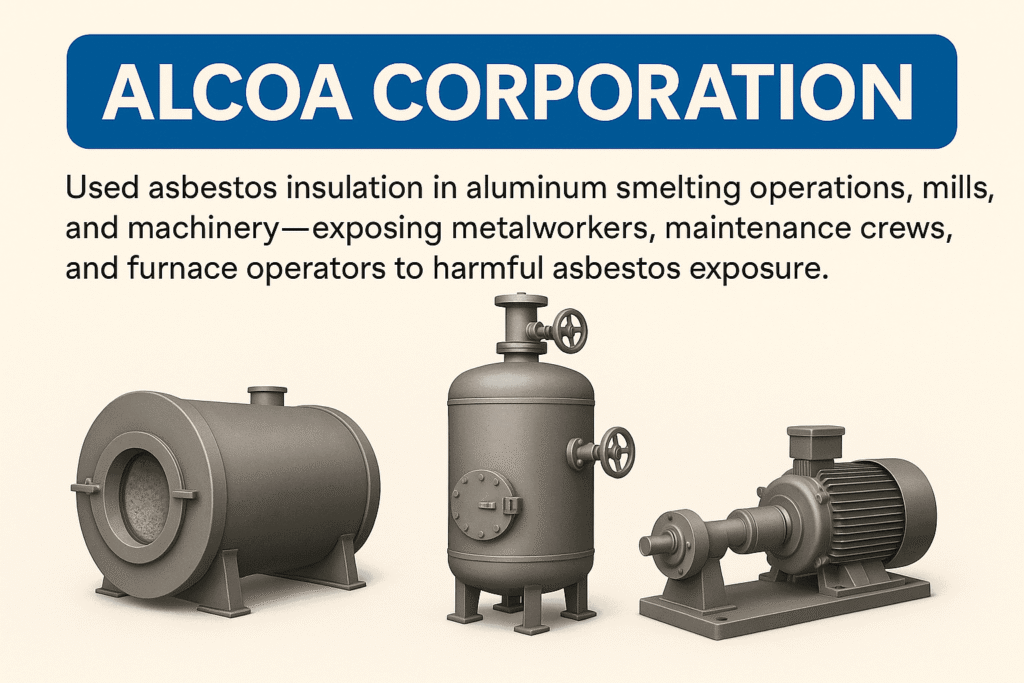
Alcoa Corporation, one of the world’s largest aluminum producers, used asbestos extensively throughout its smelting operations, rolling mills, foundries, and powerhouses for much of the 20th century. Asbestos was incorporated into insulation, fireproofing materials, gaskets, seals, and protective gear to control high temperatures and prevent fires. Unfortunately, these practices exposed metalworkers, maintenance technicians, furnace crews, and utility staff to dangerous asbestos fibers — leading to thousands of cases of mesothelioma, asbestos-related lung cancer, and asbestosis decades later.
An Alcoa asbestos investigation should focus on the exact smelter, refinery or fabrication site and a documented asbestos-containing material. Alcoa Corporation became independent in 2016; older records may name Alcoa Inc. or other entities. The modern name should not be used to assign every historical product or liability automatically.
🏢 Company History and Identity
Alcoa’s investor materials date Alcoa Corporation’s separation from Alcoa Inc. to November 1, 2016. The former Alcoa Inc. was renamed Arconic at that time. This corporate history matters when an old employment record and a current company name appear in the same claim.
Aluminum operations can include hot-process equipment, electrical systems, boilers and maintenance shops. Historical asbestos was used in some industrial insulation and heat-resistant materials generally, but the reviewed corporate record does not identify every material at a particular Alcoa facility.
| Topic | Documented point |
|---|---|
| 2016 separation | Alcoa Corporation became independent November 1, 2016. |
| Prior company | Alcoa Inc., renamed Arconic at separation. |
| Individual exposure | Requires a dated facility and material record. |
⚙️ Products and Material Questions
Identify the exact material, maker, facility and period. A corporate name or industry category alone does not establish asbestos exposure in every operation.
| Item | Investigation |
|---|---|
| Potline or furnace-area insulation | Confirm material and project period. |
| Boiler and pipe covering | Identify installer and manufacturer. |
| Gaskets and packing | Original part versus later replacement. |
| Aluminum products | Do not infer asbestos from aluminum itself. |
For related context, see Metals, Mining and Steel Companies. A related page is not evidence of a shared product or supplier.
👷 Worker Types and Exposure Settings
These roles are investigation leads, not a count of exposed people. Actual work, source material, dates and proximity need individual documentation.
| Role | What to verify |
|---|---|
| Smelter operators | Tasks near documented heated materials. |
| Potline and furnace mechanics | Repair or replacement of identified insulation. |
| Pipefitters and boiler crews | Disturbance of covering and gaskets. |
| Electricians and contractors | Specific system and dust source. |
🌫️ Possible Fiber Exposure
Asbestos fibers may become airborne when a confirmed material is mined, processed, cut, removed or damaged. An employee’s presence at a plant does not identify which material was disturbed. Distinguish direct handling, nearby repair work and unrelated products at the same site.
| Question | Useful evidence |
|---|---|
| Which material? | Specification, label, ore record, survey or suitable testing. |
| Which period? | Employment, purchasing or work-order date. |
| What activity? | Mining, processing, installation, repair or cleanup. |
| Who was present? | Crew, department and witness account. |
⚖️ Lawsuits and Claim Boundaries
I did not verify a company-specific asbestos verdict or Alcoa Corporation asbestos trust from the reviewed primary sources. Corporate separation documents establish identity and timing, not a finding that a given worker handled asbestos.
An individual lawsuit or trust claim against a separate insulation maker could depend on site purchasing and maintenance records. Counsel should review succession, employment, product identification and applicable deadlines rather than presuming the current corporation bears every historical obligation.
Read the Alcoa investor FAQs — 2016 separation for the documented scope. A bankruptcy, accounting reserve or filed lawsuit is not an individual compensation guarantee.
🗂️ Records to Gather
Gather facility and department names, employment years, equipment and outage records, product specifications, contractor invoices, coworkers and medical documentation.
Record whether the material was installed before or after a corporate transition and whether the supplier was independent of Alcoa.
| Category | Examples | Purpose |
|---|---|---|
| Work or site | Employer, mine, mill, ship, department | Places the worker. |
| Material | Product, equipment, supplier, survey | Identifies the source. |
| Contact | Task, frequency, witness, photograph | Describes disturbance and proximity. |
| Medical | Pathology, imaging, clinical history | Documents diagnosis. |
🩺 Health Risks and Medical Follow-Up
The National Cancer Institute links asbestos exposure with mesothelioma, lung cancer and other diseases. A company listing cannot diagnose a person or establish the cause of an individual condition. Discuss a dated work and exposure history with a qualified clinician.
Preserve records and avoid disturbing suspect material simply to investigate it. Qualified professionals can advise on assessment.
❓ Frequently Asked Questions
When did Alcoa Corporation become independent?
November 1, 2016.
What was the older corporate name?
Alcoa Inc.; it was renamed Arconic at separation.
Does aluminum itself contain asbestos?
The aluminum product name alone does not establish asbestos exposure.
Which workers may investigate?
People with documented dusty repair or insulation tasks.
Are all Alcoa facilities alike?
No. Site and era need separate records.
Is there an Alcoa-specific asbestos trust?
None was verified from reviewed primary sources.
Does a nameplate identify insulation maker?
No. Check invoices and project files.
What records matter?
Facility, equipment, task, material and medical history.
🔗 Related Company Pages
📚 Confirmed Primary Sources
- Alcoa investor FAQs — 2016 separation
- Alcoa — separation announcement
- EPA — Learn About Asbestos
- National Cancer Institute — Asbestos
📞 Submit Your Case
If you have an asbestos-related diagnosis and relevant work or product history, gather the records above for an individual review.
Call 800.291.0963. Chat is available 24/7/365. Submit Your Case.
General information only; not medical or legal advice. Exposure and eligibility depend on individual evidence and applicable law.