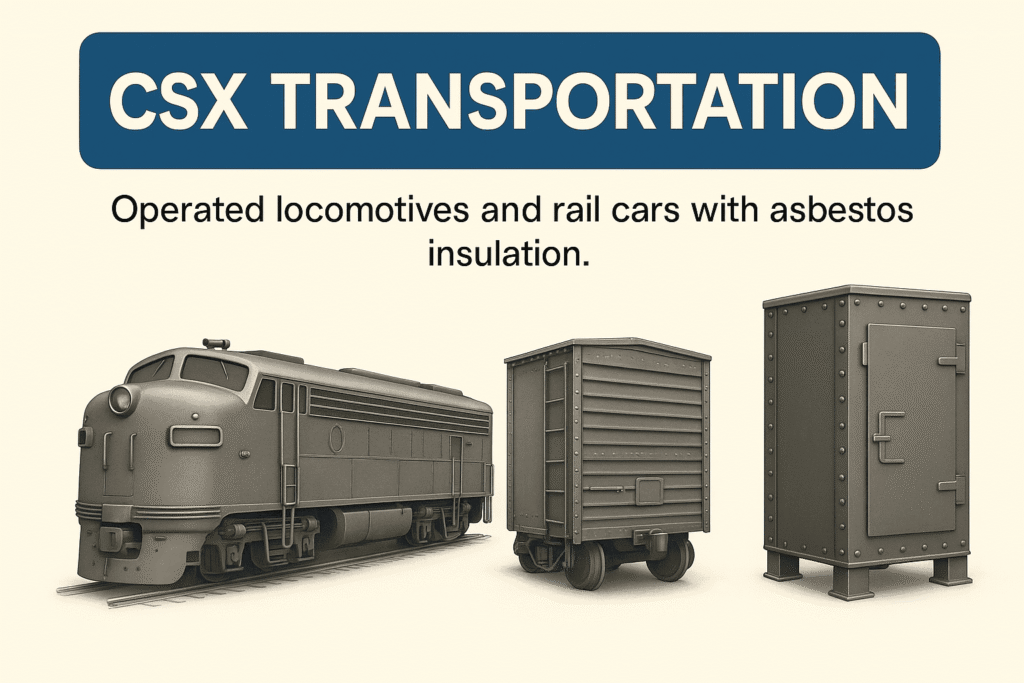
CSX Transportation Asbestos Exposure
CSX Transportation, Inc. operates a major eastern U.S. freight railroad. Its present system incorporates routes and operations associated with numerous predecessor railroads. Historical railroad work may have involved asbestos-containing insulation, gaskets, packing, friction components and building materials during equipment maintenance, facility repair or demolition.
CSX Corporation’s March 31, 2026 SEC filing expressly states that occupational reserves include liabilities arising from allegations of past asbestos exposure. That company disclosure confirms a documented claims context, but it does not prove exposure, disease or compensation for any individual. A supported case still requires evidence of the worker, employer, location, dates, duties, material and manner of disturbance.
🏢 CSX Transportation Company History
CSX Corporation was formed in 1980 through the combination of the Chessie System and Seaboard Coast Line Industries. The CSX Transportation name emerged during later consolidation of the rail subsidiaries. Present employment and property records may use CSX or CSXT, while older evidence may carry a predecessor railroad’s name.
| Period | Company development | Claim relevance |
|---|---|---|
| Before 1980 | Predecessor railroads operated routes, shops, yards and terminals later associated with CSX. | Older exposure records may not use the CSX name. |
| 1980 | Chessie System and Seaboard Coast Line Industries combined under CSX Corporation. | Corporate records must be matched to the employing railroad. |
| 1986 | CSX Transportation became the principal consolidated railroad identity. | Payroll and shop records increasingly use CSXT. |
| 1990s | Rail operations and predecessor records continued to be integrated. | Equipment may have remained in service through ownership changes. |
| 2026 | CSXT remains CSX Corporation’s principal railroad operating subsidiary. | Current corporate filings describe occupational claim reserves. |
| Name | Possible context | Accuracy point |
|---|---|---|
| CSX Corporation | Public parent company and SEC registrant. | Parent status is not the same as workplace employment. |
| CSX Transportation, Inc. | Principal railroad operating subsidiary, commonly CSXT. | Use the exact name shown on employment records. |
| Chessie System railroads | Predecessor eastern railroad operations. | Identify the specific carrier and work location. |
| Seaboard System predecessors | Southern and eastern railroad records. | Historical names can determine record custody. |
| Conrail-related operations | Routes and assets integrated into the CSX system. | Ownership date and assigned operation require verification. |
The current CSX network does not make every predecessor location a CSX exposure site. A chronology should show which legal entity employed the worker and who controlled the property or equipment during the relevant period.
🚂 Railroad Equipment and Historical Asbestos Materials
Asbestos was historically used because it resisted heat and corrosion. Federal health sources identify insulation, fireproofing, brakes and wallboard among commercial uses. In a railroad case, those broad categories must be connected to a specific locomotive, car, component, shop system or building material.
| Equipment or area | Potential historical material | Evidence to seek |
|---|---|---|
| Steam-era equipment | Boiler and pipe insulation, gaskets and valve packing. | Builder specifications, mechanical files and shop cards. |
| Diesel locomotives | Heat-resistant seals, gaskets, brake and electrical components. | Parts books, overhaul records and supplier invoices. |
| Passenger or maintenance cars | Pipe covering, flooring, panels and heat barriers. | Car diagrams, renovation files and material schedules. |
| Freight and work equipment | Brake or clutch materials and specialized seals. | Equipment number, manufacturer and repair history. |
| Shops and terminals | Boiler insulation, pipe covering, fireproofing and wall materials. | Facility plans, surveys and abatement documents. |
| Question | Why it matters |
|---|---|
| Was the equipment inherited from a predecessor? | The original purchasing record may use another railroad name. |
| What was the model, number or building? | A specific asset narrows the material search. |
| Who supplied the component? | The railroad and product manufacturer may be separate parties. |
| Was the part original or replaced? | Composition may change by date, batch or supplier. |
| Was asbestos confirmed? | Appearance alone cannot establish material content. |
Potential records include locomotive-maintenance manuals, bills of material, shop instructions, purchasing files, contractor documents, photographs and testimony from coworkers who handled the same components during the same period.
👷 CSX Workers and Job Sites
CSX’s SEC filing confirms occupational claims involving allegations of past asbestos exposure without identifying every craft, facility or product. Exposure review should focus on the work actually performed, nearby maintenance and the condition of suspected material.
| Worker or trade | Possible historical contact | Details to document |
|---|---|---|
| Machinist or diesel mechanic | Engines, brakes, gaskets, packing and insulated systems. | Shop, locomotive, component, tools and dates. |
| Boilermaker or pipefitter | Boilers, steam lines, valves and pipe insulation. | Repair type, shutdown and material condition. |
| Carman | Railcar brakes, undercarriages and interior materials. | Car series, assignment and maintenance procedure. |
| Electrician | Heat-resistant electrical parts or adjacent insulation. | Equipment, cabinet, panel and nearby trades. |
| Engineer or conductor | Operating equipment or working near running repairs. | Route, terminal, locomotive and observed disturbance. |
| Laborer or cleaner | Debris and dust from shop or building maintenance. | Source, cleanup method, frequency and ventilation. |
| Facilities employee | Pipe covering, boilers, wallboard or fireproofing. | Building, system, project and contractor. |
| Location type | Relevant activity | Useful identifiers |
|---|---|---|
| Locomotive shop or roundhouse | Inspection, overhaul and component replacement. | Railroad, city, department and bay. |
| Rail yard or engine terminal | Servicing, brake repair and running maintenance. | Yard, track, crew and shift. |
| Car shop | Brake, undercarriage and interior work. | Car type, repair program and work order. |
| Powerhouse or boiler room | Insulation, pump, valve and gasket service. | Equipment tag and maintenance history. |
| Depot, office or warehouse | Heating work, renovation or demolition. | Address, project dates and contractor. |
Need help now? Call 800.291.0963
Live chat is available 24/7, 365 days a year.
Submit Your Case
🌫️ How CSX Asbestos Exposure May Have Occurred
EPA explains that asbestos fibers may be released when asbestos-containing material is damaged or disturbed. The relevant question is not simply whether asbestos existed somewhere on a railroad. Evidence should show how qualifying material became airborne near the claimant.
| Activity | Possible release mechanism | Proof focus |
|---|---|---|
| Removing insulation | Aged pipe or equipment covering could crumble during repair. | Material, system, condition and frequency. |
| Servicing brakes | Removal or cleaning could disturb qualifying friction material. | Brake type, supplier and work method. |
| Scraping gaskets | Residue could create dust during flange preparation. | Component, brand, tools and repetition. |
| Replacing packing | Pulling or cutting old sealing material could release fibers. | Valve, pump, product and dates. |
| Renovating facilities | Demolition could disturb insulation or wall materials. | Building, project, survey and contractor. |
| Dry cleanup | Sweeping or compressed air could resuspend settled dust. | Dust source, ventilation and routine. |
| Pathway | Illustrative history | Evidence needed |
|---|---|---|
| Direct occupational | A mechanic personally removes a qualifying gasket. | Product, task, frequency and duration. |
| Occupational bystander | An employee works beside insulation removal. | Distance, overlap and shared airspace. |
| Area contamination | Shop dust remains after equipment overhaul. | Source activity and housekeeping practice. |
| Household transfer | Dust travels home on clothing or belongings. | Source worker, residence and laundering history. |
Suspected railroad material should not be cut, scraped or sampled personally. Historical documents, qualified inspection and corroborating witnesses offer safer ways to investigate composition and exposure.
⚖️ CSX Claims, FELA and Compensation
CSX’s 2026 SEC filing states that work-related injuries for CSXT employees are primarily subject to the Federal Employers’ Liability Act. FELA is a fault-based federal remedy for covered railroad employees, not automatic workers’ compensation. A claimant must address employment, negligence, causation, injury and applicable deadlines.
| Route | Who may investigate it | Important limitation |
|---|---|---|
| FELA claim | A qualifying railroad employee alleging employer negligence. | Coverage and proof depend on individual facts. |
| Product-liability claim | A person tied to an identifiable asbestos product. | Manufacturer proof and state law control. |
| Premises claim | A contractor or visitor in some circumstances. | Duty and deadlines vary by jurisdiction. |
| Household-exposure claim | A family member alleging take-home exposure. | Recognition and proof requirements differ by state. |
| Bankruptcy-trust claim | A claimant tied to a qualifying bankrupt manufacturer. | CSX employment alone does not create trust eligibility. |
| Question | Careful answer |
|---|---|
| Does CSX report asbestos-related allegations? | Yes. Its 2026 SEC filing includes past asbestos exposure in occupational reserves. |
| Does that reserve prove an individual claim? | No. It is a companywide accounting disclosure. |
| Is there a dedicated CSX asbestos trust? | No dedicated company trust was verified in the reviewed primary records. |
| Can a manufacturer’s trust be relevant? | Possibly, when a qualifying product and trust criteria are proven. |
| Is any settlement amount guaranteed? | No. Outcomes depend on evidence, law and procedure. |
The existence of occupational reserves does not reveal what any present claimant may receive. This page therefore does not convert reserve figures, historical settlements or scheduled trust values into predicted compensation.
📚 Documented CSX Records
The current SEC filing is the strongest reviewed company-specific source. It confirms CSXT’s operating role, FELA treatment of employee injuries and an occupational-reserve category that includes allegations of past asbestos exposure. It does not identify individual claimants, facilities, products or settlement amounts.
| Record | Confirmed information | Limitation |
|---|---|---|
| CSX Q1 2026 Form 10-Q | Occupational reserves include past asbestos-exposure allegations. | It does not prove a specific person’s exposure. |
| CSX Q1 2026 Form 10-Q | CSXT employee work injuries are primarily subject to FELA. | Individual statutory eligibility still requires review. |
| CSX company overview | CSXT operates about 20,000 route miles across its service territory. | Network size is not an exposure estimate. |
| 45 U.S.C. § 51 | Provides the federal railroad employee liability framework. | It does not decide negligence or causation. |
| EPA and NCI guidance | Explains asbestos uses, disturbance and health risks. | General guidance is not product identification. |
| Supported fact | Unsupported conclusion |
|---|---|
| CSX recognizes occupational asbestos allegations. | Every CSX worker experienced exposure. |
| Railroad equipment may contain historical asbestos products. | Every locomotive or railcar contained asbestos. |
| CSXT employee injury claims are primarily subject to FELA. | Every former employee automatically qualifies. |
| CSX has predecessor railroads. | CSX is responsible for every predecessor-site condition. |
| Product-company trusts may accept qualifying claims. | CSX maintains a dedicated asbestos trust. |
No reliable primary record reviewed supplied a companywide count of people exposed, a universal asbestos-use period or average CSX asbestos settlement. Those figures are omitted.
📋 Evidence for a CSX Asbestos Claim
A strong evidence file separates current CSX operations from predecessor history and connects a medical diagnosis to a specific material and work practice. The correct employer name, facility and time period guide the search for additional records.
| Category | Examples | Purpose |
|---|---|---|
| Medical | Pathology, imaging, physician reports and death certificate. | Documents the claimed asbestos-related condition. |
| Employment | Railroad Retirement Board, payroll, union and personnel records. | Identifies employer, craft and dates. |
| Location | Shop, yard, terminal, route, department and shift. | Narrows records and potential witnesses. |
| Equipment | Locomotive class, car number, boiler or building system. | Connects work to a specific asset. |
| Product | Label, invoice, specification, catalog or photograph. | Supports asbestos-content identification. |
| Work practice | Cutting, scraping, removal, cleanup and ventilation. | Explains possible fiber release. |
| Witness | Coworker, supervisor, contractor or household member. | Corroborates duties and conditions. |
| Step | Action | Result sought |
|---|---|---|
| 1 | Build an employer and predecessor chronology. | Correct legal railroad and dates. |
| 2 | List facilities, crafts and recurring assignments. | Potential exposure locations. |
| 3 | Identify equipment, components and repair methods. | Product and disturbance details. |
| 4 | Locate coworkers and historical documents. | Independent corroboration. |
| 5 | Compare proof with applicable claim rules. | Potential FELA, state-law and trust routes. |
Preserve original records and document the source of each fact. Do not alter labels, photographs or equipment records, and do not disturb suspected asbestos-containing material.
❓ Frequently Asked Questions About CSX Transportation
Does CSX acknowledge asbestos-related claims?
In its March 31, 2026 SEC report, CSX places allegations involving historical asbestos exposure within its occupational-liability reserve category. The disclosure does not establish any individual claim.
Which CSX railroad jobs may have involved exposure?
Histories involving machinists, boilermakers, pipefitters, carmen, electricians, laborers and facilities workers may warrant review. Operating crews may also report bystander contact near maintenance.
Where could exposure have occurred?
Possible locations include locomotive shops, roundhouses, engine terminals, rail yards, car shops, boiler rooms, depots and predecessor facilities undergoing repair or renovation.
Can a former CSX employee file a FELA claim?
A qualifying railroad employee may be able to pursue an occupational-disease claim under FELA. Employment, negligence, causation and filing deadlines must be evaluated individually.
Does CSX have an asbestos trust?
No dedicated CSX asbestos trust was verified in the primary sources reviewed. A separate manufacturer’s trust may be relevant only if its qualifying product and criteria are proven.
Do predecessor railroad records matter?
Yes. Older employment, shop and equipment evidence may use a Chessie, Seaboard, Conrail or another predecessor name rather than CSX. The precise entity and date should be preserved.
What documents are most useful?
Railroad-retirement and payroll records, shop assignments, equipment numbers, parts manuals, work orders, photographs, medical reports and knowledgeable coworker statements can support the chronology.
Can a household member have a claim?
Some jurisdictions recognize claims alleging asbestos carried home on work clothing or belongings. The source worker, shared residence, laundering practice, diagnosis and governing law matter.
📝 Summary
CSX Transportation operates a large railroad system built from numerous predecessor operations. Its own 2026 SEC filing confirms that occupational reserves include allegations involving past asbestos exposure. That is meaningful company-specific documentation, but it is not proof for every worker, facility or product.
| Issue | Reliable approach |
|---|---|
| Company identity | Match CSX or predecessor names to the employment period. |
| Exposure | Identify the material, task, location and disturbance. |
| Medical proof | Use diagnosis-specific clinical documentation. |
| Claim route | Evaluate FELA, product, premises, household and trust options separately. |
| Trust status | Do not treat CSX as having a verified dedicated asbestos trust. |
Employment by CSX or a predecessor does not by itself prove asbestos exposure. A supported claim connects the diagnosed person to qualifying material through reliable workplace, product and medical evidence.
🔗 Confirmed Sources
- U.S. SEC — CSX Corporation Form 10-Q for March 31, 2026
- CSX — Company Overview
- GovInfo — 45 U.S.C. § 51, Railroad Employee Liability
- OSHA — Asbestos Standard, 29 C.F.R. § 1910.1001
- U.S. EPA — Learn About Asbestos
- National Cancer Institute — Asbestos
📞 Submit Your Case
If you or a family member worked for CSX or a predecessor railroad and later received an asbestos-related diagnosis, gather the employer names, dates, job sites, crafts, equipment and medical records available.
Need help now? Call 800.291.0963
Live chat is available 24/7, 365 days a year.
Submit Your Case
This page provides general information, not medical or legal advice. Exposure, eligibility, deadlines and compensation depend on individual facts and applicable law.