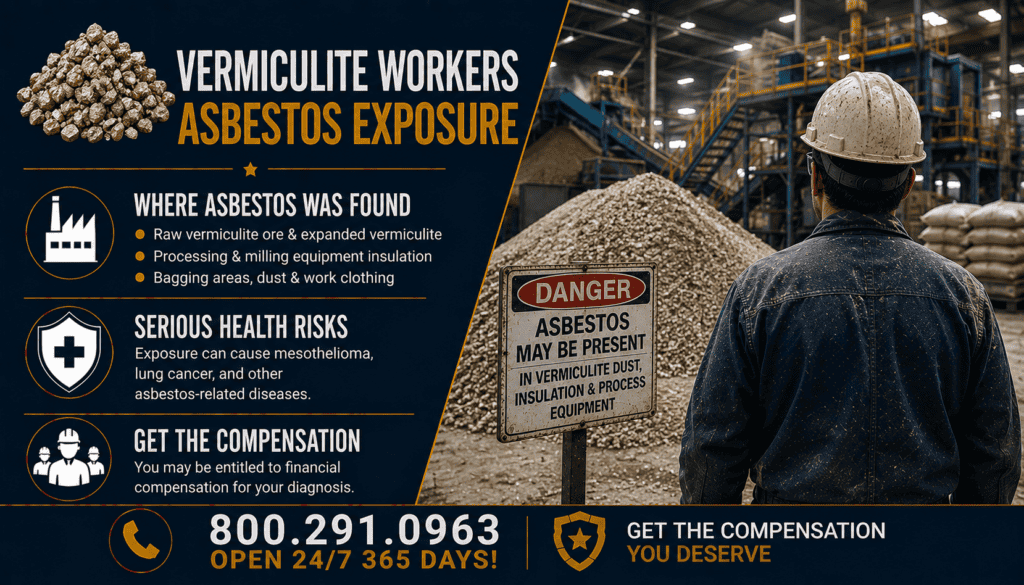
Vermiculite Workers Asbestos Exposure
Vermiculite is a mineral that expands when rapidly heated and has been used in insulation, construction, horticultural and industrial products. Vermiculite itself should not automatically be described as asbestos, but ore mined near Libby, Montana, was contaminated with asbestos and asbestos-like amphibole fibers, creating serious occupational hazards for some miners, millers, processors and downstream workers.
NIOSH has exceptionally strong worker-specific evidence for this exposure pathway. The agency documented asbestos contamination in Libby vermiculite, adverse health effects among miners and millers, and excess mortality from asbestosis, lung cancer and pleural cancer/mesothelioma in the studied worker population. Exposure history should still identify the vermiculite source, facility, dates and tasks rather than assuming every vermiculite product was contaminated.
Vermiculite Workers and Occupational Asbestos Exposure
Vermiculite workers can include miners, millers, processors, material handlers, maintenance employees and workers at facilities that expanded or incorporated vermiculite into finished products. Potential asbestos exposure depended primarily on whether the vermiculite source was contaminated with asbestos or asbestos-like fibers.
NIOSH reported that vermiculite ore mined near Libby, Montana, accounted for more than half of worldwide vermiculite production from 1925 to 1990 and was contaminated with asbestos and asbestos-like fibers. Workplace exposure caused serious health problems among local miners and millers and some downstream workers.
A later cohort mortality study followed 1,672 Libby workers who mined, milled or processed the vermiculite. The study reported significantly elevated mortality from asbestosis and lung cancer and a markedly increased risk of cancer of the pleura; the research also identified mesothelioma risk in this workforce.
These findings are powerful evidence for workers exposed to Libby-source material but should not be generalized to all vermiculite. NIOSH states that the observed asbestos-related health effects were attributable to contaminant fibers rather than uncontaminated vermiculite itself.
Related resources include mining, oil, gas and refinery workers asbestos exposure, miners asbestos exposure and production workers asbestos exposure.
Libby Vermiculite and Asbestos Contamination
NIOSH’s Libby research is central to understanding vermiculite-related asbestos exposure. The ore was mined from an open-pit operation and processed in dry and wet mills before concentrate was shipped to processing plants for expansion and use in products such as loose-fill attic insulation.
Published CDC research describes historical airborne fiber levels that varied substantially by job and era. Before 1975, exposures in the mine were estimated above 2–3 fibers per cubic centimeter for drillers, while early dry-mill sweeping exposures were reported as high as 182 fibers per cubic centimeter. These are historical measurements from the Libby operation and should not be applied to other facilities or current work.
NIOSH recommends that vermiculite originating from the Libby mine generally be regarded as potentially contaminated with asbestos. The agency also warns that bulk testing below 1% asbestos can be falsely reassuring because disturbing contaminated vermiculite containing less than 1% asbestos can still produce hazardous airborne fiber concentrations.
Much of the Libby vermiculite was used to manufacture Zonolite attic insulation, but NIOSH cautions that not all Zonolite product came from the Libby mine. Product name alone therefore does not conclusively establish source or asbestos content.
How Vermiculite Worker Asbestos Exposure Could Occur
When vermiculite was contaminated with asbestos, dusty handling and processing tasks could release fibers into workplace air.
- Mining: drilling, extracting and handling asbestos-contaminated vermiculite ore
- Milling: crushing, screening, separating and processing contaminated ore
- Sweeping and cleanup: disturbing accumulated contaminated dust in dry work areas
- Material handling: loading, unloading, bagging or transferring vermiculite concentrate
- Expansion and processing: handling Libby-source vermiculite at downstream manufacturing facilities
- Maintenance: repairing equipment or ventilation systems contaminated by vermiculite dust
- Construction work: disturbing installed loose-fill vermiculite insulation known or presumed to be contaminated
NIOSH recommends minimizing dust generation and inhalation when handling vermiculite known or presumed to be contaminated with asbestos. Recommended controls include avoiding unnecessary disturbance, isolating work areas, using wet methods when feasible, avoiding compressed-air cleaning and dry sweeping, using appropriate protective clothing and respiratory protection, and properly containing contaminated waste.
The asbestos hazard comes from contaminant fibers. Vermiculite that is not contaminated with asbestos should not be characterized as an asbestos material solely because it is vermiculite.
Mines, Mills and Vermiculite Processing Facilities
A credible exposure history identifies where the vermiculite originated and where the worker encountered it.
Libby Vermiculite Mine
NIOSH documented asbestos contamination of vermiculite mined near Libby and adverse health effects among miners. Mining at the Libby operation stopped in 1990.
Dry and Wet Mills
CDC-published research describes a dry mill operating from 1935 to 1976 and wet mills operating from 1955 to 1990 on Vermiculite Mountain. Historical fiber concentrations were particularly high during some early dry-mill operations.
Downstream Processing Facilities
Libby concentrate was shipped to processing facilities where vermiculite was expanded and incorporated into products. NIOSH recognizes occupational concerns for some downstream workers who handled contaminated material.
Insulation and Construction Work
Asbestos-contaminated Libby vermiculite was used in loose-fill attic insulation that remains in buildings. Workers who disturb known or presumed Libby vermiculite during renovation or insulation work may require asbestos controls.
Agricultural and Horticultural Work
Expanded vermiculite has also been used in potting mixes and soil conditioners. This use does not mean all horticultural vermiculite contains asbestos. Source identification and testing are important.
Industrial Product Manufacturing
NIOSH identifies historical uses of expanded vermiculite in industrial products such as insulation blocks, furnaces, drilling muds and some friction products. A worker’s asbestos history should establish that the material handled was actually contaminated.
Related resources include miners asbestos exposure, factory workers asbestos exposure, production workers asbestos exposure, machine operators asbestos exposure and maintenance workers asbestos exposure.
Secondary or Household Exposure
NIOSH recommends work practices that prevent contaminated clothing from being taken home and specifically advises against laundering contaminated work clothing with family clothing. Historical household exposure is most credible when evidence establishes that a worker handled asbestos-contaminated vermiculite and carried contaminated dust away from work.
Need help now? Call 800.291.0963
Live chat available 24/7, 365 days a year.
Submit Your Case
Mesothelioma and Other Occupational Health Risks
NIOSH research on Libby workers provides strong evidence of asbestos-related disease. The agency’s research identified adverse radiographic effects among miners and excess deaths from lung cancer and other lung diseases consistent with asbestos exposure.
A follow-up mortality study of 1,672 Libby workers reported significantly increased mortality from asbestosis, lung cancer and cancer of the pleura and documented mesothelioma in the cohort. NIOSH’s later respiratory-health review states that follow-up research confirmed increased lung-cancer mortality and demonstrated increased risk for pleural cancer, or mesothelioma.
NIOSH emphasizes that uncontaminated vermiculite itself has not been clearly shown to cause the serious health effects associated with the Libby workforce. Those effects are attributed to contaminant asbestos and asbestos-like fibers.
Medical questions about prior vermiculite exposure, symptoms, screening or diagnosis should be discussed with a qualified healthcare professional familiar with asbestos-related disease.
Documenting a Vermiculite Worker Exposure History
A useful investigation identifies the employer, facility, dates, job, vermiculite source and tasks that could have produced exposure to contaminant fibers.
- Employment evidence: mine, mill or processing employer, payroll, W-2, union and Social Security earnings records
- Source evidence: records showing whether vermiculite originated from Libby or another mine
- Facility evidence: mine, mill, expansion plant, manufacturing facility, warehouse or construction site
- Task evidence: drilling, milling, sweeping, bagging, loading, processing, maintenance or insulation disturbance
- Material evidence: mineralogical testing, bulk analysis, product records and supplier documentation
- Exposure evidence: historical air monitoring, industrial-hygiene studies and government investigations
- Witness evidence: miners, millers, processors, maintenance workers, supervisors and coworkers
ATSDR maintains reports concerning former facilities around the United States that processed Libby vermiculite. Those site-specific records may help establish whether a particular processing location received contaminated Libby material.
Questions That Can Strengthen an Exposure History
Which employer and years? Was the worker at the Libby mine or mill, or at a downstream processing plant? Did the facility receive Libby vermiculite? What job was performed? Did the worker sweep, bag, load or process dusty material? Are supplier records, industrial-hygiene reports or ATSDR site evaluations available? These details can help identify a specific pathway.
Asbestos Lawsuits, Trust Funds and Compensation
A vermiculite worker diagnosed with mesothelioma or another asbestos-related disease may have potential legal or compensation options when evidence supports exposure to asbestos-contaminated vermiculite and applicable requirements are met. Possible avenues can include claims involving legally responsible companies and asbestos bankruptcy trusts.
Vermiculite employment or product contact alone does not establish liability or asbestos trust eligibility. Each trust has separate medical and exposure requirements, and evidence may be needed connecting the worker to a covered asbestos source, company, facility or qualifying exposure period.
Potential evidence includes employment and Social Security records, mine and mill records, supplier and shipping records, facility documents, product records, industrial-hygiene monitoring, ATSDR or NIOSH investigations, photographs, coworker statements and medical documentation. Applicable law and filing deadlines should be reviewed individually.
Related Mining and Industrial Resources
Mining: Mining, Oil, Gas & Refinery Workers Asbestos Exposure · Miners Asbestos Exposure
Processing: Production Workers Asbestos Exposure · Factory Workers Asbestos Exposure
Maintenance: Maintenance Workers Asbestos Exposure
Authoritative Sources
This page was researched using NIOSH, CDC and ATSDR government sources. The strongest evidence comes from occupational studies of Libby miners, millers and processors and NIOSH guidance for workers handling vermiculite known or presumed to be contaminated with asbestos.
- NIOSH — Job-Related Asbestos Exposures and Health Effects in Libby Mining and Milling
- NIOSH — Limiting Potential Exposures to Asbestos Associated with Libby Vermiculite
- CDC Stacks — Libby Vermiculite Cohort Mortality Study
- NIOSH — Respiratory Health Research: Asbestos and Libby Vermiculite
- ATSDR — Libby Vermiculite Processing Site Reports
- NIOSH — Vermiculite Overview
Vermiculite Workers Asbestos Exposure FAQ
Is vermiculite itself asbestos?
No. Vermiculite is a separate mineral. The major asbestos concern involves vermiculite contaminated with asbestos or asbestos-like fibers, particularly material historically mined near Libby, Montana.
Was Libby vermiculite contaminated with asbestos?
Yes. NIOSH documented asbestos and asbestos-like fiber contamination in vermiculite mined and milled near Libby.
Were Libby vermiculite workers at increased risk of mesothelioma?
NIOSH and CDC research documented increased asbestos-related mortality in the worker cohort, including increased risk involving cancer of the pleura and mesothelioma.
Were only miners exposed to contaminated Libby vermiculite?
No. NIOSH identifies miners, millers and some downstream workers as groups affected by occupational exposure to contaminated Libby vermiculite.
Did all vermiculite come from Libby?
No. Vermiculite is mined from multiple sources. Source identification matters, and NIOSH cautions that even not all Zonolite product was made with vermiculite from the Libby mine.
Can low asbestos content in vermiculite still be hazardous when disturbed?
Yes. NIOSH warns that disturbing contaminated vermiculite containing less than 1% asbestos can still produce hazardous airborne asbestos concentrations and that negative bulk results can sometimes be falsely reassuring.
What records can document vermiculite-worker asbestos exposure?
Employment records, shipping and supplier records, facility histories, product documents, industrial-hygiene monitoring, NIOSH or ATSDR reports and coworker statements can help reconstruct exposure.
Can vermiculite workers qualify for asbestos trust fund claims?
Some may qualify if they satisfy a trust’s medical and exposure criteria and can connect their work to a covered asbestos source, company or qualifying facility. Vermiculite work alone does not establish eligibility.
Get Help Reviewing a Vermiculite Worker Exposure History
Call 800.291.0963
Live chat is available 24/7, 365 days a year.
Prior vermiculite mining, milling, processing or product work does not automatically prove asbestos exposure, disease causation, liability, claim eligibility or compensation. Each situation depends on the vermiculite source, employer, facility, dates, tasks, contamination evidence, medical evidence and applicable legal requirements. Compensation is not guaranteed.
⚕️ Legal & Medical Information Disclaimer
This page provides general educational information and is not medical or legal advice. The information does not establish asbestos exposure, diagnosis, causation, liability, claim eligibility or compensation. Medical concerns should be discussed with a qualified healthcare professional, and legal questions should be reviewed with a qualified attorney.