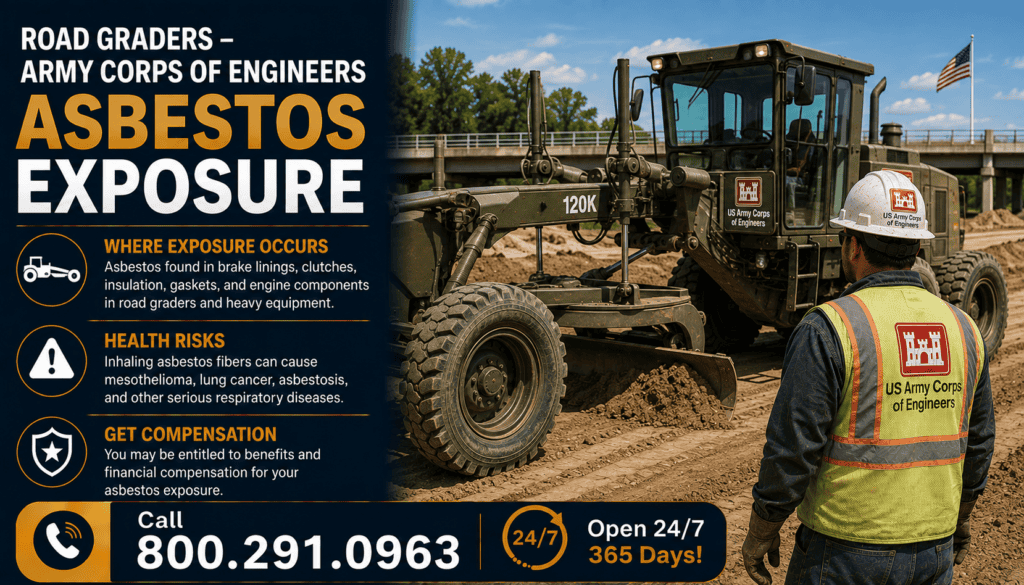
Army Corps of Engineers Road Graders Asbestos Exposure
U.S. Army Corps of Engineers projects may use road graders to shape roadbeds, level surfaces, maintain access routes, prepare construction sites, support airfield work, and improve roads around military installations, dams, waterways, flood-control projects, and other infrastructure sites. Depending on the grader, manufacturer, model, component, replacement part, and era, some historical machines may have contained asbestos in certain friction, brake, clutch, gasket, sealing, insulation, or heat-resistant components.
Operating or working near an older road grader does not by itself prove asbestos exposure. A useful investigation focuses on the exact machine, component, maintenance task, service period, work location, frequency of contact, and evidence showing whether asbestos-containing material was actually present and disturbed.
For broader context, see the Army Corps of Engineers Vehicles Asbestos Exposure hub and the main U.S. Army Corps of Engineers Asbestos Exposure guide. Related confirmed pages include Army Corps asphalt pavers, dump trucks, bulldozers, cranes, and Army Corps heavy machinery.
🚜 Army Corps Road Grader Use
Road graders may be used for road construction, site preparation, drainage shaping, surface maintenance, embankment work, and access-road improvement. Army Corps personnel or contractors may operate, inspect, maintain, or repair graders at permanent facilities or temporary project sites.
Exposure relevance depends on the worker’s actual role. An operator may have a different exposure history from a mechanic who repeatedly serviced brakes, clutches, gaskets, engines, hydraulic systems, or other components.
| Grader Activity | Possible Exposure Pathway | Evidence to Review |
|---|---|---|
| Routine operation | Usually limited unless damaged asbestos-containing material or nearby repair work released fibers | Equipment assignment and maintenance records |
| Brake service | Potential disturbance of historical friction materials | Parts catalogs, repair manuals, work orders |
| Clutch replacement | Possible contact with historical friction components | Technical manuals, parts records |
| Engine and gasket repair | Possible disturbance of older sealing or heat-resistant materials | Maintenance logs, manufacturer records |
| Major overhaul | Multiple systems may be opened, removed, cleaned, or replaced | Shop records, overhaul procedures, witness statements |
🧱 Possible Asbestos-Containing Grader Components
Historically, asbestos was used in some heavy-equipment and industrial components because it resisted heat, friction, and wear. Depending on the grader and era, components requiring investigation can include certain brake or clutch materials, gaskets, seals, insulation, and other heat-resistant products.
Not every road grader contained asbestos, and not every replacement component used asbestos. Manufacturer, model, serial number, part number, production period, and maintenance history can be important when determining whether a particular machine contained an asbestos component.
🔧 Maintenance and Repair Exposure Pathways
Maintenance may be more relevant to an asbestos investigation than ordinary grader operation. Tasks such as removing friction components, replacing brakes or clutches, scraping gaskets, opening mechanical assemblies, cleaning older parts, or performing overhaul work may be relevant if asbestos-containing material was actually present.
Personnel performing this work may include Army Corps mechanics and maintenance workers. Nearby workers could also potentially experience bystander exposure if asbestos-containing material was disturbed in a shared work area.
Direct exposure
Direct exposure may involve personally removing, scraping, cleaning, cutting, or replacing an asbestos-containing component.
Bystander exposure
Bystander exposure may involve working close to another person performing dusty maintenance or overhaul. Material identity, proximity, frequency, duration, work practices, and ventilation should all be evaluated.
🛣️ Road Building and Grading Environments
Road graders often operate alongside pavers, dump trucks, bulldozers, cranes, loaders, and other heavy equipment. Several different potential asbestos sources may therefore exist at the same project.
Possible exposure from a grader component should be distinguished from exposure involving another machine, older construction materials, underground utilities, building renovation, or demolition debris at the site. The Army Corps projects and facilities asbestos exposure hub provides broader context for those work environments.
📋 Evidence to Investigate
Historical grader exposure often requires combining employment, equipment, maintenance, product, and witness evidence.
| Evidence | What It May Help Establish |
|---|---|
| Personnel or employment records | Job, project, facility, location, and dates |
| Equipment records | Grader make, model, year, serial number, and assignment |
| Maintenance logs | Repairs, replacements, and recurring service work |
| Technical manuals | Specified brake, clutch, engine, hydraulic, and gasket components |
| Parts catalogs and procurement records | Replacement components used by the project or facility |
| Manufacturer records | Whether a particular historical component contained asbestos |
| Coworker statements | Actual tasks, work practices, proximity, frequency, and duration |
| Project records | Road-building, grading, excavation, or demolition conditions at the site |
| Medical records | Diagnosis and relevant medical history |
The strongest reconstruction connects a specific worker to a specific road grader or component and a task capable of disturbing asbestos-containing material.
🫁 Asbestos-Related Health Risks
Inhalation of asbestos fibers is associated with serious diseases including mesothelioma, lung cancer, and asbestosis. Because these diseases can develop decades after exposure, older equipment, project, and maintenance records may remain relevant to a current diagnosis.
A diagnosis alone does not establish the source of exposure or legal causation. Medical and occupational histories should be evaluated based on the individual evidence.
Need help now? If you are trying to reconstruct Army Corps road-grader work involving older brakes, clutches, gaskets, hydraulic systems, repair shops, or road projects, Call 800.291.0963, use our 24/7 live chat, or Submit Your Case.
⚖️ Legal and Benefits Investigation
A person diagnosed with an asbestos-related disease may be able to investigate legal claims or, when applicable, veterans benefits depending on the individual circumstances. Relevant factors can include diagnosis, exposure history, product identification, responsible companies, employment or military status, jurisdiction, and filing deadlines.
An investigation may examine manufacturers, suppliers, contractors, or asbestos bankruptcy trusts when supported by evidence. Army Corps employment or service, road-grader work, or diagnosis alone does not guarantee compensation or benefits.
❓ Frequently Asked Questions
Did all Army Corps road graders contain asbestos?
No. Asbestos content varied by machine, manufacturer, model, component, replacement part, and production period.
Which road grader components may require investigation?
Depending on the machine and era, investigators may review certain historical brake or clutch materials, gaskets, seals, insulation, and other heat-resistant components.
Was operating a road grader enough to establish asbestos exposure?
No. Exposure depends on whether asbestos-containing material was present and whether fibers were released into the worker’s breathing area.
Could mechanics have had more direct exposure opportunities?
Potentially. Mechanics may have worked directly with brakes, clutches, gaskets, and other components during removal, cleaning, repair, and replacement. The specific component must still be shown to have contained asbestos.
Could road-construction workers have experienced bystander exposure?
Possibly. Proximity to dusty equipment maintenance can be relevant when asbestos-containing material was actually disturbed. Distance, frequency, duration, and ventilation matter.
What records can identify an old road grader?
Equipment logs, serial numbers, maintenance records, technical manuals, parts catalogs, procurement files, photographs, project records, and coworker statements may help.
Can asbestos exposure contribute to lung cancer?
Yes. Asbestos exposure is a recognized cause of lung cancer. Individual diagnosis and causation questions should be evaluated by qualified medical professionals.
Can a family investigate an asbestos claim after a worker dies?
Possibly. Rights depend on the evidence, responsible parties, jurisdiction, and applicable deadlines. A qualified attorney can evaluate the specific circumstances.
☎️ Help Investigating Army Corps Road Grader Exposure
If you or a family member worked with Army Corps of Engineers road graders and later developed mesothelioma or lung cancer, an exposure investigation can examine equipment assignments, maintenance tasks, brakes, clutches, gaskets, manufacturers, road projects, repair shops, coworkers, and other historical records.
Call 800.291.0963 to discuss an Army Corps of Engineers asbestos exposure history. Live chat is available 24/7, 365 days a year. You can also Submit Your Case online.
There is no guarantee that a diagnosis or work history will qualify for compensation or benefits. Eligibility depends on the facts, evidence, responsible parties, jurisdiction, and filing deadlines.
⚕️ Legal & Medical Information Disclaimer
This page provides general educational information and is not medical or legal advice. It does not establish diagnosis, asbestos exposure, causation, liability, eligibility, or compensation. Consult qualified medical and legal professionals for guidance specific to your situation.