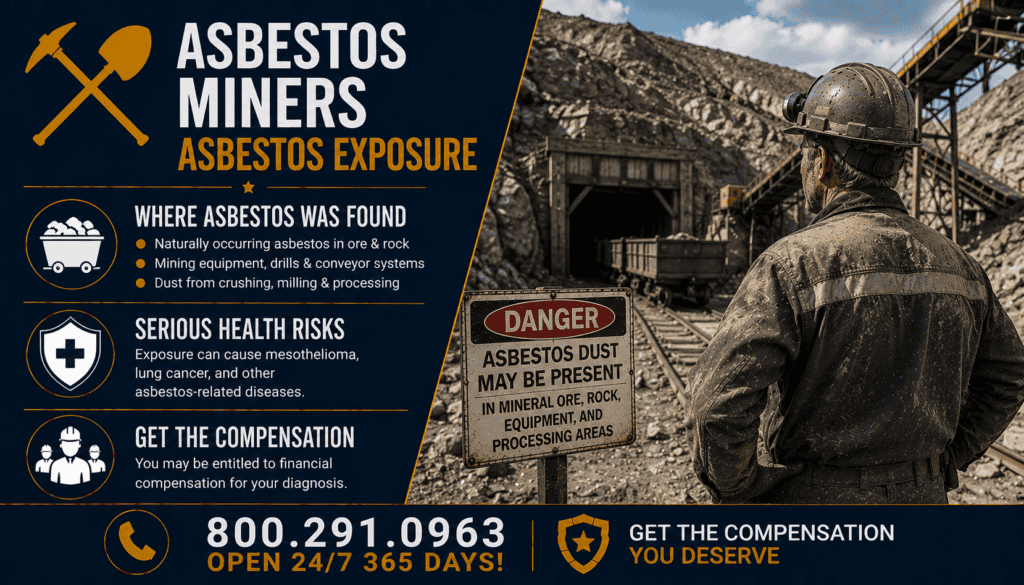
Asbestos Miners Asbestos Exposure
Asbestos miners worked directly with naturally occurring fibrous minerals extracted for commercial use. Unlike occupations where asbestos exposure depended on whether a particular product or building material contained asbestos, historical asbestos mining and milling could involve direct exposure to airborne fibers released during extraction, crushing, milling, sorting, handling and transport.
NIOSH’s scientific review describes excess respiratory cancer, asbestosis and mesothelioma among cohorts of chrysotile asbestos miners and millers. Modern NIOSH mining guidance also explains that asbestos is no longer mined in the United States as a primary commodity, although accessory asbestos can still occur in deposits mined for other minerals.
Asbestos Miners and Occupational Fiber Exposure
Commercial asbestos mining historically involved extracting mineral deposits specifically for asbestos fiber. Mining was followed by milling and processing operations designed to separate useful fibers from surrounding rock and prepare material for shipment and manufacturing.
NIOSH’s 1980 workplace asbestos review summarized research involving Quebec chrysotile miners and millers. The agency reported an increased risk of lung cancer, with the most heavily exposed workers having substantially greater risk than the least exposed workers in the cited research.
NIOSH also summarized follow-up studies finding excess respiratory cancer, asbestosis and mesothelioma in cohorts of chrysotile miners and millers. These findings provide direct occupational evidence connecting historical asbestos mining and milling with asbestos-related disease.
The exposure history still matters. Fiber type, mine, mill, dates, job, dust concentrations and duration of employment can differ greatly among mining populations.
Related resources include mining, oil, gas and refinery workers asbestos exposure, miners asbestos exposure and vermiculite workers asbestos exposure.
Asbestos Mining and Milling Operations
Asbestos is a general term for naturally occurring fibrous silicate minerals. NIOSH’s Pocket Guide lists regulated asbestos forms including chrysotile, amosite, crocidolite, tremolite, anthophyllite and actinolite asbestos.
Historical commercial operations mined asbestos-bearing ore and mechanically processed it to separate fibers. Dust generation could occur as rock was drilled, blasted, excavated, transported, crushed and milled.
NIOSH’s industrial-minerals dust-control handbook explains that asbestos is no longer mined in the United States as a primary commodity. However, asbestos can occur as a trace or accessory mineral in deposits mined for other commodities, and extraction or processing can aerosolize those fibers.
The same NIOSH handbook reports that detectable asbestos fibers were found in settled dust collected during a national mining survey at mines extracting 21 different non-asbestos commodities. That does not mean every such mine exposed every worker; it demonstrates why mineralogical and exposure evidence can matter even outside historical commercial asbestos mines.
How Asbestos Miners Could Be Exposed
Historical asbestos mining and milling could release fibers during multiple stages of production.
- Drilling and blasting: breaking asbestos-bearing rock and generating airborne mineral dust
- Extraction: excavating and handling asbestos ore
- Loading and hauling: moving dusty ore from mine workings to processing areas
- Crushing: reducing asbestos-bearing rock before fiber separation
- Milling: mechanically separating and grading asbestos fibers
- Bagging and shipping: handling processed asbestos fiber and contaminated containers
- Maintenance and cleanup: repairing dusty equipment or sweeping accumulated asbestos-containing material
NIOSH states that asbestos can become airborne when asbestos-bearing mineral deposits are extracted and processed. Because inhalation is the principal occupational pathway of concern, dust control and exposure monitoring are central to prevention.
Current mining operations involving other commodities should not automatically be characterized as asbestos mining. Coal dust, crystalline silica and diesel particulate matter are separate hazards unless asbestos fibers are independently identified.
Mines, Mills and Processing Work Areas
An asbestos miner’s occupational history can include several distinct environments, each with different opportunities for fiber release.
Underground and Surface Asbestos Mines
Historical asbestos deposits were worked through mining methods appropriate to local geology. Drilling, blasting, excavation and ore handling could disturb the asbestos-bearing rock directly.
Asbestos Mills
Milling separated commercially useful asbestos fibers from mined ore. Crushing, screening, fiber separation, grading and packaging could generate airborne dust if controls were inadequate.
Chrysotile Mines and Mills
NIOSH’s workplace asbestos review summarizes extensive epidemiologic research involving Quebec chrysotile miners and millers, including reported excess respiratory cancer, asbestosis and mesothelioma.
Accessory Asbestos in Other Mines
NIOSH explains that asbestos can occur as a trace or accessory mineral in deposits routinely mined for other commodities. Mineralogical analysis is necessary before labeling a non-asbestos mine an asbestos exposure source.
Mine Maintenance Areas
Maintenance workers could encounter asbestos-bearing mine dust on crushers, conveyors, ventilation equipment and processing machinery. Older mine buildings could also contain commercial asbestos materials, creating a separate exposure pathway.
Bagging, Warehousing and Shipping Areas
Processed asbestos fiber historically moved from mills into bags and other containers for shipment. Material handling, damaged packaging and cleanup could disturb settled fibers.
Related resources include miners asbestos exposure, vermiculite workers asbestos exposure, machine operators asbestos exposure, production workers asbestos exposure and maintenance workers asbestos exposure.
Secondary or Household Exposure
Historically, asbestos fibers could be carried away from dusty workplaces on contaminated clothing, footwear or belongings. A household exposure history should identify the asbestos miner or miller, mine or mill, employment dates and frequency of contact with contaminated work clothing or dust.
Need help now? Call 800.291.0963
Live chat available 24/7, 365 days a year.
Submit Your Case
Mesothelioma and Other Occupational Health Risks
NIOSH’s workplace asbestos review summarizes epidemiologic evidence of excess respiratory cancer, asbestosis and mesothelioma among asbestos miners and millers. The review reported confirmed and suspected mesotheliomas in a studied cohort of Quebec chrysotile miners and millers.
NIOSH’s industrial-minerals mining handbook identifies asbestosis, mesothelioma and lung cancer among diseases caused by asbestos exposure and notes that latency for lung cancer and mesothelioma can be very long.
A CDC-hosted epidemiologic record involving 1,227 male chrysotile miners in Laiyuan, China, also reported lung-cancer and mesothelioma deaths among the asbestos workers. This provides additional evidence from a different asbestos-mining population, although individual risk cannot be inferred directly from a population study.
Other mining diseases have different causes. Coal mine dust can cause coal workers’ pneumoconiosis, and crystalline silica can cause silicosis. These hazards should not be confused with asbestos disease.
Medical questions about asbestos exposure, symptoms, screening or diagnosis should be discussed with a qualified healthcare professional.
Documenting an Asbestos Miner’s Exposure History
A useful investigation identifies the mine, mill, employer, dates, asbestos fiber type, occupation, work area and tasks that could have generated airborne fibers.
- Employment evidence: mine or mill employer, payroll, union, W-2 and Social Security earnings records
- Mine evidence: mine name, location, ownership, operating dates and asbestos commodity
- Mineral evidence: geological reports, mineralogical analysis and government mine records
- Task evidence: drilling, blasting, excavation, hauling, crushing, milling, bagging or cleanup
- Exposure evidence: historical air monitoring, dust measurements, industrial-hygiene studies and government investigations
- Facility evidence: mill diagrams, equipment records, ventilation information and maintenance documentation
- Witness evidence: miners, millers, mechanics, supervisors, industrial hygienists and coworkers
Historical scientific literature can help characterize conditions at a mine or within a worker cohort, but individual exposure reconstruction is stronger when employment records can be connected to specific operations and time periods.
Questions That Can Strengthen an Exposure History
Which asbestos mine or mill and what years? What fiber type was produced? What job did the worker perform? Was the worker underground, at the crusher, in the mill or in bagging? Are exposure measurements, geological reports, company records or government studies available? These details can help define a specific occupational pathway.
Asbestos Lawsuits, Trust Funds and Compensation
An asbestos miner or miller diagnosed with mesothelioma or another asbestos-related disease may have potential legal or compensation options when evidence supports occupational exposure and applicable requirements are met. Possible avenues can include claims involving legally responsible companies and asbestos bankruptcy trusts.
Even direct historical asbestos mining employment does not automatically establish liability, trust eligibility or compensation. Each trust and legal claim has separate requirements involving diagnosis, exposure, company responsibility, qualifying dates and filing deadlines.
Potential evidence includes employment and Social Security records, union files, mine and mill records, geological reports, industrial-hygiene monitoring, company documents, product and shipping records, photographs, coworker statements and medical documentation. Applicable law and filing deadlines should be reviewed individually.
Related Mining and Industrial Resources
Mining: Mining, Oil, Gas & Refinery Workers Asbestos Exposure · Miners Asbestos Exposure · Vermiculite Workers Asbestos Exposure
Processing: Machine Operators Asbestos Exposure · Production Workers Asbestos Exposure
Maintenance: Maintenance Workers Asbestos Exposure
Authoritative Sources
This page was researched using NIOSH and CDC government sources. The strongest evidence includes NIOSH’s scientific review of asbestos-worker studies and its mining handbook addressing asbestos exposure in mineral extraction and processing.
Asbestos Miners Exposure FAQ
Were asbestos miners directly exposed to asbestos fibers?
Historical commercial asbestos mining and milling involved asbestos-bearing ore. Drilling, extraction, crushing, milling and handling could release airborne fibers, although individual exposure levels varied by job, mine, era and controls.
Did NIOSH document mesothelioma among asbestos miners and millers?
Yes. NIOSH’s workplace asbestos review summarizes studies reporting excess mesothelioma, respiratory cancer and asbestosis among cohorts of chrysotile asbestos miners and millers.
What type of asbestos did Quebec miners produce?
The major epidemiologic studies summarized by NIOSH involved chrysotile asbestos miners and millers in Quebec.
Is asbestos still mined in the United States?
NIOSH states that asbestos is no longer mined in the United States as a primary commodity. However, accessory asbestos can occur in deposits mined for other minerals.
Can workers at non-asbestos mines encounter asbestos?
Potentially. NIOSH reports that asbestos can occur as a trace or accessory mineral in some deposits. Mineralogical and exposure evidence is needed to determine whether a particular mine presented an asbestos hazard.
Is coal dust or silica the same as asbestos?
No. Coal mine dust and respirable crystalline silica are separate hazards that can cause black lung and silicosis. They should not be used as proof of asbestos exposure.
What records can document an asbestos miner’s exposure?
Employment records, mine and mill records, geological reports, industrial-hygiene monitoring, government studies, company documents and coworker statements can help reconstruct exposure.
Can asbestos miners qualify for asbestos trust fund claims?
Some may qualify if they satisfy a trust’s medical and exposure criteria and establish the required connection to a covered company, asbestos source or qualifying exposure period. Compensation is not automatic.
Get Help Reviewing an Asbestos Miner’s Exposure History
Call 800.291.0963
Live chat is available 24/7, 365 days a year.
Prior asbestos mining or milling employment does not automatically prove disease causation, liability, claim eligibility or compensation. Each situation depends on the mine, employer, dates, fiber type, exposure intensity, tasks, medical evidence and applicable legal requirements. Compensation is not guaranteed.
⚕️ Legal & Medical Information Disclaimer
This page provides general educational information and is not medical or legal advice. The information does not establish asbestos exposure, diagnosis, causation, liability, claim eligibility or compensation. Medical concerns should be discussed with a qualified healthcare professional, and legal questions should be reviewed with a qualified attorney.