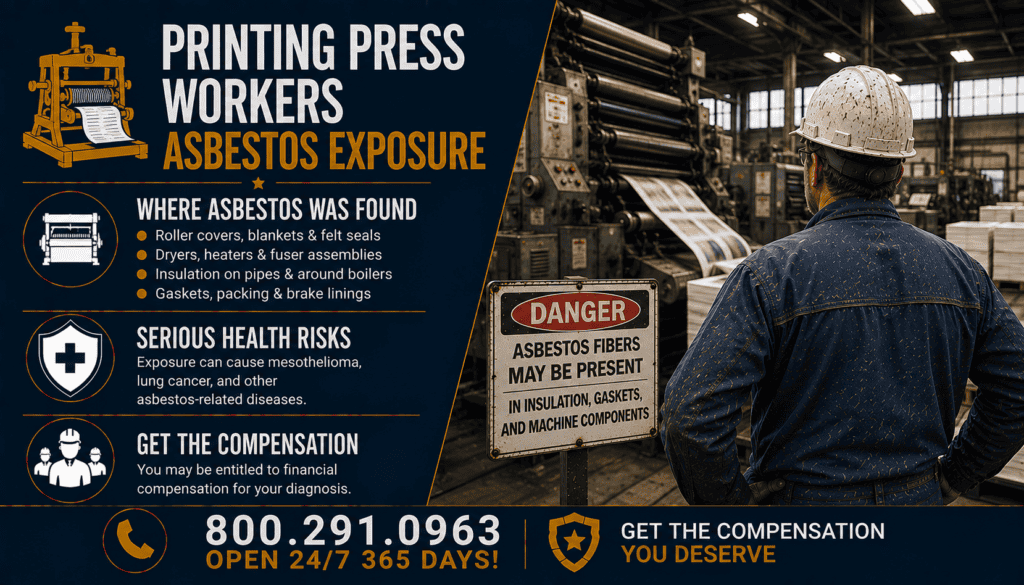
Printing Press Workers Asbestos Exposure
Printing press operators and other printing employees worked around presses, rollers, inks, solvents, paper-handling equipment and plant machinery. Printing employment itself does not prove asbestos exposure, but a NIOSH Health Hazard Evaluation documented a printing-machine operation in a facility processing asbestos where investigators required asbestos respirators and recommended vacuum cleaning instead of compressed-air cleaning.
For most printing workers, exposure should be investigated through the specific plant, process, materials, equipment and maintenance history rather than assumed from the job title. NIOSH also documents important non-asbestos printing hazards, including solvent vapors, inks and airborne particulates, making it essential to identify the actual contaminant involved.
Printing Press Workers and Asbestos Exposure
Printing press workers may operate, adjust, clean and maintain presses or work near finishing and material-handling equipment. NIOSH describes press operators and other printing workers as potentially exposed to airborne solvent vapors during press cleaning and to particulates generated during printing.
Those routine printing hazards are not proof of asbestos. A credible asbestos history needs a separate asbestos source, such as a documented asbestos-processing operation, confirmed asbestos-containing machinery or insulation, or asbestos building material disturbed in the print plant.
NIOSH provides direct historical evidence from a 1972 Health Hazard Evaluation in which a printing machine was used in an operation involving asbestos. Investigators recommended local exhaust ventilation for the printing machine, asbestos-approved respirators for workers in the area and vacuum cleaning rather than air hoses where asbestos was processed.
This evidence establishes that some specialized printing operations could involve asbestos, but it should not be generalized to every commercial printer, newspaper plant or press operator.
Related resources include textile, apparel and consumer goods manufacturing workers asbestos exposure, industrial, manufacturing and factory workers asbestos exposure, machine operators asbestos exposure and production workers asbestos exposure.
Documented Printing Work Involving Asbestos
NIOSH Health Hazard Evaluation Report 72-27 provides unusually specific evidence relevant to printing machinery and asbestos. Investigators evaluated an industrial operation where asbestos was processed and identified the printing machine as an area requiring controls.
NIOSH Recommendations in the Asbestos Printing Operation
- Install local exhaust ventilation at the printing machine to lower dust levels
- Require approved asbestos respirators in the printing-machine area until controls were installed
- Use an approved respirator when scrap asbestos was being baled
- Stop using air hoses to clean the printing machine
- Replace compressed-air cleaning with vacuum cleaning methods
- Follow asbestos environmental, medical-monitoring and housekeeping requirements
The report demonstrates why process-specific records matter. A printing machine can be part of an asbestos exposure setting when the material being printed, processed or handled contains asbestos.
Workers investigating historical exposure should look for product descriptions, production specifications, raw-material records and industrial-hygiene documents showing whether asbestos-containing sheets, textiles, insulation products or other asbestos materials passed through a particular printing or marking process.
Press Equipment and Older Printing Plants
Printing plants contain presses and other machinery as well as heating, ventilation, electrical and building systems. Potential asbestos exposure unrelated to the printing process itself can arise when documented asbestos-containing components or building materials deteriorate or are disturbed.
Plant Sources Worth Investigating
- Pipe and boiler insulation documented to contain asbestos
- Thermal insulation around older plant heating or steam systems
- Confirmed asbestos-containing gaskets or heat-resistant machine components
- Older surfacing or fireproofing materials identified as asbestos-containing
- Flooring or other building materials confirmed to contain asbestos
- Mechanical rooms and utility areas containing documented ACM
Printing machinery can create heat, motion and chemical exposures, but those characteristics do not establish that a machine contained asbestos. Equipment manuals, manufacturer specifications, maintenance records and product documentation are needed before identifying a component as asbestos-containing.
Related pages include millwrights asbestos exposure, maintenance workers asbestos exposure, maintenance mechanics asbestos exposure and industrial, manufacturing and utility buildings asbestos exposure.
Maintenance, Cleaning and Dust-Generating Tasks
Cleaning methods can materially affect airborne dust. In the NIOSH asbestos-processing evaluation, investigators specifically recommended discontinuing air hoses at the printing machine and using vacuum cleaning methods instead.
Tasks Worth Investigating
- Cleaning a press used with documented asbestos-containing material
- Using compressed air where asbestos dust had accumulated
- Changing or repairing confirmed asbestos-containing machine components
- Repairing steam lines or boilers with asbestos insulation
- Working near maintenance that disturbed asbestos-containing materials
- Renovating older print-plant areas containing confirmed ACM
- Cleaning debris after a documented asbestos disturbance
NIOSH’s current printing-control guidance separately identifies airborne particulates and solvent vapors as routine printing concerns. Therefore, dust created during press cleaning should not automatically be labeled asbestos dust unless the material source is known.
Press operators, mechanics and maintenance employees may have different exposure histories even within the same facility. Work location, frequency, duration, ventilation, housekeeping methods and the material actually disturbed should be documented.
Need help now? Call 800.291.0963
Live chat available 24/7, 365 days a year.
Submit Your Case
Solvents, Inks and Other Printing Hazards
NIOSH has studied printing operations extensively for hazards unrelated to asbestos. Press-cleaning solutions can contain solvent mixtures, and inks can contain multiple chemical constituents. Airborne exposure can occur during blending, thinning, press operation and cleanup.
NIOSH’s engineering-control research identifies solvent vapors from press cleaning and airborne particulates generated during printing. Local exhaust ventilation can reduce both vapor and dust exposures in printing operations.
Evidence That Helps Identify the Actual Hazard
- Ink, solvent and cleaning-product safety records
- Raw-material and product specifications
- Industrial-hygiene air-sampling results
- Press and equipment manuals
- Asbestos surveys and bulk-sample reports
- Maintenance and repair records
- NIOSH Health Hazard Evaluation reports
NIOSH also evaluated printing press operators who reported symptoms associated with inks and solvents. These investigations reinforce an important point: a symptom or dusty printing environment cannot by itself identify asbestos as the cause.
Mesothelioma and Other Asbestos-Related Health Risks
NIOSH’s scientific review recognizes occupational asbestos exposure as a serious carcinogenic hazard. Diseases associated with asbestos exposure include malignant mesothelioma, lung cancer and asbestosis.
Asbestos-related disease can develop long after exposure. Former printing workers may therefore need historical plant, product, equipment, maintenance and industrial-hygiene records to determine whether asbestos was present decades earlier.
The NIOSH printing-machine asbestos evaluation is strong evidence that specialized printing operations could involve asbestos. It is not evidence that ordinary printing ink, paper, press dust or cleaning solvents contained asbestos.
Employment as a press operator or printer does not by itself establish asbestos exposure or disease causation. The asbestos source, task, frequency, duration, work practices, medical evidence and other relevant factors must be evaluated individually.
Medical questions concerning prior occupational asbestos exposure, symptoms, screening or diagnosis should be discussed with a qualified healthcare professional.
Documenting Printing Press Worker Asbestos Exposure
A useful exposure history connects the worker to a specific asbestos-containing product, process, equipment component or building material.
- Employment: printer, plant, years, department and job title
- Press process: products and materials printed, marked, coated or processed
- Raw materials: records identifying asbestos-containing material handled at the facility
- Equipment: press and machinery components documented to contain asbestos
- Cleaning: vacuuming, compressed-air use and dust-removal practices
- Maintenance: repairs involving confirmed asbestos insulation or components
- Building evidence: asbestos surveys, sampling, renovation and abatement records
- Witnesses: coworkers, press operators, mechanics, maintenance staff and industrial hygienists
Questions That Can Strengthen an Exposure History
Which printing company and plant? Which years and press department? What materials passed through the press? Was asbestos processed at the facility? Were air hoses used to clean asbestos-containing dust? Did mechanics replace asbestos-containing components? Were boilers, pipes or building materials documented to contain asbestos? Are HHE reports, sampling results, equipment records or coworkers available?
Secondary or Take-Home Exposure
Take-home exposure may be relevant if a printing worker’s clothing became contaminated with asbestos at a documented asbestos-processing operation. A credible history must first establish asbestos at the workplace and a mechanism by which fibers contaminated clothing, shoes, skin or personal items.
Lawsuits, Trust Funds and Compensation
A printing press worker diagnosed with mesothelioma or another asbestos-related disease may have potential legal or compensation options when evidence supports occupational asbestos exposure and applicable requirements are met.
Printing employment alone does not establish exposure, causation, liability, trust eligibility or compensation. Depending on the evidence and jurisdiction, potential issues can involve asbestos-product manufacturers, material suppliers, equipment companies, contractors, premises-related parties, workers’ compensation systems or asbestos bankruptcy trusts.
Trust eligibility generally requires satisfying the individual trust’s medical and exposure criteria and connecting the claimant’s history to a covered company, product, facility or qualifying period. Compensation is not guaranteed.
Related Printing and Manufacturing Resources
Consumer goods manufacturing: Textile, Apparel & Consumer Goods Manufacturing Workers Asbestos Exposure
Manufacturing: Industrial, Manufacturing & Factory Workers Asbestos Exposure · Production Workers Asbestos Exposure
Equipment and maintenance: Machine Operators Asbestos Exposure · Millwrights Asbestos Exposure
Authoritative Sources
This page was researched using NIOSH government evidence. A NIOSH Health Hazard Evaluation directly documented a printing-machine operation in an asbestos-processing workplace and recommended ventilation, asbestos respirators and vacuum cleaning. Other NIOSH printing research documents solvent and particulate hazards, allowing asbestos exposure to be distinguished from ordinary printing-industry exposures.
- NIOSH — Health Hazard Evaluation Report 72-27-21
- NIOSH — Workplace Exposure to Asbestos: Review and Recommendations
- NIOSH — Controlling Cleaning-Solvent Vapors at Small Printers
- NIOSH — Personal Protective Equipment in Printing Operations
- NIOSH — Local Exhaust Ventilation Systems in Printing Operations
- NIOSH — Printing Press Operators Health Hazard Evaluation, Wallace Computer Services
Printing Press Workers Asbestos Exposure FAQ
Were all printing press workers exposed to asbestos?
No. Printing employment does not establish asbestos exposure. The plant, process, materials, equipment and maintenance history should be documented.
Did NIOSH ever document asbestos around a printing machine?
Yes. A NIOSH Health Hazard Evaluation documented a printing-machine operation in an asbestos-processing workplace and recommended ventilation, asbestos respirators and vacuum cleaning controls.
Did ordinary printing ink or paper contain asbestos?
They should not be assumed to contain asbestos. Product-specific evidence is required before identifying printing ink, paper or another material as asbestos-containing.
Could press cleaning create asbestos exposure?
Potentially, when the press was used with documented asbestos-containing material. NIOSH specifically recommended replacing compressed-air cleaning with vacuum methods in an asbestos-processing printing operation.
Could older printing plants contain asbestos building materials?
Potentially. Documented asbestos-containing insulation, surfacing materials or other ACM could create exposure concerns when damaged or disturbed.
Are solvents and inks asbestos hazards?
No. NIOSH documents solvents and inks as separate chemical hazards in printing. Their presence does not prove asbestos exposure.
What records can help document printing-worker asbestos exposure?
Employment files, production records, product specifications, equipment manuals, industrial-hygiene reports, asbestos surveys, maintenance records, HHE reports and coworker statements can help reconstruct exposure.
Can printing workers qualify for asbestos trust fund claims?
Some may qualify if they meet a trust’s medical and exposure requirements and connect their exposure to a covered asbestos company, product, facility or qualifying period. Printing employment alone does not establish eligibility.
Get Help Reviewing Printing Press Asbestos Exposure
Call 800.291.0963
Live chat is available 24/7, 365 days a year.
Prior employment as a printing press worker does not automatically prove asbestos exposure, disease causation, liability, claim eligibility or compensation. Each situation depends on the employer, plant, process, materials, equipment, work tasks, exposure evidence, medical evidence and applicable legal requirements. Compensation is not guaranteed.
⚕️ Legal & Medical Information Disclaimer
This page provides general educational information and is not medical or legal advice. The information does not establish asbestos exposure, diagnosis, causation, liability, claim eligibility or compensation. Medical concerns should be discussed with a qualified healthcare professional, and legal questions should be reviewed with a qualified attorney.