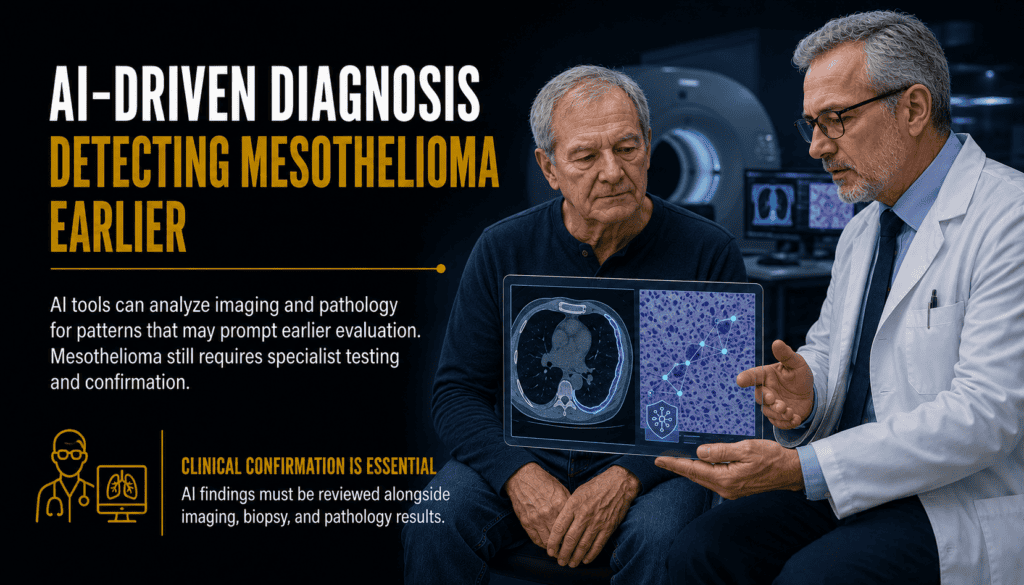
🤖 AI-Driven Diagnosis: Detecting Mesothelioma Earlier
Artificial intelligence (AI) is transforming how doctors diagnose and treat mesothelioma. With advanced imaging tools, machine learning algorithms, and predictive analytics, AI can detect early signs of mesothelioma far sooner than traditional methods — allowing for faster diagnoses, earlier interventions, and better patient outcomes.
By combining the power of data with medical expertise, AI is helping doctors find mesothelioma at stages when treatment is most effective — offering renewed hope for patients and families.
📞 Need help right now? Call 800.291.0963 for free answers and guidance today.
🧠 Step 1: How Artificial Intelligence Is Changing Diagnosis
AI analyzes massive amounts of medical data — from CT scans and pathology slides to genetic profiles — in seconds. Its ability to recognize subtle patterns that may escape the human eye is revolutionizing early detection.
AI tools can:
-
🩻 Identify tiny abnormalities on lung and abdominal scans.
-
🧬 Detect genetic and cellular markers linked to mesothelioma.
-
🧠 Compare thousands of patient cases to find diagnostic patterns.
-
📊 Predict likelihood of disease progression or treatment response.
Why it matters:
AI shortens diagnostic delays, ensuring patients begin treatment earlier — a critical factor in improving survival rates.
🔍 Step 2: Advanced Imaging and Machine Learning
AI-powered imaging software is becoming a key tool in mesothelioma diagnosis.
Breakthrough imaging technologies include:
-
🩺 Deep learning CT scan analysis: Detects mesothelioma tumors earlier and distinguishes them from benign pleural diseases.
-
🧫 Digital pathology analysis: AI evaluates biopsy slides to identify cancer cell subtypes with remarkable precision.
-
📷 MRI image enhancement: Machine learning sharpens image clarity to spot small or hidden tumors.
-
⚙️ Radiomics: Converts imaging data into quantifiable features to predict tumor behavior and treatment response.
Result:
Doctors can diagnose with greater accuracy, plan surgery more effectively, and track disease progression in real time.
🧬 Step 3: AI in Biomarker and Genetic Research
AI is accelerating biomarker discovery by analyzing complex genetic and molecular data.
Key advances include:
-
🔬 Identifying blood-based biomarkers like mesothelin, fibulin-3, and HMGB1 that signal mesothelioma presence.
-
🧠 Mapping genetic mutations such as BAP1 and NF2 that increase risk.
-
🧾 Predicting how individual patients will respond to chemotherapy or immunotherapy.
-
🧪 Using AI to detect pre-cancerous changes in cells before symptoms appear.
Impact:
These breakthroughs make it possible to diagnose mesothelioma earlier — often before it spreads — and personalize treatment to each patient’s genetic profile.
🩺 Step 4: Reducing Misdiagnosis and Diagnostic Delays
Mesothelioma can mimic other respiratory illnesses, leading to frequent misdiagnoses. AI-driven diagnostic tools are helping reduce that risk.
How AI helps:
-
⚕️ Compares CT and biopsy data against large, verified datasets.
-
💬 Flags suspicious tissue patterns for further review.
-
📈 Provides consistency across different hospitals and radiologists.
-
🔁 Continuously learns from new cases to improve accuracy.
Result:
Faster, more reliable diagnosis — ensuring patients receive appropriate care without unnecessary testing or delays.
💡 Step 5: AI-Assisted Treatment Planning
Beyond detection, AI is guiding doctors in creating personalized treatment strategies.
Applications include:
-
🧬 Predicting which therapy (surgery, chemotherapy, or immunotherapy) will be most effective.
-
⚖️ Optimizing radiation doses to minimize damage to healthy tissue.
-
📅 Scheduling treatments for maximum tolerance and success.
-
📊 Using predictive analytics to forecast patient outcomes.
Why it’s important:
AI ensures that every decision — from diagnosis to treatment — is backed by data and tailored to the patient’s individual needs.
🌎 Step 6: Global Research and AI Innovation
Hospitals and research centers worldwide are integrating AI to improve mesothelioma care.
Leading institutions and projects:
-
🏥 Mayo Clinic & MIT: Developing AI models that identify mesothelioma from CT scans with over 90% accuracy.
-
🇬🇧 University College London: Using deep learning to distinguish pleural thickening from cancerous growths.
-
🇯🇵 Kyoto University: Applying AI to automate genetic analysis of mesothelioma tissue samples.
-
🌍 European Cancer Research Network: Sharing international AI databases for cross-validation and model improvement.
Why it matters:
Global collaboration allows AI systems to learn from thousands of patient cases — accelerating breakthroughs in early detection and personalized medicine.
🧘 Step 7: The Future of AI in Mesothelioma Care
AI’s role will only expand as technology evolves.
Upcoming advancements:
-
🤖 Fully automated early-screening programs for high-risk individuals (e.g., asbestos-exposed workers).
-
🧬 Integration of AI with wearable health monitors for real-time symptom tracking.
-
☁️ Cloud-based diagnostic systems connecting local clinics with national experts.
-
🧫 Predictive modeling to anticipate recurrence and customize ongoing care.
Long-term vision:
A world where mesothelioma is detected early enough that it becomes highly treatable — transforming survival outcomes for thousands.
🤝 Where to Get Help
If you or a loved one has been exposed to asbestos or recently diagnosed with mesothelioma, our advocates can help connect you with specialized doctors, AI-powered diagnostic programs, and treatment centers using the latest technology.
📞 Call 800.291.0963 to speak with a Mesothelioma Help Center advocate today.
🧭 Summary
Artificial intelligence is redefining the fight against mesothelioma — helping doctors detect cancer earlier, diagnose with precision, and design treatments that work best for each patient.
Through advanced imaging, genetic mapping, and global collaboration, AI is creating a future where early detection means longer lives and greater hope.
You are not alone — expert help and modern technology are only one call away.
800.291.0963