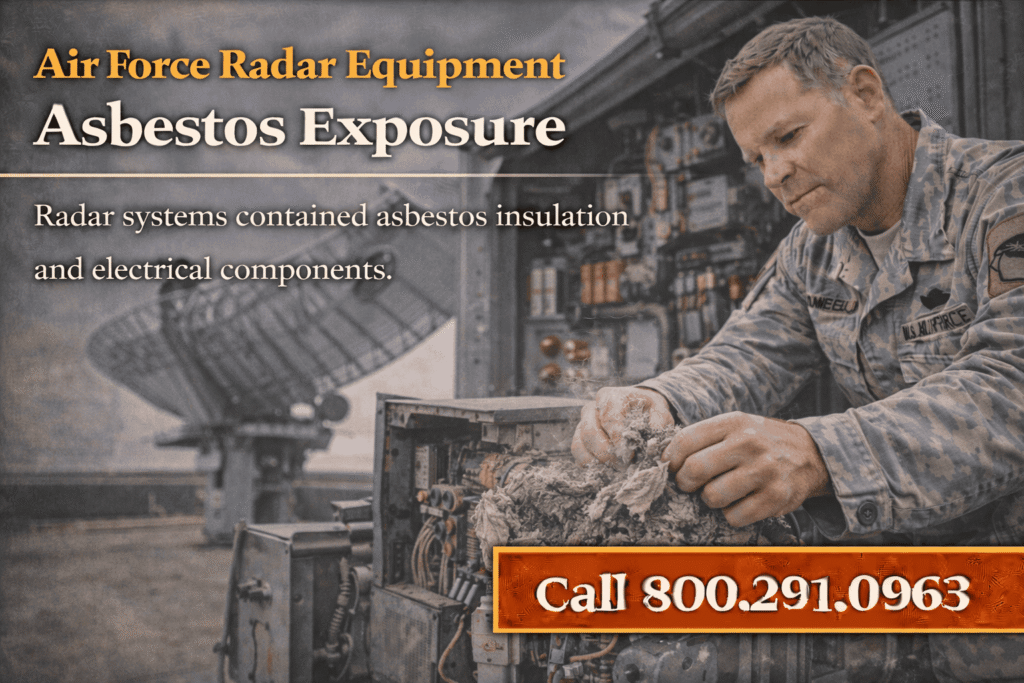
📡 Air Force Radar Equipment Asbestos Exposure
Radar Systems Contained Asbestos Insulation and Electrical Components
For decades, U.S. Air Force radar equipment exposed service members, civilian technicians, and maintenance personnel to asbestos-containing materials. From World War II through the late Cold War era, asbestos was widely used in radar transmitters, receivers, power supplies, waveguides, antenna systems, and control cabinets because it could withstand heat, electrical load, and continuous operation.
Radar systems were mission-critical to air defense, early-warning detection, air traffic control, missile tracking, and command-and-control operations. Air Force personnel routinely worked on radar equipment inside radar towers, control rooms, underground bunkers, mobile radar units, and remote installations, where asbestos-containing insulation, gaskets, wiring, and fireproofing were disturbed during maintenance and upgrades.
Today, many former Air Force veterans are being diagnosed with mesothelioma, asbestos-related lung cancer, and asbestosis decades after radar equipment exposure, leading to VA disability claims, asbestos trust fund filings, and Air Force radar equipment asbestos lawsuits against manufacturers that supplied asbestos-containing components to the military.
⚙️ Why Asbestos Was Used in Air Force Radar Equipment
Radar systems generated intense heat and relied on high-voltage electrical components that required fire-resistant and insulating materials. Asbestos was viewed as an ideal solution.
Asbestos was used in radar equipment because it provided:
-
Thermal insulation for heat-producing transmitters
-
Fire resistance around high-voltage components
-
Electrical insulation and arc protection
-
Durability under vibration and continuous operation
-
Cost-effective materials for large-scale military deployment
As a result, asbestos was incorporated into nearly every generation of Air Force radar systems, from fixed installations to mobile and overseas units.
🧱 Asbestos-Containing Components in Radar Equipment
Air Force radar equipment exposed workers through multiple asbestos sources, often during routine servicing.
⚡ Electrical Panels, Power Supplies & Switchgear
Radar systems relied on asbestos insulation in:
-
Power supply units
-
Switchgear cabinets
-
Control panels and breaker assemblies
Opening cabinets, replacing components, or upgrading systems disturbed asbestos materials.
👉 Related: Air Force Electrical Systems Asbestos Exposure
🔥 Transmitters, Receivers & Heat Shields
Radar transmitters generated extreme heat. Asbestos insulation, blankets, and heat shields were installed around components and released fibers as materials aged or failed.
⚙️ Gaskets, Seals & Packing
Waveguides, cooling systems, and power assemblies used asbestos gaskets and seals that released fibers when scraped or replaced.
🧱 Structural Fireproofing & Insulation
Radar rooms, towers, and equipment shelters often used asbestos fireproofing, wall insulation, ceiling panels, and flooring that deteriorated over time.
👉 Related: Air Force Radar & Communications Facilities Asbestos Exposure
🛠️ How Radar Equipment Maintenance Released Asbestos
Asbestos exposure did not require direct handling of asbestos products. Routine radar maintenance alone was enough.
Common exposure activities included:
-
Radar calibration and testing
-
Transmitter and receiver servicing
-
Electrical troubleshooting and upgrades
-
Cooling system repairs
-
Component replacement and retrofits
-
Emergency repairs during system failures
Much of this work was performed in confined control rooms, enclosed shelters, or underground facilities, allowing asbestos fibers to accumulate in the air.
👨✈️ Who Was Most Exposed to Radar Equipment Asbestos
Radar equipment asbestos exposure affected multiple Air Force specialties.
High-risk occupations include:
-
Radar technicians and operators
-
Electronics and communications specialists
-
Electrical technicians
-
Power and generator maintenance personnel
-
Civil engineering and facility maintenance crews
-
Missile warning and air-defense personnel
-
Contractors assigned to radar sites
-
Air Force Veterans Mesothelioma Lawsuit claimants
Many individuals worked with radar equipment daily for years, resulting in cumulative asbestos exposure.
🏢 Exposure Occurred at Radar Sites Worldwide
Radar equipment asbestos exposure occurred at:
-
Stateside Air Force bases
-
Remote radar stations and early-warning sites
-
NORAD and Cold War defense installations
-
Overseas bases in Europe, Asia, and the Arctic
-
Missile tracking and air-defense facilities
Large installations such as Wright-Patterson, Eglin, Tinker, Hill, Andrews, Luke, and Elmendorf supported extensive radar operations.
👉 Related: Major Air Force Bases Asbestos Exposure & Mesothelioma Lawsuits
🦠 Diseases Linked to Radar Equipment Asbestos Exposure
Asbestos-related diseases typically develop 20 to 50 years after exposure, meaning many veterans are diagnosed long after service ends.
🦠 Mesothelioma
A rare and aggressive cancer affecting the lining of the lungs or abdomen. Long-term radar equipment exposure is a recognized cause.
👉 Learn more: Air Force Mesothelioma Lawsuits & Asbestos Exposure
🫁 Asbestos-Related Lung Cancer
Caused by prolonged inhalation of asbestos fibers released from insulation and electrical components.
🫁 Asbestosis
A chronic lung disease marked by scarring, reduced lung capacity, and long-term breathing impairment.
🧪 Why Radar Equipment Exposure Was Especially Dangerous
Air Force radar environments created high-risk asbestos exposure conditions:
-
Continuous heat degrading insulation
-
High-voltage equipment disturbing asbestos repeatedly
-
Confined control rooms trapping fibers
-
Remote sites with limited ventilation
-
Long shifts and continuous operations
-
No asbestos warnings or respirators
Because asbestos fibers are microscopic, many Air Force personnel inhaled them unknowingly for years.
⚖️ Legal Options for Air Force Radar Equipment Asbestos Exposure
Veterans and civilian workers diagnosed with asbestos-related diseases may qualify for multiple compensation pathways.
⚖️ Air Force Radar Equipment Asbestos Lawsuits
Claims against manufacturers of asbestos-containing radar systems, insulation, gaskets, and electrical components supplied to the Air Force.
These lawsuits do not sue the U.S. Air Force.
🏦 Asbestos Trust Fund Claims
Many radar and electrical equipment manufacturers established trust funds. Claimants may qualify for multiple trust payouts.
🎖️ VA Disability & Survivor Benefits
Eligible benefits may include:
-
Monthly VA disability compensation
-
VA medical care
-
Dependency and Indemnity Compensation (DIC)
VA benefits do not block lawsuits or trust claims.
❓ Frequently Asked Questions – Radar Equipment Asbestos Exposure
1️⃣ Did Air Force radar equipment contain asbestos?
Yes. Insulation, electrical components, gaskets, and heat shields often contained asbestos.
2️⃣ Can exposure from decades ago still qualify?
Yes. Mesothelioma commonly develops 20–50 years after exposure.
3️⃣ I worked radar systems, not aircraft—am I at risk?
Yes. Radar and electronics work is a recognized asbestos exposure source.
4️⃣ Can I file VA claims and lawsuits together?
Yes. These options are separate and complementary.
5️⃣ Will I need to go to court?
Most asbestos cases settle without trial.
📞 Legal Help for Air Force Radar Equipment Asbestos Exposure
If you worked around Air Force radar equipment and were later diagnosed with mesothelioma or an asbestos-related lung disease, you may be entitled to significant financial compensation.
📞 Call 800-291-0963 for a free, confidential Air Force veteran case review.
⚖️ How an Air Force Asbestos Lawyer Can Help
An experienced asbestos lawyer can:
🔍 Trace exposure to specific radar systems and components
🏦 Identify all applicable trust funds
🎖️ Coordinate VA benefits with legal claims
💰 Maximize compensation for veterans and families
📞 Call 800-291-0963 today for a free case review.