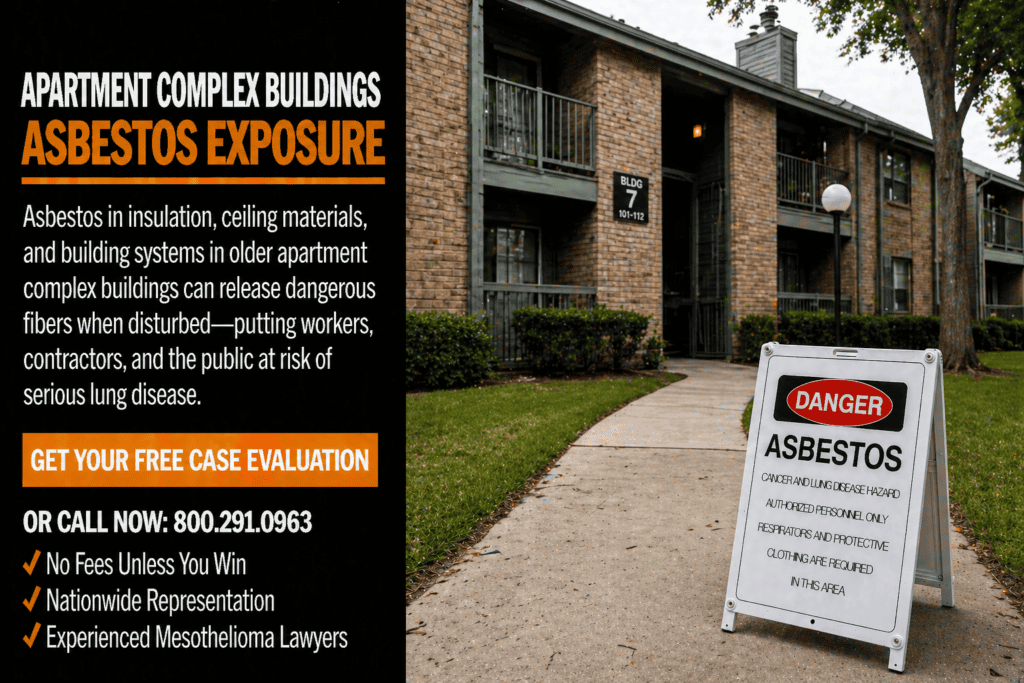
🏢 Apartment Complex Buildings Asbestos Exposure
Apartment Complex Buildings Asbestos Exposure explains how asbestos-containing materials or dust may have affected people in apartment complexes. Historical building materials and work practices varied by place and decade; a specific property or activity should not be assumed to contain asbestos without supporting evidence.
For anyone diagnosed with mesothelioma or asbestos-related lung cancer, this guide explains potential exposure pathways, medical information, relevant records and possible legal resources. The main Asbestos Exposure in Homes page provides additional context.
🏠 Understanding the Exposure
Potential exposure in apartment complexes depends on the presence of asbestos, whether fibers were released and whether a person inhaled them. Relevant situations include common areas, utility rooms, floor coverings and renovations. Asbestos was historically incorporated into some building products because of its heat resistance and durability. Intact materials are different from materials being broken, drilled, cut or removed.
Exposure reconstruction should focus on dates, the actual material, how it was handled and the person’s proximity. For apartment complexes, evidence may include tenant notices, lease records, work orders and photographs. A property name, job title or year of construction alone does not establish an individual’s exposure.
People who handled contaminated clothing or lived with an exposed worker may also need to review secondhand asbestos exposure and the household clothing and shoes guide.
Building a Reliable Exposure Timeline
Begin with the earliest possible date, then identify each address, employer, work assignment or renovation event. Separate what you personally remember from information confirmed by records. For apartment complexes, details such as the room, floor, equipment location and time spent nearby may be useful. Include both short, intensive projects and repeated activities over several years.
Whenever possible, match a product or material to the relevant period. A later replacement component may not have the same composition as the original. Keep a list of documents you have obtained and those still missing. This organized record can make conversations with doctors, inspectors and legal professionals more productive.
Understanding What Evidence Can and Cannot Show
An inspection report establishes what was observed or sampled at a particular time. It does not automatically establish the condition of a material decades earlier. Similarly, a building permit can establish that work was authorized without identifying every product disturbed during the work. Witness accounts may help fill gaps, but dates and details should be checked against available records.
Evidence about a potentially responsible product should be evaluated separately from medical causation and any legal duty owed. Keeping these questions distinct helps avoid overstatements and supports a clearer assessment of available options.
🏢 Where Exposure Can Occur
Potential exposure settings include common areas, utility rooms, floor coverings and renovations. Different areas of the same building can have different construction histories. Renovation dates, material substitutions and past abatement work are important.
| Area or activity | Possible concern | Evidence to preserve |
|---|---|---|
| Heating and mechanical spaces | Older pipe, boiler or equipment insulation disturbed during repair | Equipment manuals, maintenance orders and photographs |
| Floors and interior finishes | Some historic floor coverings, adhesives and textured finishes | Renovation dates, product records and inspection results |
| Building renovation or demolition | Dust from cutting, sanding or removing suspect materials | Permits, contractor names, work schedules and notices |
| Household or shared spaces | Transfer of dust on clothing or movement of disturbed debris | Household timelines and witness recollections |
Not all materials in these categories contained asbestos. When current disturbance is planned, a qualified professional should assess suspect material before work begins.
👥 People and Occupations
People potentially affected include tenants, building maintenance workers and contractors. The exposure history may differ between those who directly disturbed material and those who occupied nearby rooms or cleaned dust after work.
| Group | Relevant questions |
|---|---|
| Residents or occupants | Were they present during demolition, maintenance or dusty renovations? |
| Maintenance employees | Did work involve older pipe insulation, flooring, boilers or mechanical systems? |
| Construction contractors | Which materials were cut, removed, repaired or replaced? |
| Family members | Was dust carried into living spaces on clothing, footwear or equipment? |
Work records and housing documents may identify the timing and nature of activities. Apartment managers, maintenance records and renovation notices can help, but must be evaluated alongside medical and product evidence.
🧱 Materials and Evidence
Historically, certain insulation, resilient floor coverings, roofing and siding, textured coatings, fireproofing and mechanical equipment components contained asbestos. Product composition changed over time, so a broad product category is not proof of asbestos content.
| Material or record | Why it matters |
|---|---|
| Product label, invoice or specification | May help identify a manufacturer and particular formulation |
| Inspection and laboratory documentation | Can establish whether a sampled material contained asbestos |
| Maintenance and renovation files | May connect disturbance of a material to a date and location |
| Photographs and witnesses | May help reconstruct conditions and identify people present |
When planning to disturb a suspected material, review testing your home for asbestos and obtain qualified professional advice. Avoid collecting samples or using household cleaning methods that could spread dust.
🫁 Mesothelioma
Mesothelioma is a cancer that develops in the lining of certain organs, most often the pleura surrounding the lungs. Asbestos exposure is its principal established cause. The disease may not become apparent until decades after exposure, so a diagnosis today can lead families to examine work or housing events from many years earlier.
Symptoms such as shortness of breath, chest pain, fatigue and fluid around the lungs are not unique to mesothelioma. Diagnosis requires a clinician’s evaluation, imaging and usually pathology. Treatment decisions should be discussed with a qualified medical team.
People with a confirmed diagnosis can preserve pathology reports, scans, employment history, residential addresses and dates of renovation or other potential exposure. This documentation may help with medical history and any later legal review. It does not by itself prove the cause of an individual case.
🩺 Asbestos-Related Lung Cancer
Asbestos-related lung cancer begins in lung tissue and is different from mesothelioma. Asbestos is a recognized cause of lung cancer. Smoking and asbestos together substantially increase lung cancer risk, but smoking history does not automatically rule out asbestos as a contributing exposure.
A physician may review imaging, pathology, smoking and occupational history and other clinical information. For a possible claim, exposure records and product identification may also be relevant. A residence or workplace’s age is not sufficient evidence of causation.
Anyone with new or concerning respiratory symptoms should seek medical care rather than relying on a webpage to diagnose illness. If a diagnosis has been established, maintain copies of the medical records and a detailed exposure timeline.
⚖️ Lawsuits and Compensation
Depending on medical findings, exposure evidence and applicable law, a person diagnosed with an asbestos-related disease may be able to explore a personal-injury lawsuit, wrongful-death claim or asbestos bankruptcy trust claim. Not every home-related exposure creates a viable claim, and compensation is never guaranteed.
Potential responsibility can turn on the product manufacturer, supplier, contractor, property owner, employment relationship and jurisdiction. The legal rules for residents, employees and visitors may differ. Identifying asbestos at a property does not by itself identify a legally responsible party.
Filing deadlines can be affected by state law, discovery, diagnosis, death and other facts. A qualified attorney can explain which deadlines and proof requirements apply to a specific situation. Keep treatment records, photographs, building records and any communications concerning the material.
🛡️ Protecting Families and Next Steps
For current safety concerns, avoid cutting, sanding, sweeping or disturbing material suspected of containing asbestos. An appropriately trained and qualified professional can advise whether the material should be left in place, encapsulated or removed under applicable rules. An ordinary household vacuum is not suitable for cleaning suspect asbestos debris.
If the concern involves an occupied rental property, preserve communications with management and seek information about inspection, planned work and applicable local requirements. For family exposure related to work clothing, consult protecting families from secondary asbestos exposure.
Related Homes resources include Hotel Buildings Asbestos Exposure; Residential and Community Asbestos Exposure; Understanding Household Exposure Paths: Clothing, Shoes & Furniture; Testing Your Home for Asbestos: What You Should Know. These links are provided to help readers follow the topic that most closely matches their experience rather than treating all household exposure as the same event.
❓ Frequently Asked Questions
Does every older building contain asbestos?
No. Certain historic products contained asbestos, but age and appearance alone cannot identify asbestos in a specific property.
Can residents be exposed during renovation?
If asbestos-containing materials are disturbed, fibers can become airborne. Actual exposure depends on the material, work and proximity.
How can a material be checked?
Qualified inspectors and appropriately accredited laboratories can assess or test suspect materials; do not disturb material merely to check it.
Can family members be affected without handling asbestos directly?
Yes. Nearby renovation dust and take-home fibers from clothing or tools are potential exposure pathways.
Does a mesothelioma diagnosis prove which building caused exposure?
No. A medical diagnosis and a documented exposure history are separate pieces of evidence.
Is asbestos-related lung cancer different from mesothelioma?
Yes. Lung cancer begins in lung tissue; mesothelioma usually develops in the lining around the lungs.
What records should be saved?
Medical reports, address and work timelines, photographs, inspection results, permits and maintenance records can be helpful.
Are lawsuits or trust fund claims guaranteed?
No. Each claim has its own medical, exposure, legal and filing requirements.
📌 Summary
Apartment Complex Buildings Asbestos Exposure explains how historical materials and activities may have created exposure concerns. For a person diagnosed with mesothelioma or asbestos-related lung cancer, medical records, a careful timeline and verified material information can help clarify available resources. Read the main Asbestos Exposure in Homes page for related topics.
☎️ Review Your Asbestos Exposure History
GET THE COMPENSATION YOU DESERVE
Call 800.291.0963 — Open 24/7, 365 days a year. Helping people for more than 25 years.
Disclaimer: Mesothelioma Help Center is not a law firm or medical provider and does not determine legal or VA eligibility. This information is general and not medical or legal advice.