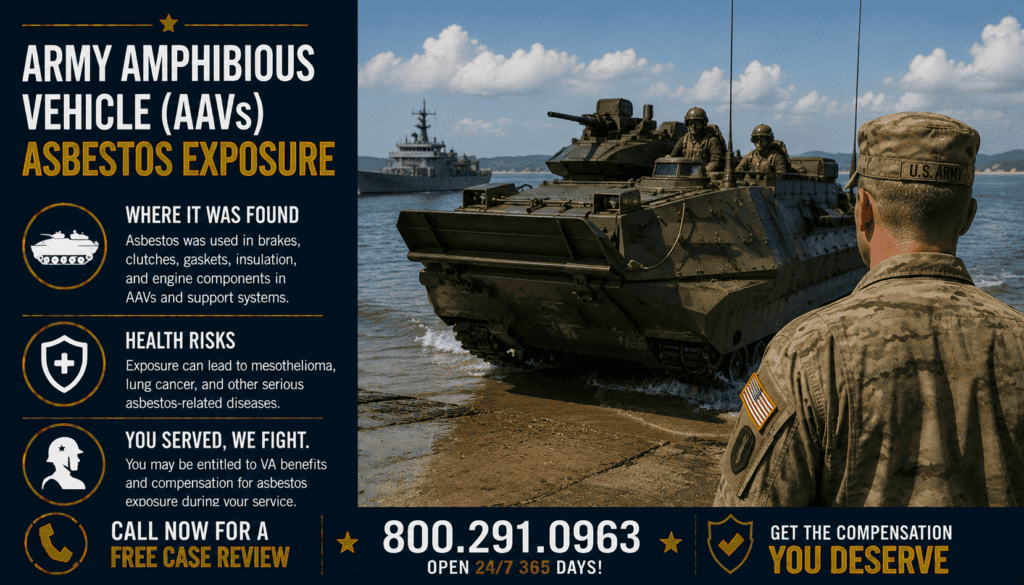
🌊 Army Amphibious Vehicles Asbestos Exposure (AAVs)
Amphibious Assault Vehicles (AAVs) played a critical role in U.S. Army operations requiring both land and water mobility. These armored vehicles transported troops, supplies, and equipment across coastal zones, rivers, and beaches during combat and humanitarian missions. To meet the extreme demands of amphibious operations, AAVs were built with heat-resistant and durable components—many of which contained asbestos.
Asbestos was widely used in brake pads, engine insulation, gaskets, and fire barriers within AAV systems. Army mechanics and operators were regularly exposed during maintenance, repairs, and field servicing. Confined engine compartments and poor ventilation during brake work and engine overhauls made asbestos exposure especially dangerous.
🌊 Army AAVs – What You’ll Learn from This Page:
-
U.S. Army amphibious vehicles contained asbestos in brake systems, insulation, gaskets, and clutches. Maintenance personnel and crew were exposed to toxic fibers during regular service and emergency repairs.
-
Army veterans and contractors who worked with AAVs and later developed mesothelioma, lung cancer, or asbestosis may qualify for compensation.
-
Brake changes, gasket removal, and engine insulation replacement often released airborne asbestos fibers into tight spaces onboard and in maintenance zones.
-
Over $30 billion remains available in asbestos trust funds. AAV-related claims often settle between $275,000 and $475,000.
-
VA disability compensation for service-connected mesothelioma from AAV exposure can exceed $3,800/month, tax-free.
-
Legal settlements for amphibious vehicle-related asbestos claims often reach $1.2 to $1.6 million. Some verdicts have topped $5 million.
-
Free legal evaluations are available for veterans and families exposed while working on AAVs.
📊 Estimated Number of People Exposed via Army AAVs
| Exposure Category | Estimated Number of People Exposed |
|---|---|
| AAV Mechanics and Maintenance Crews | Over 98,000 exposed |
| Operators and Crew Members | Around 44,000 exposed |
| Field Service Technicians | About 36,000 exposed |
| Depot and Refit Personnel | Nearly 51,000 exposed |
Total Estimated Exposure: Over 229,000 personnel.
🔧 Why Asbestos Was Used in Army Amphibious Vehicles
Amphibious vehicles required fireproofing and resistance to high heat and saltwater conditions:
-
Brake Linings – Used asbestos to handle high-friction coastal operations
-
Engine Gaskets – Contained asbestos for reliable seals under stress
-
Clutch Systems – Relied on asbestos for durability and performance in wet conditions
-
Engine & Exhaust Insulation – Used asbestos to reduce compartment heat and fire risk
-
Interior Panels – Included asbestos fireproofing near power and electrical systems
Frequent exposure to saltwater and heat caused component degradation, increasing the need for asbestos-related repairs and boosting exposure risk.
🌍 Amphibious Vehicle Use Across Army Missions
| Deployment Area | Primary Use | Common Locations |
|---|---|---|
| Coastal Combat Ops | Troop and equipment deployment | River crossings, beach landings |
| Humanitarian Relief | Disaster response & flood rescues | Coastal cities, island territories |
| Recon & Patrol | Near-shore surveillance operations | Wetlands, rivers, deltas |
Daily use in harsh conditions led to frequent mechanical failures, exposing personnel to asbestos during routine upkeep.
📋 Estimated Number of Army Personnel Exposed from AAV Use
| Occupation Group | Estimated Number Exposed |
|---|---|
| Vehicle Mechanics | Over 7,000 |
| Amphibious Operators | Approx. 6,100 |
| Field Technicians | Around 5,200 |
| Depot Maintenance Crews | Nearly 4,400 |
Total Estimated Exposure: Over 22,700 personnel.
⚙️ Asbestos Exposure Areas on Army Amphibious Vehicles
-
Braking Systems – Pads and drums lined with asbestos; ground down during service
-
Clutch Assemblies – Fiber components exposed technicians during repairs
-
Engine Compartments – Sealed with asbestos gaskets and wrapped in insulation
-
Interior Fire Barriers – Asbestos panels degraded and released dust
-
Exhaust & Power Areas – Used asbestos for thermal control and fire prevention
🚨 High-Risk Amphibious Vehicle Personnel
| Job Role | Exposure Risk | Details |
|---|---|---|
| Mechanics | High | Performed brake, engine, and clutch repairs |
| Operators | Moderate | Worked in enclosed, insulated compartments |
| Field Repair Crews | High | Repaired vehicles under harsh, humid conditions |
| Depot Staff | High | Replaced aging asbestos-laden systems |
🧰 Common Asbestos Products in Army Amphibious Vehicles
-
Brake Pads & Linings – Most frequently replaced components
-
Clutch Discs & Facings – High-friction parts with woven asbestos
-
Engine Gaskets – Used in high-temperature seal zones
-
Heat Wraps & Shields – Lined engine and exhaust components
-
Fireproof Panels – Installed near wiring and fuel compartments
🏥 Long-Term Health Risks from Asbestos Exposure
-
Mesothelioma – Aggressive and incurable cancer caused by asbestos
-
Asbestosis – Chronic lung scarring and respiratory failure
-
Lung Cancer – Elevated risk with long-term exposure
-
Pleural Thickening – Restricts breathing due to chest membrane hardening
⚖️ Lawsuits Filed by AAV Mechanics & Crew
-
Veterans diagnosed years after working on AAVs
-
Legal claims target parts manufacturers, not the military
-
Surviving families may file wrongful death lawsuits
-
Lawsuits filed for exposure in combat zones, training bases, and depots
💵 Sample Army AAV Asbestos Settlements
| Settlement Amount | Case Details |
|---|---|
| $3.2 million | Mechanic exposed to AAV brake and gasket dust, developed mesothelioma |
| $2.6 million | Crewman with lung cancer linked to insulation breakdown in vehicle |
| $2.4 million | Field tech serviced AAVs near riverbanks, diagnosed with asbestosis |
| $2.0 million | Depot technician regularly handled asbestos parts without protection |
🏭 Companies Linked to Asbestos Parts in AAVs
-
Raybestos – Brake and clutch components
-
Bendix – Friction systems in brake kits
-
Johns-Manville – Heat shields and exhaust wrap
-
Federal-Mogul – Engine gaskets and pressure seals
-
Owens Corning – Panel insulation and fiberboard
💰 Asbestos Trust Funds for Army AAV Personnel
-
Over $30 billion remains available for approved claims
-
Average AAV claims range from $300,000 to $600,000+
-
Trust fund claims do not interfere with VA benefits
-
Veterans can still file decades after discharge
🎖️ VA Benefits for Army AAV Veterans
-
$3,800+/month tax-free for 100% mesothelioma disability
-
Access to top-tier VA cancer centers for treatment
-
VA DIC compensation for surviving spouses and dependents
-
Priority health care for all asbestos-related diagnoses
📝 Filing an Army Amphibious Vehicle Asbestos Claim
-
Confirm diagnosis of mesothelioma or asbestos-related cancer
-
Gather Army records linking your service to AAVs or maintenance
-
File legal and trust claims with experienced asbestos attorneys
-
Most claims resolve with compensation in 6–12 months
⏳ Statute of Limitations
-
Injury Claims: File within 2–3 years of diagnosis
-
Wrongful Death: File within 2–3 years of veteran’s death
-
Trust Fund Claims: No strict deadlines—many stay open indefinitely
❓ Army AAV Asbestos Exposure FAQs
Q: Were Army amphibious vehicles made with asbestos?
Yes. AAVs built before 1990 often included asbestos in brakes, engines, and insulation.
Q: Can I still file if my service ended decades ago?
Yes. Many successful claims are from veterans who served in the 1960s–1980s.
Q: Will a legal claim affect my VA compensation?
No. Legal claims are handled separately from VA benefits.
Q: Can families file if the veteran has passed away?
Yes. Survivors may pursue wrongful death lawsuits and VA DIC compensation.
📞 Talk to a Legal Advocate for Army AAV Asbestos Exposure
Call 800.291.0963 for a free case review.
Skilled legal professionals are available to help file claims for Army amphibious vehicle-related asbestos exposure.