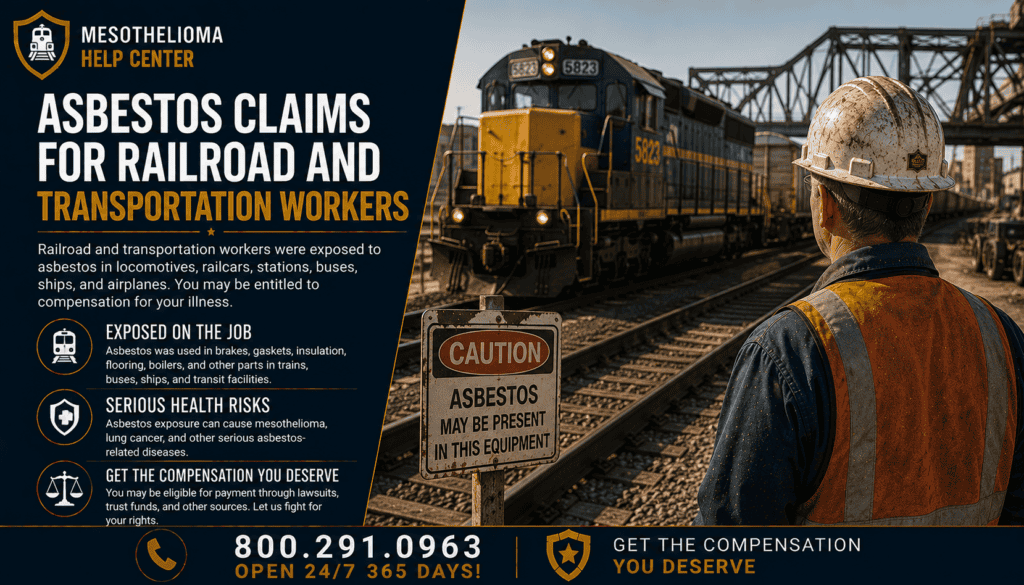
🚆 Asbestos Claims for Railroad and Transportation Workers
See how mechanics, conductors, and engineers qualify for compensation due to asbestos in brakes and insulation.
For more than 60 years, railroad and transportation companies relied heavily on asbestos to insulate engines, line brake systems, protect electrical components, and shield workers from extreme heat. Mechanics, conductors, brakemen, engineers, shop workers, and yard crews often spent decades surrounded by asbestos dust—without being warned of the danger.
Today, thousands of former railroad workers have developed mesothelioma, lung cancer, or asbestosis from long-term exposure. Fortunately, federal laws and legal precedents give transportation workers powerful rights to pursue compensation.
This guide explains how exposure occurred, how to prove it using railroad records, and how workers—or their families—can file claims.
For immediate legal help, call 800.291.0963.
🚂 How Railroad and Transportation Workers Were Exposed to Asbestos
Railroad companies relied on asbestos for its durability, heat resistance, and insulation qualities. Nearly every component of a locomotive or passenger rail system contained asbestos at some point.
Common asbestos-containing materials used in railroads included:
-
Brake shoes and brake linings
-
Clutch assemblies
-
Pipe insulation and boiler lagging
-
Steam lines and hot-water systems
-
Gaskets and packing
-
Electrical panels and wiring insulation
-
Floor tiles and ceiling panels in passenger cars
-
Welding blankets and fireproof gloves
-
Heating units and radiators
Where exposure occurred:
-
Locomotive repair shops
-
Roundhouses
-
Brake-repair bays
-
Engine rooms
-
Car-maintenance facilities
-
Train yards
-
Diesel shops
-
Onboard passenger cars during travel
-
Trackside work when older equipment broke down
Even workers who never handled asbestos directly inhaled dust from repairs, brake changes, or material deterioration.
👷 Workers at Highest Risk in Railroad and Transportation Jobs
Although nearly all railroad personnel faced exposure, certain job titles were affected the most.
High-risk positions include:
-
Mechanics and maintenance workers
-
Conductors and engineers
-
Brakemen and switchmen
-
Pipefitters and steamfitters
-
Electricians and welders
-
Carman and car-repair personnel
-
Diesel mechanics
-
Roundhouse laborers
-
Equipment operators
-
Track-maintenance crews
-
HVAC and electrical technicians
Even clerks, ticket agents, or dispatchers who frequently worked inside maintenance buildings encountered airborne dust.
📜 Proving Asbestos Exposure in Railroad Claims
One major advantage railroad workers have is the extensive documentation rail companies kept during the 20th century. Attorneys use these records to prove exposure—even if the employee worked decades ago.
1. Maintenance and repair logs
These show:
-
Brake replacements
-
Pipe insulation repairs
-
Boiler maintenance
-
Gasket and packing changes
-
Car overhauls and engine rebuilds
2. Locomotive blueprints and engineering diagrams
Blueprints often list:
-
Asbestos-containing insulation
-
Brake components
-
Steam-line coverings
-
Electrical insulation materials
3. Manufacturer product lists
Common asbestos manufacturers used by railroads include:
-
Johns-Manville
-
Raybestos-Manhattan
-
Eagle-Picher
-
Owens-Corning
-
Abex
-
Garlock
Law firms match these products to job-site duties.
4. Industrial hygiene studies
Many railroads conducted air sampling that documented asbestos dust in:
-
Brake shops
-
Engine rooms
-
Tight mechanical spaces
5. Union records and job descriptions
Railroad unions historically kept clear documentation of:
-
Craft duties
-
Exposure environments
-
Safety hazards
6. Co-worker testimony
Fellow employees can confirm:
-
Work conditions
-
Repair practices
-
Visible dust during tasks
-
Which materials workers handled regularly
7. Railroad company archives
Old safety manuals, procurement records, and equipment catalogs often identify asbestos components.
All this evidence helps prove strong, detailed exposure histories.
⚖️ Legal Protections: Why Railroad Workers Have Unique Rights
Railroad employees are protected by the Federal Employers’ Liability Act (FELA)—a powerful law that allows workers to sue railroad companies directly if negligence contributed to illness.
Under FELA, workers can recover compensation for:
-
Medical costs
-
Lost income
-
Pain and suffering
-
Reduced earning capacity
-
Wrongful-death damages
-
Punitive damages (in some cases)
The law does not require railroads to be 100% responsible.
Even partial negligence is enough to win compensation.
This makes railroad cases stronger than many other types of asbestos claims.
💼 Other Legal Options for Railroad Workers
In addition to FELA lawsuits, many workers qualify for multiple compensation channels.
1. Asbestos Trust Funds
Railroads purchased asbestos materials from dozens of manufacturers that later went bankrupt. Trust claims can be filed without going to court.
2. Product-liability lawsuits
Workers can sue manufacturers of:
-
Brake systems
-
Insulation
-
Gaskets and packing
-
Electrical components
-
Fireproofing materials
3. Workers’ Compensation (in limited situations)
Some contracted workers, rather than railroad employees, may qualify for state workers’ comp programs.
4. Wrongful-Death Claims
Families can file claims if a loved one passed away due to asbestos-related disease.
5. Veterans’ Claims
Many railroad workers also served in the military, where asbestos exposure was common.
VA disability benefits may be available.
🩺 Medical Evidence Needed for a Strong Claim
A successful claim requires medical proof that asbestos caused the illness.
Common medical documentation includes:
-
CT scans or PET scans
-
Biopsy results
-
Immunohistochemistry (IHC) testing
-
Pulmonary-function tests
-
Pathology confirming mesothelioma, lung cancer, or asbestosis
-
Occupational-exposure summary
Mesothelioma’s strong link to asbestos makes these claims especially credible.
💰 Compensation Available to Railroad & Transportation Workers
Compensation varies depending on exposure history, diagnosis, and defendants involved.
Possible financial recovery includes:
-
Medical bills (past and future)
-
Lost income or early retirement losses
-
Pain and suffering
-
Travel for cancer treatment
-
At-home caregiving expenses
-
Household-service costs
-
Funeral expenses
-
Wrongful-death compensation
-
Punitive damages in extreme negligence cases
Many railroad workers qualify for multiple settlements from different defendants.
🏛️ Landmark Railroad Asbestos Cases
Several landmark lawsuits prove railroad companies’ long-term negligence.
🔹 Brake Repair Cases
Courts ruled that railroads knew brake dust contained asbestos but failed to warn workers.
🔹 Shop-Facility Exposure
Roundhouse and repair-shop cases showed extreme airborne asbestos levels, especially during brake changes and insulating work.
🔹 Locomotive Boiler & Steam Line Cases
Manufacturers were held liable for selling equipment packed with asbestos insulation.
🔹 Diesel Shop Contamination
Many diesel-repair centers were shown to have asbestos dust coating floors, beams, and workstations.
These cases created the legal foundation for modern railroad claims.
📅 Statute of Limitations: Don’t Wait to File
Railroad asbestos claims have strict deadlines.
FELA claims
Must typically be filed within 3 years of diagnosis.
Wrongful-death claims
Must generally be filed within 3 years of death.
Because symptoms may not appear for decades, victims should contact an attorney immediately after diagnosis.
📝 What Railroad Workers Should Do Now
If you or a loved one were diagnosed with mesothelioma or another asbestos-related disease:
Take these steps right away:
-
List all railroads and facilities where you worked
-
Document your job duties and exposure points
-
Gather union or employment records
-
Contact former co-workers
-
Speak with a mesothelioma specialist
-
Contact an attorney experienced in railroad asbestos litigation
The more detailed your work history, the stronger your claim.
📞 Get Legal Help for Railroad & Transportation Asbestos Exposure
Railroad and transportation workers face some of the highest asbestos exposure levels of any industry. If you or a family member developed mesothelioma or lung cancer after working on trains, in shops, or inside rail facilities, you may qualify for significant compensation.
Our team specializes in reconstructing railroad work histories, analyzing brake and equipment records, and filing FELA and trust-fund claims.
Call 800.291.0963 today for free legal help.