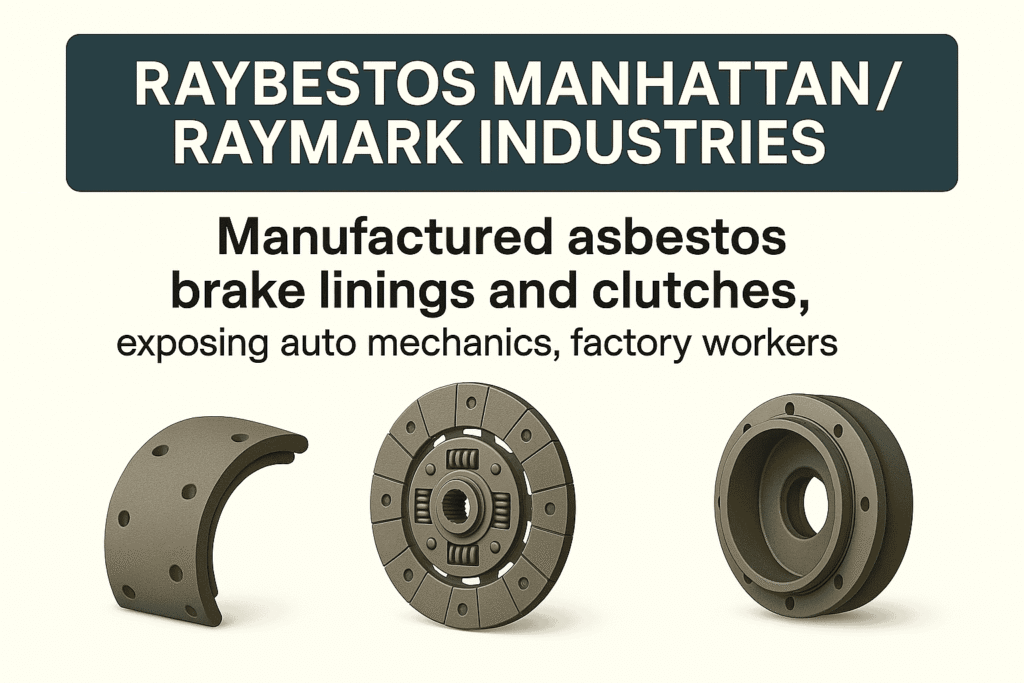
Raybestos-Manhattan and Raymark Industries Asbestos Exposure
Raybestos-Manhattan and its successor, Raymark Industries, manufactured automotive and industrial friction materials for much of the twentieth century. Federal records identify brake linings and clutch facings among the products made at the company’s Stratford, Connecticut, operation. Those records also document the use of asbestos and the environmental consequences of decades of manufacturing.
This page focuses on the manufacturer and its corporate succession. It is distinct from a general Raybestos brand page and from a Raytech Corporation page centered on bankruptcy and trust administration. A valid claim still requires evidence connecting a person’s work, product or location to a covered Raybestos-Manhattan or Raymark exposure.
🏢 Raybestos-Manhattan and Raymark Company History
The business began with the A.H. Raymond Company and developed the Raybestos name for friction materials. A 1929 merger with Manhattan Rubber Manufacturing Company created Raybestos-Manhattan. The company later adopted the Raymark name. Because records may use any of these names, claim research should follow the corporate history instead of searching for only one label.
| Period | Documented development | Claim relevance |
|---|---|---|
| Early 1900s | The A.H. Raymond Company developed the business associated with Raybestos friction products. | Older records may predate the Raybestos-Manhattan name. |
| 1929 | Raybestos and Manhattan Rubber Manufacturing Company combined. | The Raybestos-Manhattan name appears in product and employment histories. |
| 1919–1989 | DOJ records describe friction-product manufacturing at Stratford. | Plant work and product manufacture require date-specific investigation. |
| 1982 | The company adopted the Raymark name. | Later records may identify Raymark rather than Raybestos-Manhattan. |
| 1986–1988 | Raytech was formed and later divested Raymark while acquiring selected non-asbestos businesses. | The restructuring led to successor-liability litigation. |
| 1989 onward | Raytech entered Chapter 11 and later reorganized around an asbestos trust. | Qualifying liabilities are evaluated through the Raytech Trust process. |
| Name | Role | Accuracy point |
|---|---|---|
| Raybestos | Historical friction-product trade name. | A brand name alone does not prove a particular product’s composition. |
| Raybestos-Manhattan | Historical manufacturer created by the 1929 combination. | Important in plant, catalog and employment records. |
| Raymark Industries | Later corporate name for the manufacturer. | Federal records connect Raymark to the Stratford operation. |
| Raytech Corporation | Company created during restructuring. | Courts addressed its responsibility for Raymark asbestos liabilities. |
| Raytech PI Trust | Bankruptcy trust that reviews qualifying claims. | It is not a product manufacturer. |
Modern businesses and products using the Raybestos name should not automatically be treated as the same historical entity or formulation. The relevant evidence is the manufacturer, product, dates, facility and legal relationship applicable to the individual exposure.
⚙️ Raybestos-Manhattan and Raymark Asbestos Products
The U.S. Department of Justice states that Raymark manufactured friction products, including brake linings and clutch facings, from 1919 through 1989 and disposed of asbestos and other contaminants. This is strong evidence of historical asbestos use, but it does not establish that every item bearing a related brand contained asbestos.
| Category | Historical function | Evidence to seek |
|---|---|---|
| Brake linings | Provided friction in drum brake assemblies. | Packaging, part number, catalog, vehicle and service date. |
| Clutch facings | Transferred power in clutch assemblies. | Brand, equipment, supplier and replacement records. |
| Brake blocks | Served heavier automotive or industrial braking applications. | Equipment type, markings and purchasing records. |
| Brake shoes or pads | Held or incorporated friction material. | Exact component, formulation and manufacturing period. |
| Industrial friction materials | Provided heat-resistant friction in machinery. | Application, plant, product literature and date. |
| Question | Careful answer |
|---|---|
| Did historical Raymark operations use asbestos? | Yes. Federal records document asbestos in the company’s friction-material operations. |
| Did every Raybestos product contain asbestos? | No. Composition varied by item and period. |
| Does a logo establish the manufacturer? | Not by itself; investigate packaging, invoices and corporate dates. |
| Do current products prove past exposure? | No. Historical and modern formulations must be separated. |
| Should an old component be disturbed for identification? | No. Use safe documentary and photographic evidence. |
Product proof is strongest when several details agree: the printed name, part number, application, purchase source, year and testimony from someone who used or supplied the component. Generic recollection of “brake dust” is less specific.
👨🔧 Workers and Job Sites Linked to Raymark Friction Materials
Potential exposure extended beyond vehicle mechanics. Manufacturing employees could encounter raw materials, compounds, unfinished parts and production dust. Maintenance and cleanup employees could work around equipment or settled residue. Outside the plant, mechanics and rebuilders could disturb qualifying historical components during removal, fitting or resurfacing.
| Worker | Possible contact | Useful proof |
|---|---|---|
| Production worker | Mixing, molding, curing or finishing friction material. | Department, task, shift, dates and coworkers. |
| Machinist or finisher | Grinding, drilling or shaping manufactured components. | Machine, product line and ventilation records. |
| Plant maintenance worker | Repairing dusty production equipment. | Work orders, location and recurring assignments. |
| Automotive mechanic | Removing or fitting historical brake and clutch parts. | Shop, vehicle, supplier and parts evidence. |
| Fleet or heavy-equipment mechanic | Repeated service of larger friction assemblies. | Fleet files, equipment models and invoices. |
| Brake or clutch rebuilder | Riveting, arcing, drilling or cleaning components. | Process description, brands and witnesses. |
| Household member | Contact with dust carried from covered work. | Source worker, shared residence and laundry routine. |
| Setting | Research focus |
|---|---|
| Stratford manufacturing operation | Employment files, department, job duties and government site records. |
| Automotive repair shop | Parts invoices, distributor records, boxes and coworker accounts. |
| Fleet garage | Vehicle history, recurring brake work and purchasing records. |
| Rebuild facility | Grinding, riveting, dust collection and product sources. |
| Industrial maintenance area | Machine application and friction-component identity. |
| Home or laundry area | Connection to a documented occupational source. |
A listed occupation or location is a lead for investigation, not automatic proof of exposure. Claim evidence must connect the person to a covered product or operation during a relevant period.
Need help now? Call 800.291.0963
Live chat is available 24/7, 365 days a year.
Submit Your Case
🌫️ How Raybestos-Manhattan Asbestos Exposure May Have Occurred
Asbestos-containing friction material can release fibers when cut, abraded or otherwise disturbed. Historical manufacturing and repair methods could create airborne dust or resuspend settled material. Exposure analysis should identify the task, product, frequency, distance and available controls rather than assuming exposure from a job title alone.
| Activity | Possible pathway | Details to document |
|---|---|---|
| Mixing compounds | Handling ingredients used in qualifying friction products. | Formula, product line, containers and protective measures. |
| Grinding or drilling | Abrading an asbestos-containing component could generate dust. | Tool, duration, ventilation and nearby workers. |
| Opening brake drums | Accumulated friction dust could be disturbed. | Vehicle, component, visible conditions and frequency. |
| Arcing brake linings | Shaping qualifying linings could release fine particles. | Machine, brand, dates and dust collection. |
| Replacing clutches | Disassembly and cleaning could disturb residue. | Equipment, facing identity and cleaning method. |
| Compressed-air cleaning | Air pressure could disperse dust from covered parts. | Procedure, proximity and shop layout. |
| Dry sweeping or laundry | Settled occupational dust could be resuspended. | Source, frequency and relationship to covered work. |
| Fact | Why it matters |
|---|---|
| Specific product name or part number | Helps distinguish covered material from unrelated parts. |
| Reliable dates | Connects the work to manufacturing and formulation periods. |
| Repeated task description | Shows how and how often dust may have been generated. |
| Independent witness | May corroborate product use and working conditions. |
| Contemporaneous records | Can confirm employer, supplier, vehicle or plant assignment. |
The EPA recommends controls for brake and clutch repair because asbestos-containing components cannot always be identified by appearance. Suspected legacy material should be handled under appropriate safety procedures, not disturbed to collect claim evidence.
⚖️ Raymark Asbestos Claims and Compensation
There is no separate Raymark asbestos trust for these claims. Qualifying Raymark liabilities are addressed through the Raytech Corporation Asbestos Personal Injury Settlement Trust, created through Raytech’s bankruptcy reorganization. Claims Processing Facility, Inc. administers the process under the Trust Distribution Procedures and filing instructions.
| Item | Verified information |
|---|---|
| Formal name | Raytech Corporation Asbestos Personal Injury Settlement Trust. |
| Administrator | Claims Processing Facility, Inc. |
| Liability connection | Qualifying claims tied to Raymark, predecessors or covered affiliates. |
| Current referenced percentage | 1.35%, effective November 14, 2024, under the official dated notice. |
| Governing documents | Current TDP, filing instructions, forms and notices. |
| Guaranteed recovery | None; each claim is reviewed individually. |
| Disease category | Adjusted scheduled value | Illustration at 1.35% |
|---|---|---|
| Mesothelioma | $179,760 | $2,426.76 |
| Lung Cancer | $59,249 | $799.86 |
| Other Cancer | $30,918 | $417.39 |
| Severely Disabling Asbestosis | $59,249 | $799.86 |
These figures use the official adjusted values effective July 31, 2024 and simple multiplication by 1.35%. They are illustrations, not promised payments. Eligibility, review route, offsets, document sufficiency and later Trust changes can affect an actual result. Always verify the current Trust documents before filing.
| Issue | What the claimant may need to establish |
|---|---|
| Diagnosis | Medical evidence meeting the Trust criteria for the claimed disease. |
| Covered exposure | Meaningful, credible exposure to a product or operation for which the Trust is responsible. |
| Dates | Exposure within applicable periods; scheduled mesothelioma criteria reference exposure before December 31, 1982. |
| Latency | The required interval between first asbestos exposure and diagnosis. |
| Product or plant proof | Records or testimony connecting exposure to Raybestos-Manhattan or Raymark. |
| Complete submission | Current proof-of-claim materials and supporting documents. |
📚 Documented Raymark Cases and Government Records
Primary records establish important parts of the corporate and manufacturing history. The DOJ describes decades of friction-product manufacturing and disposal at Stratford. Federal bankruptcy materials describe Raytech as successor in liability to Raymark for strict-liability tort claims. SEC filings explain the restructuring, bankruptcy and ownership relationship with the PI Trust.
| Record | What it supports | What it does not prove |
|---|---|---|
| DOJ Raymark enforcement release | Brake-lining and clutch-facing manufacturing at Stratford from 1919–1989 and disposal of asbestos. | An individual worker’s exposure or diagnosis. |
| Federal bankruptcy opinion | Raytech’s successor-liability relationship to Raymark tort claims. | That every Raymark allegation qualifies for payment. |
| Raytech 2005 Form 10-K | Formation, divestiture history and continuing successor-liability litigation. | Product identity in a particular workplace. |
| Raytech 2005 Form 8-K | The PI Trust’s approximately 83% ownership of Raytech common stock at that time. | Claim value or exposure. |
| Stratford municipal site page | Local history and public information for the Raymark Superfund site. | Medical causation for a resident or employee. |
| Trust documents | Claim criteria, review procedures and published payment information. | Guaranteed acceptance or compensation. |
These records must be read precisely. They confirm that Raymark made asbestos-containing friction materials and document Raytech’s responsibility for qualifying Raymark liabilities. They do not establish that every Raybestos-branded item contained asbestos, that every Stratford worker experienced exposure or that a published Trust value guarantees payment.
📋 Evidence for a Raybestos-Manhattan or Raymark Claim
A useful claim file connects the medical diagnosis to a coherent exposure history. It should distinguish the historical manufacturer from later businesses, identify the covered product or operation, and explain how the material was disturbed. Evidence may come from several sources when no single document tells the entire story.
| Category | Examples | Purpose |
|---|---|---|
| Medical | Pathology, imaging, physician reports and death certificate. | Supports diagnosis and disease category. |
| Employment | Social Security earnings, personnel files, union records and pay stubs. | Confirms employers, locations and dates. |
| Product | Boxes, labels, invoices, part numbers, catalogs and photographs. | Identifies manufacturer and component. |
| Work-practice | Job descriptions, repair procedures and industrial-hygiene records. | Explains how dust could have been generated. |
| Witness | Coworker, supervisor, supplier or household-member statements. | Corroborates product use and conditions. |
| Trust | Current claim form, exposure affidavit and required releases. | Meets procedural requirements. |
| Question | Reason |
|---|---|
| Is the diagnosis documented under current criteria? | A diagnosis label alone may be insufficient. |
| Which corporate name appears in the records? | Raybestos-Manhattan, Raymark and Raytech have different roles. |
| Can the product or operation be identified? | General automotive work does not prove covered exposure. |
| Are exposure dates and latency supported? | Trust criteria depend on timing. |
| Do records and witnesses tell a consistent story? | Contradictions can delay review. |
| Were the latest forms and notices checked? | Procedures and percentages may change. |
Do not invent exposure frequency, product composition or settlement figures to fill a record gap. A qualified attorney can evaluate alternative proof, filing deadlines, releases and whether other responsible parties or compensation systems may apply.
❓ Frequently Asked Questions
What was Raybestos-Manhattan?
Raybestos-Manhattan was the historical manufacturer formed after Raybestos combined with Manhattan Rubber Manufacturing Company in 1929. It was associated with automotive and industrial friction materials and later used the Raymark name.
Did Raymark manufacture asbestos-containing products?
Yes. The DOJ states that the Stratford operation manufactured friction products, including brake linings and clutch facings, and disposed of asbestos among other contaminants.
Are Raybestos-Manhattan and Raymark the same company?
They are names from successive periods of the same historical manufacturing business. Records can use either name, so searches should account for the date and corporate transition.
How is Raytech connected to Raymark?
Raytech was created during a restructuring involving Raymark-related businesses. Courts and bankruptcy records treated Raytech as responsible for qualifying Raymark asbestos liabilities despite the corporate separation.
Is there a separate Raymark asbestos trust?
No separate Raymark trust handles these liabilities. Qualifying claims are reviewed through the Raytech Corporation Asbestos Personal Injury Settlement Trust.
Did every Raybestos brake or clutch part contain asbestos?
No. Federal records confirm historical asbestos friction manufacturing, but product composition varied. A claimant should identify the specific part, date, application and manufacturer whenever possible.
Which workers may have experienced exposure?
Potential groups include friction-material production workers, machinists, maintenance and cleanup employees, automotive or fleet mechanics, brake rebuilders and people exposed to dust carried from documented covered work.
What evidence may support a claim?
Medical records, employment files, product packaging, invoices, part numbers, catalogs, vehicle or equipment records, work-practice documents and credible witness statements may help establish the required connection.
🧾 Raybestos-Manhattan and Raymark Company Summary
| Detail | Confirmed or carefully qualified information |
|---|---|
| Historical names | Raybestos-Manhattan and Raymark Industries. |
| Documented operation | Friction-product manufacturing in Stratford, Connecticut. |
| DOJ manufacturing period | 1919–1989. |
| Named products | Brake linings and clutch facings. |
| Asbestos use | Confirmed in historical friction operations; not every branded item is proven asbestos-containing. |
| Potential workers | Manufacturing, maintenance, cleanup, repair and rebuilding personnel. |
| Successor connection | Federal records describe Raytech’s liability for qualifying Raymark tort claims. |
| Claims vehicle | The asbestos PI Trust established in Raytech’s reorganization. |
| Administrator | CPF, Inc. |
| Guaranteed compensation | No. |
🔗 Confirmed Primary, Government and Court Sources
- U.S. Department of Justice — Raymark Stratford Friction-Product History
- U.S. Bankruptcy Court, District of Connecticut — Raytech and Raymark Opinion
- SEC — Raytech Corporation 2005 Form 10-K
- SEC — Raytech Corporation 2005 Form 8-K
- Town of Stratford — Raymark Industries Superfund Site
- Claims Processing Facility — Official Raytech Trust Page
- Raytech Trust — Trust Distribution Procedures
- Raytech Trust — Adjusted Scheduled Values, July 31, 2024
- Raytech Trust — November 2024 Payment Percentage Notice
- EPA — Brake and Clutch Repair Worker Practices
- National Cancer Institute — Asbestos Health Information
📨 Submit Your Case
Call 800.291.0963
Live chat is available 24/7, 365 days a year.
Submit Your Case
Working at a listed facility or handling a Raybestos-branded part does not automatically establish a payable claim. Product identity, asbestos content, exposure circumstances, dates, medical proof and current Trust requirements must be evaluated individually. Compensation is not guaranteed.
⚕️ Legal & Medical Information Disclaimer
This page provides general information, not legal or medical advice. Consult qualified professionals about individual exposure, diagnosis, safety and claim options.