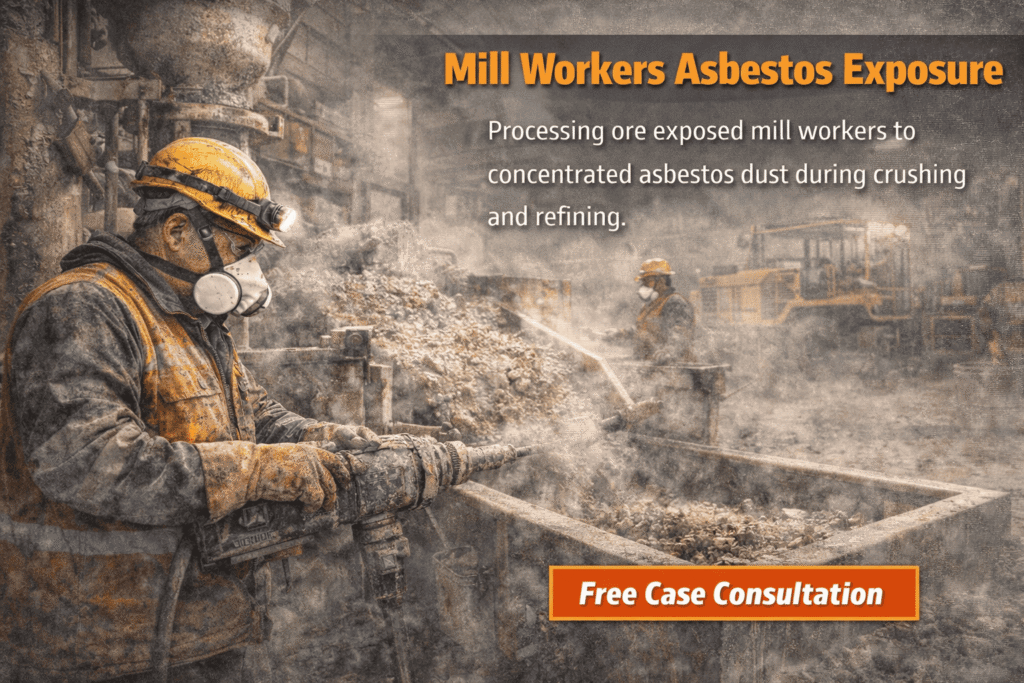
⛏️ Mill Workers Asbestos Exposure
Processing ore exposed mill workers to concentrated asbestos dust during crushing, grinding, drying, and refining operations.
Mill workers faced extreme asbestos exposure while processing raw ore into usable materials after extraction. Milling operations involved crushing, grinding, screening, drying, and refining ore—processes that released high concentrations of airborne asbestos fibers when asbestos-contaminated rock or minerals were handled.
Unlike underground miners who moved between locations, mill workers often spent entire shifts inside enclosed processing buildings where asbestos dust continuously circulated. Poor ventilation, constant machinery operation, and dry processing methods allowed fibers to remain suspended in the air for long periods.
Because mills operated year-round and workers remained stationed at fixed processing points, exposure was intense, repetitive, and cumulative. Many former mill workers were later diagnosed with mesothelioma, asbestos-related lung cancer, and asbestosis decades after leaving their jobs.
🧪 Why Milling Operations Created Severe Asbestos Risk
Milling environments were especially hazardous because asbestos fibers were:
-
Mechanically freed from ore during crushing and grinding
-
Reduced to respirable size during fine milling
-
Circulated repeatedly through enclosed buildings
-
Disturbed during maintenance and cleanup
-
Rarely controlled by dust suppression systems
Unlike open mining areas, mills concentrated asbestos fibers indoors, greatly increasing inhalation risk.
🏗️ Where Asbestos Exposure Occurred in Mills
Asbestos fibers were released throughout milling facilities.
🪨 Crushers, Grinders & Pulverizers
Mechanical breakdown of ore generated dense asbestos dust clouds.
🏭 Drying, Screening & Refining Areas
Thermal and mechanical processing disturbed embedded asbestos fibers.
🔄 Conveyor Systems & Transfer Points
Material movement released dust at each transfer stage.
🧱 Enclosed Mill Buildings
Limited airflow trapped asbestos fibers near breathing zones.
🧹 Cleanup & Maintenance Areas
Sweeping, shoveling, and repairs resuspended settled asbestos dust.
🫁 How Mill Workers Were Exposed
Exposure occurred during routine processing and facility operations.
🛠️ Equipment Operation
Running mills and crushers continuously released asbestos fibers.
🧼 Maintenance & Repairs
Replacing liners, seals, and insulation disturbed asbestos materials.
🏗️ Facility Cleaning
Dry sweeping and compressed air cleanup increased airborne fiber levels.
🏠 Secondary (Take-Home) Exposure
Fibers clung to clothing, exposing workers’ families at home.
🧬 Diseases Linked to Mill Workers Asbestos Exposure
Mill worker asbestos exposure is strongly linked to serious disease.
💀 Mesothelioma
High-intensity, long-term exposure significantly increased mesothelioma risk.
🫁 Lung Cancer
Chronic inhalation of asbestos dust raised lung cancer incidence.
📉 Asbestosis
Heavy cumulative exposure caused progressive lung scarring and disability.
Many mill workers developed disease years after exposure ended, often without early warning symptoms.
👷 Mill Jobs With Highest Exposure Risk
High-risk mill positions included:
-
Crusher and grinder operators
-
Mill and pulverizer operators
-
Screening and sorting workers
-
Dryer and kiln operators
-
Conveyor and material handlers
-
Maintenance and cleanup crews
Exposure often affected entire milling facilities, not just specific job titles.
⏱️ When Mill Worker Exposure Was Most Severe
Exposure peaked from the early 1900s through the 1980s, when milling operations lacked adequate ventilation, dust controls, or protective equipment.
Legacy exposure continues during mill demolition, remediation, and environmental cleanup projects.
⚖️ Mill Workers Asbestos Lawsuits & Compensation
Mill worker asbestos exposure has resulted in numerous lawsuits and asbestos trust fund claims nationwide. Claims may involve:
-
Mining companies
-
Milling and processing operators
-
Equipment manufacturers
-
Asbestos product suppliers
Available claims may include:
-
Asbestos personal injury lawsuits
-
Asbestos trust fund claims
-
Wrongful death lawsuits
🧑⚖️ Legal & Claims Options for Mill Workers
Mill Workers Mesothelioma Lawsuit
Mill workers diagnosed with mesothelioma may pursue claims against responsible companies.
Mill Workers Asbestos Trust Fund Claims
Many manufacturers established trust funds compensating exposed mill workers.
Mill Workers Wrongful Death Lawsuits
Families may seek compensation after fatal asbestos-related disease.
Mill Workers Statute of Limitations
Deadlines vary by state and diagnosis date—early legal review is critical.
Mill Workers Settlement & Verdict History
Mill-related asbestos cases have produced significant settlements and jury verdicts.
📞 Legal Help for Mill Workers Asbestos Exposure
If you or a loved one worked as a mill worker and were later diagnosed with mesothelioma, asbestos-related lung cancer, or asbestosis, legal help may be available.
📞 Call 800-291-0963 for a free case review
✔ No upfront costs
✔ Nationwide representation
✔ Full mining exposure investigation
✔ Assistance with lawsuits and asbestos trust fund claims