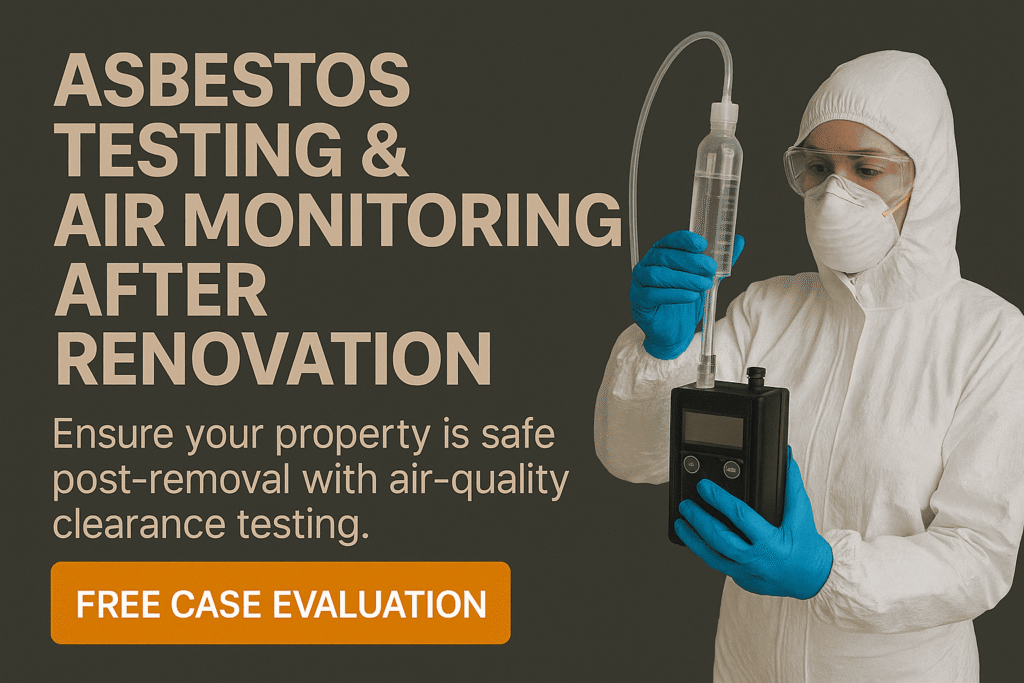
Asbestos Testing & Air Monitoring After Renovation
Renovation projects in older homes often disturb hidden asbestos materials — even when homeowners or contractors believe everything was handled safely. After work is complete, the most important step is confirming your property is truly free of airborne fibers.
Professional asbestos air monitoring and clearance testing ensures your home is safe to re-enter, live in, or continue renovating.
If you recently completed remodeling and want post-renovation clearance testing, call 800.291.0963 to schedule certified air-quality monitoring.
🏚️ Step 1: Why Post-Renovation Air Testing Is Critical
Renovations often involve sanding, scraping, drilling, tearing out drywall, replacing flooring, or opening enclosed spaces. These activities can disturb asbestos-containing materials (ACMs) without anyone realizing it.
Even small exposures can release enough fibers to contaminate a home.
📌 Why You Must Test After Renovation
-
Renovation dust may contain asbestos fibers
-
Fibers can stay airborne for hours or settle into carpets and furniture
-
HVAC systems can circulate fibers through the entire property
-
Improper removal can contaminate whole rooms or floors
-
Asbestos is invisible, odorless, and cannot be detected without testing
Clearance testing is the only reliable way to confirm the home is safe after construction or asbestos abatement.
🧱 Step 2: Renovation Activities That Can Release Asbestos
Even if you did not intentionally remove asbestos, many common renovation tasks disturb hidden ACMs.
✔ High-Risk Activities Include:
-
Demolishing walls or ceilings
-
Removing old vinyl tile or linoleum
-
Sanding drywall or joint compound
-
Scraping popcorn ceilings
-
Replacing insulation
-
Cutting into HVAC ducts
-
Removing old mastic adhesive
-
Drilling holes into walls or plaster
-
Pulling up carpet with asbestos-containing backing
If your home is older than 1980, assume asbestos materials may have been present unless proven otherwise.
🧪 Step 3: What Is Post-Renovation Air Monitoring?
Air monitoring evaluates whether asbestos fibers are circulating inside the home after renovation, repair, or abatement.
📌 What Air Monitoring Measures
-
Fiber concentration in the air
-
Whether fibers were released during renovation
-
Whether cleanup was effective
-
Whether the home meets safety standards
-
Whether further remediation is needed
🔬 Types of Air Tests Used
-
PCM (Phase Contrast Microscopy) – measures fiber count
-
TEM (Transmission Electron Microscopy) – identifies asbestos type & size
-
Clearance Testing – confirms safe occupancy levels
-
Background Air Testing – taken before work begins for comparison
TEM is the gold standard for post-abatement and post-renovation clearance.
🚧 Step 4: When You Need Post-Renovation Testing
Even if you were careful during remodeling, fibers may have become airborne without obvious warnings.
✔ You Should Always Test If:
-
Renovation took place in a home built before 1980
-
You removed popcorn ceilings, old drywall, or flooring
-
Contractors did not test materials before demolition
-
You see unusual dust after renovation
-
Your contractor is not certified for asbestos removal
-
Work disturbed old insulation, HVAC ducts, or plaster
-
You discovered asbestos mid-project
-
A previous owner remodeled without testing
Testing protects your health — and prevents future contamination.
🛑 Step 5: Why DIY Air Testing Is Not Recommended
Over-the-counter test kits cannot detect airborne fibers accurately.
⚠️ Risks of DIY Air Testing
-
Inaccurate results
-
Improper collection traps fibers inaccurately
-
Kits often measure dust, not airborne fibers
-
No chain-of-custody for lab analysis
-
No professional interpretation
Only a certified asbestos inspector can provide reliable clearance testing.
👷 Step 6: How Professional Air Monitoring Works
A licensed asbestos air-monitoring specialist performs the following tasks:
📌 Step-by-Step Process
-
Visual Inspection
Verifies that no visible dust, debris, or damaged materials remain. -
Setup of Air Pumps
Pumps run for several hours to collect airborne fiber samples. -
Filter Collection
Filters are sealed and transported to a certified laboratory. -
Laboratory Analysis
Using PCM or TEM technology to identify asbestos fibers. -
Clearance Criteria
Results are compared to regulatory standards to determine safety. -
Final Report
Provides documentation for homeowners, insurance, or contractors.
Professional air monitoring ensures compliance, accuracy, and a safe living environment.
🌬️ Step 7: What Clearance Testing Confirms
A clearance test is the official certification that the home is safe to occupy.
✔ Clearance Testing Must Confirm:
-
No visible dust or debris remains
-
Fiber concentration meets regulatory limits
-
Renovation areas were cleaned properly
-
HVAC airflow is not spreading contamination
-
Containment barriers were effective
-
No cross-contamination entered hallways or adjacent rooms
You should receive a written clearance certificate showing your home has passed.
🧼 Step 8: What Happens If Tests Show Asbestos Fibers Are Present
If air monitoring reveals elevated asbestos levels, immediate action is necessary.
📌 Next Steps May Include:
-
Re-cleaning with HEPA vacuums
-
Additional containment procedures
-
Re-testing after cleanup
-
Professional asbestos abatement
-
HVAC system cleaning
-
Removing contaminated flooring or insulation
Do NOT attempt to clean asbestos dust yourself.
Professionals use specialized HEPA systems and negative-air machines to safely decontaminate.
🗂️ Step 9: Documentation You Should Receive
A reputable testing company will provide:
✔ Required Documentation
-
Lab analysis results (PCM or TEM)
-
Chain-of-custody forms
-
Summary of testing methods
-
Diagrams of sampling locations
-
Clearance certificate
-
Recommendations for future safety
-
Background vs. post-renovation comparisons
These documents are vital for insurance, real estate disclosure, and personal records.
⚠️ Step 10: Warning Signs Your Home Needs Immediate Testing
Certain symptoms indicate possible asbestos contamination.
🚨 Red Flags Include:
-
Unusual fine dust coating surfaces
-
Persistent coughing or breathing irritation after renovation
-
Contractors removed materials without testing
-
Popcorn ceilings or old tile were disturbed
-
Renovation debris was swept or vacuumed
-
HVAC system was running during demolition
-
Renovation occurred in a pre-1980 property
If any of these apply, schedule air testing immediately.
📘 Step 11: How to Choose the Right Tester or Monitoring Professional
Always hire a certified asbestos inspector, not a general contractor.
✔ Look For:
-
State asbestos inspector license
-
EPA training certificates
-
Independent testing (not tied to the abatement company)
-
Experience with post-renovation clearance
-
TEM testing capability
-
Transparent pricing and documentation
Independent testing prevents conflicts of interest and ensures accurate results.
🏥 Where to Get Help
If you completed renovations and want to ensure your home is safe, we can help you:
-
Schedule professional air monitoring
-
Identify certified asbestos inspectors
-
Interpret laboratory test results
-
Confirm whether your home meets safety standards
-
Arrange safe asbestos cleanup if needed
-
Protect your property from long-term contamination
-
Provide documentation for insurance or real estate needs
📞 Call 800.291.0963 today to arrange asbestos clearance testing after renovation.
📝 Summary
Post-renovation asbestos testing is essential for ensuring your property is truly safe:
-
Renovations can release hidden asbestos fibers
-
Air monitoring identifies contaminated areas
-
TEM and PCM testing provide accurate results
-
Clearance certificates confirm when the home is safe
-
Professional assessments prevent long-term health risks
-
DIY testing is unreliable and unsafe
Protect your home and your family after remodeling.
📞 Call 800.291.0963 today to schedule professional asbestos air testing.