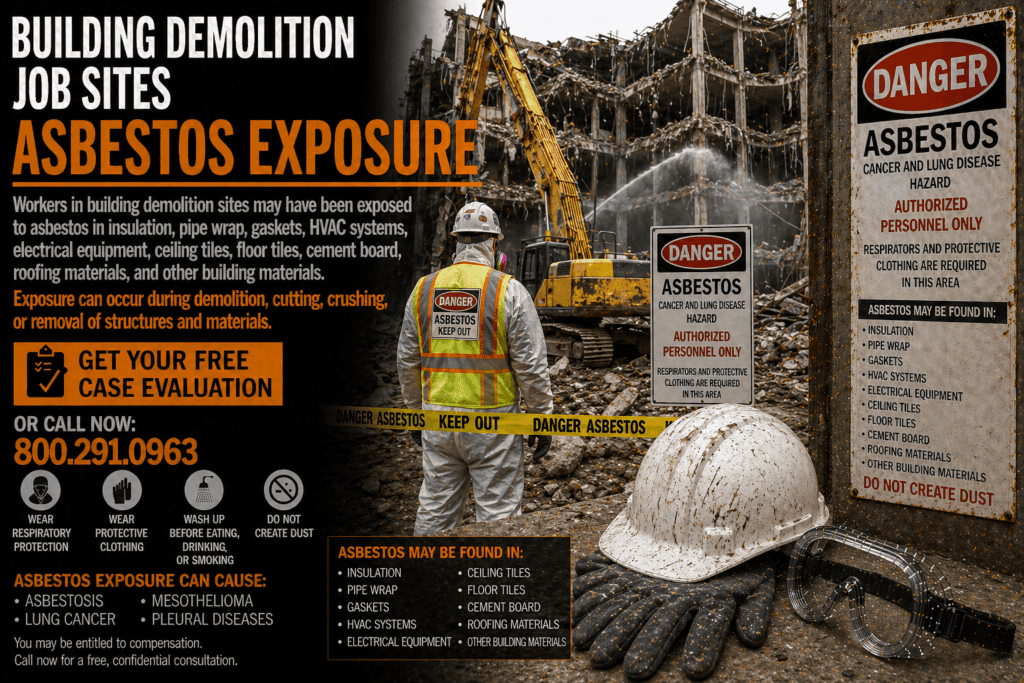
💥 Building Demolition Sites Asbestos Exposure
Building demolition sites are among the most dangerous environments for asbestos exposure. Structures built before the 1980s often contained asbestos in insulation, ceiling panels, wallboard, tile, roofing, and HVAC systems. When those buildings were demolished, asbestos-containing materials were shattered—releasing vast amounts of dust into the air.
Demolition workers faced daily exposure as they tore down walls, ceilings, piping, and flooring that contained hidden asbestos. Without proper containment or protective equipment, fibers were inhaled and clung to clothing, tools, and equipment—putting workers and nearby bystanders at risk.
🧨 Construction Demolition Sites Asbestos Exposure – What You’ll Learn From This Page:
🏗️ Demolition sites of buildings—especially those built before the 1980s—were hotspots for asbestos in insulation, ceiling panels, tiles, siding, roofing, HVAC systems, and ductwork.
👷 Demolition laborers, heavy equipment operators, electricians, utility workers, cleanup crews, and supervisors inhaled asbestos fibers daily as materials shattered and became airborne.
💨 Airborne fiber clouds from ripping, crushing, cutting, or simply moving debris contaminated work zones and neighboring areas, especially when containment measures were absent.
⚠️ Workers included general wrecking crews, apprentices, surveyors, load‑haulers, HVAC and plumbing trades, and even inspectors—all unknowingly exposed while doing essential tasks.
💰 Many demolition workers now face mesothelioma, asbestosis, or asbestos lung cancer—and may qualify for six‑figure trust fund payouts or legal settlements.
Estimated Number of People Exposed to Asbestos on U.S. Demolition Sites
Based on historical demolition activity and workforce size, asbestos exposure was prevalent across varied job roles and surrounding communities.
| Exposure Category | Estimated Number of People Exposed |
|---|---|
| Occupational Exposure (demolition labor, equipment ops, trades, cleanup) | Approx. 1,500,000 workers |
| Secondary Exposure (family members of workers) | Approx. 300,000 individuals |
| Environmental Exposure (bystanders, surveyors, neighbors) | Approx. 700,000 people |
👉 Total Estimated Exposure:
Over 2.5 million people in the U.S. were likely exposed to asbestos during building demolition activities.
📊 Facts About Demolition Workers and Asbestos
• Thousands of U.S. buildings constructed before 1980 contain asbestos.
• Asbestos Exposure: Extremely high during demolition of old buildings, especially without proper abatement.
• Asbestos-Related Disease Risk: Among the highest in construction-related trades.
• Studies confirm elevated rates of mesothelioma in demolition crews and cleanup laborers.
• Similar Occupations: General demolition workers, heavy equipment operators, laborers, foremen, cleanup crews
🏗️ History of Asbestos Use in Pre-1980 Buildings
Between 1930 and 1980, asbestos was widely used in more than 3,000 construction materials. Older homes, commercial buildings, factories, and public facilities often featured asbestos in pipe insulation, ceiling tiles, cement board, drywall, roofing, adhesives, and fireproof panels.
When these materials are torn, cracked, or crushed—as during demolition—they release microscopic fibers that can remain airborne for hours. Many crews worked without proper training or protective equipment, breathing in dust daily.
⚠️ Mesothelioma Risk for Demolition Workers
Medical research and compensation claims show a clear link between demolition work and asbestos-related illness:
• Disturbing friable materials during demolition sends clouds of fibers into the air.
• Exposure occurred even for those not directly handling asbestos—such as equipment operators or cleanup crews.
• Illnesses may not appear for decades, long after the job or project has ended.
Many demolition workers are only now being diagnosed, years after their highest exposure risk.
🧪 Asbestos Products Disturbed on Demolition Sites
🧱 Pipe and Boiler Insulation
Often found in basements and mechanical rooms; crumbled and airborne during teardown.
🧪 Drywall and Joint Compound
Contained asbestos in seams and coatings; fibers released when walls were broken or removed.
🔩 Ceiling Tiles and Panels
Installed in offices and schools; fell and shattered during demolition, releasing fibers.
🔥 Roofing Shingles and Felt
Contained asbestos for weather resistance; removed or destroyed during rooftop demolition.
🧰 Cement Board and Siding
Cracked and broken during structural teardown; exposure occurred when struck or cut.
🧴 Adhesives and Mastics
Used under tile and flooring; scraped and sanded during flooring removal.
⚡ Electrical Panel Backings
Lined with asbestos insulation; disturbed during wall removal or rewiring.
🔥 Fireproof Doors and Panels
Core materials contained asbestos; exposure occurred during removal or destruction.
🧥 Duct Insulation and Lagging
Wrapped around HVAC systems; dust released during collapse or duct removal.
📦 Acoustic Plaster and Textured Coatings
Found on ceilings and walls; created airborne dust during scraping or tearing down.
🛠 Floor Tile and Linoleum
Vinyl asbestos tile (VAT) cracked during demolition; fibers released from tile and glue.
🧯 Wall and Attic Insulation
Blown-in or batt insulation disturbed during ceiling collapse or wall demolition.
👷 How Demolition Workers Were Exposed
Demolition projects put workers in direct contact with crumbling asbestos materials. Exposure was common throughout the process.
💥 Demolition Laborers
Tore down walls, ceilings, and piping with crowbars and sledgehammers; inhaled fiber clouds daily.
🛠 Heavy Equipment Operators
Ran excavators and bulldozers through asbestos-filled structures; airborne fibers surrounded cabins.
🧱 General Laborers and Helpers
Cleaned debris, removed broken tiles, and shoveled dust; exposed without knowing the risk.
⚡ Electricians and Utility Workers
Cut wires and panels inside asbestos-lined walls and boxes; exposure occurred during live teardown.
🧹 Cleanup Crews
Swept and removed contaminated dust and debris from floors and surfaces.
🧰 HVAC and Plumbing Workers
Pulled out ducts and pipes insulated with asbestos; fibers released during dismantling.
🔧 Supervisors and Site Managers
Monitored demolition progress in dusty areas; exposed during walkthroughs or oversight.
🚛 Waste Haulers and Loaders
Handled dumpsters and trucks full of broken asbestos materials.
🪚 Saw Operators and Carpenters
Cut walls and siding without knowing they contained asbestos; released fibers during saw use.
🧪 Surveyors and Estimators
Entered aging buildings for inspection; secondhand exposure during evaluations.
🏗 Wrecking Crews
Used battering tools or machines to break apart buildings; inhaled dust at ground level.
🧍 Untrained Workers or Apprentices
Often given cleanup jobs with no protective gear; high risk due to lack of awareness.
🏢 Types of Demolition Sites With Asbestos Exposure
🏠 Residential Home Demolition
Older homes contained asbestos in flooring, ceilings, walls, and insulation; exposure occurred during tear-down.
🏢 Commercial Office Buildings
Structures from 1940s–1970s used asbestos in ceiling tiles, ducts, and siding; fibers released during removal.
🏫 School and University Buildings
Used asbestos in classrooms and auditoriums; exposure occurred during modernization and demolition projects.
🏭 Factory and Industrial Site Tear-Downs
Asbestos wrapped pipes, boilers, and panels; exposure common during dismantling.
🏨 Hospital and Medical Building Demolition
Asbestos was used in ceiling tile, drywall, and pipe insulation; dangerous during renovation or teardown.
🔥 Fire-Damaged Buildings
Heat made asbestos materials friable; collapse released large amounts of airborne dust.
📦 Warehouse and Distribution Centers
Contained asbestos roofing, flooring, and wall panels; exposure occurred during roofing or structural demolition.
🛠 Retail and Shopping Centers
Older strip malls and stores contained asbestos materials; exposure occurred during expansion or replacement.
🚧 Bridge and Tunnel Projects
Expansion joints and pipe insulation contained asbestos; exposure occurred during demolition of old infrastructure.
🏢 Government and Municipal Buildings
Post offices, libraries, and city buildings built mid-century contained asbestos; exposure during structural removal.
❓ Common Questions About Demolition Asbestos Claims
Can I file if I was not warned about asbestos on-site?
Yes — lack of training or notice does not disqualify you from a claim.
What if I was a subcontractor, not a full-time employee?
Subcontractors, temps, and union members may all qualify based on site exposure.
What if the building no longer exists?
Attorneys use building records and known asbestos product lists to prove exposure—even if the structure is gone.
Can family members file after a worker’s death?
Yes — wrongful death claims can be filed by surviving spouses or children.
How much compensation is possible?
Many demolition-related asbestos cases lead to six-figure settlements or trust fund awards.
⚖️ How a Mesothelioma Attorney Can Help Demolition Workers
A qualified asbestos attorney can help by:
• Reviewing your demolition job sites and exposure history
• Identifying which asbestos products were present
• Filing asbestos trust fund claims or lawsuits
• Meeting state deadlines for filing
• Supporting families with wrongful death claims
• Charging no fees unless you win compensation
Legal help is available with no upfront costs.
📞 Free Legal Help for Demolition Workers & Families
If you or a loved one worked on demolition sites and have been diagnosed with mesothelioma, asbestos lung cancer, or asbestosis—you may qualify for financial compensation.
Whether you used a sledgehammer or operated heavy machinery, legal support is available.
Call Now: 800.291.0963
• Free case review
• No fees unless we win
• Asbestos exposure investigation
• Help for families, retirees, and contractors
Or request help online 24/7