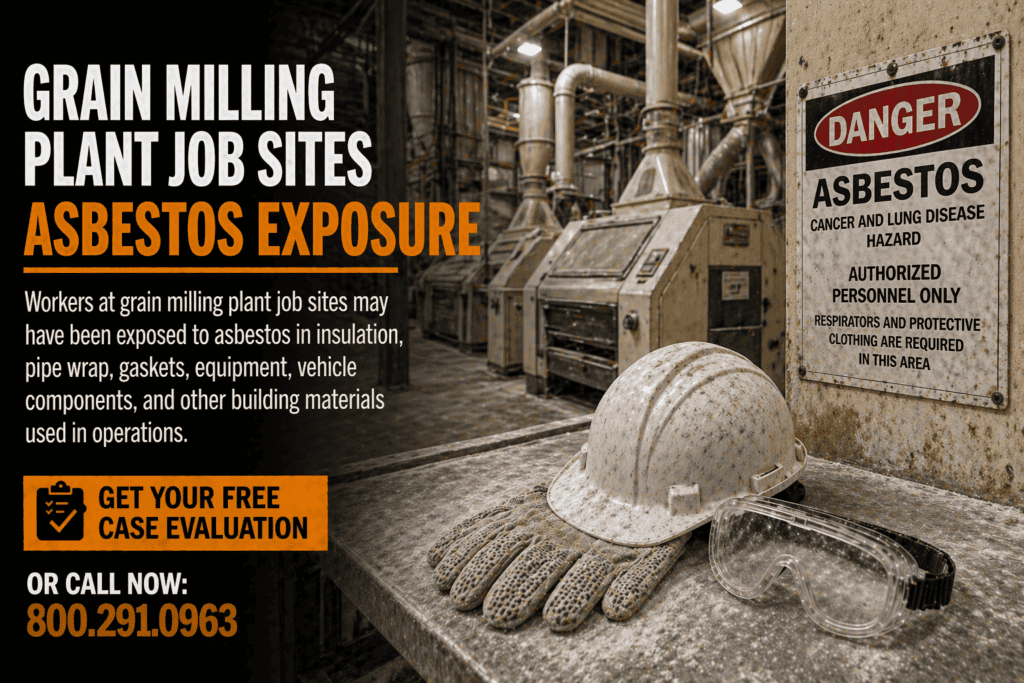
🏭 Grain Milling Plant Job Sites Asbestos Exposure
Older grain milling facilities relied on mechanical drives, process heat, steam utilities and industrial equipment. Some facilities used asbestos-containing insulation, gaskets, packing or friction materials that released dust when disturbed during repair, replacement or renovation.
For people diagnosed with mesothelioma or asbestos-related lung cancer, a detailed work history can help identify the relevant equipment, years, contractors and products. Exposure is not established by a job title alone; site-specific evidence and medical evaluation matter.
🏭 Where Asbestos Was Found
Historical asbestos concerns in grain milling facilities most often center on older equipment and building systems, not the finished product. The following work areas warrant a careful review of original maintenance and purchasing records.
Receiving Elevators and Grain Handling
At grain milling facilities, receiving elevators and grain handling involved machinery, workspaces and maintenance tasks that differed by plant design and operating period. Older equipment records, purchase orders and contractor logs may help establish which components were installed and who serviced them.
For related boiler and steam-system components, review Power Plant Equipment & Systems Asbestos Exposure.
Potential exposure depends on whether asbestos-containing material was actually present and disturbed. Workers performing repairs could have encountered airborne dust, while employees working nearby could have shared the same air. The specific years, product identification, ventilation and cleanup methods should be documented rather than assumed.
Roller Mills and Grinding Rooms
At grain milling facilities, roller mills and grinding rooms involved machinery, workspaces and maintenance tasks that differed by plant design and operating period. Older equipment records, purchase orders and contractor logs may help establish which components were installed and who serviced them.
For other milling machinery and maintenance tasks, see Milling Operation Job Sites.
Potential exposure depends on whether asbestos-containing material was actually present and disturbed. Workers performing repairs could have encountered airborne dust, while employees working nearby could have shared the same air. The specific years, product identification, ventilation and cleanup methods should be documented rather than assumed.
Dryers, Boilers and Process Heat
At grain milling facilities, dryers, boilers and process heat involved machinery, workspaces and maintenance tasks that differed by plant design and operating period. Older equipment records, purchase orders and contractor logs may help establish which components were installed and who serviced them.
For steam systems used in food manufacturing, see Food Processing Plant Job Sites Asbestos Exposure.
Potential exposure depends on whether asbestos-containing material was actually present and disturbed. Workers performing repairs could have encountered airborne dust, while employees working nearby could have shared the same air. The specific years, product identification, ventilation and cleanup methods should be documented rather than assumed.
Conveyors, Bearings and Mechanical Drives
At grain milling facilities, conveyors, bearings and mechanical drives involved machinery, workspaces and maintenance tasks that differed by plant design and operating period. Older equipment records, purchase orders and contractor logs may help establish which components were installed and who serviced them.
Potential exposure depends on whether asbestos-containing material was actually present and disturbed. Workers performing repairs could have encountered airborne dust, while employees working nearby could have shared the same air. The specific years, product identification, ventilation and cleanup methods should be documented rather than assumed.
Maintenance Shops and Building Materials
At grain milling facilities, maintenance shops and building materials involved machinery, workspaces and maintenance tasks that differed by plant design and operating period. Older equipment records, purchase orders and contractor logs may help establish which components were installed and who serviced them.
Potential exposure depends on whether asbestos-containing material was actually present and disturbed. Workers performing repairs could have encountered airborne dust, while employees working nearby could have shared the same air. The specific years, product identification, ventilation and cleanup methods should be documented rather than assumed.
👷 Workers and Daily Jobs
Job duties, not merely job titles, determine whether a worker might have contacted asbestos-containing components at grain milling facilities. Both plant employees and outside contractors may have worked around the same maintenance activities.
Mill Operators and Grain Handlers
Mill Operators and Grain Handlers may have encountered older insulation, gaskets, seals or friction components while maintaining equipment or working near repairs. Whether exposure occurred depends on the specific products, dates, duties and conditions at the facility.
Workers who operated grinders and material-handling machinery can review Machine Operators Asbestos Exposure.
Millwrights who serviced conveyors, drives, and production machinery can review Millwrights Asbestos Exposure.
Potential exposure depends on whether asbestos-containing material was actually present and disturbed. Workers performing repairs could have encountered airborne dust, while employees working nearby could have shared the same air. The specific years, product identification, ventilation and cleanup methods should be documented rather than assumed.
Millwrights and Maintenance Mechanics
Millwrights and Maintenance Mechanics may have encountered older insulation, gaskets, seals or friction components while maintaining equipment or working near repairs. Whether exposure occurred depends on the specific products, dates, duties and conditions at the facility.
Pipefitters who worked on steam lines and process piping can review Pipefitters Asbestos Exposure.
Potential exposure depends on whether asbestos-containing material was actually present and disturbed. Workers performing repairs could have encountered airborne dust, while employees working nearby could have shared the same air. The specific years, product identification, ventilation and cleanup methods should be documented rather than assumed.
Boiler Operators and Pipefitters
Boiler Operators and Pipefitters may have encountered older insulation, gaskets, seals or friction components while maintaining equipment or working near repairs. Whether exposure occurred depends on the specific products, dates, duties and conditions at the facility.
Electrical maintenance personnel can find occupation-specific information in Electricians Asbestos Exposure.
Potential exposure depends on whether asbestos-containing material was actually present and disturbed. Workers performing repairs could have encountered airborne dust, while employees working nearby could have shared the same air. The specific years, product identification, ventilation and cleanup methods should be documented rather than assumed.
Electricians and Instrument Technicians
Electricians and Instrument Technicians may have encountered older insulation, gaskets, seals or friction components while maintaining equipment or working near repairs. Whether exposure occurred depends on the specific products, dates, duties and conditions at the facility.
Plant repair crews can review Maintenance Mechanics Asbestos Exposure.
Potential exposure depends on whether asbestos-containing material was actually present and disturbed. Workers performing repairs could have encountered airborne dust, while employees working nearby could have shared the same air. The specific years, product identification, ventilation and cleanup methods should be documented rather than assumed.
Contractors and Cleanup Crews
Contractors and Cleanup Crews may have encountered older insulation, gaskets, seals or friction components while maintaining equipment or working near repairs. Whether exposure occurred depends on the specific products, dates, duties and conditions at the facility.
Workers who maintained steam boilers and pressure equipment can review Boilermakers Asbestos Exposure.
Potential exposure depends on whether asbestos-containing material was actually present and disturbed. Workers performing repairs could have encountered airborne dust, while employees working nearby could have shared the same air. The specific years, product identification, ventilation and cleanup methods should be documented rather than assumed.
🧱 Products and Equipment
Potentially relevant historical materials included older boilers and insulated steam distribution, industrial brake linings, seals and friction components, and pump and valve packing, flange gaskets and thermal insulation. The presence and asbestos content of any particular product must be verified.
Older Boilers and Insulated Steam Distribution
At grain milling facilities, older boilers and insulated steam distribution involved machinery, workspaces and maintenance tasks that differed by plant design and operating period. Older equipment records, purchase orders and contractor logs may help establish which components were installed and who serviced them.
For examples of industrial seals, packing, and piping systems, see Manufacturing Plant Piping, Valves & Gaskets Asbestos Exposure.
Potential exposure depends on whether asbestos-containing material was actually present and disturbed. Workers performing repairs could have encountered airborne dust, while employees working nearby could have shared the same air. The specific years, product identification, ventilation and cleanup methods should be documented rather than assumed.
Industrial Brake Linings, Seals and Friction Components
At grain milling facilities, industrial brake linings, seals and friction components involved machinery, workspaces and maintenance tasks that differed by plant design and operating period. Older equipment records, purchase orders and contractor logs may help establish which components were installed and who serviced them.
Potential exposure depends on whether asbestos-containing material was actually present and disturbed. Workers performing repairs could have encountered airborne dust, while employees working nearby could have shared the same air. The specific years, product identification, ventilation and cleanup methods should be documented rather than assumed.
Pump and Valve Packing, Flange Gaskets and Thermal Insulation
At grain milling facilities, pump and valve packing, flange gaskets and thermal insulation involved machinery, workspaces and maintenance tasks that differed by plant design and operating period. Older equipment records, purchase orders and contractor logs may help establish which components were installed and who serviced them.
Potential exposure depends on whether asbestos-containing material was actually present and disturbed. Workers performing repairs could have encountered airborne dust, while employees working nearby could have shared the same air. The specific years, product identification, ventilation and cleanup methods should be documented rather than assumed.
🌫️ How Exposure Occurred
Exposure pathways in grain milling facilities varied with the equipment, maintenance method and period of operation. Asbestos fibers can become airborne when certain older materials are cut, scraped, drilled, removed or otherwise disturbed.
Mill Equipment Service and Brake Replacement
At grain milling facilities, mill equipment service and brake replacement involved machinery, workspaces and maintenance tasks that differed by plant design and operating period. Older equipment records, purchase orders and contractor logs may help establish which components were installed and who serviced them.
Potential exposure depends on whether asbestos-containing material was actually present and disturbed. Workers performing repairs could have encountered airborne dust, while employees working nearby could have shared the same air. The specific years, product identification, ventilation and cleanup methods should be documented rather than assumed.
Boiler and Piping Insulation Work
At grain milling facilities, boiler and piping insulation work involved machinery, workspaces and maintenance tasks that differed by plant design and operating period. Older equipment records, purchase orders and contractor logs may help establish which components were installed and who serviced them.
Potential exposure depends on whether asbestos-containing material was actually present and disturbed. Workers performing repairs could have encountered airborne dust, while employees working nearby could have shared the same air. The specific years, product identification, ventilation and cleanup methods should be documented rather than assumed.
Renovation Or Demolition of Older Structures
At grain milling facilities, renovation or demolition of older structures involved machinery, workspaces and maintenance tasks that differed by plant design and operating period. Older equipment records, purchase orders and contractor logs may help establish which components were installed and who serviced them.
Potential exposure depends on whether asbestos-containing material was actually present and disturbed. Workers performing repairs could have encountered airborne dust, while employees working nearby could have shared the same air. The specific years, product identification, ventilation and cleanup methods should be documented rather than assumed.
Bystander Contact During Shutdown Maintenance
At grain milling facilities, bystander contact during shutdown maintenance involved machinery, workspaces and maintenance tasks that differed by plant design and operating period. Older equipment records, purchase orders and contractor logs may help establish which components were installed and who serviced them.
Potential exposure depends on whether asbestos-containing material was actually present and disturbed. Workers performing repairs could have encountered airborne dust, while employees working nearby could have shared the same air. The specific years, product identification, ventilation and cleanup methods should be documented rather than assumed.
🩺 Mesothelioma After Workplace Exposure
Diagnosis and Long Latency
Mesothelioma is a cancer of the mesothelial lining, often involving the pleura around the lungs. Asbestos exposure is an established major cause, and symptoms may appear many years after exposure. Medical specialists may use imaging, tissue pathology and other tests to establish the diagnosis and guide treatment.
A specialist can explain the testing process; the Mesothelioma Diagnosis.
A person formerly employed in grain milling plant facilities can preserve medical records while independently building a timeline of workplaces and duties. The diagnosis establishes a medical condition; it does not by itself identify which workplace product, if any, caused exposure or which company might be legally responsible.
Preparing for Specialist Care
Ask the treating team about pathology confirmation, staging, treatment options, symptom management and specialist referrals. A second opinion may be appropriate in complex cases. Do not delay medical care while attempting to collect historical employment records.
For an overview of care options to discuss with the treating team, see Mesothelioma Treatments.
Documenting Historical Contact
An occupational chronology should include the facility address, employer and contractor names, departments, years, and equipment serviced. Former coworkers may remember specific products or renovations. Preserve uncertainty where facts are unknown rather than filling gaps with assumptions.
For related exposure histories, consult Factory Asbestos Exposure.
🫁 Asbestos-Related Lung Cancer
Asbestos and Lung Cancer
Asbestos exposure is an established cause of lung cancer. Smoking is a separate risk factor, and combined asbestos and tobacco exposure can increase lung-cancer risk substantially. A smoking history does not automatically rule out an occupational contribution.
People diagnosed with asbestos-related lung cancer can review Asbestos Lung Cancer Lawsuits.
Medical Assessment
Clinical evaluation may include imaging, pathology and a review of occupational, environmental and tobacco exposures. Patients should tell their clinicians about past dusty work and known asbestos-containing products, even when that work occurred decades earlier.
Legal Evaluation Is Separate
A lung-cancer diagnosis alone does not establish a compensable asbestos claim. Product identification, exposure history, medical evidence, jurisdiction and filing deadlines can affect available options. Qualified medical and legal professionals address different aspects of these questions.
Other historical work settings are discussed under Construction Material Manufacturing Plants.
📋 Work History and Evidence
Begin with a chronological list of the facilities and employers associated with grain milling plant facilities. Include dates, department, shifts, tasks, nearby contractors and remembered maintenance events. Separate firsthand observations from later information, and retain copies of original documents.
| Record to seek | How it may help |
|---|---|
| Historical model-year parts lists | Connects a work area, period, person, task or historical material to a documented event |
| Brake and clutch supplier invoices | Connects a work area, period, person, task or historical material to a documented event |
| Assembly line and test-cell assignments | Connects a work area, period, person, task or historical material to a documented event |
| Foundry furnace maintenance records | Connects a work area, period, person, task or historical material to a documented event |
| Facility renovations and contractor schedules | Connects a work area, period, person, task or historical material to a documented event |
Build a Facility and Equipment Timeline
Build a facility and equipment timeline by comparing employer files, historical facility names, purchase orders and witness accounts. At grain milling plant facilities, departments and equipment changed over time. A document from one decade should not be assumed to describe an earlier installation without supporting evidence.
A useful statement identifies what a person personally observed, including dates, locations, materials and cleanup methods. Keep uncertain recollections clearly marked. If a facility closed, union archives, suppliers, regulatory records and former workers may still hold relevant information.
Identify Manufacturers and Contractors
Identify manufacturers and contractors by comparing employer files, historical facility names, purchase orders and witness accounts. At grain milling plant facilities, departments and equipment changed over time. A document from one decade should not be assumed to describe an earlier installation without supporting evidence.
A useful statement identifies what a person personally observed, including dates, locations, materials and cleanup methods. Keep uncertain recollections clearly marked. If a facility closed, union archives, suppliers, regulatory records and former workers may still hold relevant information.
Preserve Testimony and Gaps
Preserve testimony and gaps by comparing employer files, historical facility names, purchase orders and witness accounts. At grain milling plant facilities, departments and equipment changed over time. A document from one decade should not be assumed to describe an earlier installation without supporting evidence.
A useful statement identifies what a person personally observed, including dates, locations, materials and cleanup methods. Keep uncertain recollections clearly marked. If a facility closed, union archives, suppliers, regulatory records and former workers may still hold relevant information.
A broader comparison is available for Paper Mills Asbestos Exposure.
⚖️ Compensation and Legal Options
Personal-Injury and Wrongful-Death Lawsuits
A person with a qualifying diagnosis may be able to explore a personal-injury claim; surviving family members may have separate options under applicable law. A qualified attorney can explain whether this route is available based on documented exposure, defendants, jurisdiction and deadlines. No particular outcome or payment is guaranteed.
For how bankruptcy trust claims differ from lawsuits, see What Are Asbestos Trust Funds?.
For a history involving grain milling plant facilities, focus on identifying products and responsible parties rather than assuming the industry itself proves a claim. Some people worked at several facilities, so each exposure setting may need to be assessed separately.
Asbestos Bankruptcy Trust Claims
Some manufacturers or suppliers have established asbestos bankruptcy trusts with their own evidence and filing requirements. A qualified attorney can explain whether this route is available based on documented exposure, defendants, jurisdiction and deadlines. No particular outcome or payment is guaranteed.
For claims involving mill equipment and work histories, review Milling Operations Lawsuits & Compensation.
For a history involving grain milling plant facilities, focus on identifying products and responsible parties rather than assuming the industry itself proves a claim. Some people worked at several facilities, so each exposure setting may need to be assessed separately.
Deadlines and Jurisdiction
Statutes of limitations and other filing rules differ by state, claim type and individual circumstances. A qualified attorney can explain whether this route is available based on documented exposure, defendants, jurisdiction and deadlines. No particular outcome or payment is guaranteed.
For a history involving grain milling plant facilities, focus on identifying products and responsible parties rather than assuming the industry itself proves a claim. Some people worked at several facilities, so each exposure setting may need to be assessed separately.
Preparing for Legal Consultation
Organize diagnosis records, work dates, company names, equipment details, potential witnesses and any known asbestos product documents. A qualified attorney can explain whether this route is available based on documented exposure, defendants, jurisdiction and deadlines. No particular outcome or payment is guaranteed.
For a history involving grain milling plant facilities, focus on identifying products and responsible parties rather than assuming the industry itself proves a claim. Some people worked at several facilities, so each exposure setting may need to be assessed separately.
📚 Confirmed Sources
These sources support general occupational safety and medical information; they do not establish asbestos exposure at a specific facility or prove legal liability.
- OSHA — Asbestos Standards
- OSHA — General Industry Asbestos Standard
- OSHA — Construction Asbestos Standard
- National Cancer Institute — Asbestos Exposure and Cancer Risk
❓ Frequently Asked Questions
Was Asbestos Used at Every Grain Milling Facilitie?
No. Components varied by manufacturer and model year; a specific part must be identified.
Which Records Help Identify Asbestos at Grain Milling Facilities?
Handling or nearby disturbance of identified asbestos-containing components may be relevant.
Can Maintenance Workers and Nearby Employees Both Be Affected?
Manufacturing exposure concerns factory production and testing; field repair has different tasks and records.
What Should Someone With a Diagnosis Do Next?
Yes. Procurement files and parts catalogs may identify historical components and substitutes.
🧭 Summary
For grain milling plant facilities, a useful asbestos exposure history connects a specific product and work activity to a particular person, time and place. Preserve records, obtain appropriate medical care after a diagnosis, and seek individualized legal advice about potential claims and deadlines.
GET THE COMPENSATION YOU DESERVE
Find out if you may qualify for asbestos compensation today.
Call 800.291.0963 or Submit Your Case Here.
Helping people for more than 25 years. Open 24/7, 365 days!
Disclaimer: Mesothelioma Help Center is not a law firm or medical provider and does not determine legal or VA eligibility. This information is not individualized medical or legal advice.