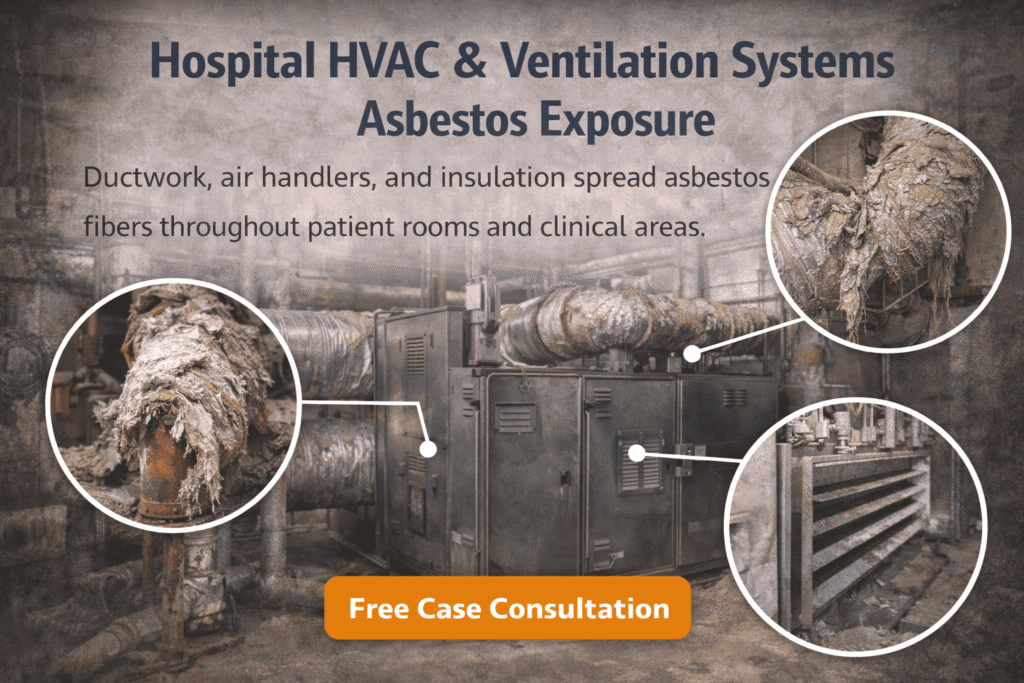
🌬️ Hospital HVAC & Ventilation Systems Asbestos Exposure
Hospital HVAC and ventilation systems incorporated asbestos in duct insulation, air handlers, fire dampers, gaskets, sealants, and fireproofing materials that released airborne asbestos fibers during operation, maintenance, filter changes, and renovations—spreading contamination throughout patient rooms, operating suites, laboratories, and offices.
Hospitals depend on complex heating, ventilation, and air-conditioning systems to maintain sterile environments, regulate temperature, and control airflow across large multi-story facilities. In hospitals built or expanded before the 1980s, asbestos was widely used throughout HVAC systems to provide fire resistance, thermal insulation, and vibration control. Over time, these materials deteriorated and became friable.
Because HVAC systems move air continuously, asbestos released inside ducts and mechanical rooms did not stay contained. Fibers were distributed across entire buildings, exposing clinical staff, patients, visitors, and support personnel who never worked near mechanical equipment.
🏛️ Why Hospitals Used Asbestos in HVAC & Ventilation Systems
Hospitals relied on asbestos in ventilation systems because it provided:
-
🔥 Fire resistance in ducts and plenums
-
💨 Thermal insulation to maintain airflow temperatures
-
⚙️ Vibration and noise reduction
-
🧱 Durability in high-use systems
-
🏥 Compliance with strict fire and building codes
HVAC systems often operated 24/7 for decades, accelerating wear on asbestos insulation and fireproofing.
🧪 Asbestos-Containing Components in Hospital HVAC Systems
Asbestos was commonly present in:
🌬️ Ductwork & Plenums
-
Asbestos-insulated ducts
-
Fireproofed plenums and chases
-
Duct lagging and wraps
⚙️ Air Handling Units & Fans
-
Insulated housings
-
Gaskets and vibration pads
-
Internal fireproofing materials
🔥 Fire Dampers & Fire Barriers
-
Asbestos fire dampers
-
Fire-rated seals and linings
-
Smoke control components
🧱 Mechanical Rooms & Ceiling Spaces
-
Spray-applied asbestos fireproofing
-
Insulation above drop ceilings
-
Access panels and enclosures
🛠️ Sealants, Adhesives & Gaskets
-
Duct sealants and mastics
-
Flange gaskets and joint compounds
As these components aged, routine operation and maintenance caused asbestos fibers to break loose and enter the airstream.
⚠️ How Asbestos Exposure Occurred Through HVAC Systems
Exposure commonly occurred during:
-
Changing or servicing air filters
-
Accessing ceiling spaces for repairs
-
Opening ductwork or plenums
-
Repairing or replacing dampers
-
Sealing or resealing duct joints
-
Renovation and system upgrades
-
Emergency airflow adjustments
Even minor tasks released fibers that were immediately carried through the ventilation system.
🌫️ Building-Wide Airborne Asbestos Distribution
HVAC-related exposure was especially dangerous because:
-
🌬️ Fibers were actively distributed through airflow
-
🏥 Large hospitals amplified spread across wings and floors
-
⏱️ Continuous operation increased cumulative exposure
-
🧹 Dust settled and was repeatedly re-aerosolized
Asbestos fibers entered patient rooms, nursing stations, operating suites, laboratories, waiting areas, and administrative offices—creating hospital-wide exposure.
🧑⚕️ Hospital Workers Most at Risk
🛠️ HVAC Technicians & Maintenance Staff
Serviced ducts, air handlers, and dampers.
🩺 Nurses & Clinical Staff
Worked full shifts breathing contaminated air.
🧪 Laboratory & Imaging Staff
Occupied areas with heavy ventilation demand.
🧹 Environmental Services & Custodial Workers
Disturbed settled asbestos dust during cleaning.
👩💼 Administrative & Office Staff
Spent long hours in ventilated office spaces.
🏥 Patients & Visitors
Were exposed during extended stays or repeated visits.
Because HVAC systems serve entire facilities, exposure was not limited to mechanical personnel.
🧬 Secondary (Take-Home) Asbestos Exposure
Hospital workers exposed via HVAC systems often carried asbestos fibers home on:
-
Uniforms and work clothing
-
Shoes and outerwear
-
Hair and skin
-
Personal vehicles
Family members were exposed during laundry and close contact. Many mesothelioma cases have been linked to secondary exposure from hospital employees.
🫁 Health Risks Linked to HVAC-Related Asbestos Exposure
Long-term asbestos exposure through ventilation systems is associated with:
🧠 Mesothelioma
A rare, aggressive cancer caused almost exclusively by asbestos.
🫁 Asbestosis
Progressive lung scarring leading to chronic breathing difficulty.
🫁 Lung Cancer
Elevated risk following prolonged asbestos exposure.
Because HVAC exposure was often low-level but continuous, diseases frequently appeared decades after exposure.
📜 Safety Failures Involving Hospital HVAC Systems
Many hospitals failed to:
-
Identify asbestos in ducts and ventilation components
-
Warn staff of airborne asbestos risks
-
Monitor indoor air quality
-
Isolate areas during HVAC maintenance
-
Use HEPA filtration or wet methods
-
Perform abatement before renovations
These failures form the basis of many asbestos claims involving hospital ventilation systems.
❓ Frequently Asked Questions (FAQs)
1️⃣ Did hospital HVAC systems really contain asbestos?
Yes. Duct insulation, fire dampers, and sealants commonly contained asbestos.
2️⃣ Could patients be exposed through ventilation?
Yes. Fibers circulated directly into patient rooms.
3️⃣ Was filter replacement a risky task?
Yes. Filters trapped asbestos fibers that became airborne during handling.
4️⃣ Can family members file secondary exposure claims?
Yes. Take-home asbestos exposure is legally recognized.
5️⃣ Can claims still be filed decades later?
Yes. Asbestos diseases have long latency periods.
⚖️ How a Lawyer Can Help Get Compensation
An experienced asbestos lawyer can help hospital workers and families by:
-
Investigating HVAC system designs and maintenance records
-
Identifying asbestos-containing ducts, dampers, and sealants
-
Tracing manufacturers of HVAC components
-
Documenting occupational and secondary exposure
-
Filing mesothelioma lawsuits
-
Submitting asbestos trust fund claims
-
Coordinating claims across multiple exposure sources
-
Maximizing total compensation available
Because ventilation systems spread asbestos building-wide, legal cases often involve multiple responsible parties.
📞 Free Case Evaluation – Get Help Today
If you worked in a hospital affected by asbestos-contaminated HVAC systems and developed mesothelioma or another asbestos-related illness—or were exposed through a family member—help is available.
📞 Call Now for a FREE Case Evaluation: 800-291-0963
There is no obligation, and compensation may be available.
📌 Key Takeaways
-
Hospital HVAC systems contained asbestos
-
Airflow distributed fibers building-wide
-
Exposure affected staff, patients, and visitors
-
Families faced secondary exposure risks
-
Legal options may still be available