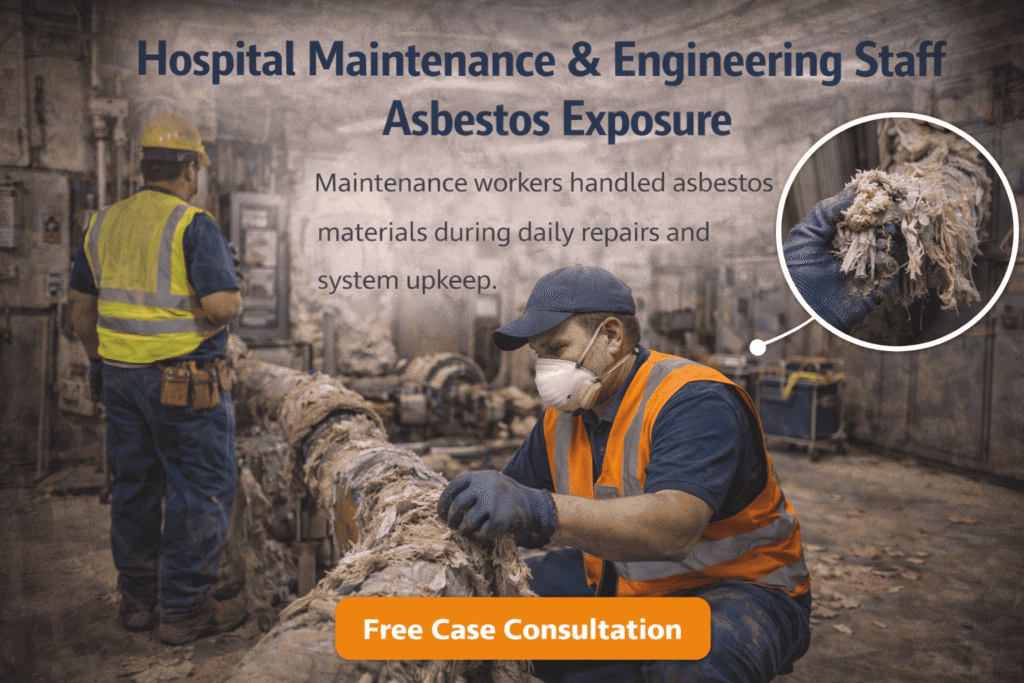
🛠️ Hospital Maintenance & Engineering Staff Asbestos Exposure
Hospital maintenance and engineering staff were routinely exposed to asbestos while repairing, upgrading, and servicing building systems that contained asbestos insulation, fireproofing, flooring, piping, electrical components, HVAC materials, and equipment housings—often while hospitals remained fully operational.
Maintenance and engineering teams are responsible for keeping hospitals functioning 24 hours a day. In facilities built or renovated before the 1980s, nearly every system these workers touched contained asbestos. Unlike clinical staff, maintenance workers frequently disturbed asbestos directly, often without warnings, protective equipment, or containment.
Because hospitals cannot shut down for repairs, maintenance work was commonly performed during active patient care, allowing asbestos fibers released during tasks to spread throughout occupied areas—exposing not only maintenance staff but also nurses, patients, and visitors.
🏛️ Why Hospital Maintenance Staff Faced High Asbestos Exposure
Hospital maintenance and engineering staff experienced elevated asbestos exposure because they:
-
🧱 Worked directly with asbestos-containing materials
-
🛠️ Accessed hidden spaces behind walls and ceilings
-
🔥 Serviced heat- and fire-resistant systems insulated with asbestos
-
🌬️ Repaired ventilation systems that spread fibers building-wide
-
⏱️ Performed repeated tasks over many years
Maintenance roles required frequent contact with aging infrastructure where asbestos was deteriorating and easily released.
🧪 Asbestos-Containing Materials Maintenance Staff Encountered
Maintenance and engineering staff commonly encountered asbestos in:
🔥 Mechanical & Utility Systems
-
Boiler insulation and refractory materials
-
Steam pipe lagging and insulation cement
-
Valve packing and gaskets
🌬️ HVAC & Ventilation Systems
-
Insulated ductwork and plenums
-
Fire dampers and air handler linings
-
Deteriorated insulation above ceilings
⚡ Electrical Systems & Fireproofing
-
Asbestos-insulated wiring and conduit
-
Electrical panels and switchgear linings
-
Spray-applied fireproofing on beams
🧱 Interior Building Materials
-
Vinyl asbestos floor tiles
-
Ceiling tiles and acoustic panels
-
Drywall joint compound and plaster
🧰 Equipment Rooms & Structural Areas
-
Fire-rated wallboards and panels
-
Equipment housings and backer boards
-
Sealants and firestop compounds
Because these materials were integrated throughout hospital buildings, maintenance staff encountered asbestos on nearly every job.
⚠️ How Asbestos Exposure Occurred During Maintenance Work
Exposure commonly occurred during tasks such as:
-
Cutting, removing, or repairing pipe insulation
-
Scraping valve packing and replacing gaskets
-
Drilling through walls, floors, and ceilings
-
Accessing ceiling spaces and mechanical chases
-
Repairing HVAC ducts and dampers
-
Replacing damaged floor or ceiling tiles
-
Emergency repairs during leaks, outages, or failures
Many of these tasks generated visible dust in confined spaces, often without respirators or containment.
🌫️ Widespread Asbestos Spread from Maintenance Activities
Maintenance-related exposure was especially dangerous because:
-
🌬️ HVAC systems distributed fibers throughout buildings
-
🏥 Vertical chases connected multiple floors
-
🧹 Cleanup re-aerosolized settled dust
-
🚶 Workers tracked fibers across hospital areas
Asbestos fibers migrated into patient rooms, operating suites, nursing stations, offices, and waiting areas—expanding exposure far beyond maintenance zones.
🧑⚕️ Maintenance & Engineering Roles Most at Risk
🛠️ General Maintenance Workers
Performed daily repairs involving asbestos materials.
⚙️ Engineers & Plant Operators
Maintained boilers, chillers, and mechanical systems.
🔧 Plumbers & Pipefitters
Handled insulated pipes, valves, and fittings.
⚡ Electricians
Worked with asbestos-insulated wiring and fireproofing.
🌬️ HVAC Technicians
Serviced ducts, air handlers, and fire dampers.
Because maintenance teams responded to every type of building issue, exposure was frequent and cumulative.
🧬 Secondary (Take-Home) Asbestos Exposure
Maintenance workers often carried asbestos fibers home on:
-
Work uniforms and coveralls
-
Boots, gloves, and tools
-
Hair and skin
-
Personal vehicles
Family members were exposed during laundry and close contact. Many mesothelioma cases have been linked to secondary exposure from hospital maintenance work.
🫁 Health Risks Linked to Maintenance-Related Asbestos Exposure
Long-term asbestos exposure among maintenance staff is associated with:
🧠 Mesothelioma
A rare, aggressive cancer almost exclusively caused by asbestos.
🫁 Asbestosis
Progressive lung scarring leading to chronic breathing difficulty.
🫁 Lung Cancer
Significantly increased risk following prolonged exposure.
Because maintenance staff often experienced high-intensity exposure over long careers, disease risk was substantial.
📜 Safety Failures Affecting Hospital Maintenance Staff
Many hospitals failed to:
-
Identify asbestos in building systems
-
Warn maintenance staff of asbestos hazards
-
Provide respirators or protective equipment
-
Implement containment during repairs
-
Use wet methods or HEPA filtration
-
Perform asbestos abatement before upgrades
These failures form the basis of many asbestos claims involving hospital maintenance and engineering staff.
❓ Frequently Asked Questions (FAQs)
1️⃣ Were hospital maintenance workers heavily exposed to asbestos?
Yes. They frequently disturbed asbestos-containing materials directly.
2️⃣ Was emergency repair work especially dangerous?
Yes. Repairs were rushed and often unprotected.
3️⃣ Could maintenance work expose others in the hospital?
Yes. Fibers spread through ventilation and foot traffic.
4️⃣ Can family members file secondary exposure claims?
Yes. Take-home asbestos exposure is legally recognized.
5️⃣ Can claims still be filed decades later?
Yes. Asbestos diseases have long latency periods.
⚖️ How a Lawyer Can Help Get Compensation
An experienced asbestos lawyer can help hospital maintenance workers and families by:
-
Investigating hospital maintenance records and work histories
-
Identifying asbestos-containing materials and systems
-
Tracing manufacturers of insulation, gaskets, and fireproofing
-
Documenting occupational and secondary exposure
-
Filing mesothelioma lawsuits
-
Submitting asbestos trust fund claims
-
Coordinating claims across multiple exposure sources
-
Maximizing total compensation available
Because maintenance staff encountered many different asbestos products, detailed legal investigation is essential.
📞 Free Case Evaluation – Get Help Today
If you worked as hospital maintenance or engineering staff and developed mesothelioma or another asbestos-related illness—or were exposed through a family member—help is available.
📞 Call Now for a FREE Case Evaluation: 800-291-0963
There is no obligation, and compensation may be available.
📌 Key Takeaways
-
Hospital maintenance staff faced frequent asbestos exposure
-
Repairs disturbed asbestos across many building systems
-
Exposure spread to staff, patients, and visitors
-
Families faced secondary exposure risks
-
Legal options may still be available