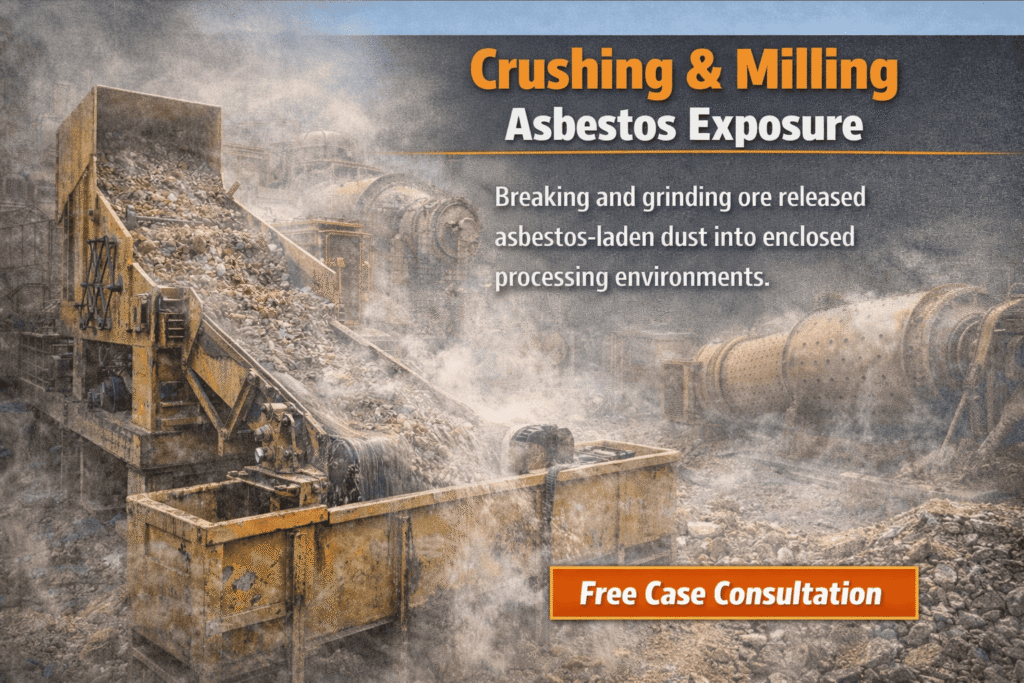
⛏️ Crushing & Milling Asbestos Exposure
Breaking, crushing, and grinding ore released asbestos-laden dust into enclosed processing environments.
Crushing and milling operations exposed workers to extremely high concentrations of airborne asbestos fibers when asbestos-contaminated ore was mechanically broken down into smaller particles. These processes occurred after extraction and involved crushers, grinders, mills, screens, and conveyors designed to reduce raw rock into usable material.
As ore passed through crushing and milling systems, asbestos fibers embedded in the rock were liberated and aerosolized, creating dense dust clouds. Because crushing and milling facilities were often enclosed with limited ventilation, asbestos dust remained suspended in the air for prolonged periods, greatly increasing inhalation risk.
Workers assigned to crushers, mills, control rooms, and cleanup crews experienced continuous exposure throughout entire shifts. Many later developed mesothelioma, asbestos-related lung cancer, and severe asbestosis decades after employment ended.
🧪 Why Crushing & Milling Created Extreme Asbestos Risk
Crushing and milling were particularly dangerous because they mechanically freed microscopic asbestos fibers from ore. Exposure occurred because:
-
Crushing fractured asbestos-bearing rock
-
Grinding reduced material to respirable dust
-
Screening and sorting disturbed loose fibers
-
Conveyors and transfer points released dust
-
Cleanup activities resuspended settled asbestos
Unlike extraction work, crushing and milling intensified fiber release by repeatedly breaking material into smaller particles.
🏗️ Where Asbestos Exposure Occurred in Crushing & Milling
Asbestos fibers were released throughout processing facilities.
🪨 Primary & Secondary Crushers
Initial rock reduction released large volumes of asbestos dust.
🏭 Grinding Mills & Pulverizers
Fine grinding created respirable fibers easily inhaled deep into the lungs.
🔄 Screening, Sorting & Transfer Points
Material movement disturbed loose asbestos fibers at each transfer stage.
🧱 Enclosed Processing Buildings
Limited ventilation trapped asbestos dust inside work areas.
🧹 Cleanup & Maintenance Areas
Sweeping and equipment maintenance resuspended settled asbestos dust.
🫁 How Crushing & Milling Workers Were Exposed
Exposure occurred during routine processing operations.
🛠️ Equipment Operation
Running crushers and mills continuously released asbestos fibers.
🧼 Maintenance & Repairs
Replacing liners, seals, and screens disturbed asbestos-contaminated dust.
🏗️ Facility Cleaning
Dry sweeping and compressed air cleanup increased airborne fiber levels.
🏠 Secondary (Take-Home) Exposure
Asbestos dust clung to clothing, exposing family members at home.
🧬 Diseases Linked to Crushing & Milling Asbestos Exposure
Crushing and milling exposure is linked to severe asbestos-related illness.
💀 Mesothelioma
High-intensity fiber exposure significantly increased mesothelioma risk.
🫁 Lung Cancer
Long-term inhalation of asbestos dust raised lung cancer incidence.
📉 Asbestosis
Heavy exposure caused rapid and progressive lung scarring.
Workers often developed disease after years of unprotected exposure in enclosed facilities.
👷 Workers Most at Risk in Crushing & Milling
High-risk job roles included:
-
Crusher operators
-
Mill and grinder operators
-
Processing plant workers
-
Control room operators
-
Maintenance and cleanup crews
-
Conveyor and material handlers
Exposure frequently affected entire processing plants, not just individual roles.
⏱️ When Crushing & Milling Exposure Was Most Severe
Exposure peaked from the early 1900s through the 1980s, when asbestos-contaminated ore was widely processed without dust controls.
Legacy exposure continues during facility demolition, remediation, and site cleanup projects.
⚖️ Crushing & Milling Asbestos Lawsuits & Compensation
Crushing and milling asbestos exposure has resulted in numerous lawsuits and trust fund claims nationwide. Claims commonly involve:
-
Mining companies
-
Processing facility operators
-
Equipment manufacturers
-
Asbestos product suppliers
Available claims may include:
-
Asbestos personal injury lawsuits
-
Asbestos trust fund claims
-
Wrongful death lawsuits
🧑⚖️ Legal & Claims Options for Crushing & Milling Workers
Crushing & Milling Mesothelioma Lawsuit
Workers diagnosed with mesothelioma may pursue claims against responsible companies.
Crushing & Milling Asbestos Trust Fund Claims
Some manufacturers established trust funds that continue compensating victims.
Crushing & Milling Wrongful Death Lawsuits
Families may seek compensation after fatal asbestos-related disease.
Crushing & Milling Statute of Limitations
Deadlines vary by state and diagnosis date—early legal review is critical.
Crushing & Milling Settlement & Verdict History
Cases involving processing exposure have produced significant compensation awards.
📞 Legal Help for Crushing & Milling Asbestos Exposure
If you or a loved one worked in crushing or milling operations and were later diagnosed with mesothelioma, asbestos-related lung cancer, or asbestosis, legal help may be available.
📞 Call 800-291-0963 for a free case review
✔ No upfront costs
✔ Nationwide representation
✔ Full mining exposure investigation
✔ Assistance with lawsuits and asbestos trust fund claims