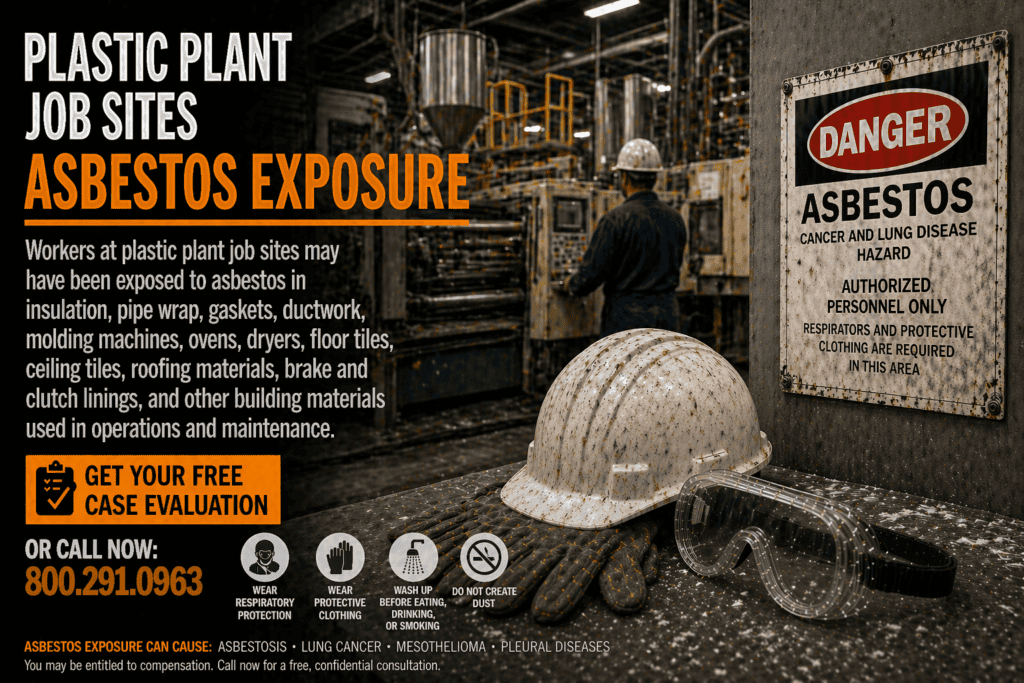
🏭 Plastic Manufacturing Plants Asbestos Exposure
If you worked around injection molding, plastic extrusion, resin compounding and steam utilities and have been diagnosed with mesothelioma or asbestos-related lung cancer, your work history matters. Older asbestos-containing materials were disturbed during maintenance and repairs, releasing dangerous fibers into shared work areas.
Learn where asbestos was found in plastic manufacturing plants, what work released dust, and what information can help you and your family after a diagnosis. Start with the tasks, machinery and coworkers you remember; you do not need every product name.
🏭 Where Asbestos Was Found
Injection Molding Presses
At injection molding presses, workers performed equipment service, removal and cleanup. When older asbestos-containing insulation, sealing materials or building products were cut, stripped or scraped, fibers entered the air. The specific product and year of the work are important.
If you remember work around injection molding presses, write down the machinery, approximate dates, repair crew and coworkers. Those details can help connect your job to particular materials rather than treating every kind of dust as asbestos.
Extrusion Lines
At extrusion lines, workers performed equipment service, removal and cleanup. When older asbestos-containing insulation, sealing materials or building products were cut, stripped or scraped, fibers entered the air. The specific product and year of the work are important.
If you remember work around extrusion lines, write down the machinery, approximate dates, repair crew and coworkers. Those details can help connect your job to particular materials rather than treating every kind of dust as asbestos.
Resin Mixing Rooms
At resin mixing rooms, workers performed equipment service, removal and cleanup. When older asbestos-containing insulation, sealing materials or building products were cut, stripped or scraped, fibers entered the air. The specific product and year of the work are important.
If you remember work around resin mixing rooms, write down the machinery, approximate dates, repair crew and coworkers. Those details can help connect your job to particular materials rather than treating every kind of dust as asbestos.
Boiler Rooms
At boiler rooms, workers performed equipment service, removal and cleanup. When older asbestos-containing insulation, sealing materials or building products were cut, stripped or scraped, fibers entered the air. The specific product and year of the work are important.
If you remember work around boiler rooms, write down the machinery, approximate dates, repair crew and coworkers. Those details can help connect your job to particular materials rather than treating every kind of dust as asbestos.
Tool And Maintenance Shops
At tool and maintenance shops, workers performed equipment service, removal and cleanup. When older asbestos-containing insulation, sealing materials or building products were cut, stripped or scraped, fibers entered the air. The specific product and year of the work are important.
If you remember work around tool and maintenance shops, write down the machinery, approximate dates, repair crew and coworkers. Those details can help connect your job to particular materials rather than treating every kind of dust as asbestos.
👷 Workers and Daily Jobs
Jobs at plastic manufacturing plants differed. Direct repair work, nearby operations and cleanup all deserve accurate descriptions. The following workers had different tasks and equipment assignments:
- Molding Operators — record equipment serviced, nearby repairs, dust conditions and approximate dates.
- Extrusion Technicians — record equipment serviced, nearby repairs, dust conditions and approximate dates.
- Millwrights — record equipment serviced, nearby repairs, dust conditions and approximate dates.
- Pipefitters — record equipment serviced, nearby repairs, dust conditions and approximate dates.
- Electricians — record equipment serviced, nearby repairs, dust conditions and approximate dates.
Working near crews who removed asbestos-containing components also mattered. Explain what you personally saw and how frequently it happened; a job title alone does not establish exposure.
⚙️ Asbestos Products and Equipment
Heater Insulation
Older asbestos-containing versions of heater insulation were used in some relevant industrial or building applications. Servicing, cutting, scraping or removing these materials released fibers. Not every product with this name contained asbestos; check the brand, dates and installation records.
Thermal Blankets
Older asbestos-containing versions of thermal blankets were used in some relevant industrial or building applications. Servicing, cutting, scraping or removing these materials released fibers. Not every product with this name contained asbestos; check the brand, dates and installation records.
Boiler Lagging
Older asbestos-containing versions of boiler lagging were used in some relevant industrial or building applications. Servicing, cutting, scraping or removing these materials released fibers. Not every product with this name contained asbestos; check the brand, dates and installation records.
Gaskets
Older asbestos-containing versions of gaskets were used in some relevant industrial or building applications. Servicing, cutting, scraping or removing these materials released fibers. Not every product with this name contained asbestos; check the brand, dates and installation records.
Valve Packing
Older asbestos-containing versions of valve packing were used in some relevant industrial or building applications. Servicing, cutting, scraping or removing these materials released fibers. Not every product with this name contained asbestos; check the brand, dates and installation records.
🌬️ How Asbestos Dust Reached Workers
Work such as reactor turnaround, gasket scraping, steam-line replacement, pump rebuilds and plant expansion disturbed older equipment. Where asbestos-containing materials were present, cutting, scraping and removing them released microscopic fibers. Dry sweeping and compressed-air cleaning spread settled fibers again. Dust could reach workers who never personally handled the original material.
A major shutdown often brought several trades together: crews opened machines, stripped coverings and removed worn components while other employees moved through the same work area. In injection molding, plastic extrusion, resin compounding and steam utilities, this combination of repair work and shared space is important when explaining how exposure happened. The absence of visible dust does not prove the absence of asbestos fibers.
Some workers also carried contaminated dust home on clothes, boots and tools. Family members who shook out work clothes or washed dusty uniforms should describe those activities separately from direct workplace exposure. No individual exposure should be assumed without identifying the relevant material and circumstances.
🩺 Mesothelioma After Workplace Exposure
Mesothelioma is a serious cancer strongly linked to asbestos exposure. It often develops decades after fibers were inhaled, so work done long before retirement can remain important. You may remember the equipment, work crews and repair routines even if you never knew which products contained asbestos.
If you have been diagnosed after years in injection molding, plastic extrusion, resin compounding and steam utilities, ask for copies of your pathology report, imaging and treatment records. Then write a timeline of your jobs, departments, major repair projects and contractors. Include earlier employers and military service when relevant; asbestos exposure can involve more than one workplace.
Your medical team can explain treatment options and specialist care. You can seek information about possible legal or trust fund options while continuing treatment. Do not postpone medical appointments while trying to locate old employment documents.
🫁 Asbestos-Related Lung Cancer
Asbestos is also an established cause of lung cancer. Smoking is another major cause, and the two exposures can work together to raise risk. Having smoked does not make a real workplace asbestos history irrelevant. A diagnosis alone, however, does not establish which exposure contributed to an individual cancer.
Tell your treating physician about work near reactors, mixing vessels, pipe racks, solvent recovery lines and utility buildings, especially repairs that disturbed older insulation, gaskets or seals. Preserve pathology findings, imaging reports, treatment dates and your employment timeline. An occupational medicine specialist can assess the work history alongside other medical information.
If a claim is being considered, the exact job tasks, materials and years are more useful than a general statement that the plant was dusty. Keep descriptions accurate and do not assume that every type of industrial dust was asbestos.
📋 Documents That Help Explain Your Exposure
Begin with a one-page employment timeline. Include plant names and addresses, employers, dates, departments, job titles, shift schedules and the names of coworkers. Approximate dates are acceptable when that is all you remember. Describe firsthand observations separately from information learned later.
| Record | What it helps show |
|---|---|
| Pay stubs, pension statements and Social Security earnings | Employer names and years of service |
| Union cards and apprenticeship records | Trade, contractor and work assignments |
| Maintenance logs and purchasing records | Equipment, suppliers and replacement products |
| Photographs and equipment manuals | Machine names, plant layout and work areas |
| Coworker statements | Repair tasks, dust conditions and who was nearby |
| Medical records | Diagnosis and treatment dates |
If the plant closed, former union locals, pension administrators, contractors and coworkers may still have information. Keep originals safe, save copies and avoid sharing personal identification or medical details on public websites.
⚖️ Lawsuits, Trust Funds and Compensation
People diagnosed with mesothelioma or asbestos-related lung cancer after working around asbestos in injection molding, plastic extrusion, resin compounding and steam utilities may have options involving lawsuits, asbestos bankruptcy trust claims or other benefits. Eligibility depends on the medical diagnosis, exposure evidence, responsible products and companies, and applicable filing deadlines.
Some claims involve manufacturers of asbestos-containing insulation, gaskets or other components rather than the company that operated the plant. Trust funds have separate medical and exposure criteria. Family members may have wrongful-death options in certain circumstances, and veterans may have separate VA benefits based on qualifying military service.
Deadlines differ by state and claim type. You do not need to solve every question before asking for information, but it is sensible to act promptly after a diagnosis. Compensation is not automatic and no outcome can be promised.
For related work details, see Agricultural Equipment Manufacturing Job Sites Asbestos Exposure. Compare the tasks described with your own work history.
For related work details, see Maintenance Shop Job Sites. Compare the tasks described with your own work history.
For related work details, see Rail Maintenance Yard Job Sites Asbestos Exposure. Compare the tasks described with your own work history.
For related work details, see Airplane Manufacturing Workers Asbestos Exposure. Compare the tasks described with your own work history.
For related work details, see Aluminum Plant Workers Asbestos Exposure. Compare the tasks described with your own work history.
For related work details, see Tire Plant Workers Asbestos Exposure. Compare the tasks described with your own work history.
For related work details, see Rubber Plant Workers Asbestos Exposure. Compare the tasks described with your own work history.
For related work details, see Power Plant Workers Asbestos Exposure. Compare the tasks described with your own work history.
For related work details, see Hotel Workers Asbestos Exposure. Compare the tasks described with your own work history.
For related work details, see Hospital Workers Asbestos Exposure. Compare the tasks described with your own work history.
📚 Confirmed Sources
❓ Frequently Asked Questions and Next Steps
Did every facility use asbestos?
No. Materials, manufacturers and installation dates differed. Older asbestos-containing products were used in parts of injection molding, plastic extrusion, resin compounding and steam utilities, but a specific plant and work period still matter.
What if I never handled asbestos insulation?
Workers who stood near repairs or cleaned up debris also encountered dust. Describe what you saw, where you worked and how often the work happened.
Can work from decades ago still matter?
Yes. Mesothelioma often develops many years after asbestos exposure. Older jobs remain important to a complete employment history.
What if the plant has closed?
Union, pension, contractor, Social Security earnings and former coworker records can help establish where and when you worked.
Does smoking rule out asbestos-related lung cancer?
No. Smoking and asbestos both affect lung cancer risk. Qualified professionals assess each case using the medical and exposure facts.
Do I need product names before asking for help?
No. Start with your work tasks, machines, departments, approximate dates and coworkers. Product identification can follow from records.
Are trust fund payments guaranteed?
No. Each trust evaluates claims under its own criteria and supporting-document requirements.
Can family members ask about claims?
Some jurisdictions allow surviving family members to pursue claims. The deadlines and eligibility rules vary.
What should I do first?
Continue medical care, save diagnosis records, write a work history and ask promptly about any filing deadlines.
GET THE COMPENSATION YOU DESERVE
If you have been diagnosed with mesothelioma or asbestos-related lung cancer after working around asbestos, you deserve clear answers about your options. Tell us where you worked and when you were diagnosed. Ask about possible asbestos claims and trust fund compensation—even if you do not remember the product names.
Helping people for more than 25 years · Open 24/7, 365 days!
Call us to discuss your work history:
800.291.0963Or send your information online:
Mesothelioma Help Center is not a law firm or medical provider and does not determine legal or VA eligibility. This information is not individualized medical or legal advice.