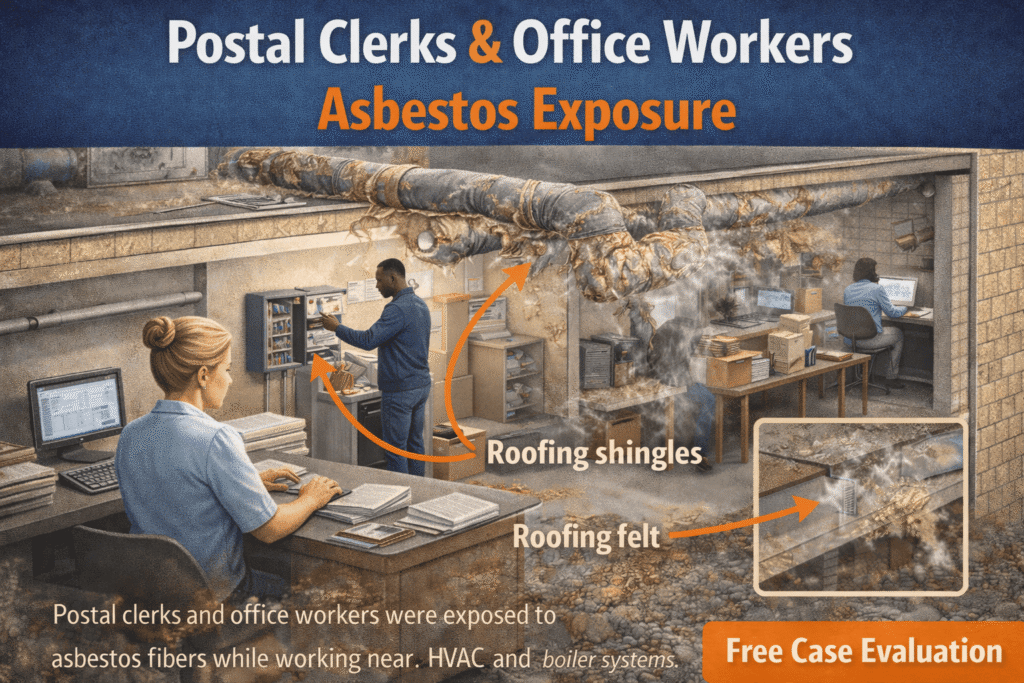
📨 Postal Clerks & Office Workers Asbestos Exposure
Postal clerks and office workers were exposed to asbestos by working daily inside post office buildings that contained aging asbestos insulation, ceiling tiles, flooring, pipe systems, and contaminated HVAC ventilation systems that circulated airborne fibers throughout offices and sorting areas.
Unlike maintenance or construction workers who disturbed asbestos directly, postal clerks and office employees faced chronic, long-term exposure simply by occupying asbestos-containing buildings for years or decades. Many post offices and mail processing centers were built or renovated during peak asbestos use, and clerks spent full shifts breathing air contaminated by deteriorating materials hidden behind walls, ceilings, and ventilation systems.
Because this exposure was continuous and often invisible, many clerks were never warned of the risk until decades later—after being diagnosed with mesothelioma or another asbestos-related disease.
🏛️ Why Postal Clerks & Office Workers Were Exposed to Asbestos
Postal clerks and office workers faced asbestos exposure because:
-
🧱 Post office buildings were constructed with asbestos materials
-
🌬️ HVAC systems circulated asbestos fibers building-wide
-
🏢 Aging insulation deteriorated over time
-
🧹 Maintenance and renovation disturbed hidden asbestos
-
⏱️ Clerks worked long shifts for many years in the same buildings
Even workers who never entered mechanical rooms or performed repairs were exposed due to environmental contamination inside postal facilities.
🧪 Asbestos-Containing Materials Inside Post Office Buildings
Postal clerks and office workers were exposed to asbestos from materials such as:
🧱 Walls, Ceilings & Structural Materials
-
Asbestos fireproofing on beams and columns
-
Ceiling tiles and acoustic panels
-
Drywall joint compound and plaster
🪜 Flooring & Adhesives
-
Vinyl floor tiles containing asbestos
-
Tile mastic and floor adhesives
-
Worn flooring that released dust
🌬️ HVAC & Ventilation Systems
-
Asbestos-lined ductwork
-
Deteriorating duct insulation
-
Air handlers and plenum fireproofing
🔥 Pipe Insulation & Utility Systems
-
Steam pipes running through offices
-
Insulated risers and chases
-
Valve packing and gasket dust
🛠️ Renovation & Maintenance Residue
-
Dust released during ceiling, lighting, or office upgrades
-
Fibers tracked through buildings after repairs
As these materials aged or were disturbed, asbestos fibers entered the indoor air environment.
⚠️ How Asbestos Exposure Occurred for Clerks & Office Workers
Postal clerks were exposed through:
-
🌬️ Breathing recirculated air contaminated with asbestos
-
🧹 Settled dust disturbed by daily activity
-
🚧 Renovation or repair work during normal operations
-
🪟 Fibers entering offices through vents and ceiling spaces
-
👟 Tracking asbestos dust across floors and work areas
Because clerks worked 8–12 hour shifts, exposure accumulated slowly but continuously over long careers.
🌫️ Building-Wide Asbestos Contamination
Exposure was especially dangerous because:
-
🌬️ Ventilation systems spread fibers throughout buildings
-
🏢 Large open workrooms amplified circulation
-
⏱️ Continuous occupancy increased cumulative dose
-
🧹 Dust was repeatedly re-aerosolized
This meant clerks could be exposed even if asbestos was located far from their desks.
🧑🏭 Postal Clerks & Office Workers Most at Risk
📨 Postal Clerks
Worked daily at service counters and processing desks.
🗂️ Administrative & Office Staff
Spent full workdays in enclosed office spaces.
📬 Mail Processing Clerks
Worked in large ventilated sorting areas.
👨💼 Supervisors & Managers
Occupied offices within asbestos-containing buildings.
🧹 Support & Clerical Staff
Moved between contaminated areas throughout shifts.
Because exposure was environmental, job title did not eliminate risk.
🧬 Secondary (Take-Home) Asbestos Exposure
Postal clerks exposed to asbestos frequently carried fibers home on:
-
Work clothing and uniforms
-
Shoes and outerwear
-
Hair and skin
-
Personal vehicles
Family members were exposed during laundry and household contact. Many mesothelioma cases have been linked to secondary exposure from postal clerks who never handled asbestos directly.
🫁 Health Risks Linked to Clerical Asbestos Exposure
Long-term environmental asbestos exposure is associated with:
🧠 Mesothelioma
A rare, aggressive cancer caused almost exclusively by asbestos.
🫁 Asbestosis
Chronic lung scarring leading to breathing impairment.
🫁 Lung Cancer
Elevated risk following prolonged asbestos exposure.
Because clerks experienced low-level exposure over many years, diseases often appeared decades later.
📜 Safety Failures Affecting Postal Clerks & Office Workers
Many postal facilities failed to:
-
Identify asbestos hazards in occupied areas
-
Warn clerks of environmental asbestos exposure
-
Monitor air quality in older buildings
-
Isolate work areas during renovations
-
Perform asbestos abatement before upgrades
These failures are central to asbestos claims filed by clerical and office workers.
❓ Frequently Asked Questions (FAQs)
1️⃣ Can office workers really develop mesothelioma from asbestos?
Yes. Long-term environmental exposure is a known cause.
2️⃣ I never worked maintenance—can I still file a claim?
Yes. Exposure does not require direct handling.
3️⃣ Were HVAC systems a major exposure source?
Yes. They spread fibers throughout buildings.
4️⃣ Can family members file secondary exposure claims?
Yes. Take-home asbestos exposure is legally recognized.
5️⃣ Can claims still be filed decades later?
Yes. Asbestos diseases have long latency periods.
⚖️ How a Lawyer Can Help Get Compensation
An experienced asbestos lawyer can help postal clerks and families by:
-
Investigating post office building histories
-
Identifying asbestos-containing materials and HVAC systems
-
Tracing manufacturers of insulation, flooring, and fireproofing
-
Documenting environmental and secondary exposure
-
Filing mesothelioma lawsuits
-
Submitting asbestos trust fund claims
-
Coordinating claims across multiple exposure sources
-
Maximizing total compensation available
Because clerical exposure is often building-wide, legal investigation frequently uncovers multiple responsible parties.
📞 Free Case Evaluation – Get Help Today
If you worked as a postal clerk or office employee and developed mesothelioma or another asbestos-related illness—or were exposed through a family member—help is available.
📞 Call Now for a FREE Case Evaluation: 800-291-0963
There is no obligation, and compensation may be available.
📌 Key Takeaways
-
Postal clerks faced daily asbestos exposure
-
HVAC systems spread fibers throughout offices
-
Exposure occurred without direct handling
-
Families faced secondary exposure risks
-
Legal options may still be available