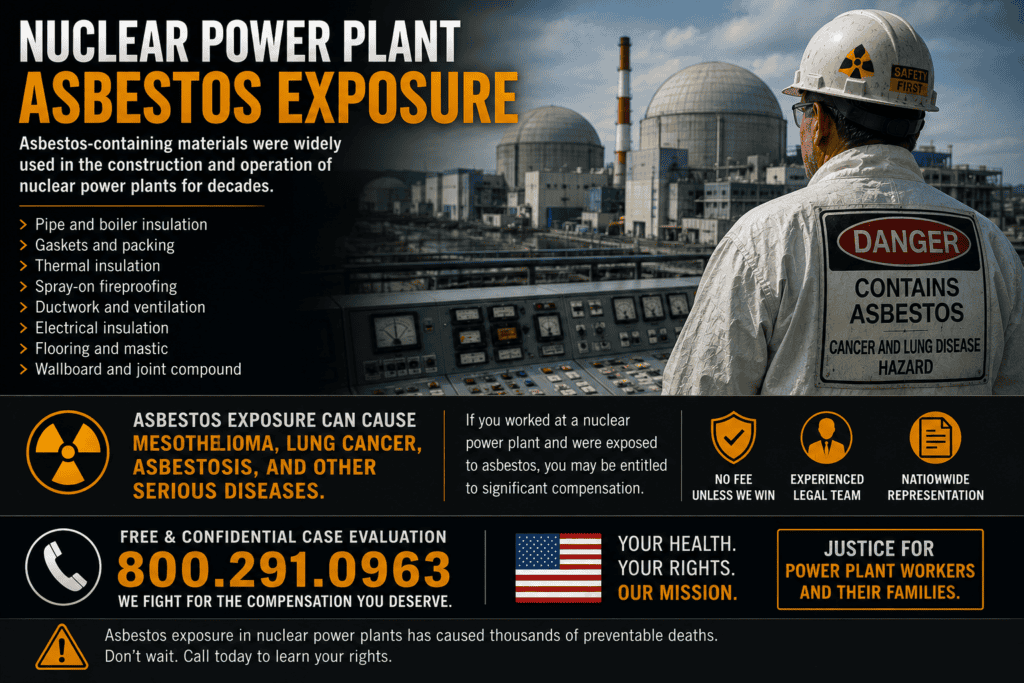
🏭 Nuclear Power Plant Asbestos Exposure
Nuclear power plants relied extensively on asbestos-containing materials throughout much of the 20th century. Although nuclear facilities are known for radiation hazards, many workers were also exposed to asbestos insulation, fireproofing, and heat-resistant components used throughout reactor auxiliary systems, turbine halls, piping networks, and control areas.
Asbestos was heavily used because nuclear plants required materials capable of withstanding extreme heat, pressure, vibration, and fire risk. Maintenance, retrofitting, refueling outages, and system upgrades frequently disturbed asbestos materials, releasing microscopic fibers into enclosed workspaces.
Many nuclear plant workers were exposed for years without proper warnings or protective equipment. Decades later, former employees and contractors have developed mesothelioma, lung cancer, and asbestosis linked to occupational asbestos exposure at nuclear facilities.
🔥 Why Asbestos Was Used in Nuclear Power Plants
Nuclear power plants operate complex systems involving steam generation, heat exchange, electrical distribution, and safety containment. Asbestos was used because it could:
-
Withstand extreme temperatures and thermal cycling
-
Provide insulation for steam, auxiliary, and cooling systems
-
Prevent fires in electrical and control environments
-
Reduce heat loss and protect equipment
-
Reinforce gaskets, seals, and fire barriers
Reactor auxiliary systems — which support reactor operation but are separate from the nuclear core — were especially asbestos-heavy. These systems included steam lines, pumps, valves, heat exchangers, containment penetrations, and emergency equipment.
At the time of construction, asbestos was considered essential for plant safety and efficiency. The long-term health consequences for workers were often ignored or concealed.
🧱 Where Asbestos Was Found in Nuclear Power Plants
Asbestos-containing materials were present throughout nuclear facilities, particularly in plants built or expanded before the late 1970s.
🔧 Reactor Auxiliary Systems
Auxiliary systems supporting reactor operation used asbestos insulation on piping, tanks, heat exchangers, and pressure vessels. Maintenance work routinely disturbed these materials.
🔩 Steam & Cooling Piping
Miles of piping carried steam, condensate, and cooling water throughout nuclear plants. Pipe lagging and insulation frequently contained asbestos and deteriorated over time.
🧰 Valves, Pumps & Gaskets
Asbestos gaskets and packing were used to seal high-pressure valves and pumps. Routine replacement released asbestos fibers into the air.
🛡️ Electrical Rooms & Control Areas
Electrical panels, cable trays, insulating blankets, and fire barriers often contained asbestos to reduce fire risk. Electricians and control technicians encountered asbestos during servicing.
🧱 Fireproofing & Structural Materials
Sprayed fireproofing, refractory materials, and wall panels frequently contained asbestos, especially in turbine halls and auxiliary buildings.
🫁 How Nuclear Power Plant Workers Were Exposed
Asbestos exposure occurred during everyday plant operations, not just during major construction projects.
🛠️ Maintenance & Refueling Outages
Scheduled outages required extensive maintenance, insulation removal, and system upgrades. These activities released asbestos fibers into confined areas.
🧼 Insulation Removal & Retrofitting
Retrofitting older systems to meet modern standards often involved removing asbestos insulation, disturbing decades-old materials.
🏗️ Equipment Installation & Replacement
Installing new pumps, valves, and piping required cutting through existing asbestos-containing components.
🏠 Secondary (Take-Home) Exposure
Workers carried asbestos fibers home on clothing, exposing family members during laundering and daily contact.
🧪 Diseases Linked to Nuclear Power Plant Asbestos Exposure
Asbestos-related diseases have long latency periods, often appearing decades after exposure.
💀 Mesothelioma
An aggressive cancer of the lung, abdominal, or heart lining. Asbestos exposure is the only known cause.
🫁 Lung Cancer
Asbestos exposure significantly increases lung cancer risk, even in non-smokers.
📉 Asbestosis
A chronic lung disease caused by scarring from inhaled asbestos fibers, leading to progressive respiratory impairment.
👷 Jobs at Highest Risk in Nuclear Power Plants
Workers most at risk included:
-
Reactor maintenance technicians
-
Auxiliary system mechanics
-
Pipefitters and steamfitters
-
Electricians and control technicians
-
Insulators
-
Welders
-
Engineers and supervisors
-
Outage contractors
-
Cleanup and labor crews
Even workers not directly handling asbestos were exposed through airborne fibers circulating in ventilation systems.
⏱️ When Exposure Was Most Common
Asbestos use peaked from the 1950s through the late 1970s. Nuclear plants built during this era often contained extensive asbestos insulation. While regulations reduced new asbestos use, legacy materials remained in place for decades.
Retrofits, safety upgrades, and decommissioning projects continue to pose exposure risks if asbestos is not properly managed.
⚖️ Nuclear Power Plant Asbestos Lawsuits & Compensation
Asbestos exposure at nuclear power plants has resulted in numerous lawsuits and asbestos trust fund claims nationwide. Workers were exposed through reactor auxiliary systems, insulation, piping, turbines, electrical equipment, and fireproofing materials.
Many nuclear plant workers were never warned about asbestos hazards or provided adequate protection. Legal responsibility often falls on asbestos product manufacturers, contractors, and companies that failed to protect workers.
Workers and families may qualify for:
-
Personal injury asbestos lawsuits
-
Asbestos trust fund claims
-
Wrongful death lawsuits
-
Veterans benefits (for military-connected or federally operated nuclear facilities)
🧑⚖️ Legal & Claims Options for Nuclear Power Plant Workers
Nuclear Power Plant Mesothelioma Lawsuit
Workers diagnosed with mesothelioma, lung cancer, or asbestosis may pursue lawsuits against manufacturers of asbestos insulation, gaskets, fireproofing, and equipment.
Nuclear Power Plant Asbestos Trust Fund Claims
Many suppliers of asbestos products created trust funds to compensate victims. Eligible workers may receive compensation without filing a lawsuit.
Nuclear Power Plant Wrongful Death Lawsuits
Families may pursue compensation after fatal asbestos-related illnesses caused by nuclear plant exposure.
Nuclear Power Plant Statute of Limitations
Deadlines vary by state and diagnosis date. Early legal review is critical to preserve eligibility.
Nuclear Power Plant Settlement & Verdict History
Significant settlements and verdicts have resulted from asbestos exposure cases involving nuclear facilities and contractors.
📞 Legal Help for Nuclear Power Plant Asbestos Exposure
If you or a loved one worked at a nuclear power plant and were later diagnosed with mesothelioma, asbestos-related lung cancer, or asbestosis, legal help may be available.
📞 Call 800-291-0963 for a free case review
✔ No upfront costs
✔ Nationwide representation
✔ Full nuclear plant exposure investigation
✔ Assistance with lawsuits and asbestos trust fund claims
✅ Next in the series (when ready):
Gas Turbine Power Plant Asbestos Exposure
or
Municipal & Industrial Power Plant Asbestos Exposure
Just say “Next” and I’ll continue in the same locked format.
Here is the next full ~1,500-word article, written in the same locked structure, tone, headings, and legal layout as the previous Nuclear Power Plant article.
⚠️ Gas Turbine Power Plant Asbestos Exposure
Combustion enclosures and ductwork contained asbestos that was disturbed during overhauls.
🏭 Overview of Gas Turbine Power Plant Asbestos Exposure
Gas turbine power plants relied extensively on asbestos-containing materials throughout much of the 20th century. These facilities used high-temperature combustion turbines to generate electricity, often operating continuously under extreme heat and pressure. To manage these conditions, asbestos was widely incorporated into turbine enclosures, exhaust systems, ductwork, piping, and auxiliary equipment.
Workers at gas turbine power plants were frequently exposed to asbestos during routine maintenance, overhauls, inspections, and retrofits. Combustion enclosures and exhaust ducting were insulated with asbestos to control heat and prevent fires. Over time, these materials degraded and released microscopic fibers into the air, particularly when disturbed during servicing.
Many workers were exposed for years without knowing asbestos was present or dangerous. Decades later, former gas turbine power plant employees and contractors have developed mesothelioma, lung cancer, and asbestosis linked to occupational asbestos exposure.
🔥 Why Asbestos Was Used in Gas Turbine Power Plants
Gas turbine power plants generate electricity by burning fuel to spin turbine blades connected to generators. These turbines operate at extremely high temperatures, creating fire and heat hazards throughout the facility. Asbestos was used because it could:
-
Withstand extreme combustion temperatures
-
Insulate turbine casings and exhaust systems
-
Prevent fires in confined turbine enclosures
-
Reduce heat transfer to surrounding equipment
-
Strengthen gaskets, seals, and expansion joints
Asbestos insulation helped protect workers and equipment from heat while improving efficiency. At the time, asbestos was considered essential for safe turbine operation, despite growing evidence of its health risks.
🧱 Where Asbestos Was Found in Gas Turbine Power Plants
Asbestos-containing materials were present throughout gas turbine facilities, particularly those built or upgraded before the late 1970s.
🔧 Combustion Turbine Enclosures
Turbine housings and combustion enclosures were insulated with asbestos blankets, boards, and wraps. Maintenance work inside these enclosures released asbestos fibers directly into breathing zones.
🔩 Exhaust Ductwork & Expansion Joints
Hot exhaust gases traveled through large duct systems lined with asbestos insulation. Expansion joints often contained asbestos fabric and packing that deteriorated with heat and vibration.
🧰 Gaskets, Seals & Packing
Asbestos gaskets and packing were used in turbine flanges, fuel systems, and auxiliary piping. Replacing worn components released asbestos dust during removal.
🛡️ Auxiliary Equipment & Piping
Compressors, heat exchangers, pumps, and fuel lines were insulated with asbestos materials to manage heat and pressure.
🧱 Fireproofing & Structural Materials
Sprayed fireproofing, refractory panels, and wall materials often contained asbestos, especially in turbine halls and mechanical rooms.
🫁 How Gas Turbine Power Plant Workers Were Exposed
Asbestos exposure occurred during both scheduled and unscheduled work.
🛠️ Turbine Overhauls & Inspections
Major turbine overhauls required removing insulation, opening enclosures, and servicing internal components. These tasks released concentrated asbestos fibers.
🧼 Insulation Removal & Replacement
Old insulation degraded over time. Removing or replacing asbestos insulation released fibers into enclosed workspaces.
🏗️ Equipment Installation & Upgrades
Retrofitting turbines or upgrading exhaust systems disturbed asbestos-containing ductwork and insulation.
🏠 Secondary (Take-Home) Exposure
Workers unknowingly carried asbestos fibers home on clothing, boots, and tools, exposing family members.
🧪 Diseases Linked to Gas Turbine Power Plant Asbestos Exposure
Asbestos-related diseases often appear decades after exposure.
💀 Mesothelioma
A rare, aggressive cancer affecting the lining of the lungs, abdomen, or heart. Asbestos exposure is the sole known cause.
🫁 Lung Cancer
Prolonged asbestos exposure significantly increases lung cancer risk, even among non-smokers.
📉 Asbestosis
A chronic lung disease caused by scarring from inhaled asbestos fibers, leading to progressive breathing difficulties.
👷 Jobs at Highest Risk in Gas Turbine Power Plants
Workers most at risk included:
-
Turbine mechanics and technicians
-
Maintenance mechanics
-
Pipefitters and steamfitters
-
Insulators
-
Welders and metalworkers
-
Electricians
-
Engineers and supervisors
-
Contractors and outage workers
-
Laborers and cleanup crews
Even workers not directly handling asbestos could be exposed through airborne fibers circulating through ventilation systems.
⏱️ When Exposure Was Most Common
Asbestos use peaked from the 1950s through the late 1970s. Gas turbine power plants constructed or expanded during this period often contained large amounts of asbestos insulation.
While regulations reduced new asbestos use, many facilities continued operating with legacy asbestos materials for decades. Maintenance and retrofit work remained hazardous well into the 1990s and beyond.
⚖️ Gas Turbine Power Plant Asbestos Lawsuits & Compensation
Asbestos exposure at gas turbine power plants has resulted in numerous lawsuits and asbestos trust fund claims nationwide. Workers were exposed through turbine enclosures, exhaust ductwork, insulation, gaskets, and fireproofing materials.
Many workers were never warned about asbestos dangers or provided protective equipment. Legal responsibility often lies with asbestos product manufacturers, contractors, and companies that failed to implement safety measures.
Workers and families may qualify for:
-
Personal injury asbestos lawsuits
-
Asbestos trust fund claims
-
Wrongful death lawsuits
-
Veterans benefits (for military-connected or federally operated power facilities)
🧑⚖️ Legal & Claims Options for Gas Turbine Power Plant Workers
Gas Turbine Power Plant Mesothelioma Lawsuit
Workers diagnosed with mesothelioma, lung cancer, or asbestosis may pursue lawsuits against manufacturers of asbestos turbine insulation, gaskets, expansion joints, and fireproofing materials.
Gas Turbine Power Plant Asbestos Trust Fund Claims
Many asbestos suppliers created trust funds to compensate exposed workers. Eligible claimants may recover compensation without filing a lawsuit.
Gas Turbine Power Plant Wrongful Death Lawsuits
Families may seek compensation after a loved one’s death from asbestos-related diseases caused by turbine plant exposure.
Gas Turbine Power Plant Statute of Limitations
Deadlines vary by state and diagnosis date. Early legal review is critical to preserve eligibility.
Gas Turbine Power Plant Settlement & Verdict History
Significant settlements and verdicts have resulted from asbestos exposure cases involving gas turbine power plants and contractors.
📞 Legal Help for Gas Turbine Power Plant Asbestos Exposure
If you or a loved one worked at a gas turbine power plant and were later diagnosed with mesothelioma, asbestos-related lung cancer, or asbestosis, legal help may be available.
📞 Call 800-291-0963 for a free case review
✔ No upfront costs
✔ Nationwide representation
✔ Full turbine plant exposure investigation
✔ Assistance with lawsuits and asbestos trust fund claims