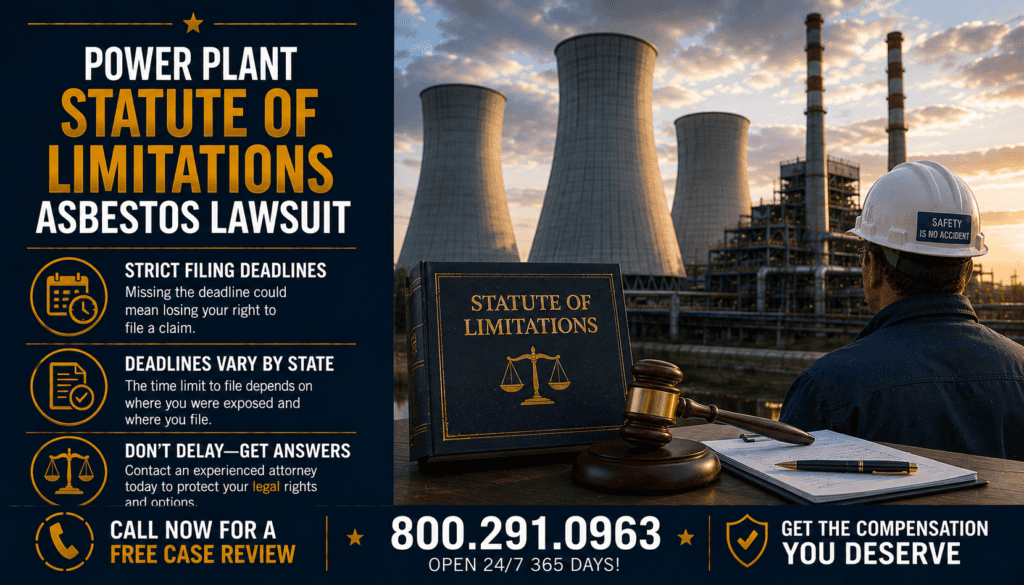
Power Plant Statute of Limitations
Former power plant workers diagnosed with mesothelioma or asbestos-related lung cancer may have options for compensation. The time to file a claim can be limited, even when asbestos exposure occurred many years ago.
This guide explains how filing deadlines may affect power plant workers and their families, what information matters, and how to seek help without waiting until every historical record has been found.
⚖️ Why Filing Deadlines Matter
A former power plant worker diagnosed with mesothelioma or asbestos-related lung cancer may have legal options even when the exposure happened decades ago. But every potential claim has timing rules. A filing deadline can affect whether a court will consider a lawsuit, so waiting for every employment record or product name before seeking help can create unnecessary risk.
The applicable deadline is not simply the number of years since someone worked at a plant. State law, the type of claim, where the case may be filed, the diagnosis date and other circumstances can all matter. In many asbestos cases, a legal rule related to discovering an injury affects when the time period begins. Its application is not identical in every state, and exceptions cannot be assumed.
If you or a family member has received a diagnosis, ask promptly for a review of the relevant filing deadline. A lawyer experienced in asbestos claims can identify possible states and defendants, explain which deadlines may apply, and determine whether an urgent filing is appropriate. You do not need to know every manufacturer before requesting that review.
🗺️ Which State’s Deadline May Apply
Power plant workers often lived in one state, worked at facilities in another and later moved after retirement. Some worked for utilities with multiple generating stations. Those facts can affect the legal analysis. The state where you live today does not automatically control every potential lawsuit.
Important details include the plant’s location, the employer’s business relationships, the places where exposure occurred, the residence of the injured person, and where a defendant may be sued. Different states may apply different rules to these circumstances. An asbestos attorney may also need to consider choice-of-law rules and whether a particular court can hear the case.
When speaking with legal counsel, give the names and approximate locations of every plant where you worked, including temporary assignments and shutdown jobs. If you worked at both fossil-fuel and nuclear facilities, list them separately. Record the states where you lived during employment and at diagnosis. This information helps identify relevant deadlines without guessing which state’s law applies.
🩺 Mesothelioma And Lung Cancer Diagnosis Dates
Asbestos-related illnesses can appear long after exposure. For this reason, the date of a workplace exposure is not necessarily the date from which a legal deadline is measured. However, there is no universal rule that gives every patient the same amount of time after diagnosis. The specific diagnosis, knowledge of a possible asbestos connection, prior medical findings and governing law may affect the analysis.
For mesothelioma, keep the pathology report, biopsy findings, imaging results, specialist notes and the date a clinician first explained the diagnosis. A second opinion or later treatment at a specialty center may be important medically, but should not be assumed to restart a legal clock. Information about Mesothelioma Diagnosis and Mesothelioma Treatments can help patients understand medical terminology while legal deadlines are evaluated separately.
For asbestos-related lung cancer, the medical history may be more complicated. A clinician may assess tobacco exposure, occupational hazards, imaging, pathology and prior asbestos work. A diagnosis of lung cancer alone does not establish asbestos causation, and smoking history does not automatically exclude a possible asbestos-related claim. Families should preserve the actual medical records rather than trying to determine causation themselves. See Asbestos Lung Cancer Lawsuits for an overview of possible legal options.
🏭 Power Plant Work That May Have Involved Asbestos
Power plants used high-temperature equipment, steam distribution systems, turbines, boilers, pumps and electrical infrastructure. In older facilities, some insulation, gaskets, packing, fireproofing and other materials contained asbestos. Exposure was especially plausible when workers cut, removed, scraped, replaced or cleaned up asbestos-containing materials. Merely working at a power plant does not prove a particular person inhaled asbestos fibers.
Power Plant Pipefitters Asbestos Exposure may have worked around insulated steam lines and flanges. Power Plant Mechanics Asbestos Exposure may have opened pumps and valves containing older packing or gaskets. Power Plant Electricians Asbestos Exposure may have worked near heat-resistant electrical components or disturbed adjacent building materials during repairs. Power Plant Insulators Asbestos Exposure often worked directly with thermal insulation. Operators, cleaners and nearby trades could also encounter dust released by another crew during outages.
Consider the tasks you actually performed: removing boiler insulation, repairing a valve, cutting gaskets, replacing packing, sweeping debris after an outage or entering a turbine room during major maintenance. Identify whether the material was old, friable, damaged or handled dry. Do not assume every gasket or insulation product contained asbestos. The material type, product era, supplier and work method matter.
For a broader description of plant environments, see Power Plants Asbestos Exposure , Power Plant Workers And Occupations and Asbestos Exposure In Equipment .
📁 Records That Can Help Protect Your Claim
Start with what you can access safely and legally. Write down the employer, plant name, city, job title, approximate employment years, department and regular tasks. Note shutdown periods, contractors, union locals and coworkers who may remember the equipment. A partial but accurate timeline is more useful than a detailed account based on guesses.
Employment records may include pay statements, pension histories, union records, Social Security earnings information, training records or contractor assignments. Medical documents can include pathology, radiology reports, appointment notes and occupational histories. Keep copies of records showing when a diagnosis was communicated; those dates may be relevant to deadline questions.
Older plant records may be unavailable because a utility merged, a facility closed or a contractor changed names. That does not necessarily prevent a claim. Coworker testimony, product documents, historical invoices and other evidence may help fill gaps. Tell a legal representative what is missing; do not alter records, enter restricted facilities or contact former employers under false pretenses to obtain documents.
When exposure may have involved take-home dust on work clothing, explain that history separately. Secondhand Asbestos Exposure may be relevant for a household member with a diagnosis, but the applicable legal theories and deadlines require individual review.
👨👩👧 Wrongful Death And Family Deadlines
When a former worker has died from mesothelioma or another disease potentially related to asbestos, surviving family members may have questions about compensation. Wrongful-death claims and claims brought on behalf of a deceased person’s estate can be different legal actions. They may have different eligible claimants, proof requirements and filing deadlines.
The date of death can be important, but it is not safe to assume every state starts every relevant deadline on that date. A claim filed during the worker’s lifetime, a prior settlement or the status of an estate may also affect what remains available. An executor or other legally authorized person may need to act on behalf of the estate.
Families should keep the death certificate, relevant medical records, marriage or birth records where applicable, and any correspondence about earlier asbestos claims. A prompt legal review can clarify who has authority to file and whether separate personal-injury, survival or wrongful-death rules apply. The goal is to avoid losing a potentially available option while the family is dealing with a death.
💰 Lawsuits, Bankruptcy Trusts And Other Benefits
Some asbestos companies established bankruptcy trusts to compensate qualifying claimants. Trust submissions are not identical to civil lawsuits: each trust has its own eligibility criteria, evidence requirements and filing procedures. A trust’s submission rules should not be confused with a state statute of limitations, and submitting a trust claim should not be assumed to preserve a lawsuit deadline.
Depending on the exposure history, a person may have potential claims involving more than one company or product. A legal review can address possible civil defendants, trust criteria, prior settlements and any coordination requirements. Asbestos Trust Funds explains the basic trust-fund framework; Mesothelioma Claims describes common claim types.
Workers with military service may also want to discuss separate veterans’ benefit questions. Service-related exposure and civilian power plant exposure should be described distinctly. U.S. Military Veterans Asbestos Exposure offers background on military asbestos exposure, but VA eligibility and civil liability are not interchangeable determinations.
Compensation is not guaranteed. Whether a claim is available depends on evidence, medical findings, applicable law, responsible parties and timing.
📞 What To Do After A Diagnosis
First, prioritize medical care. Ask your treating team to explain the diagnosis and whether consultation with a mesothelioma or thoracic oncology specialist is appropriate. If you are still working around suspect materials, do not disturb them; report the concern to the appropriate safety personnel and follow applicable protective procedures.
Second, preserve your work history in a simple timeline. Include the plant’s name, years, job duties, known products, other nearby trades and coworkers who can be contacted. If you have photos, pay records or union documents, keep the originals and copies. You can describe an exposure without claiming certainty about the fiber content of a particular product.
Third, request a timely legal consultation specifically about the deadline. Ask which state’s law might apply, what date may trigger it, whether a family claim differs from a personal-injury claim, and what information counsel needs immediately. Mesothelioma Filing Deadlines and Mesothelioma Lawsuit provide general context; neither replaces advice based on your facts.
Finally, do not wait for a complete collection of decades-old records before raising a deadline concern. Gathering evidence and checking filing time limits can proceed together.
❓ Frequently Asked Questions
How Long Do I Have To File After A Mesothelioma Diagnosis?
There is no single nationwide deadline. A lawyer must assess the relevant state law, claim type and facts. Seek advice promptly rather than relying on a general number of years.
Can I File If I Retired From The Power Plant Decades Ago?
Possibly. Long latency is common with asbestos-related diseases. The exposure date alone does not decide whether a lawsuit is timely, but the legal review should not be delayed.
What If I Worked At Plants In Several States?
List every facility and the years worked. A lawyer can examine where exposure occurred, possible defendants and which law may govern.
Does Filing A Trust Claim Stop The Lawsuit Deadline?
Do not assume so. Trust procedures and civil-court deadlines differ, and their interaction depends on the specific claims and applicable law.
Can My Family File If I Die Before A Case Is Finished?
There may be survival or wrongful-death options, but the people entitled to act and the deadlines vary. Ask counsel to review the estate and any pending claims immediately.
Do I Need To Identify The Exact Asbestos Product First?
No. A detailed work history is a useful starting point. Product identification may require additional evidence, and a deadline assessment should not wait for certainty about every material.
Does Lung Cancer Qualify Even If I Smoked?
Smoking does not automatically rule out an asbestos-related claim. Medical causation and legal responsibility require individualized evaluation.
Can I Recover Compensation If The Plant Closed?
Closure does not automatically eliminate legal options. The relevant parties may include manufacturers, contractors or qualifying bankruptcy trusts, depending on the evidence.
🧭 Summary
A diagnosis after years of power plant work deserves prompt medical attention and a timely assessment of potential asbestos claims. Filing deadlines depend on the relevant state and type of claim; they cannot be determined from exposure dates alone. Keep the diagnosis records and a practical work history, and ask about lawsuits, trust funds and any family claims before a deadline may expire.
📚 Confirmed Sources
Get The Compensation You Deserve
Find out if you may qualify for asbestos compensation today. Call 800.291.0963 or Submit Your Case Here .
25+ years of experience. Help is available 24/7/365.
Disclaimer: Mesothelioma Help Center is not a law firm or medical provider and does not determine legal or VA eligibility. This information is not individualized medical or legal advice.