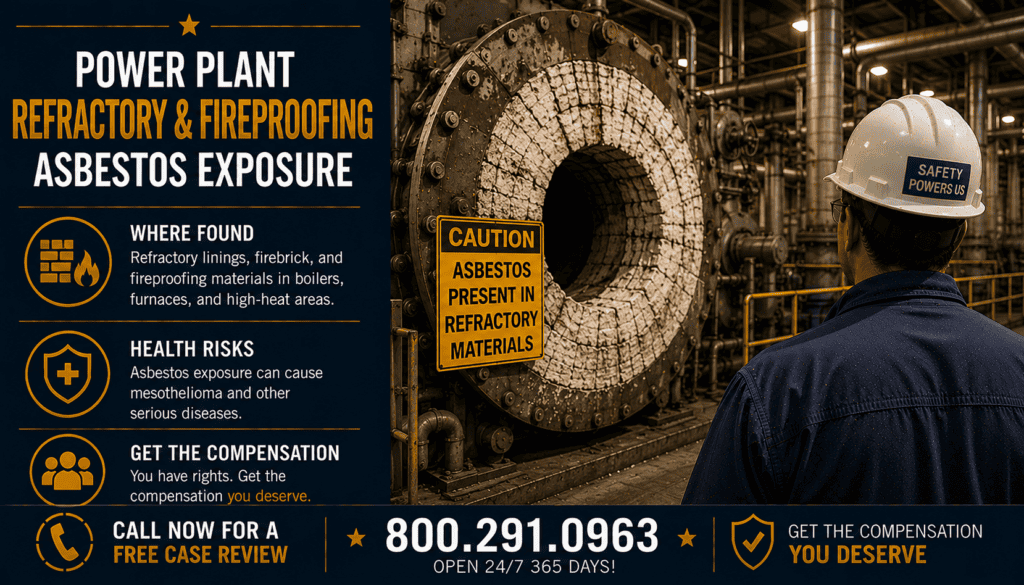
🏭 Power Plant Refractory & Fireproofing Asbestos Exposure
At older generating stations, workers maintained boiler furnaces, burner floors, structural steel, breeching and high-temperature equipment rooms. Some legacy installations used heat-resistant or fire-resistant products that contained asbestos, although composition differed by product and date. The relevant question is which materials were actually present and disturbed during a worker’s assignment.
This guide explains power plant refractory & fireproofing asbestos exposure, including historical refractory mixes, insulating cement, sprayed fireproofing and heat-resistant seals, the jobs most closely associated with the equipment, and steps that may help someone diagnosed with mesothelioma or asbestos-related lung cancer document a possible workplace exposure.
🏭 Power Plant Work Areas and Equipment
Site Layout and Installation History
The relevant locations include boiler furnaces, burner floors, structural steel, breeching and high-temperature equipment rooms. Equipment drawings and plant renovation records can identify which systems were installed during a worker’s employment. A building’s age is useful context but cannot by itself establish that a particular component contained asbestos. For the broader generating-station setting, the Power Plants Asbestos Exposure.
In a generating station, the same work area may have changed after an overhaul or outage. A worker assigned to a turbine hall, boiler house or electrical annex should identify the specific equipment and work period rather than relying only on the name of the plant. Related plant layouts are discussed under Mesothelioma Diagnosis. Related plant layouts are discussed under Valve Products Asbestos Exposure.
Questions to Ask About Site Layout and Work Records
Which years did the work take place? What specific rooms, equipment, or tasks were involved? Who performed removal, repair, and cleanup? Were dust controls used? Were contractors working nearby? These questions help narrow the history without assuming every employee had the same exposure.
Keep dates and facts distinct from recollections. A job title is useful, but the combination of location, work assignment, material, and frequency is more informative. Records from several sources can corroborate a timeline even when individual product labels are no longer available.
👷 Workers and Trades Potentially Affected
Maintenance Trades and Contractors
Workers with potentially relevant duties included boilermakers, refractory masons, insulators, demolition crews and outage contractors. Their exposure histories depend on the tasks they performed, their proximity to other trades, ventilation, and whether any asbestos-containing materials were damaged or disturbed. The occupation-specific history in Power Plant Workers Asbestos Exposure.
Contractors often entered during shutdowns to remove, repair or replace equipment. Employment records, union dispatches and contractor work packages may help distinguish routine operation from high-disturbance maintenance. Another relevant trade is covered in Asbestos Lung Cancer Lawsuits.
Questions to Ask About Jobs and Overlapping Crews
Which years did the work take place? What specific rooms, equipment, or tasks were involved? Who performed removal, repair, and cleanup? Were dust controls used? Were contractors working nearby? These questions help narrow the history without assuming every employee had the same exposure.
Keep dates and facts distinct from recollections. A job title is useful, but the combination of location, work assignment, material, and frequency is more informative. Records from several sources can corroborate a timeline even when individual product labels are no longer available.
🧱 Materials and Components to Identify
Identifying Historic Materials
Historically relevant products include historical refractory mixes, insulating cement, sprayed fireproofing and heat-resistant seals. Not every refractory or fireproofing product contained asbestos; the formulation and installation era matter. Purchase records, equipment specifications and original product packaging may clarify the manufacturer and material type. A related material and equipment guide is Power Plant Electrical Equipment Asbestos Exposure.
The material category is important: historical refractory and sprayed or troweled-on surfacing materials. In many cases the hazard was not the machinery itself but a replaceable insulating, sealing or fire-resistant component installed around it. Compare historic component types with HVAC Technicians Asbestos Exposure.
Questions to Ask About Materials and Equipment Identification
Which years did the work take place? What specific rooms, equipment, or tasks were involved? Who performed removal, repair, and cleanup? Were dust controls used? Were contractors working nearby? These questions help narrow the history without assuming every employee had the same exposure.
Keep dates and facts distinct from recollections. A job title is useful, but the combination of location, work assignment, material, and frequency is more informative. Records from several sources can corroborate a timeline even when individual product labels are no longer available.
At generating stations, equipment histories can be especially complex because components were refurbished or replaced at different times. Review outage schedules, insulation specifications, contractor work packages, and maintenance logs together. Distinguish original construction materials from later replacement parts, and note which crews worked close to open machinery during each phase of a shutdown.
🌫️ How Asbestos Fibers Could Become Airborne
Repair and Removal Activities
Tasks of concern included chipping old furnace linings, stripping fireproofing, preparing surfaces and handling debris. Cutting, scraping, grinding or removing an asbestos-containing product can release respirable fibers; simply working near equipment does not establish that exposure occurred. Maintenance work in adjacent systems is covered in Electricians Asbestos Exposure.
Exposure histories should record who did the disturbance, how long it lasted, whether workers shared the same space, and what containment or cleanup procedures were used. Never disturb suspected asbestos to obtain evidence. Other disturbance scenarios are described in Boiler Products Asbestos Exposure.
Questions to Ask About Disturbance and Airborne Fibers
Which years did the work take place? What specific rooms, equipment, or tasks were involved? Who performed removal, repair, and cleanup? Were dust controls used? Were contractors working nearby? These questions help narrow the history without assuming every employee had the same exposure.
Keep dates and facts distinct from recollections. A job title is useful, but the combination of location, work assignment, material, and frequency is more informative. Records from several sources can corroborate a timeline even when individual product labels are no longer available.
🩺 Mesothelioma Diagnosis and Exposure History
Diagnosis and Job History
Mesothelioma may develop many years after asbestos exposure. Someone diagnosed with the disease can prepare a chronological history of jobs, work areas, contractors, materials and coworkers to discuss with qualified medical and legal professionals. For clinical evaluation and testing, consult Pipefitters Asbestos Exposure.
Medical records establish the diagnosis; work records help evaluate possible exposure. Neither one alone identifies a particular responsible product manufacturer. Related exposure histories are documented in HVAC Products Asbestos Exposure.
Questions to Ask About Diagnosis and Medical Records
Which years did the work take place? What specific rooms, equipment, or tasks were involved? Who performed removal, repair, and cleanup? Were dust controls used? Were contractors working nearby? These questions help narrow the history without assuming every employee had the same exposure.
Keep dates and facts distinct from recollections. A job title is useful, but the combination of location, work assignment, material, and frequency is more informative. Records from several sources can corroborate a timeline even when individual product labels are no longer available.
Learn about testing and confirmation in the Mesothelioma Diagnosis guide.
🫁 Asbestos-Related Lung Cancer
Medical and Occupational Evidence
Asbestos exposure is an established risk factor for lung cancer. A treating physician should evaluate the individual medical history, while worksite records can help document the nature and timing of potential occupational exposure. Information about potential lung-cancer claims appears in Insulators Asbestos Exposure.
Smoking and asbestos exposure are separate risk factors that can act together. Legal eligibility depends on the evidence and applicable jurisdiction, not simply on an occupation name. For workplace context, compare Pump Products Asbestos Exposure.
Questions to Ask About Lung Cancer and Exposure History
Which years did the work take place? What specific rooms, equipment, or tasks were involved? Who performed removal, repair, and cleanup? Were dust controls used? Were contractors working nearby? These questions help narrow the history without assuming every employee had the same exposure.
Keep dates and facts distinct from recollections. A job title is useful, but the combination of location, work assignment, material, and frequency is more informative. Records from several sources can corroborate a timeline even when individual product labels are no longer available.
For legal context after diagnosis, read Asbestos Lung Cancer Lawsuits.
📋 Documents and Records Worth Preserving
Records That May Clarify Exposure
Useful records include plant layouts, job cards, maintenance logs, outage schedules, invoices, equipment specifications, union records and coworker recollections about boiler furnaces, burner floors, structural steel, breeching and high-temperature equipment rooms. Keep dates, employers and specific tasks separate from assumptions about asbestos content. Useful work-history categories are outlined in Boilermakers Asbestos Exposure.
When possible, note the equipment model and the product that was actually removed or replaced. Avoid taking samples from a facility; qualified professionals should handle suspected asbestos. Related equipment identification information appears in Refractory Materials Asbestos Exposure.
Questions to Ask About Evidence to Preserve
Which years did the work take place? What specific rooms, equipment, or tasks were involved? Who performed removal, repair, and cleanup? Were dust controls used? Were contractors working nearby? These questions help narrow the history without assuming every employee had the same exposure.
Keep dates and facts distinct from recollections. A job title is useful, but the combination of location, work assignment, material, and frequency is more informative. Records from several sources can corroborate a timeline even when individual product labels are no longer available.
How to Build A Reliable Exposure Timeline
Start with the earliest known year at the facility and work forward in order. Record the name used by the employer at that time, since companies, contractors, and facilities may have changed names. Separate regular duties from occasional shutdowns, emergencies, temporary assignments, and major construction projects. A worker who spent most days in one area may have had a different experience during a short overhaul or cleanup assignment. Note whether the work was indoors or outdoors and whether mechanical ventilation was operating. Describe what was being repaired or removed, who did the work, and how debris was handled. This level of detail is more useful than a general statement that the entire site was dusty.
Next, compare the timeline with any surviving purchasing records, engineering drawings, maintenance instructions, union documents, and co-worker recollections. A product’s presence at a facility does not necessarily mean it was present during a particular person’s employment. Likewise, a company name in an old document may not identify the manufacturer of the material actually disturbed. Record uncertainty openly instead of filling gaps with assumptions. If photographs are available, preserve the original files and any captions, dates, or location details. If a colleague can describe the same task, note how that person knows the information. These steps can help medical and legal professionals evaluate the history more accurately.
⚖️ Compensation and Legal Options
Claims and Eligibility
Depending on the facts, legal options may include claims involving responsible asbestos product manufacturers, asbestos bankruptcy trusts, and certain veterans benefits. The type of claim, deadlines and available evidence vary by jurisdiction. For related asbestos legal context, review Millwrights Asbestos Exposure.
Questions to Ask About Potential Compensation Routes
A lawyer experienced in asbestos matters can review a person’s diagnosis, work history and possible product identification. No article can determine whether an individual qualifies for compensation. A separate occupational resource is Turbine Products Asbestos Exposure.
Keep dates and facts distinct from recollections. A job title is useful, but the combination of location, work assignment, material, and frequency is more informative. Records from several sources can corroborate a timeline even when individual product labels are no longer available.
📚 Related Worksite and Occupation Guides
For more detailed information, the linked occupation, system, and facility guides above can help identify the records relevant to a particular work history.
❓ Frequently Asked Questions
Does Working At This Site Prove Asbestos Exposure?
No. A workplace name or job title alone cannot confirm asbestos exposure. Material identification, job duties, dates, and corroborating records are important.
Can Exposure Happen Without Handling Insulation Directly?
Yes. Where asbestos-containing material was disturbed, workers nearby may have encountered airborne fibers. Actual exposure depends on the conditions and controls.
How Long After Exposure Can Illness Appear?
Mesothelioma and asbestos-related lung cancer can appear decades after exposure. A clinician should assess symptoms and individual risk.
What If The Employer Has Closed?
Employment, union, Social Security, product, and contractor records may still help reconstruct a work history.
Do All Claims Have The Same Deadline?
No. Filing deadlines and legal options depend on the jurisdiction and facts. Seek individualized advice promptly.
📚 Confirmed Sources
🧭 Summary
Document the site, work years, job assignments, equipment, and any asbestos-containing materials identified in records. Preserve diagnosis documents and ask qualified professionals to evaluate medical and legal questions. Exposure cannot be determined from a facility name alone.
GET THE COMPENSATION YOU DESERVE
Find out if you may qualify for asbestos compensation today. Call 800.291.0963. Help is available 24/7/365. 25+ years of experience.
Mesothelioma Help Center is not a law firm or medical provider and does not determine legal or VA eligibility. This information is not individualized medical or legal advice.