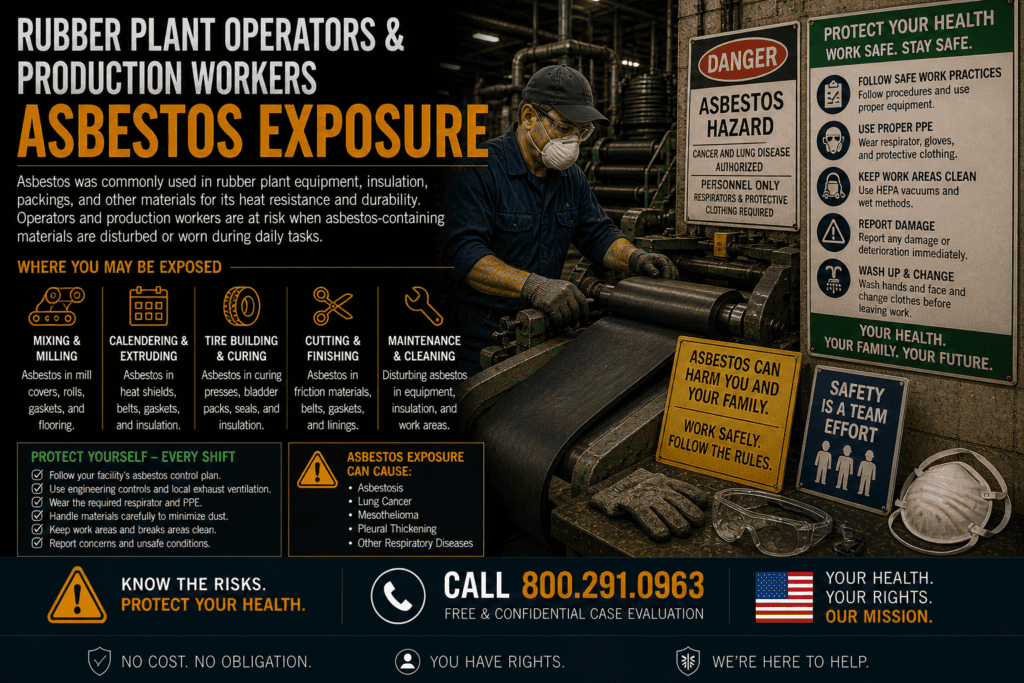
🏭 Rubber Plant Operators & Production Workers Asbestos Exposure
Rubber plant operators and production workers were exposed to airborne asbestos fibers while running mixers, presses, molding lines, curing ovens, conveyors, and material-handling equipment that contained asbestos insulation, gaskets, seals, friction components, and fireproofing—placing workers at risk during daily operations, equipment wear, and nearby maintenance activities.
Rubber manufacturing relied on continuous, high-heat production environments. Operators and production workers staffed mixers, presses, calendars, molding stations, curing lines, and finishing areas for entire shifts, often standing within feet of asbestos-containing machinery. In plants built or modernized before the 1980s, asbestos was embedded throughout equipment and building systems. Even when operators did not directly repair machinery, normal operation and deterioration released fibers into the air they breathed every day.
Because production lines ran around the clock, operators experienced chronic, cumulative exposure—often for decades—without warnings, respirators, or adequate ventilation.
🏭 Why Operators Faced Continuous Asbestos Exposure
Rubber plant operators were uniquely vulnerable because they:
-
⚙️ Worked directly beside asbestos-insulated equipment
-
🔥 Operated machinery at extreme temperatures
-
🌬️ Breathed air circulating through contaminated spaces
-
🧹 Cleaned work areas with settled asbestos dust
-
🚶 Moved between departments, spreading contamination
Unlike maintenance crews who had episodic exposure, operators were exposed every shift, often across multiple job stations.
🧪 Asbestos Sources in Production Areas
Asbestos was commonly present in and around production equipment operators used daily, including:
⚙️ Mixers, Mills & Calendars
-
Heat-resistant insulation and linings
-
Gaskets and seals on access doors
-
Steam-heated housings and piping
🔥 Presses, Molding & Curing Lines
-
Asbestos insulation on platens and ovens
-
Thermal blankets and heat shields
-
Mold seals and compression gaskets
🚰 Steam, Heating & Utility Systems
-
Overhead pipe insulation and lagging
-
Valve packing and flange gaskets
-
Heat exchangers and condensate lines
🛑 Conveyors & Material Handling
-
Asbestos friction materials in brakes
-
Clutches and drive components
-
Fireproof panels near motors
🧱 Building & Structural Materials
-
Spray-applied asbestos fireproofing
-
Ceiling tiles and insulation
-
Floor tiles and mastics
As these materials aged, cracked, or vibrated loose, asbestos fibers entered the air in production zones.
⚠️ How Asbestos Exposure Occurred During Daily Operations
Operators and production workers were exposed during:
-
Normal operation of mixers, presses, and ovens
-
Heat cycling that degraded insulation and gaskets
-
Opening access doors and panels between runs
-
Standing beneath overhead insulated piping
-
Cleanup of dust and debris at workstations
-
Maintenance and repairs performed nearby
-
Startups, shutdowns, and equipment malfunctions
Even without touching asbestos directly, workers inhaled fibers released into shared airspaces.
🌫️ Airborne Asbestos Throughout Production Floors
Asbestos exposure in production areas was intensified because:
-
🌬️ Ventilation systems recirculated contaminated air
-
🏭 Large enclosed floors trapped fibers indoors
-
🧹 Dry sweeping and compressed air re-aerosolized dust
-
🚶 Constant foot traffic spread fibers plant-wide
Asbestos dust settled on control panels, work surfaces, uniforms, and personal items—creating repeated exposure throughout each shift.
🧑🏭 Rubber Plant Workers Most at Risk
🏭 Production Line Operators
Ran mixers, presses, molding, and curing equipment.
🛞 Machine Tenders & Assistants
Loaded materials and monitored equipment.
🧹 Utility & Cleanup Workers
Cleaned production floors and machinery.
🚜 Material Handlers & Forklift Operators
Moved contaminated materials through the plant.
👷 Relief & Float Workers
Moved between departments with varying exposure sources.
Because operators rotated through multiple areas, exposure accumulated across the entire facility.
🧬 Secondary (Take-Home) Asbestos Exposure
Rubber plant operators often carried asbestos fibers home on:
-
Work uniforms and coveralls
-
Gloves, boots, and PPE
-
Hair and skin
-
Vehicles and personal items
Family members were exposed during laundry and household contact. Many mesothelioma cases have been linked to secondary exposure from long-term production work in rubber plants.
🫁 Health Risks Linked to Operator Asbestos Exposure
Long-term asbestos exposure among operators and production workers is associated with:
🧠 Mesothelioma
A rare, aggressive cancer caused almost exclusively by asbestos.
🫁 Asbestosis
Progressive lung scarring leading to chronic breathing difficulty.
🫁 Lung Cancer
Significantly increased risk following prolonged asbestos exposure.
Because operators inhaled low-level asbestos daily for years, disease often appeared decades after exposure ended.
📜 Safety Failures Affecting Production Workers
Many rubber manufacturers failed to:
-
Identify asbestos hazards in production equipment
-
Warn operators of airborne asbestos risks
-
Upgrade ventilation in high-heat areas
-
Provide respirators or protective clothing
-
Restrict dry sweeping and compressed air use
-
Remove asbestos during equipment modernization
These failures form the basis of many asbestos claims involving rubber plant operators.
❓ Frequently Asked Questions (FAQs)
1️⃣ Were operators exposed even if they didn’t do repairs?
Yes. Deteriorating materials released fibers during normal operation.
2️⃣ Did heat make asbestos exposure worse?
Yes. Heat and vibration accelerated breakdown of insulation and gaskets.
3️⃣ Could exposure occur plant-wide?
Yes. Ventilation systems spread fibers beyond workstations.
4️⃣ Can family members file secondary exposure claims?
Yes. Take-home asbestos exposure is legally recognized.
5️⃣ Can claims still be filed decades later?
Yes. Asbestos diseases often appear 20–50 years after exposure.
⚖️ How a Lawyer Can Help Get Compensation
An experienced asbestos lawyer can help rubber plant operators and families by:
-
Investigating job duties and production areas
-
Identifying asbestos-containing equipment near workstations
-
Tracing manufacturers of insulation, gaskets, and fireproofing
-
Documenting occupational and secondary exposure
-
Filing mesothelioma lawsuits
-
Submitting asbestos trust fund claims
-
Coordinating claims across multiple exposure sources
-
Maximizing total compensation available
Because operators were exposed across many systems over long careers, detailed investigation is essential.
📞 Free Case Evaluation – Get Help Today
If you worked as an operator or production worker in a rubber plant and developed mesothelioma or another asbestos-related illness—or were exposed through a family member—help is available.
📞 Call Now for a FREE Case Evaluation: 800-291-0963
There is no obligation, and compensation may be available.
📌 Key Takeaways
-
Rubber plant operators faced daily asbestos exposure
-
Heat and vibration released fibers during normal operations
-
Exposure was chronic and cumulative
-
Families faced secondary exposure risks
-
Legal options may still be available