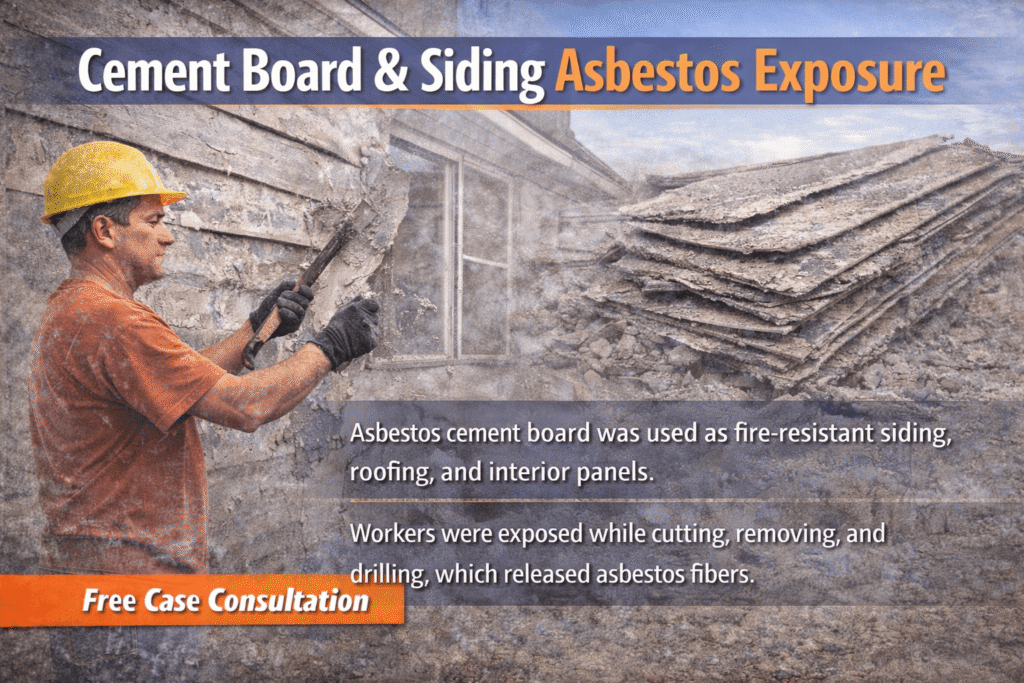
🧱 Cement Board & Siding Asbestos Exposure
Cement board and siding work exposed construction workers to asbestos when cutting, drilling, snapping, sanding, or removing asbestos-cement products used extensively on homes, apartments, commercial buildings, and industrial structures.
For much of the 20th century, asbestos-cement products were marketed as durable, fire-resistant, rot-proof building materials. From the 1930s through the late 1980s, cement siding, panels, shingles, and backer boards commonly contained asbestos fibers bonded into cement. While intact products appeared solid, cutting or breaking them released respirable asbestos dust, often at face level.
Because cement board and siding installation was widespread—and removal work increased as buildings aged—exposure occurred across multiple trades and decades.
🧱 Why Asbestos Was Used in Cement Board & Siding
Manufacturers added asbestos to cement products because it:
-
🔥 Improved fire resistance
-
💪 Increased strength and crack resistance
-
🌧️ Enhanced weather and moisture durability
-
🧱 Reinforced brittle cement mixtures
-
🪚 Allowed thinner, lighter panels
-
💲 Reduced long-term maintenance costs
Asbestos-cement became a standard exterior and backer material nationwide.
🏗️ Cement Board & Siding Products That Contained Asbestos
Workers often handled asbestos-cement daily without warnings.
🧰 High-risk asbestos-cement products included:
-
🧱 Exterior siding panels and shingles
-
🧱 Flat cement wall panels
-
🧱 Roofing shingles and shakes
-
🧱 Soffit and fascia boards
-
🧱 Backer board behind tile
-
🧱 Cement lap siding
-
🧱 Fence panels and utility enclosures
-
🧱 Fire-resistant wall assemblies
Cutting or snapping these materials released fine asbestos particles.
👷 How Asbestos Exposure Occurred During Cement Board Work
Exposure occurred during routine installation and removal tasks.
High-risk activities included:
-
🪚 Sawing or cutting cement boards
-
🔨 Snapping panels to size
-
🧱 Drilling holes for fasteners
-
🧹 Sanding edges or surfaces
-
🏚️ Removing old siding during renovations
-
🚜 Demolishing exterior walls
-
🌬️ Dry cutting without dust controls
Power tools dramatically increased airborne fiber concentrations.
🧑🏭 Workers Most at Risk From Cement Board Asbestos Exposure
Cement-board exposure affected multiple trades.
High-risk workers include:
-
🧱 Siding installers and carpenters
-
🛠️ Remodelers and renovation crews
-
🧰 Tile setters using cement backer board
-
🏗️ General construction laborers
-
🧹 Demolition and cleanup crews
-
👷 Construction supervisors and foremen
-
🏠 Homeowners performing DIY siding work
Secondhand exposure frequently affected family members through dusty clothing.
🏢 Job Sites Where Cement Board Asbestos Exposure Occurred
Asbestos-cement products were used on:
-
🏠 Residential homes and apartments
-
🏢 Office buildings and retail stores
-
🏫 Schools and universities
-
🏥 Hospitals and clinics
-
🏭 Factories and warehouses
-
🏛️ Government and municipal buildings
-
🏚️ Public housing and military housing
Many structures still contain asbestos-cement beneath newer materials.
🫁 Diseases Linked to Cement Board & Siding Asbestos Exposure
Asbestos diseases often develop 20–50 years after exposure.
Common diagnoses include:
-
Mesothelioma
-
Asbestos-related lung cancer
-
Asbestosis
-
Pleural plaques and thickening
Workers with long construction careers often experienced repeated cumulative exposure.
⚠️ Why Cement Board Asbestos Exposure Was Often Overlooked
Exposure persisted because:
-
❌ Products appeared solid and “safe”
-
❌ Dust was considered normal construction debris
-
❌ No warning labels were provided
-
❌ Outdoor work was assumed low-risk
-
❌ Removal regulations came decades later
Many workers were never informed until after diagnosis.
⚖️ Legal Options for Cement Board & Siding Asbestos Victims
Victims may qualify for:
-
⚖️ Asbestos personal injury lawsuits
-
🏦 Multiple asbestos trust fund claims
-
⚰️ Wrongful death lawsuits (for families)
-
🇺🇸 VA benefits (if exposure occurred on federal or military projects)
Claims typically target manufacturers of asbestos-cement products, not employers.
🧑⚖️ How a Lawyer Can Help With Cement Board Asbestos Claims
An experienced asbestos lawyer can:
-
🔍 Identify asbestos-cement products by era and use
-
📂 Reconstruct siding and construction job histories
-
🏭 Match exposure to responsible manufacturers
-
🏦 File multiple asbestos trust fund claims
-
⚖️ File lawsuits in favorable jurisdictions
-
⏱️ Protect statute of limitations deadlines
-
🤝 Handle multi-site exposure cases
Cement-board cases often involve multiple manufacturers and trust funds.
❓ Frequently Asked Questions (FAQs)
❓ Does all cement board contain asbestos?
Not all, but many products manufactured before the late 1980s did.
❓ Is breaking cement siding more dangerous than leaving it intact?
Yes. Cutting or breaking releases airborne fibers.
❓ I worked siding briefly—can I still file?
Yes. Even intermittent exposure can cause disease.
❓ Can tile setters file claims for backer board exposure?
Yes. Cement backer board was a common asbestos source.
❓ Can families file claims after death?
Yes. Wrongful death and trust fund claims may still be available.
📞 Get Help for Cement Board & Siding Asbestos Exposure
If you worked with cement board, siding, or asbestos-cement products and were later diagnosed with mesothelioma or another asbestos-related disease, compensation may still be available—even decades later.
📌 You May Qualify For:
-
Asbestos lawsuits
-
Multiple asbestos trust fund claims
-
Wrongful death compensation
-
VA benefits (if applicable)
📞 Call 800-291-0963 for a free, confidential cement board asbestos exposure review
⏱️ No upfront costs • Nationwide representation • Deadline-protected claims
Cement siding looked strong—but hid a serious danger. Your case deserves accountability.