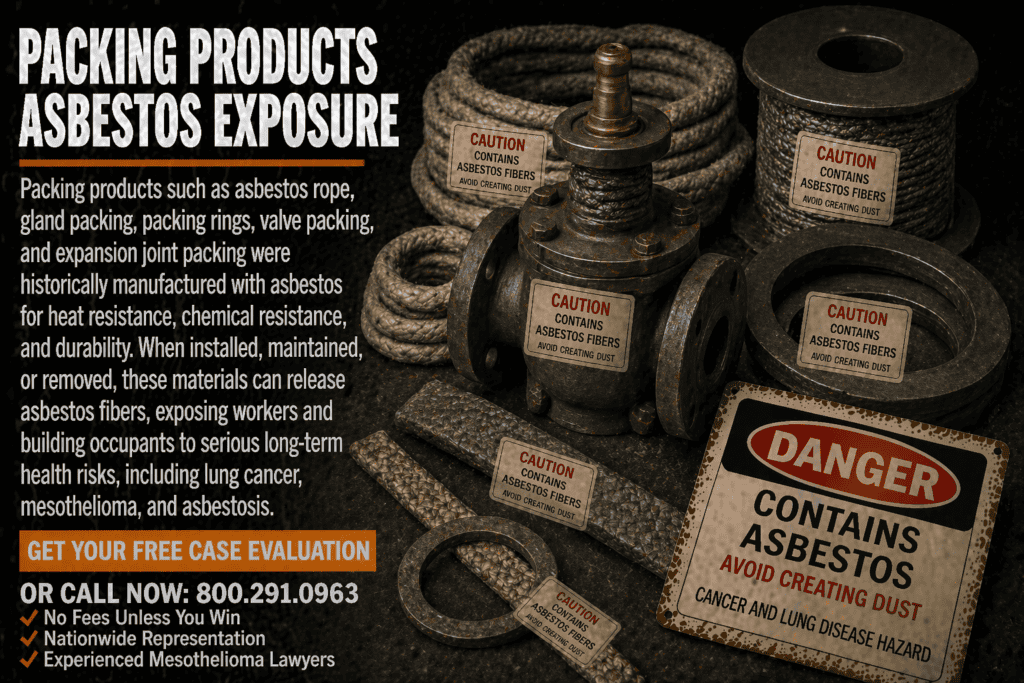
Packing Products Asbestos Exposure
Asbestos was historically used in some mechanical packing products because its fibers could withstand heat, friction and chemical exposure while helping control leakage around moving shafts, rods and valve stems. Older asbestos packing was used in pumps, valves, expansion joints, soot blowers and other mechanical equipment where motion made a flexible sealing material necessary.
Not every packing product contained asbestos. Packing materials have also been made from graphite, PTFE, aramid, cotton, flax, rubber and other non-asbestos fibers. Product identification therefore depends on the manufacturer, packing style, equipment application, installation or replacement period and service records.
Historical exposure is most plausible when asbestos-containing packing was cut from coils or rings, pulled from stuffing boxes, scraped from equipment, brushed or blown out during cleanup, or otherwise disturbed during pump, valve or machinery maintenance.
Packing Products and Historical Asbestos Use
Mechanical packing is used where a seal must function around a moving component. OSHA historically distinguished asbestos packing from gaskets by noting that gaskets are generally used in static sealing situations, while packing is used in dynamic applications such as pumps and valves where motion occurs.
Asbestos packing could be braided, woven, twisted or formed into rings and installed around shafts, rods or valve stems. Depending on the product, asbestos fibers could be combined with lubricants, binders or impregnating compounds selected for the temperature, pressure, fluid or chemical service involved.
The presence of an older pump, valve or machine does not prove that asbestos packing was installed. Packing was routinely replaced during maintenance, and replacement materials could vary over the equipment’s service life.
Pump, Valve and Machinery Packing Applications
Historical asbestos-containing packing was used in a range of mechanical sealing applications, including:
- rotary, centrifugal and reciprocating pumps;
- valve stems and valve stuffing boxes;
- pump shafts and rotating equipment;
- expansion joints;
- soot blowers used with boiler systems;
- steam and process equipment;
- turbines and other rotating machinery;
- industrial equipment requiring containment of liquids or gases; and
- specialty high-temperature sealing applications.
These applications do not establish that every packing product used in the equipment contained asbestos. Manufacturer, grade, composition, service period and replacement history should be evaluated whenever possible.
How Asbestos Exposure Could Occur
A potential exposure pathway requires asbestos-containing packing and work that disturbs it. Installed packing may be compressed inside a stuffing box or gland, while removal and replacement can involve direct handling of dry or worn material.
- pulling old packing from pumps or valves;
- cutting replacement packing from braided or rope-like stock;
- separating packing rings;
- scraping packing residue from stuffing boxes;
- brushing or cleaning packing cavities;
- overhauling pumps, valves or turbines;
- repairing steam and process equipment;
- handling worn or deteriorated packing material;
- cleaning debris from maintenance benches or floors; and
- disposing of removed packing.
Actual exposure depends on asbestos content, packing condition, removal method, frequency, duration, proximity, ventilation and controls.
Worked with older pump, valve or machinery packing? If you are trying to identify historical sealing materials and reconstruct a possible asbestos exposure, Call 800.291.0963. Live chat available 24/7, 365 days a year. Submit Your Case.
Workers and Workplaces That May Have Encountered Asbestos Packing
Workers who installed, removed, cut or replaced historical packing may have encountered asbestos-containing material when those products were present and disturbed. A job title alone does not establish exposure.
Potentially relevant occupations may include pump repair workers, valve mechanics, pipefitters, steamfitters, millwrights, machinists, boilermakers, stationary engineers, turbine mechanics and industrial maintenance employees.
Possible settings include power plants, refineries, chemical plants, factories, shipyards, boiler rooms, engine rooms, pumping stations, industrial maintenance shops and equipment-rebuild facilities.
Nearby workers may also be relevant when packing removal or cleanup generated dust in shared work areas.
Packing Removal, Installation and Cleanup Exposure Risks
Removing old packing
Packing can become compressed, hardened or degraded after extended service. Maintenance workers may use packing hooks, picks or similar tools to pull old material from stuffing boxes. If the packing contained asbestos, this work could disturb fibers.
Cutting replacement packing
Braided or rope-like packing was often cut into rings or lengths to fit a pump or valve. Cutting asbestos-containing packing could directly disturb the fibrous material.
Cleaning stuffing boxes
Workers may scrape, brush or wipe cavities before installing new packing. Residue from deteriorated asbestos-containing packing could be disturbed during this work.
Pump and valve overhaul
Repeated maintenance can involve numerous packing replacements over the service life of equipment. The number of repair cycles, products used and work methods can be relevant when reconstructing exposure.
Cleanup and disposal
Removed packing, fibers and debris may accumulate on benches, floors or tools. Historical dry sweeping, brushing or compressed-air cleanup could increase the potential for dust to become airborne.
Evidence That May Identify Asbestos-Containing Packing
Exposure reconstruction is strongest when evidence identifies the exact packing product, manufacturer, grade, equipment application, service period and work performed.
- packing manufacturer and brand names;
- product labels, boxes, spools or packaging;
- packing style, grade or part numbers;
- pump, valve, turbine or equipment manuals;
- illustrated parts lists and maintenance instructions;
- purchase orders, invoices and supplier records;
- storeroom or maintenance inventory records;
- shutdown and overhaul logs;
- repair and replacement work orders;
- historic photographs of products or equipment;
- technical data sheets and safety data sheets where available;
- laboratory analysis of surviving packing material;
- employer, union or military records documenting assignments; and
- coworker or supervisor statements identifying the products and tasks.
Evidence should distinguish packing from nearby gaskets, rope, insulation and other sealing materials whenever those products can be separately identified.
Medical and pathology records may document an asbestos-related diagnosis but do not establish which historical packing product was an exposure source.
Secondhand Exposure and Health Risks
If work with asbestos-containing packing generated fibers that accumulated on clothing, shoes, tools or belongings, asbestos could potentially have been carried away from the workplace. This is a possible secondhand exposure pathway, but family relationship alone does not establish exposure.
Asbestos exposure is associated with mesothelioma, asbestos-related lung cancer, asbestosis and other asbestos-related disease. Working with older pumps, valves or packing materials does not diagnose disease and does not establish individual medical causation.
Anyone concerned about historical occupational asbestos exposure should discuss their work history and health with a qualified healthcare professional.
Legal and Compensation Considerations
Depending on the evidence and circumstances, legal options may be available to a person diagnosed with an asbestos-related disease after documented exposure to a specific asbestos-containing packing product.
A legal review may consider the packing manufacturer, distributor or supplier, equipment manufacturer where relevant, workplace, service period, tasks performed, frequency and duration of exposure, diagnosis, jurisdiction and filing deadlines.
Identifying a pump, valve, turbine or machinery manufacturer does not automatically establish that it supplied every replacement packing product used during the equipment’s service life or that it is legally responsible. Liability is case-specific and depends on product evidence, exposure evidence and governing law.
Some matters may involve asbestos trust funds, but each trust has its own product, exposure and medical documentation requirements. Eligibility is not automatic, and compensation is not guaranteed.
Exposure that occurred decades ago does not by itself determine whether a claim is timely. Statutes of limitation and other deadlines vary by jurisdiction and circumstances and should be reviewed individually.
Packing Products Asbestos Exposure FAQs
Did some old packing products contain asbestos?
Yes. Historical asbestos packing was used in pumps, valves, expansion joints, soot blowers and other mechanical equipment where motion required a flexible seal.
How is packing different from a gasket?
Gaskets are generally used between static surfaces, while mechanical packing is commonly used around moving shafts, rods or valve stems to control leakage.
Why was asbestos used in packing?
Asbestos offered heat resistance, strength and chemical resistance that could be useful in dynamic sealing applications.
Can removing old packing release asbestos fibers?
Potentially, if the packing contains asbestos and removal, pulling, cutting, scraping or cleanup disturbs the material.
Can cutting packing rings create asbestos exposure?
Potentially, when asbestos-containing braided or rope-like packing is cut to fit pumps, valves or other equipment.
Did every old pump or valve use asbestos packing?
No. Packing materials varied by manufacturer, service requirements and replacement period, and many non-asbestos alternatives have been used.
What evidence can identify asbestos packing?
Useful evidence can include manufacturer names, product grades, packaging, equipment manuals, invoices, maintenance records, laboratory reports and witness testimony.
Does working with old packing automatically qualify someone for compensation?
No. Legal eligibility depends on product identification, asbestos-content evidence, exposure history, diagnosis, jurisdiction and other case-specific facts. Compensation is not guaranteed.
For related information, see Industrial Components & Sealing Products Asbestos Exposure, Gasket Products Asbestos Exposure, Pumps, Valves & Gaskets Asbestos Exposure, Steam Products Asbestos Exposure, Boiler Products Asbestos Exposure, Turbine Products Asbestos Exposure, Engine Products Asbestos Exposure, Rope Products Asbestos Exposure, and the main Asbestos Exposure in Products guide.
Get Help Reviewing Packing Product Exposure
If you or a family member has been diagnosed with mesothelioma, asbestos-related lung cancer or another asbestos-related disease and you are trying to identify older pump packing, valve packing, shaft packing or other mechanical sealing materials from a power plant, refinery, chemical plant, factory, shipyard, boiler room or industrial maintenance setting, we can help organize the product and exposure history that may be relevant.
Call 800.291.0963 to discuss what you remember about the packing product, manufacturer, equipment, workplace and work performed. Live chat is available 24/7, 365 days a year. Submit Your Case using the form below.
Prior exposure does not automatically establish a legal claim. Eligibility depends on the evidence, diagnosis, jurisdiction and other circumstances, and compensation is not guaranteed.
⚕️ Legal & Medical Information Disclaimer
This page provides general educational information and is not medical or legal advice. The information does not establish asbestos exposure, diagnosis, causation, liability, claim eligibility or compensation. Medical concerns should be discussed with a qualified healthcare professional, and legal questions should be reviewed with a qualified attorney.