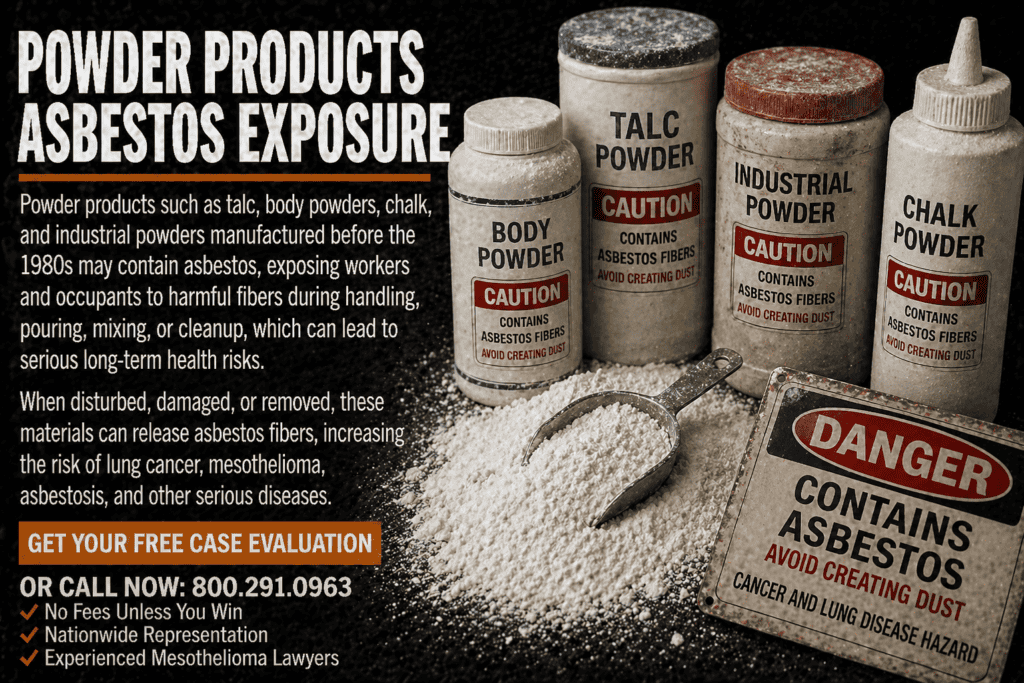
🧯 Powder Products Asbestos Exposure Mesothelioma Lawsuit
If you or a loved one has been diagnosed with mesothelioma or asbestos-related lung cancer due to exposure from asbestos-containing powder products, you may qualify to file a powder products mesothelioma lawsuit. Our experienced legal team helps industrial workers, factory employees, miners, mechanics, veterans, and families pursue financial compensation by identifying the companies responsible for their asbestos exposure — often through negligent manufacturing practices and a failure to provide proper safety warnings. We carefully build strong legal cases based on occupational and environmental exposure history, including asbestos exposure from talcum powders, industrial molding powders, chemical insulation powders, refractory powders, cosmetic powders, and fireproofing materials used in factories, shipyards, refineries, power plants, chemical plants, and residential environments.
Through powder product asbestos lawsuits, victims may recover compensation for medical expenses, lost income, pain and suffering, long-term care, and wrongful death. At Mesothelioma Help Center, we guide families through every step of the legal process — with no upfront fees, and no payment unless we win. Our attorneys have decades of experience securing asbestos verdicts, settlements, and trust fund claims, helping victims hold negligent powder product manufacturers and suppliers accountable and obtain the justice they deserve.
📚 Here’s What You’ll Learn When You Read This Page:
-
Asbestos was widely used in powder products for insulation, fire resistance, and manufacturing purposes.
-
Workers and consumers were exposed while manufacturing, mixing, applying, or using asbestos-containing powders.
-
Exposure was common in factories, refineries, construction sites, homes, chemical plants, and even personal hygiene products.
-
Victims of powder product asbestos exposure have filed lawsuits and trust fund claims.
📊 Facts About Asbestos in Powder Products
• Powdered products often contained asbestos to improve heat resistance, chemical durability, and fireproofing.
• Asbestos Exposure: Extremely high in manufacturing plants, insulation work, chemical processing facilities, and cosmetic use.
• Asbestos-Related Disease Risk: Severe for factory workers, miners, chemical technicians, insulators, mechanics, and even consumers.
• Asbestos improved powder performance for industrial molding, insulation, and fireproofing applications.
• Similar Occupations: Chemical workers, insulation installers, machine operators, refinery technicians, and product packagers.
🏭 History of Asbestos Use in Powder Products
From the 1920s through the late 1980s, asbestos was widely used in powder products across numerous industries. Manufacturers blended asbestos fibers into powders to enhance fire resistance, improve molding and insulation capabilities, and create heat-resistant industrial materials. Asbestos was also a common contaminant in talc-based powders, used in cosmetics, personal care, and pharmaceutical applications.
Industrial powders containing asbestos were used in molding processes, insulation applications, refractory coatings, fireproofing materials, and adhesives. Workers mixing, pouring, or applying these powders inhaled airborne asbestos fibers as the materials were handled. Even minor disturbances — such as sweeping floors or pouring powder into molds — could release hazardous fibers into the air.
One of the most infamous uses of asbestos powder was in talcum products, where natural talc deposits were contaminated with asbestos minerals. Millions of consumers unknowingly used contaminated talcum powders in their homes, creating secondary exposure risks for family members.
Even today, older facilities and legacy products containing asbestos powders continue to pose risks during maintenance, demolition, or industrial work.
👷♂️ Number of U.S. Workers Exposed to Asbestos from Powder Products
| Occupational Group | Estimated Number of Workers Exposed |
|---|---|
| Industrial & Factory Workers | Over 1,200,000 exposed while mixing and handling asbestos powders. |
| Chemical Plant & Refinery Employees | Around 850,000 exposed during production and processing. |
| Miners & Talc Processors | Approximately 700,000 exposed while mining and refining asbestos-contaminated powders. |
| Construction & Fireproofing Crews | Nearly 600,000 exposed while applying or mixing asbestos fireproofing powders. |
| HVAC & Insulation Installers | About 500,000 exposed during insulation powder mixing and application. |
| Consumer & Retail Workers | Roughly 300,000 exposed to asbestos talcum and cosmetic powders. |
Total Estimated Exposure: Over 4.1 million U.S. workers were exposed to asbestos from powder products.
🧪 Asbestos Powder Products
Asbestos was present in a wide range of powdered materials used across multiple industries. These powders offered essential fire resistance, insulation, and manufacturing benefits — but they also exposed millions of workers and consumers to dangerous asbestos fibers.
🏭 Industrial Molding Powders
Asbestos was commonly added to plastic and resin molding powders to enhance strength and heat resistance. Pouring and mixing these powders released fibers into factory air.
🧱 Fireproofing and Insulation Powders
Industrial buildings, boilers, and furnaces were coated with asbestos-based fireproofing powders. Workers spraying or mixing these materials inhaled asbestos dust during application.
🪨 Refractory and Chemical Powders
Used in high-temperature furnaces, kilns, and chemical processing equipment, refractory powders often contained asbestos for thermal stability. Handling and mixing these powders created heavy airborne exposure.
🧴 Talcum and Cosmetic Powders
Some consumer talcum powders — including popular household brands — were contaminated with asbestos. Daily use caused chronic exposure for consumers and their families.
⚙️ Construction and Adhesive Powders
Asbestos was used in powdered adhesives, cement, and joint compounds. Mixing or sanding these powders released dangerous fibers during construction and renovation.
🛠️ Types of Workers & Asbestos Exposure from Powder Products
Asbestos powder exposure impacted workers across manufacturing, construction, chemical processing, and consumer industries. Many were unaware of the risks and were provided no protective equipment.
🏭 Industrial & Factory Workers
Mixed and poured asbestos powders into molds, insulation systems, and fireproof coatings. Dust clouds formed during production, exposing workers to high fiber levels.
🧪 Chemical Plant & Refinery Employees
Handled asbestos powders in chemical formulations, catalysts, and thermal coatings. Heat and vibration caused powders to become airborne.
⛏️ Miners & Talc Processors
Mined talc and asbestos minerals often found together. Dust exposure occurred during extraction, grinding, and packaging.
🧱 Construction & Fireproofing Crews
Mixed and sprayed asbestos fireproofing powders on structural steel and building surfaces. Dust contaminated air and ventilation systems.
🛠️ HVAC & Insulation Installers
Applied asbestos insulation powders to pipes, boilers, and ducts. Cutting and mixing materials released microscopic fibers.
👩🔬 Consumer & Retail Workers
Handled asbestos-contaminated talcum and cosmetic powders during packaging and retail sales. Consumers experienced long-term exposure from daily product use.
❓ FAQs About Powder Products and Mesothelioma Lawsuits
Who qualifies?
Anyone diagnosed with mesothelioma or asbestos-related cancer after exposure to asbestos powder materials may qualify for legal claims and asbestos trust fund compensation.
How did exposure happen?
Mixing, pouring, applying, or using asbestos-containing powders released microscopic fibers into the air, where they were easily inhaled or ingested.
Are veterans eligible?
Yes. Veterans exposed to asbestos powders in shipyards, military bases, or supply chains may qualify for VA benefits and lawsuits against manufacturers and suppliers.
What’s the filing deadline?
Most states allow 1–3 years from the date of diagnosis or death to file a lawsuit. Acting quickly preserves legal rights and strengthens your case.
Do I pay anything upfront?
No. Our asbestos attorneys work on a contingency basis — you pay nothing unless compensation is successfully recovered.
🏭 Manufacturers of Asbestos Powder Products
Many powder product manufacturers and suppliers incorporated asbestos into their products or sold asbestos-contaminated materials. These companies exposed millions of workers and consumers to deadly asbestos fibers.
-
Industrial Materials Companies: Produced asbestos powders for insulation, adhesives, and fireproofing.
-
Chemical & Refining Manufacturers: Supplied asbestos powder for thermal processing and catalysts.
-
Cosmetic & Consumer Brands: Sold talcum powders contaminated with asbestos to millions of consumers.
-
Construction Material Suppliers: Distributed asbestos powder for cement, coatings, and adhesives.
📈 Powder Products Mesothelioma Cases
From the 1920s through the 1980s, asbestos powder products were widely used in manufacturing, chemical processing, construction, and consumer goods. Their fire-resistant and thermal properties made them indispensable — but they also exposed countless workers and consumers to asbestos dust. Decades later, thousands developed mesothelioma and other asbestos-related diseases.
Who Qualifies
Individuals diagnosed with mesothelioma after working with or near asbestos powder products — including factory workers, chemical technicians, miners, and construction workers — may qualify for compensation. Family members exposed secondhand may also be eligible.
Statistics
-
Thousands of mesothelioma cases are directly linked to asbestos powder exposure.
-
High-risk sites include chemical plants, refineries, factories, construction sites, and homes.
-
Settlements often exceed six figures, with additional compensation available from asbestos trust funds.
🫁 Powder Products Asbestos Lung Cancer Cases
Asbestos powder products were also a major cause of asbestos-related lung cancer. Mixing, pouring, sanding, or using asbestos powders released fibers that remained airborne for hours, significantly increasing disease risk after years of exposure.
Who Qualifies
Workers diagnosed with asbestos-related lung cancer after handling or disturbing asbestos powders — including chemical plant employees, miners, and construction crews — may qualify for compensation. Family members exposed secondhand may also be eligible.
Statistics
-
Thousands of asbestos-related lung cancer lawsuits have been linked to asbestos powder exposure.
-
Many claims result in six-figure settlements or trust fund payouts for medical treatment and long-term care.
📜 History of Mesothelioma and Asbestos Lung Cancer From Powder Products
-
1920s–1970s: Asbestos powders were widely used for insulation, fireproofing, and manufacturing.
-
1980s: Federal safety regulations restricted asbestos use, but older products and contaminated talc continued to expose workers.
-
Today: Many diagnosed individuals were exposed decades earlier while handling or using asbestos-containing powders.
⚖️ How a Mesothelioma Lawyer Can Help Powder Industry Workers
If you or a loved one worked with asbestos-containing powder products and later developed mesothelioma, asbestos lung cancer, or asbestosis, legal support is available. Powder product lawsuits have secured billions in compensation for victims.
-
Investigate Job Sites and Exposure Records: Attorneys trace asbestos use in manufacturing, chemical, and consumer products.
-
File Trust Fund Claims and Lawsuits: Lawyers secure compensation for medical bills, lost wages, and treatment.
-
Represent Families of Deceased Workers: Wrongful death lawsuits provide justice for families.
-
Work on a No-Win, No-Fee Basis: No upfront costs — attorneys are paid only if compensation is recovered.
-
Assist Veterans: Attorneys help veterans file VA claims linked to asbestos powder exposure.
📞 Legal Help for Powder Products Asbestos Exposure
If you or a loved one worked with asbestos powder products or used contaminated consumer products and developed mesothelioma, lung cancer, or asbestosis — you may be entitled to significant financial compensation.
📍 Call Now: 800.291.0963
-
No upfront cost
-
No fees unless we win
-
Comprehensive exposure investigation
-
Help for factory workers, chemical technicians, miners, and families
Or request legal help online 24/7: