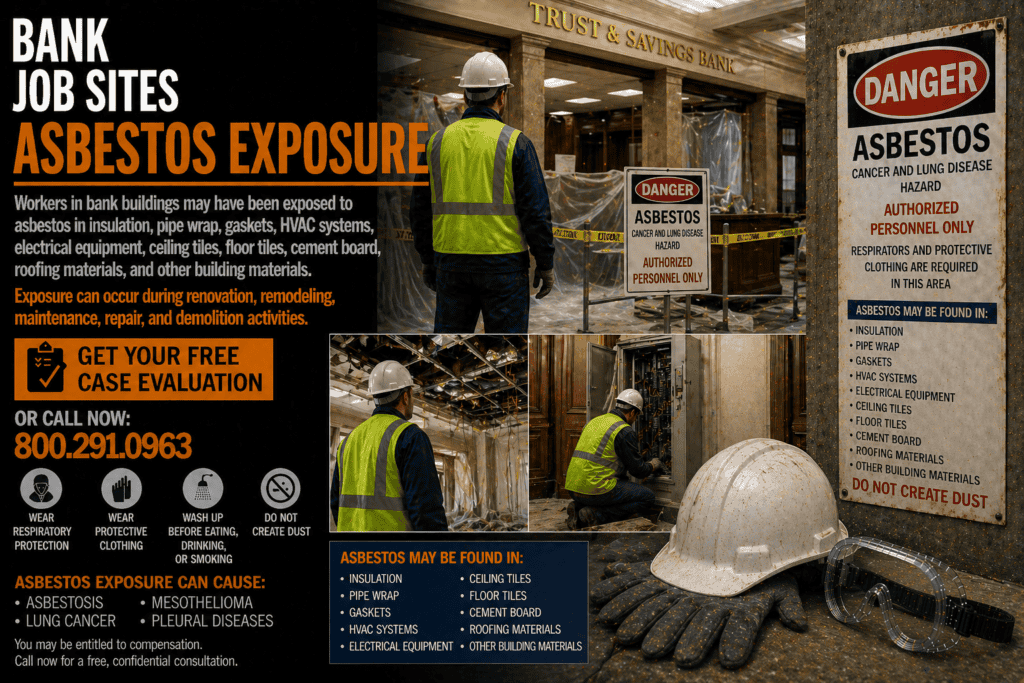
🏦 Banks Asbestos Exposure
Banks constructed before the 1980s frequently contained asbestos in insulation, flooring, cement, ceiling panels, and HVAC systems. These materials were used to reduce fire risk, provide soundproofing, and insulate walls and equipment—but posed deadly health risks as they aged or were disturbed.
Exposure occurred during renovations, maintenance, and utility upgrades. Workers often encountered asbestos while repairing wiring, replacing tiles, or opening walls—unknowingly inhaling fibers released into the air.
Today, many former bank workers, maintenance staff, and contractors suffer from:
• Mesothelioma
• Asbestos-related lung cancer
• Asbestosis
🏦 Bank Job Sites – What You’ll Learn From This Page:
💰 Bank buildings constructed before 1980 often used asbestos in ceiling tiles, pipe wrap, insulation, and fireproofing sprays.
🛠️ Renovations exposed tellers, contractors, and janitors to airborne asbestos during tile removal and HVAC repairs.
🏛️ Office workers, security staff, and clients were secondarily exposed when materials degraded or during remodeling.
🌫️ Fiber release occurred during drilling, rewiring, or structural changes without proper containment.
💰 Those exposed in bank buildings who developed asbestos disease may be eligible for compensation.
Estimated Number of People Exposed to Asbestos in U.S. Banks
| Exposure Category | Estimated Number of People Exposed |
|---|---|
| Occupational Exposure (contractors, janitors, HVAC techs) | Around 250,000 workers exposed |
| Secondary Exposure (tellers, clerks, staff) | Estimated 100,000 exposed |
| Environmental Exposure (clients, inspectors, visitors) | Around 200,000 people exposed |
👉 Total Estimated Exposure:
Over 550,000 people were exposed in bank job sites.
📊 Facts About Bank Buildings & Worker Exposure
• Thousands of bank branches were built with asbestos materials between the 1940s and 1980s.
• Asbestos Exposure: High during HVAC work, tile removal, ceiling replacement, and electrical upgrades.
• Asbestos-Related Disease Risk: Elevated for building staff, contractors, and renovation crews.
• Many banks were renovated without full abatement during the 1990s and 2000s.
• Similar Occupations: Electricians, janitors, HVAC techs, general contractors, architects, property managers
🏗️ History of Asbestos Use in Banks
Asbestos was considered a durable, fireproof material and was widely used in bank construction. Ceiling tiles, spray-on insulation, floor adhesives, and cement panels contained asbestos—especially in teller areas, vaults, mechanical rooms, and ceilings.
Over time, these materials deteriorated or were disturbed during retrofits. The dust released settled in air vents, ceilings, and employee areas—exposing workers and maintenance crews for decades.
⚠️ Mesothelioma Risk for Bank Workers
Even short-term exposure during repairs or renovations could lead to illness years later:
• Contractors and electricians disturbed asbestos insulation while installing wiring or equipment.
• HVAC techs encountered asbestos while accessing ducts or servicing climate systems.
• Cleaning crews unknowingly swept asbestos dust from damaged tiles or crumbling wall panels.
Symptoms may take 20–50 years to appear, delaying diagnosis for many exposed in older bank buildings.
🧪 Asbestos Products Found in Banks
🧱 Ceiling Tiles and Panels
Used in teller areas and offices; released fibers during drilling, light installation, or removal.
🔩 HVAC Duct Insulation
Lined ductwork and vents in ceilings; exposure during filter changes or duct sealing.
📦 Floor Tiles and Mastic Adhesives
Common in lobbies and back offices; fibers released as tiles cracked or glue degraded.
🚪 Wall Insulation and Fireproof Panels
Used in vaults and offices for temperature control; sanding or drilling released dust.
⚡ Electrical Panel Insulation
Found in breaker boxes and wiring chases; disturbed during upgrades or retrofits.
🔥 Spray-On Fireproofing
Applied to ceilings and beams; flaked or released fibers during vibration or access.
🧰 Pipe Wraps and Boiler Insulation
Used in bank basements or utility rooms; disturbed during valve repairs or heating fixes.
🪵 Cement Board and Sheeting
Used behind teller counters and partitions; cutting or demolition released fibers.
🧯 Door Cores and Fire Barriers
Fire-rated doors and walls often included asbestos cores.
🧴 Sealants and Compounds
Used to install or seal equipment; sanding or aging released asbestos particles.
👷 How Bank Workers Were Exposed
Many job roles put individuals near deteriorating asbestos or in contact with exposed materials.
🛠 Maintenance Workers
Replaced tiles, repaired walls, and serviced HVAC; disturbed asbestos-laced materials.
🧹 Custodians and Janitors
Cleaned floors and ceilings containing asbestos; swept fibers without respiratory protection.
⚡ Electricians
Installed or updated wiring in panels lined with asbestos insulation.
🌡 HVAC Technicians
Serviced systems wrapped in asbestos tape; exposure during access and repair.
🔧 Contractors and Renovation Crews
Demolished or remodeled bank interiors; heavy dust exposure from insulation and adhesives.
🏗 Property Managers and Inspectors
Regularly walked through mechanical areas; long-term secondhand exposure.
👨💼 Bank Employees and Managers
Worked daily in buildings with asbestos ceilings, tiles, and HVAC dust.
📸 Security and IT Technicians
Installed cameras and cables in walls and ceilings; disturbed embedded asbestos.
📦 Vault and Archive Staff
Handled files in dusty storage rooms; exposed to airborne fibers from older wallboard or tiles.
🔨 Carpenters and Interior Installers
Cut through asbestos panels for counter or display installations.
🧱 Painters and Decorators
Scraped walls and ceilings that released asbestos during surface prep.
🏛 Types of Bank Buildings With Asbestos Exposure
🏦 Urban Bank Branches
Often built in mid-century styles with asbestos in floors, ceilings, and HVAC systems.
🏢 Regional Banking Headquarters
Large multistory structures with central boilers and ductwork lined with asbestos.
🏛 Historic Bank Buildings
Pre-1950s banks used heavy asbestos cement and tile; high exposure during renovations.
🏚 Closed or Repurposed Banks
Converted into other businesses or residences; asbestos disturbed during repurposing.
🏫 Banks Inside Schools or Government Buildings
Shared infrastructure often included asbestos heating and ceiling systems.
🏠 Small-Town Bank Buildings
Single-story banks often used asbestos floor tiles and roofing.
🏬 Banks in Shopping Centers
Built with asbestos materials during mall expansions; HVAC and fireproofing posed risks.
🏗 Drive-Up and ATM Locations
Contained asbestos in canopy ceilings, electrical lines, and partition walls.
❓ Common Questions About Bank Asbestos Claims
Can bank workers file asbestos claims?
Yes — if diagnosed with an illness caused by workplace asbestos, you may qualify.
What if I only worked in a bank during a renovation?
Short-term exposure during high-risk work like demolition may still support a claim.
Can I file if I was a contractor?
Yes — contractors, HVAC techs, and electricians can all file asbestos claims if exposed.
Do I need proof of exposure?
Attorneys use job site records, building materials, and witness accounts to prove exposure.
Can my family file if I’ve passed away?
Yes — your loved ones may pursue a wrongful death claim or asbestos trust payout.
⚖️ How a Mesothelioma Attorney Can Help Bank Workers
A skilled asbestos lawyer can help by:
• Reviewing your work history and identifying asbestos sources
• Obtaining building material records or blueprints
• Filing lawsuits or trust claims before deadlines expire
• Helping families file wrongful death claims
• Charging no legal fees unless compensation is recovered
Legal help is available for bank employees, contractors, and maintenance staff.
📞 Free Legal Help for Bank Workers & Renovation Contractors
If you or a loved one worked in a bank and now suffer from mesothelioma or an asbestos-related illness—legal support is available.
Whether you were a maintenance tech, security installer, janitor, or employee, you may qualify for compensation.
Call Now: 800.291.0963
• No fees unless we win
• Free case evaluation
• Lawsuit and trust filing help
• Support for families, retirees, and contractors
Or request help online 24/7