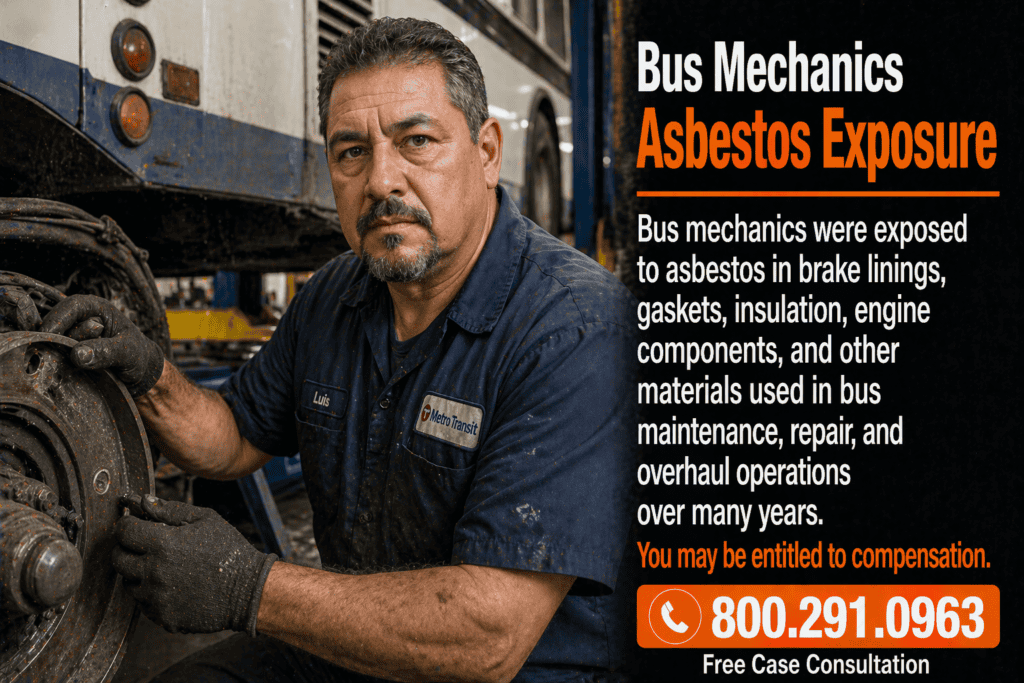
Bus Mechanics Asbestos Exposure
Bus mechanics inspect, maintain and repair braking, clutch, drivetrain and other systems on transit buses, school buses, motor coaches and fleet vehicles. Some historical brake linings, brake shoes, clutch facings and related friction components contained asbestos, creating a potential exposure pathway when mechanics inspected, disassembled, cleaned, rebuilt or replaced asbestos-containing parts.
NIOSH has investigated asbestos hazards in vehicle brake maintenance and specifically evaluated a bus maintenance shop for employee concerns about asbestos-containing brake dust. OSHA’s mandatory brake-and-clutch rules and EPA guidance also recognize that some, but not all, brakes and clutches may contain asbestos. A worker’s history should therefore identify the bus fleet, parts, years and maintenance methods involved.
Bus Mechanics and Occupational Asbestos Exposure
Bus mechanics can work for public transit agencies, school districts, private coach operators, transportation contractors and fleet maintenance companies. Duties may include brake inspection, brake rebuilding, clutch work, wheel and axle service, engine maintenance and general mechanical repair.
NIOSH evaluated a bus maintenance shop in Huntington Station, New York after employees raised concerns about asbestos-containing dust during vehicle brake repair. Investigators collected bulk samples of brake dust and pieces of brake shoes and pads specifically to determine whether asbestos was present.
Importantly, the samples collected during that 2007 investigation did not contain asbestos, and NIOSH recommended continuing to select and use non-asbestos brake shoes and pads. That finding illustrates an important accuracy rule: bus maintenance does not automatically establish asbestos exposure.
Historical exposure remains plausible when evidence identifies asbestos-containing friction components. NIOSH’s broader industrial-hygiene research at automobile and truck brake-service facilities documented airborne asbestos during brake maintenance, while EPA states that some brakes and clutches may contain asbestos.
Related resources include automotive mechanics and heavy equipment workers asbestos exposure, truck mechanics asbestos exposure and mechanics mesothelioma and asbestos exposure lawsuits.
Asbestos in Older Bus Brakes, Clutches and Friction Parts
Potential asbestos sources depended on the bus, manufacturer, replacement components and era. Relevant parts can include:
- Older asbestos-containing drum brake linings and brake shoes
- Older asbestos-containing clutch facings
- Brake and clutch residue generated from confirmed asbestos-containing friction material
- Older friction components that were ground, fitted or rebuilt where asbestos content is documented
- Other heat-resistant vehicle components where manufacturer or laboratory evidence confirms asbestos content
EPA explains that some, but not all, automotive brakes and clutches may contain asbestos. It specifically notes that brake and clutch dust can be visible when a disk, drum, clutch cover or wheel is removed from a car, truck or other equipment and that, if the component contains asbestos, the dust may contain inhalable asbestos fibers.
OSHA’s mandatory Appendix F establishes engineering controls and work practices for covered brake and clutch inspection, disassembly, repair and assembly. Specified approaches include negative-pressure enclosure/HEPA vacuum and low-pressure/wet-cleaning methods.
A bus brake shoe or clutch facing cannot reliably be identified as asbestos-containing simply by appearance. Manufacturer literature, packaging, parts catalogs, invoices, maintenance records and laboratory analysis can provide stronger evidence.
How Bus Mechanics Could Encounter Asbestos
Where asbestos-containing bus friction components were actually present, fibers could be released during direct servicing and certain historical maintenance practices.
- Brake inspection: opening drums containing residue from asbestos-containing linings
- Brake replacement: removing and handling older asbestos-containing shoes or linings
- Brake rebuilding: servicing or fitting confirmed asbestos-containing friction components
- Cleaning: disturbing accumulated asbestos-containing brake residue
- Compressed-air use: historically blowing dust from brake assemblies when asbestos-containing components were present
- Clutch work: disassembling and replacing asbestos-containing clutch facings
- Nearby work: sharing a maintenance bay where asbestos-containing friction dust was dispersed
NIOSH’s brake-mechanic research found that asbestos exposure varied with assembly-cleaning methods and the time required for cleaning. Peak concentrations during compressed-air cleaning were particularly concerning in historical studies.
NIOSH’s dedicated brake-drum publication recommends engineering controls and work practices to reduce asbestos exposure during brake maintenance. OSHA’s mandatory requirements likewise focus on containing, capturing or wetting residue rather than dispersing fibers into the mechanic’s breathing zone.
Transit Garages, Fleet Shops and Bus Maintenance Areas
A credible exposure history identifies the employer, maintenance facility, bus types, dates, components serviced and work practices.
Public Transit Maintenance Facilities
Transit agencies may operate large garages where mechanics repeatedly service buses. Historical asbestos exposure depends on whether the friction components being serviced contained asbestos and how brake and clutch work was performed.
School Bus Garages
School district and contractor mechanics can maintain bus fleets over many years. Fleet age, replacement-part history and brake-service methods are important when investigating possible asbestos exposure.
Private Motor Coach Shops
Private bus and coach operators may perform in-house mechanical work. Exposure should be connected to specific asbestos-containing components rather than inferred from fleet employment alone.
Bus Brake Repair Areas
NIOSH’s 2007 bus-shop investigation specifically sampled brake dust, brake shoes and pads after employees raised asbestos concerns. The samples did not contain asbestos, demonstrating why component-specific evidence is essential.
Heavy-Duty Vehicle Preparation Areas
In a separate federal vehicle research facility, NIOSH described a preparation area used for heavy-duty vehicles including straight trucks, tractor-trailers and buses. The evaluation identified possible asbestos exposure from brake assembly inspection and rebuilding while also evaluating diesel exhaust and other hazards separately.
Shared Mechanical Bays
Mechanics, helpers and other employees may work near brake-service operations. If confirmed asbestos-containing friction dust was dispersed, adjacent-worker exposure can be investigated using shop layout, work practices and witness evidence.
Related resources include automotive mechanics and heavy equipment workers asbestos exposure, truck mechanics asbestos exposure, auto body technicians asbestos exposure, mechanics mesothelioma and asbestos exposure lawsuits, maintenance mechanics asbestos exposure and high-risk jobs asbestos exposure.
Secondary or Household Exposure
If a bus mechanic’s clothing or belongings became contaminated during actual asbestos-containing brake or clutch work, fibers could historically be carried away from the garage. A household exposure history still requires evidence of the original asbestos source and a plausible contamination pathway.
Need help now? Call 800.291.0963
Live chat available 24/7, 365 days a year.
Submit Your Case
Mesothelioma and Other Occupational Health Risks
NIOSH identifies asbestos exposure as associated with serious health effects including lung cancer, asbestosis and mesothelioma. For a bus mechanic, those risks become relevant to an occupational history when actual exposure to asbestos-containing friction components or another confirmed asbestos source can be supported.
EPA emphasizes that some, but not all, brakes and clutches may contain asbestos. A dusty bus brake job therefore does not by itself establish asbestos exposure.
Bus mechanics can also encounter non-asbestos hazards. NIOSH’s bus maintenance investigation evaluated diesel exhaust, solvents, ventilation and other safety concerns in addition to asbestos. These hazards are separate and should not be used as evidence that asbestos exposure occurred.
Medical questions about prior asbestos exposure, symptoms, screening or diagnosis should be discussed with a qualified healthcare professional.
Documenting a Bus Mechanic Exposure History
A useful investigation identifies the employer, dates, garage, bus fleet, brake and clutch components and servicing methods.
- Employment evidence: transit agency, school district, coach operator, contractor, payroll, W-2, union and Social Security records
- Fleet evidence: bus makes, models, model years and vehicle identification records
- Part evidence: brake shoes, linings, clutch facings, manufacturers, part numbers and packaging
- Task evidence: drum removal, brake inspection, rebuilding, cleaning, grinding, fitting or clutch replacement
- Material evidence: manufacturer literature, parts catalogs, invoices, service manuals and laboratory analyses
- Exposure evidence: industrial-hygiene monitoring, OSHA records, NIOSH evaluations and shop procedures
- Witness evidence: mechanics, helpers, fleet supervisors, parts employees and coworkers
Historical fleet purchasing and parts records can be particularly useful because a mechanic may remember servicing a bus but not whether a specific brake shoe or clutch facing contained asbestos.
Questions That Can Strengthen an Exposure History
Which transit agency, school district or bus company and years? What buses were serviced? Were drum brakes common? How were brake assemblies cleaned? Were linings ground or rebuilt? Were clutches replaced? What brands or part numbers were used? Are fleet invoices, catalogs, shop records or coworker statements available? These details can help identify a specific exposure pathway.
Asbestos Lawsuits, Trust Funds and Compensation
A bus mechanic diagnosed with mesothelioma or another asbestos-related disease may have potential legal or compensation options when evidence supports occupational asbestos exposure and applicable requirements are met. Possible avenues can include claims involving legally responsible companies and asbestos bankruptcy trusts.
Bus-mechanic employment alone does not establish liability or asbestos trust eligibility. Each claim has separate medical, exposure, company, product and filing requirements. Evidence connecting the worker to an asbestos-containing brake, clutch or another covered asbestos source may be necessary.
Potential evidence includes employment and Social Security records, union records, fleet purchasing files, parts invoices, manufacturer catalogs, product packaging, service manuals, industrial-hygiene reports, photographs, coworker statements and medical documentation. Applicable law and filing deadlines should be reviewed individually.
Related Bus Mechanic and Automotive Resources
Automotive and heavy equipment: Automotive Mechanics & Heavy Equipment Workers Asbestos Exposure · Truck Mechanics Asbestos Exposure
Mechanics: Mechanics Mesothelioma, Asbestos Exposure & Lawsuits · Maintenance Mechanics Asbestos Exposure
Related automotive work: Auto Body Technicians Asbestos Exposure
Authoritative Sources
This page was researched using NIOSH, OSHA and EPA government sources. The strongest bus-specific evidence includes a NIOSH health hazard evaluation of a bus maintenance shop and a separate federal vehicle research facility where heavy-duty vehicles, including buses, were maintained and brake assembly work was evaluated.
- NIOSH — HHE 2007-0055-3073, Bus Maintenance Shop
- NIOSH — HHE 81-0135-0912, Vehicle Research and Test Center
- NIOSH — Asbestos Exposure Assessment for Brake Mechanics
- NIOSH — Control of Asbestos Exposure During Brake Drum Service
- OSHA — Mandatory Appendix F for Automotive Brake and Clutch Work
- EPA — Current Best Practices for Brake and Clutch Repair Workers
Bus Mechanics Asbestos Exposure FAQ
Did older bus brakes contain asbestos?
Some may have. EPA states that some, but not all, automotive brakes and clutches may contain asbestos. Product and fleet records are important for determining whether a particular bus component contained asbestos.
Did NIOSH investigate asbestos concerns in a bus maintenance shop?
Yes. NIOSH evaluated a bus maintenance shop in 2007 and sampled brake dust, brake shoes and pads. The samples collected in that investigation did not contain asbestos, showing why individual component evidence matters.
Could bus brake repair release asbestos fibers?
Potentially, when the brake components actually contained asbestos. Historical NIOSH research documented airborne asbestos during vehicle brake maintenance and found that exposure varied with cleaning methods.
Is all bus brake dust asbestos?
No. Brake dust can contain multiple materials, and not every brake shoe or pad contains asbestos. Dust alone does not prove asbestos exposure.
Could compressed-air cleaning increase asbestos exposure?
Historical NIOSH research found high peak asbestos concentrations during compressed-air cleaning when asbestos-containing brake components were involved. Federal guidance recommends controlled cleaning methods instead.
What records can document a bus mechanic’s asbestos exposure?
Employment records, fleet purchasing records, parts invoices, manufacturer catalogs, service manuals, product packaging, industrial-hygiene reports and coworker statements can help reconstruct exposure.
Could a bus mechanic carry asbestos dust home?
Potentially, if work clothing became contaminated during actual asbestos-containing brake or clutch work. Evidence of the original asbestos source and a plausible take-home pathway is still needed.
Can bus mechanics qualify for asbestos trust fund claims?
Some may qualify if they meet a trust’s medical and exposure criteria and can connect their work to a covered asbestos product, company or qualifying exposure period. Bus-mechanic employment alone does not establish eligibility.
Get Help Reviewing a Bus Mechanic Exposure History
Call 800.291.0963
Live chat is available 24/7, 365 days a year.
Prior bus, transit or fleet maintenance work does not automatically prove asbestos exposure, disease causation, liability, claim eligibility or compensation. Each situation depends on the employer, dates, buses, components, servicing methods, asbestos-content evidence, medical evidence and applicable legal requirements. Compensation is not guaranteed.
⚕️ Legal & Medical Information Disclaimer
This page provides general educational information and is not medical or legal advice. The information does not establish asbestos exposure, diagnosis, causation, liability, claim eligibility or compensation. Medical concerns should be discussed with a qualified healthcare professional, and legal questions should be reviewed with a qualified attorney.