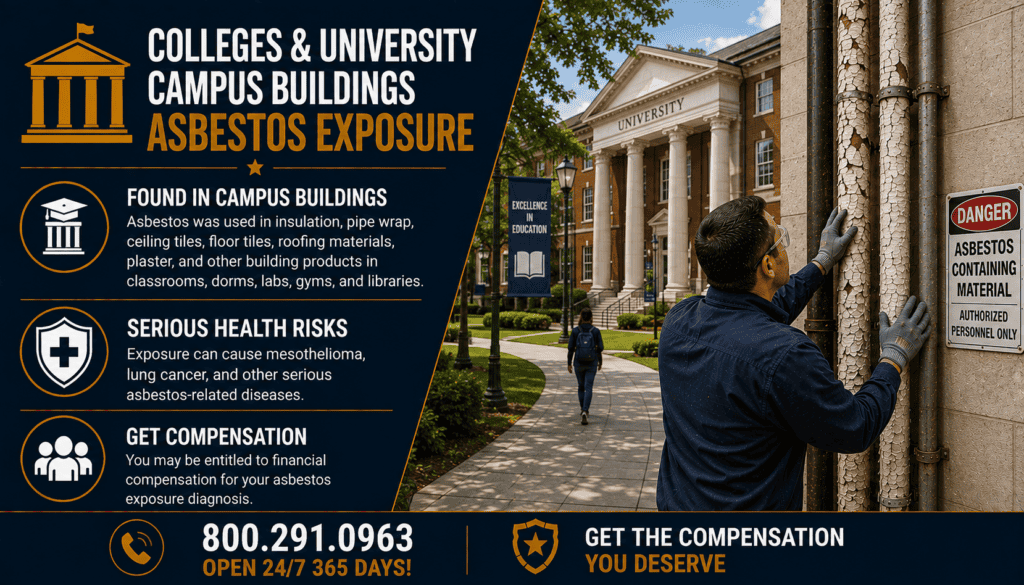
🎓 Colleges & University Campus Buildings Asbestos Exposure
Universities relied on asbestos throughout classrooms, administrative buildings, laboratories, and libraries.
Colleges and universities across the United States expanded rapidly throughout the mid-20th century. During this period, asbestos-containing materials were widely used in campus construction to meet fire codes, reduce noise, insulate heating systems, and lower building costs. As a result, many university campuses still contain asbestos today—often spread across dozens or even hundreds of buildings.
Unlike elementary and secondary schools, university campuses often include complex infrastructure such as research laboratories, medical facilities, power plants, tunnels, libraries, and residence halls. These environments increase the likelihood that asbestos materials may be disturbed during routine maintenance, renovations, or modernization projects, placing students, faculty, staff, and contractors at risk of long-term exposure.
🧱 Why Asbestos Was Used on College & University Campuses
From the 1930s through the late 1970s, asbestos was considered a “miracle material” for large institutional construction. Universities relied on asbestos because it offered:
-
🛡️ Fire resistance for lecture halls, dormitories, libraries, and laboratories
-
🔥 Thermal insulation for boilers, steam tunnels, and campus heating systems
-
🎧 Sound control in classrooms, auditoriums, and performance spaces
-
🧱 Durability for high-traffic academic and residential buildings
-
💲 Cost efficiency for large, publicly funded campus expansions
Many universities constructed entire building wings, residence halls, and utility systems using asbestos-containing products—often without any warning labels or safety guidance.
🧪 Common Asbestos-Containing Materials in University Buildings
Asbestos may be present throughout college and university campuses, including:
🧰 Heating & Mechanical Systems
-
Boiler insulation
-
Steam pipe insulation
-
Mechanical room insulation
-
Underground steam tunnels
🔳 Flooring, Walls & Ceilings
-
Vinyl floor tiles
-
Floor tile adhesives and mastics
-
Acoustic ceiling tiles
-
Plaster walls and joint compounds
🔥 Fireproofing & Structural Materials
-
Sprayed-on fireproofing
-
Cement panels
-
Structural steel fireproofing
⚙️ Specialized Campus Areas
-
Research laboratories
-
Libraries and archives
-
Administrative offices
-
Residence halls and dining facilities
While intact asbestos materials may pose limited immediate risk, aging infrastructure, vibration, water intrusion, or renovation work can release microscopic fibers into the air.
⚠️ How Asbestos Exposure Occurs on College Campuses
Asbestos exposure occurs when fibers become airborne and are inhaled. On university campuses, this commonly happens during:
-
Renovation or modernization projects
-
HVAC system upgrades
-
Electrical or plumbing repairs
-
Ceiling tile or flooring replacement
-
Maintenance in steam tunnels or mechanical rooms
-
Demolition of older campus buildings
Because asbestos fibers are invisible and odorless, exposure may occur without students or staff realizing it. College students may live, study, and work in the same buildings for years, increasing cumulative exposure risk.
🧑🏫 Who Is Most at Risk on University Campuses
🎓 Students
Students may be exposed in classrooms, residence halls, libraries, and laboratories. Graduate students and student workers who spend extended hours in older facilities may face increased risk.
👩🏫 Professors & Faculty
Faculty members often work in the same buildings for decades, increasing long-term exposure to deteriorating asbestos materials or contaminated ventilation systems.
🧹 Facilities, Maintenance & Custodial Staff
Campus maintenance workers face elevated exposure risk when performing repairs, upgrades, or emergency work involving pipes, ceilings, and mechanical systems.
🛠️ Contractors & Renovation Crews
Outside contractors frequently disturb asbestos during campus remodeling, expansion, and modernization projects—especially in older academic and residential buildings.
🧬 Health Risks Linked to University Asbestos Exposure
Asbestos-related diseases typically develop decades after exposure. Common conditions include:
🫁 Asbestosis
A chronic lung disease caused by asbestos fiber scarring, leading to breathing difficulties and reduced lung function.
🧠 Mesothelioma
A rare and aggressive cancer affecting the lining of the lungs or abdomen. Mesothelioma is almost always caused by asbestos exposure.
🫁 Lung Cancer
Long-term asbestos exposure significantly increases lung cancer risk, particularly when combined with smoking.
Because symptoms may not appear for 20–50 years, many individuals do not connect their illness to campus asbestos exposure until much later in life.
📜 Asbestos Regulations for Colleges & Universities
Colleges and universities are required to:
-
Identify asbestos-containing materials in campus buildings
-
Maintain asbestos management plans
-
Conduct regular inspections and re-inspections
-
Repair or remove damaged asbestos materials
These regulations emphasize management rather than removal, meaning asbestos often remains in place unless it becomes damaged or disturbed.
❓ Frequently Asked Questions (FAQs)
1️⃣ Do most colleges and universities contain asbestos?
Many campuses built or expanded before 1980 used asbestos-containing materials, especially in mechanical systems and older academic buildings.
2️⃣ Can students be exposed to asbestos in dorms or classrooms?
Yes. Asbestos may be present in ceiling tiles, flooring, pipe insulation, or ventilation systems in dormitories and classrooms.
3️⃣ Is asbestos exposure on campus dangerous?
Exposure risk increases when materials are damaged or disturbed. Long-term, low-level exposure can still lead to serious health conditions.
4️⃣ Can former students develop asbestos-related illness years later?
Yes. Asbestos diseases often develop decades after exposure, including exposure during college years.
5️⃣ Should universities remove all asbestos?
Removal is not always required, but damaged or deteriorating asbestos must be properly repaired or removed to protect occupants.
⚖️ How a Lawyer Can Help Get Compensation
Individuals diagnosed with asbestos-related illnesses may have legal options. An experienced asbestos lawyer can help by:
-
Identifying campus buildings where exposure occurred
-
Determining responsible asbestos manufacturers or contractors
-
Filing claims against asbestos trust funds
-
Pursuing compensation for medical expenses, lost income, and pain and suffering
-
Assisting families with wrongful death claims
Asbestos cases involving universities can be complex due to long exposure timelines and multiple responsible parties. Legal guidance can help protect your rights and maximize compensation.
📞 Free Case Evaluation – Get Help Today
If you or a loved one were exposed to asbestos at a college or university and later developed an asbestos-related illness, help is available.
📞 Call Now for a FREE Case Evaluation: 800-291-0963
There is no obligation, and compensation may be available.
📌 Key Takeaways
-
Colleges and universities widely used asbestos in campus construction
-
Many campus buildings still contain asbestos today
-
Exposure can occur during renovations, maintenance, or deterioration
-
Students, faculty, staff, and contractors may face long-term health risks
-
Legal options may be available for asbestos-related illnesses