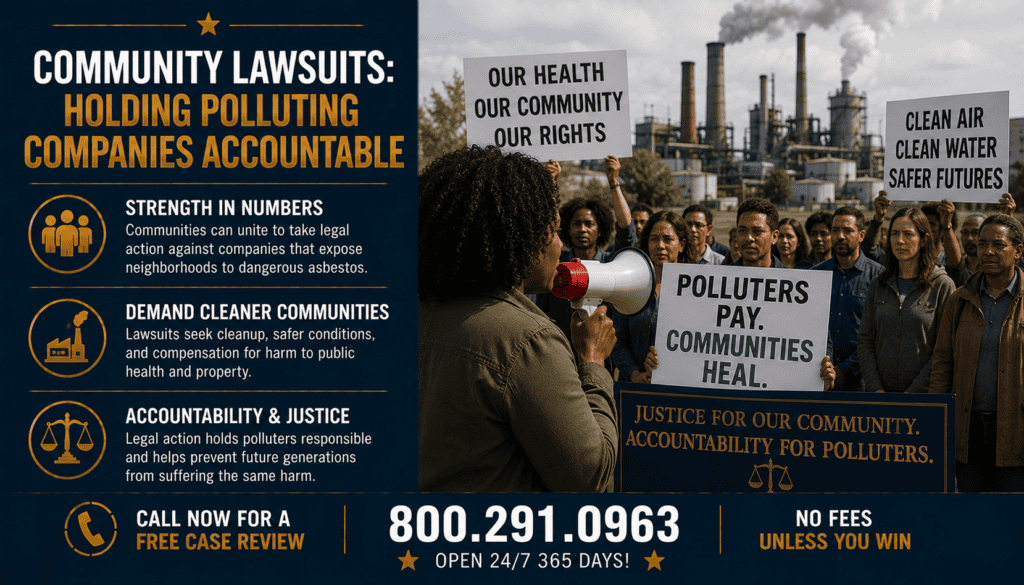
🌆 Community Lawsuits: Holding Polluting Companies Accountable
Explore real examples of community settlements that compensated residents for industrial asbestos contamination.
Across the United States, entire neighborhoods have been exposed to deadly asbestos fibers released by factories, shipyards, power plants, refineries, chemical facilities, demolition contractors, mines, and manufacturing plants. These environmental releases often contaminated the air, soil, and water surrounding residential communities for decades.
Many residents later developed mesothelioma, lung cancer, or asbestosis — even though they never worked directly with asbestos. Community lawsuits and mass-tort actions have become powerful tools to hold polluters accountable and secure compensation for victims.
This guide explains how community lawsuits work, real examples of major settlements, and how residents can protect their legal rights.
For immediate help, call 800.291.0963.
🏭 How Industrial Pollution Causes Community Asbestos Exposure
Asbestos-containing materials were widely used across major U.S. industries from the 1920s through the early 1980s. When these materials were cut, sanded, burned, broken, or improperly removed, fibers escaped into neighborhoods.
Common contamination sources include:
-
Manufacturing plants producing insulation, gaskets, textiles, or cement
-
Shipyards using asbestos on naval and civilian vessels
-
Power plants and refineries insulated with asbestos materials
-
Demolition of old commercial buildings
-
Mining operations
-
Rail yards and locomotive-repair centers
-
Landfills that accepted asbestos waste
-
Chemical plants producing heat-resistant products
How fibers spread into communities:
-
Airborne emissions from factory exhaust
-
Open-air asbestos processing
-
Dumping of asbestos-contaminated waste
-
Dust clouds from demolition or renovation
-
Soil contamination near industrial zones
-
Truck or equipment movement carrying fibers off-site
Some contamination persisted for decades, especially in low-income communities and older industrial towns.
📜 Legal Basis for Community Asbestos Lawsuits
Community lawsuits rely on several legal principles that protect the public from environmental harm.
Key legal foundations include:
1. Public Nuisance
Companies created a dangerous condition affecting entire neighborhoods.
2. Negligence
They failed to safely manage, contain, or dispose of asbestos.
3. Premises Liability
Companies are responsible for contamination originating on their property.
4. Failure to Warn
Manufacturers knew asbestos was hazardous but hid risks.
5. Strict Product Liability
Manufacturers or suppliers of asbestos-containing materials can still be sued.
6. Environmental Violations
Community lawsuits often include violations of:
-
EPA NESHAP asbestos rules
-
Clean Air Act standards
-
State environmental codes
-
Local demolition regulations
These laws provide strong support for residents seeking justice.
👥 Types of Community Asbestos Lawsuits
Depending on the scale of contamination, attorneys may pursue one or more types of legal action.
1. Mass-Tort Community Actions
Each resident files a separate case, but evidence is shared.
2. Class-Action Lawsuits
A single lawsuit covers all affected residents.
3. Property-Damage Claims
Families demand compensation for:
-
Home contamination
-
Cleaning and remediation
-
Reduced property value
-
Forced relocation
4. Medical-Monitoring Claims
Courts may require companies to pay for:
-
Screening tests
-
Imaging
-
Long-term medical surveillance
5. Wrongful-Death Claims
Families sue for compensation after losing a loved one to asbestos disease.
These actions often involve multiple defendants, increasing total recovery.
🏆 Real Examples of Community Settlements
Community asbestos exposure lawsuits have resulted in significant settlements and cleanup agreements nationwide. Below are well-known cases demonstrating how families successfully held corporations accountable.
🔹 Libby, Montana — The WR Grace Vermiculite Disaster
One of the most devastating environmental asbestos cases in U.S. history.
-
WR Grace processed asbestos-contaminated vermiculite for decades.
-
Fibers polluted the entire town, contaminating soil, homes, schools, and air.
-
Thousands became sick; many died.
-
WR Grace paid hundreds of millions in settlements, medical-monitoring funds, and cleanup obligations.
-
Libby was eventually declared a Superfund site.
🔹 Ambler, Pennsylvania — Asbestos Waste Piles
Ambler was home to massive asbestos manufacturing.
-
Waste piles were left exposed near homes and playgrounds.
-
EPA declared the area a Superfund site.
-
Multiple lawsuits resulted in compensation for residents with asbestos diseases.
🔹 Los Angeles, California — Industrial Demolition Contamination
Several LA neighborhoods were affected by improper demolition of older industrial structures.
-
Residents filed mass-tort claims.
-
Settlements covered medical costs, property cleaning, and relocation assistance.
🔹 Shipyard Communities Nationwide
Shipyards in states like:
-
California
-
Virginia
-
Washington
-
Louisiana
released asbestos dust that drifted into nearby homes. Many shipyard-adjacent neighborhoods have received compensation through lawsuits and trust-fund claims.
🔹 Public-Housing Contamination in Major Cities
Cities including New York, Chicago, Baltimore, and Philadelphia faced allegations of:
-
Hidden asbestos
-
Unsafe renovation practices
-
Failure to protect residents
Some public-housing authorities paid large settlements or court-ordered remediation costs.
🔹 Railroad Repair Yards (Midwest and Northeast)
Train-maintenance facilities often contaminated nearby soil.
-
Factories and rail yards in Illinois, Ohio, and Minnesota were sued for community harm.
-
Settlements provided cleanup funds and compensation for sick residents.
These examples show that neighborhood exposure is legally recognized and compensable.
📊 Evidence Used in Community Exposure Cases
Community lawsuits rely on a combination of environmental, scientific, and historical evidence.
Key evidence includes:
-
EPA or state environmental-agency reports
-
Air-quality studies
-
Soil-testing results
-
City demolition or renovation records
-
Corporate asbestos-handling documents
-
Scientific studies linking exposure to disease
-
Testimony from environmental experts
-
Medical records and pathology reports
-
Maps showing proximity to polluting sites
-
Satellite photos of demolition or waste piles
This evidence proves how pollution migrated from industrial sites to neighboring homes.
💰 Compensation Available to Community Exposure Victims
Residents exposed to asbestos through community contamination may qualify for significant compensation.
Possible compensation includes:
-
Medical expenses
-
Future treatment costs
-
Lost wages
-
Pain and suffering
-
Emotional distress
-
Property-damage reimbursement
-
Relocation assistance
-
Cleanup and remediation costs
-
Wrongful-death damages
-
Punitive damages (for systemic corporate negligence)
Victims may also receive compensation from asbestos trust funds, even if exposure occurred far from the workplace.
📅 Filing Deadlines for Community Lawsuits
Each state has a statute of limitations that limits how long victims have to file.
Typical limits:
-
1–3 years after diagnosis of mesothelioma or asbestos disease
-
1–3 years after death for wrongful-death claims
Because illnesses often appear 40–60 years after exposure, it is critical to contact an attorney quickly to preserve your rights.
🛡️ What Residents Should Do If They Suspect Community Exposure
If you believe your neighborhood was contaminated:
Take these steps immediately:
-
Seek medical evaluation and screening
-
Document past addresses
-
Collect local news articles about contamination
-
Photograph dust, debris, or industrial activity
-
Speak with neighbors who may also have been exposed
-
Obtain city or EPA reports
-
Contact an asbestos attorney experienced in community cases
Early documentation is essential for a strong claim.
📞 Get Legal Help for Community Asbestos Exposure
Community asbestos contamination is devastating — but residents are not powerless. Lawsuits and class actions have forced corporations, developers, shipyards, and government entities to take responsibility.
If you or a loved one developed mesothelioma after living near an industrial site, factory, shipyard, or contaminated neighborhood, you may qualify for significant financial compensation.
Our legal team investigates contamination sources, collects environmental evidence, and fights for justice on behalf of affected communities.
Call 800.291.0963 today for free legal help.