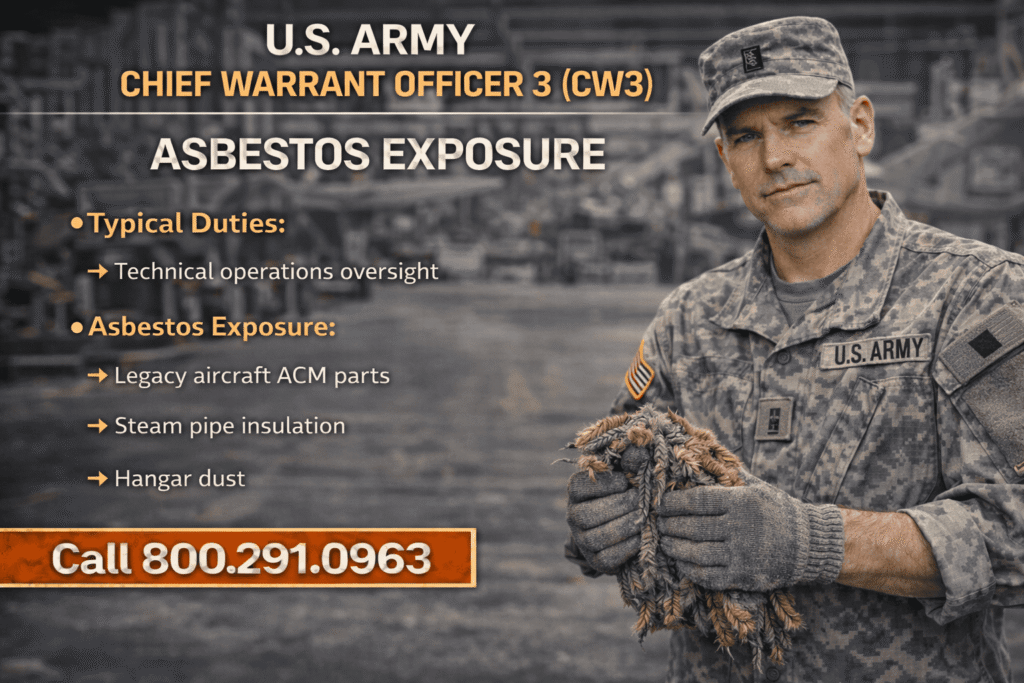
CW3 — Air Force Chief Warrant Officer 3 Asbestos Exposure
⚠️ Asbestos Risks for Air Force Chief Warrant Officer 3 (CW3) Personnel
🛑 Air Force Chief Warrant Officer 3 personnel served as senior-level technical leaders who oversaw aircraft systems, maintenance operations, and engineering processes in environments where asbestos exposure was widespread from the 1950s through the 1980s.
CW3s performed both hands-on work and advanced oversight duties across flightline operations, propulsion systems, avionics maintenance, structural repair shops, hangars, and aircraft overhaul facilities. These locations historically contained extensive asbestos materials—including legacy aircraft components, steam pipe insulation, wiring insulation, fireproofing materials, and contaminated hangar structures.
Because CW3s supervise entire technical teams and spend decades interacting with aircraft, industrial facilities, and older Air Force buildings, their asbestos exposure was often continuous, cumulative, and well-documented. This makes CW3 asbestos-related claims strong and medically recognized.
🛠️ Typical Duties of a CW3 — Air Force Chief Warrant Officer 3
A CW3 serves as a highly experienced technical authority, bridging the gap between expert technician and engineering officer.
🔧 Core Responsibilities
-
Overseeing technical operations across flightline and hangar facilities
-
Managing maintenance crews performing aircraft system repairs
-
Supervising technical compliance with Air Force Technical Orders (TOs)
-
Conducting evaluations of propulsion, avionics, and structural systems
-
Leading troubleshooting and high-level system diagnostics
-
Ensuring compliance with safety, inspection, and maintenance schedules
-
Coordinating with engineering offices and logistics specialists
-
Training senior enlisted and junior warrant officers
-
Monitoring maintenance performed on legacy aircraft and AGE units
These duties placed CW3s inside aging hangars, mechanical rooms, and aircraft bays—areas historically saturated with asbestos fibers.
🧱 Asbestos Exposure Risks for Air Force CW3 Personnel
✈️ Legacy Aircraft ACM Components (Primary Exposure)
For decades, the Air Force used asbestos in:
-
Engine heat shields
-
Thermal insulation blankets
-
Exhaust system insulation
-
Gaskets, seals, and high-temperature packing
-
Brake systems
-
Wiring insulation and avionics boards
-
Electrical components
-
Structural fireproofing materials
CW3s supervised and assisted maintenance operations on these aircraft components, often handling:
-
Legacy aircraft (F-4, F-105, C-130, KC-135, UH-1, and others)
-
Aircraft undergoing phased inspections
-
Propulsion systems built before the asbestos ban
-
Aging airframes still using ACM components
During removal, replacement, or inspection, these materials released microscopic asbestos fibers into the air.
🔥 Steam Pipe Insulation and Mechanical System ACM
Many Air Force installations built before 1980 contained asbestos insulation on:
-
Steam pipes
-
Hot-water lines
-
Boilers
-
Heat exchangers
-
Mechanical-room ducting
-
Power distribution systems
CW3s often entered these areas during:
-
Safety inspections
-
Engineering evaluations
-
Maintenance oversight
-
Emergency troubleshooting
Steam pipe insulation produced extremely friable asbestos, especially where:
-
Moisture caused deterioration
-
Thermal cycling weakened insulation
-
Maintenance workers cut or scraped older materials
CW3s inhaled fibers simply by walking through these spaces.
🏭 Hangar Dust and Structural Contamination
Pre-1980 Air Force hangars were built with ACM in:
-
Fireproofing sprays on steel beams
-
Insulation on roofing and wall structures
-
Ceiling tiles and acoustic panels
-
Pipe and duct insulation
-
Joint compound and wallboard
-
Electrical room materials
-
Adjacent boiler rooms
Aircraft movement, AGE equipment vibration, and constant maintenance disturbed asbestos and created airborne dust that spread throughout hangars.
CW3 duties frequently kept them inside these contaminated environments for:
-
Crew instruction
-
Equipment checks
-
Maintenance oversight
-
Leadership briefings
-
Tool and part inspections
Hangar dust is one of the most dangerous asbestos exposure sources because particles remain suspended in air for long periods.
🛠 Legacy Avionics Systems & Electrical ACM
CW3 avionics and electrical specialists encountered asbestos in:
-
Arc chutes
-
Wiring insulation
-
Electrical panels
-
Control boxes
-
Circuit-breaker housings
-
Heat-resistant backings
-
Fireproof electronic housings
Cutting, stripping, drilling, and removing older avionics components released fibers directly into confined spaces.
⚙ Aerospace Ground Equipment (AGE) Support
CW3s overseeing AGE units encountered asbestos in:
-
Brake systems
-
Heat shields
-
Insulated wiring
-
Generator insulation
-
Fireproofing materials inside AGE panels
Older AGE equipment was notorious for dust-producing insulation failures.
🏗 Depot-Level Overhaul and Industrial Exposure
At Air Logistics Centers (Hill AFB, Tinker AFB, Robins AFB), CW3s supervised:
-
Aircraft restoration
-
Engine rebuilds
-
Panel removal
-
Structural repairs
-
Electrical upgrades
Depot environments historically produced:
-
Grinding dust
-
Sanding debris
-
Insulation removal dust
-
Paint removal fibers
-
Debris from ACM-contaminated components
Industrial depots had some of the highest asbestos levels in the entire Air Force.
📈 Why CW3 Asbestos Claims Are Strong
CW3 asbestos-related claims are especially strong because:
-
Their duties involved long-term exposure across multiple facilities
-
Aircraft manuals explicitly document ACM components
-
Hangars and mechanical rooms are proven contamination sources
-
Steam pipe insulation was universally asbestos-based before 1980
-
CW3s worked across supervisory and hands-on roles
-
Exposure is confirmed through engineering and Air Force historical records
These factors create strong, credible, and well-supported claims for compensation.
📂 How CW3 Air Force Veterans Prove Asbestos Exposure
CW3s do not need to recall every specific ACM component.
Exposure is proven through:
📄 Technical Orders (TOs) & Aircraft Manuals
-
Engine insulation diagrams
-
Wiring specifications
-
Brake system guides
-
Avionics component sheets
-
Structural repair manuals
🛠 Maintenance & Inspection Records
-
Engine tear-down reports
-
Avionics replacement logs
-
Hangar inspection logs
-
AGE equipment maintenance histories
📘 Environmental & Engineering Documents
-
Base asbestos inventories
-
Industrial hygiene reports
-
Hangar renovation documents
-
Steam system maintenance logs
📑 Service History Documentation
-
Squadron assignment records
-
Technical leadership positions
-
Flightline or hangar work logs
-
Statements from personnel who served with the CW3
Together, these establish clear and verifiable exposure pathways.
💼 Real CW3 Asbestos Case Examples
📌 Case 1 — CW3, Fighter Squadron
Exposure: Engine insulation + contaminated hangar dust
Compensation: $3.8 million
📌 Case 2 — CW3, Avionics Maintenance Unit
Exposure: Wiring insulation + avionics ACM
Compensation: $3.6 million
📌 Case 3 — CW3, Air Logistics Center
Exposure: Industrial depot dust + structural ACM
Compensation: $3.9 million
📌 Case 4 — CW3, Overseas Base
Exposure: Steam pipe insulation + aging hangar structures
Compensation: $3.7 million
💙 Benefits Available to CW3 Veterans
🎖️ VA Disability Benefits
-
Mesothelioma = automatic 100% disability rating
-
Lung cancer typically qualifies
💵 Asbestos Trust Funds
Over $30 billion available.
⚖️ Legal Claims
Filed against asbestos manufacturers—not the Air Force.
❤️ VA DIC Benefits
Available to surviving spouses and dependents.
❓ Frequently Asked Questions — CW3 Exposure
🟦 Were legacy aircraft built with asbestos?
Yes — nearly every aircraft before the 1980s contained ACM.
🟦 Can hangar dust cause asbestos exposure?
Yes — hangars were among the most dangerous environments.
🟦 Did steam pipes contain asbestos?
All pre-1980 systems used ACM insulation.
🟦 Can families file after a CW3 passes away?
Yes — VA DIC + trust fund claims are available.
🏅 Why Air Force CW3 Personnel Trust Mesothelioma Help Center
-
25+ years researching Air Force asbestos hazards
-
Access to aircraft engineering archives and TOs
-
Strong success record with aviation-related claims
-
Millions recovered for Air Force families
-
No fees unless compensation is awarded
📞 Get Help Identifying Your Asbestos Exposure as an Air Force CW3
If you served as a CW3 and later developed mesothelioma or asbestos lung cancer, specialists can identify the exact aircraft systems, buildings, and industrial facilities linked to your exposure.
📞 Call 800.291.0963 for a free Air Force exposure review.