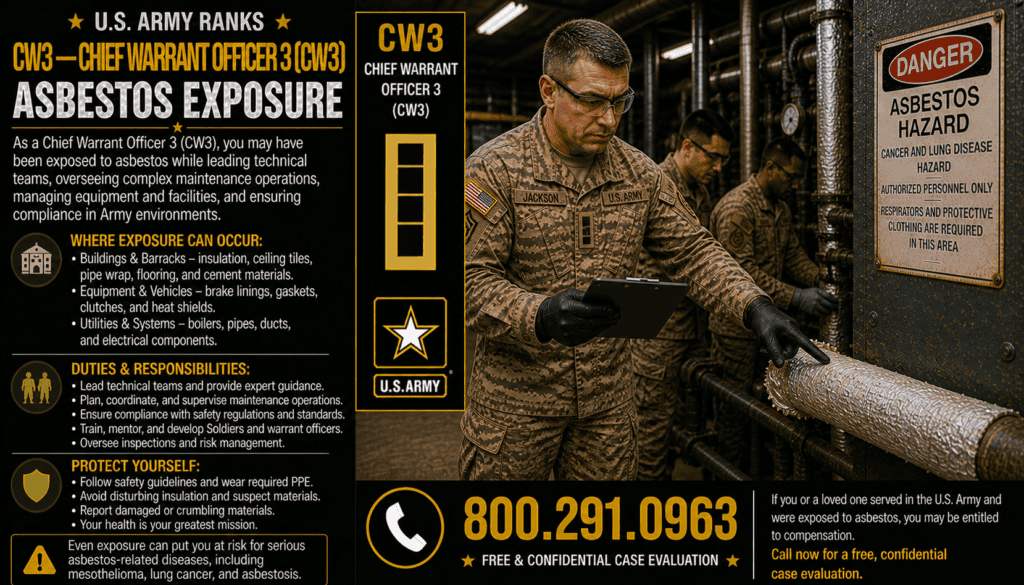
⚠️ CW3 – Army Chief Warrant Officer Asbestos Exposure
Risks in Aviation & Engineering Leadership
Army Chief Warrant Officer 3 (CW3) personnel serve as advanced technical leaders who oversee aviation operations, engineering repairs, aircraft maintenance quality control, and complex propulsion/engine evaluations. Throughout the 1940s–1990s, these duties placed CW3s directly inside high-risk environments where hangar insulation dust, engine compartment ACM (asbestos-containing materials), and aging Army aviation facilities exposed them to dangerous asbestos fibers.
While CW3s are often in supervisory or leadership roles, these positions required constant presence in contaminated hangars, engine bays, and maintenance facilities. Because asbestos was used heavily in insulation, wiring, gaskets, fireproofing and high-heat engine components, CW3s faced daily inhalation exposure even when not directly handling ACM.
Today, many former CW3 aviation and engineering specialists are being diagnosed with mesothelioma, asbestos-related lung cancer, or asbestosis—conditions directly tied to their prolonged work in Army aviation environments.
This page explains where exposure occurred, why CW3s faced elevated risk, and what compensation options are available.
🛠️ Typical Duties of an Army Chief Warrant Officer (CW3)
CW3s represent the advanced tier of the Army’s Warrant Officer corps. Their responsibilities typically include:
-
Leadership in aviation maintenance and flight-line operations
-
Oversight of engine and transmission system repairs
-
Supervision of aircraft inspections and airworthiness assessments
-
Engineering support for powertrain upgrades and technical overhauls
-
Quality control for aircraft and vehicle repairs
-
Troubleshooting complex mechanical and electrical failures
-
Training and supervising maintenance teams
-
Managing work conducted in hangars, engine test facilities, and maintenance shops
CW3s often spent thousands of hours in Army aviation environments where asbestos had been widely used for insulation, fireproofing, and thermal control.
🧱 Asbestos Exposure Risks for CW3 Personnel
Hangar Insulation Dust (Primary Exposure Source)
Army hangars built between WWII and the late 1980s contained asbestos in:
-
Pipe insulation
-
Steam system coverings
-
Boiler insulation
-
Fireproofing spray
-
Acoustic ceiling tiles
-
Deteriorating wallboard
-
Floor tiles and mastic
As these materials aged, they produced constant ambient dust—fibers that circulated through ventilation systems and settled on aircraft, tools, uniforms, and work surfaces.
CW3s spending long hours inside these structures breathed this dust daily.
Engine Compartment ACM
Army aviation engines and powertrain systems used asbestos in:
-
High-temperature gaskets
-
Heat shields
-
Insulation blankets
-
Exhaust wraps
-
Engine compartment wall panels
-
Transmission housing insulation
-
Rotor brake linings
During inspections or repairs, cutting or removing these components released dangerous airborne fibers.
Aircraft Electrical & Avionics Systems
CW3 engineering leaders oversaw systems that included:
-
Asbestos-wrapped wiring
-
Arc chutes
-
Electrical insulation boards
-
High-amp circuit protection
-
Avionics heat shielding
Electrical troubleshooting often involved opening or disturbing asbestos-insulated parts.
Rotor & Brake Systems
Helicopter rotor braking systems and ground-support equipment used:
-
Asbestos brake pads
-
Clutch discs
-
Drum brake systems
Servicing these systems produced heavy friction dust.
Facility Renovation Exposure
CW3s assigned to long-term installations worked in buildings undergoing repairs involving:
-
Ceiling tile removal
-
HVAC overhauls
-
Pipe replacement
-
Engine-bay renovations
-
Hangar upgrades
-
Office expansions
These projects generated thick asbestos dust clouds, even when located in adjoining rooms.
✈️ Why CW3s Faced Higher Exposure Than Lower Ranks
CW3s often spent:
-
Longer hours inside hangars than junior enlisted personnel
-
More total years in aviation environments
-
More time directly near ongoing maintenance operations
-
More time in WWII-, Korea-, or Vietnam-era buildings
Additionally:
-
CW3s oversaw complex engine repairs where asbestos components were concentrated
-
Leadership required constant presence “on the floor” during major system overhauls
-
CW3s routinely conducted inspections near exposed ACM layers
Aviation Soldiers (Warrant and Enlisted) have one of the highest asbestos-related disease rates across all Army job categories.
🏛️ Common Asbestos-Containing Materials Encountered by CW3 Aviation Leaders
Hangar & Facility ACM
-
Pipe and boiler insulation
-
Steam line wrapping
-
Floor tile and adhesive
-
Acoustic ceiling panels
-
Spray fireproofing
-
Insulated ductwork
-
Cement sheeting and wallboard
Aircraft & Powertrain ACM
-
Engine heat shields
-
High-temperature gaskets
-
Insulation blankets
-
Exhaust system wraps
-
Rotor brake components
-
Avionics thermal barriers
Electrical Components
-
Wiring insulation
-
Circuit boards
-
Arc suppression devices
-
Heat-resistant electrical panels
CW3s often supervised, inspected, or worked beside all of these materials.
📈 Why CW3 Exposure Creates a Strong VA & Legal Claim
CW3s almost always have clear, well-documented exposure pathways, because:
-
Their MOS/Ratings connect to asbestos-heavy aircraft and engine systems
-
Aviation hangars were among the most contaminated structures in the Army
-
Technical manuals list asbestos-containing parts by name and number
-
Most CW3s served 12–22+ years
-
Many were stationed in aging, asbestos-filled facilities
-
Aircraft they supervised (UH-1, AH-1, OH-58, CH-47, UH-60) all used ACM during key eras
This makes exposure proof strong even without personal recall.
📊 How CW3 Exposure Is Proven for VA Disability & Legal Claims
Experts use:
-
Aviation maintenance manuals
-
Army technical bulletins
-
Environmental surveys
-
Hangar construction/renovation records
-
Aircraft part supplier lists
-
Engine component diagrams
-
MOS assignment history
-
Installation facility data (WWII–Vietnam era)
CW3 veterans do not need to remember exact components—documentation already exists.
📚 Real Examples of CW3 Asbestos Exposure
Case 1 — CW3 Aviation Maintenance Leader
Exposure: Hangar insulation dust, engine shielding
Compensation: $3.9 million
Case 2 — CW3 Engineering Supervisor
Exposure: High-temperature gaskets and exhaust wraps
Compensation: $3.1 million
Case 3 — CW3 QC Inspector
Exposure: Wiring insulation, avionics insulation boards
Compensation: $2.8 million
Case 4 — CW3 Powertrain Analyst
Exposure: Engine compartment ACM
Compensation: $3.2 million
🧭 How CW3 Veterans Prove Exposure
CW3s rarely handled asbestos directly—but that doesn’t matter.
Exposure is proven using:
-
Duty records
-
Aircraft repair logs
-
Aviation manuals listing asbestos parts
-
Hangar environmental evaluations
-
Known ACM components by aircraft model
-
Installation data for asbestos usage
-
Part number histories from manufacturers
This creates a complete exposure profile for VA and trust fund claims.
💙 Benefits Available to CW3 Veterans with Asbestos Diseases
VA Disability Benefits
-
Mesothelioma = automatic 100% rating
-
Lung cancer typically qualifies
Asbestos Trust Funds
More than $30 billion remains available.
Legal Compensation
Claims target manufacturers—not the Army.
VA DIC for Families
Surviving spouses and dependents may qualify for tax-free monthly benefits.
❓ Frequently Asked Questions — CW3 Asbestos Exposure
If I mostly supervised repairs, am I still eligible?
Yes—supervisors inhaled the same airborne fibers as maintenance teams.
Can hangar dust alone cause mesothelioma?
Yes. Long-term, low-dose exposure is medically sufficient.
Do I need evidence of specific parts?
No. Experts retrieve decades of aircraft documentation.
Can families file after a veteran dies?
Yes—VA DIC + asbestos trust funds remain available.
🏅 Why Aviation Warrant Officers Trust Mesothelioma Help Center
-
25+ years specializing in Army aviation asbestos exposure
-
Access to historic Army aircraft manuals and part lists
-
Detailed mapping of hangar and maintenance facility ACM
-
Millions recovered for Warrant Officers and aviation personnel
-
No fees unless compensation is awarded
📞 Get Help Identifying Your Asbestos Exposure as a CW3 Army Chief Warrant Officer
If you or a loved one served as a CW3 and later developed mesothelioma or asbestos lung cancer, specialists can trace your exposure to specific aircraft, facilities, and components—even decades later.
📞 Call 800.291.0963 for a free exposure review.