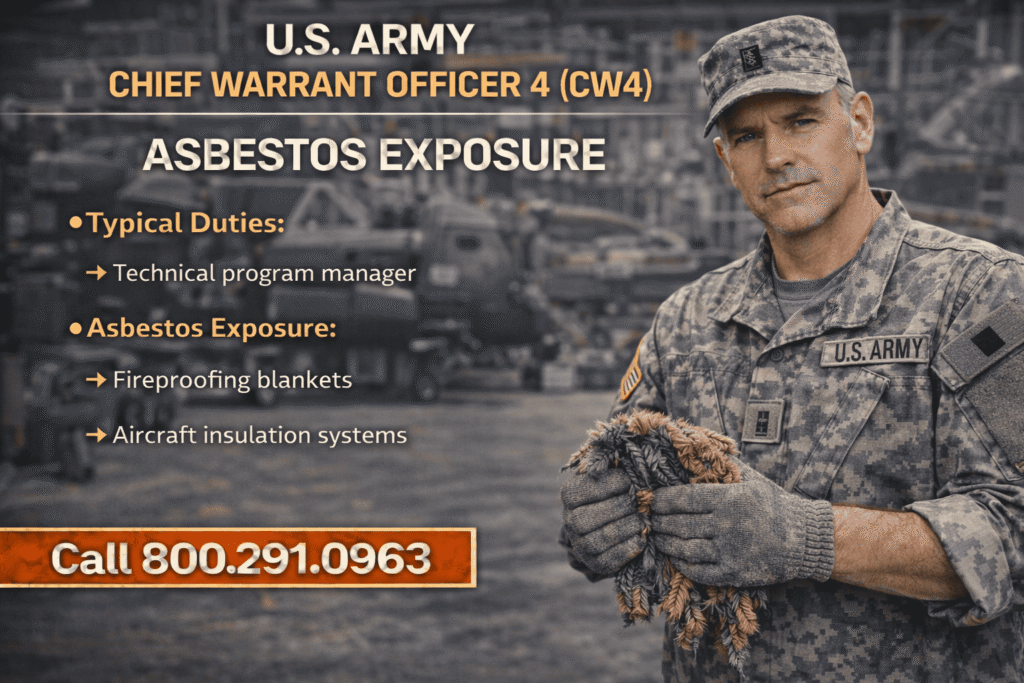
CW4 — Air Force Chief Warrant Officer 4 Asbestos Exposure
⚠️ Asbestos Risks for Air Force Chief Warrant Officer 4 (CW4) Personnel
🛑 Air Force Chief Warrant Officer 4 personnel served as senior technical program managers, overseeing aviation systems, aircraft maintenance programs, and complex engineering operations throughout pre-1980 Air Force facilities. Their leadership roles placed them in direct contact with high-risk asbestos environments including aircraft engine bays, avionics systems, maintenance shops, and older hangars built with asbestos insulation and fireproofing materials.
Although the modern Air Force no longer maintains the Warrant Officer program, historical CW4 duties resembled today’s highest-ranking technical advisors. These men and women had long careers—20, 25, or even 30+ years—which greatly increased their cumulative exposure to asbestos fibers throughout numerous bases, hangars, aircraft, and maintenance facilities.
CW4s supervised major repair programs and aircraft system upgrades, many of which required repeated removal, inspection, or replacement of asbestos-containing materials (ACM). They also conducted safety evaluations, program oversight, and facility inspections inside aircraft hangars that contained deteriorating fireproofing, insulation, and aging ACM panels.
🛠️ Typical Duties of a CW4 — Chief Warrant Officer 4
CW4s served as senior technical leaders, often responsible for managing entire aircraft maintenance programs or complex engineering operations.
🔧 Core Responsibilities
-
Serving as technical program manager for aircraft systems
-
Overseeing fleet-wide propulsion, avionics, or structural programs
-
Evaluating maintenance procedures and ensuring compliance with Technical Orders (T.O.s)
-
Conducting inspections across hangars, flightlines, and maintenance bays
-
Supervising senior NCOs, CW2s/CW3s, and civilian maintenance teams
-
Reviewing engineering data, component testing, and system performance
-
Managing logistics, repair schedules, and long-term planning
-
Directing root-cause analysis for major aircraft issues
-
Overseeing depot-level, base-level, and field-level maintenance programs
-
Inspecting fireproofing systems, insulation, and aircraft protective materials
These job responsibilities placed CW4s in constant proximity to asbestos-containing aircraft components and structures.
🧱 Asbestos Exposure Risks for Air Force CW4 Personnel
🔥 Fireproofing Blankets and Thermal Protection Systems (Primary Exposure)
Aircraft used asbestos-based fireproofing blankets for decades to shield components from extreme heat, including:
-
Engine nacelles
-
Firewall areas
-
Exhaust systems
-
Auxiliary power units (APUs)
-
High-temperature avionics bays
-
Hydraulic lines exposed to heat
-
Fuel system components near engines
CW4s supervised and sometimes directly participated in removal, inspection, and installation of:
-
Fireproofing blankets
-
Asbestos cloth wrapping
-
High-temperature insulation pads
-
Thermal protection liners
These materials grew brittle with age and shed fibers during:
-
Routine checks
-
Engine overhauls
-
Insulation replacement
-
Aircraft retrofits
-
Structural repairs
Because CW4s oversaw multiple teams, they frequently encountered these materials across numerous aircraft platforms.
✈️ Aircraft Insulation Systems
Pre-1980 aircraft insulation contained asbestos in:
-
Soundproofing blankets
-
Wall and ceiling insulation inside large aircraft
-
Thermal barriers under floor panels
-
Vibration-damping insulation
-
Electrical penetration seals
-
Brake system components
-
Wiring insulation in avionics compartments
CW4s responsible for evaluating system integrity were regularly exposed while:
-
Inspecting aircraft interiors
-
Supervising avionics or structural technicians
-
Opening insulation panels
-
Overseeing engine bay work
-
Conducting fleet-wide system audits
Large aircraft like the C-130, KC-135, C-141, and early Boeing models used massive quantities of asbestos insulation.
🏭 Hangar Fireproofing and Structural ACM
Hangars constructed before 1980 used asbestos in:
-
Overhead fireproofing spray
-
Roofing insulation
-
Wallboard joint compound
-
Pipe and duct insulation
-
Electrical switchgear components
-
Mechanical rooms connected to hangars
-
Boiler rooms adjacent to maintenance spaces
CW4s spent extensive time in these hangars while supervising:
-
Aircraft rebuilds
-
Phase inspections
-
Avionics upgrades
-
Structural repairs
-
Engine teardown programs
Constant aircraft vibration, AGE equipment movement, and hangar traffic dislodged aging ACM, creating airborne fibers across the workspace.
⚡ Avionics and Electrical ACM Exposure
Although CW4s performed fewer hands-on avionics tasks, their oversight required them to frequently inspect and verify work involving:
-
Wiring insulation
-
Arc chutes
-
Electrical panel insulation
-
Thermal-resistant mounting boards
-
Fuse housing components
-
High-voltage distribution boxes
When technicians disturbed these components, airborne asbestos fibers circulated through small avionics bays.
🚧 Depot-Level and Base-Level Overhaul Exposure
CW4s supervised or audited maintenance performed at:
-
Air Logistics Centers (Tinker, Hill, Robins)
-
Overseas repair depots
-
On-base heavy maintenance facilities
These environments produced extreme asbestos dust during:
-
Panel removal
-
Abrasive blasting
-
Sanding operations
-
Thermal stripping
-
Brake system overhauls
-
Insulation removal
Supervisory personnel, including CW4s, were often present during these high-risk evolutions.
📈 Why CW4 Asbestos Claims Are Strong
CW4 claims are among the strongest due to:
-
Long career spans with repeated exposure
-
Oversight roles requiring entry into high-risk spaces
-
Aircraft systems historically saturated with ACM
-
Technical manuals that document asbestos components
-
Hangars built before 1980 containing widespread asbestos
-
Well-preserved Air Force engineering and base records
-
Verified exposure pathways recognized by the VA
CW4s commonly qualify for multiple types of compensation through trust funds, VA benefits, and legal claims.
📂 How CW4 Air Force Veterans Prove Asbestos Exposure
CW4s do not need to identify individual asbestos parts from memory.
Exposure is proven using:
📄 Technical Orders (T.O.s) & Aircraft Manuals
-
Insulation specifications
-
Fireproofing blanket diagrams
-
Wiring system schematics
-
Engine bay maintenance instructions
🛠 Hangar & Facility Engineering Records
-
Base asbestos inventories
-
Hangar fireproofing maps
-
Asbestos abatement reports
-
Mechanical room logs
-
HVAC contamination documentation
📘 Maintenance Records
-
Engine overhaul logs
-
Avionics insulation updates
-
Aircraft structural repair orders
-
Brake system replacement histories
📑 Service History Evidence
-
Duty assignment records
-
Maintenance management logs
-
Statements from technicians and supervisors
-
Program management reports confirming oversight roles
These confirm exposure to known ACM facilities and aircraft.
💼 Real CW4 Asbestos Case Examples
📌 Case 1 — CW4, Strategic Air Command
Exposure: Aircraft insulation + hangar fireproofing
Compensation: $4.0 million
📌 Case 2 — CW4, Overseas Aircraft Depot
Exposure: Fireproofing blankets during aircraft overhaul
Compensation: $3.8 million
📌 Case 3 — CW4, Avionics & Electrical Program Manager
Exposure: ACM wiring insulation + hangar contamination
Compensation: $3.7 million
📌 Case 4 — CW4, Technical Program Oversight
Exposure: Multiple aircraft types + contaminated mechanical rooms
Compensation: $3.9 million
💙 Benefits Available to CW4 Veterans
🎖️ VA Disability Benefits
-
Mesothelioma → automatic 100% rating
-
Lung cancer → typically qualifies
💵 Asbestos Trust Funds
Over $30 billion available.
⚖️ Legal Compensation
Filed against manufacturers—not the military.
❤️ VA DIC for Families
Tax-free benefits for surviving spouses and dependents.
❓ Frequently Asked Questions — CW4 Exposure
🟦 Were fireproofing blankets asbestos-based?
Yes — nearly all were until the early 1980s.
🟦 Did aircraft insulation contain asbestos?
Yes — especially large transport, tanker, and early jet aircraft.
🟦 Could hangars expose supervisory personnel?
Yes — hangar dust is one of the leading sources of contamination.
🟦 Can families file after the veteran passes?
Yes — through VA DIC and trust fund claims.
🏅 Why Air Force CW4 Personnel Trust Mesothelioma Help Center
-
25+ years of aviation-specific asbestos research
-
Access to aircraft manuals and base engineering archives
-
Proven success in aviation technician and supervisor claims
-
Millions recovered for Air Force veterans and families
-
No fees unless compensation is awarded
📞 Get Help Identifying Your Asbestos Exposure as an Air Force CW4
If you served as a CW4 and later developed mesothelioma or asbestos-related lung cancer, specialists can identify the exact aircraft, hangars, and maintenance facilities linked to your exposure.
📞 Call 800.291.0963 for a free Air Force exposure review.