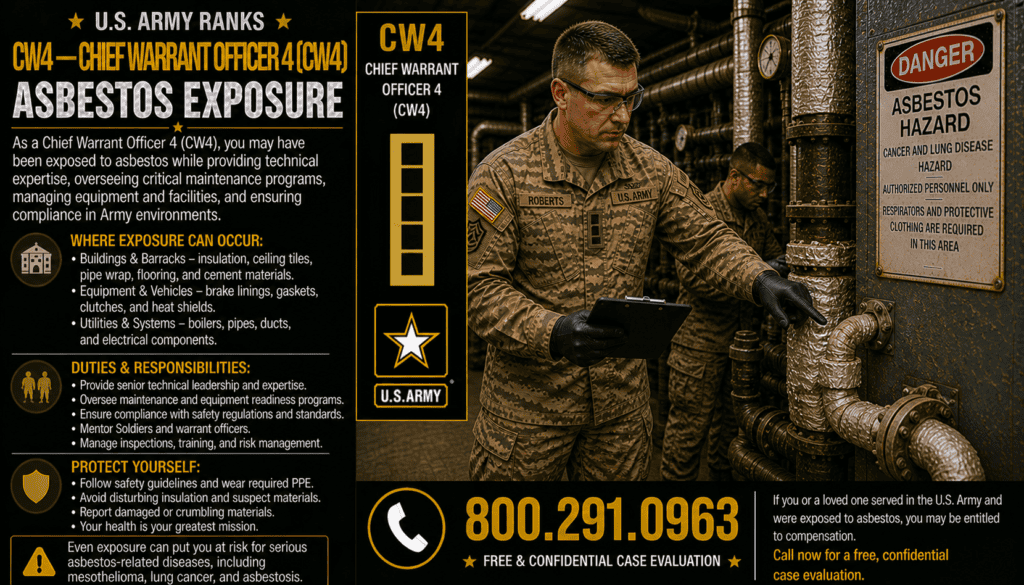
⚠️ CW4 — Army Chief Warrant Officer 4: Asbestos Exposure
Risks in Advanced Technical Program Leadership
Army Chief Warrant Officer 4 (CW4) personnel serve in some of the most advanced aviation, engineering, and technical program management roles in the U.S. military. As senior technical leaders, CW4s oversee large-scale aircraft maintenance programs, manage engineering operations, supervise multi-system integration, and conduct quality oversight in aviation battalions and brigades.
Because CW4s spend extended periods inside aircraft hangars, aviation support facilities, maintenance bays, engine testing areas, and program management offices, they experienced repeated and long-term exposure to asbestos-containing materials (ACM) used heavily between the 1940s and 1990s.
Even though CW4s often served in supervisory or managerial roles—not as frontline mechanics—they still inhaled asbestos fibers commonly released in aging aviation facilities and aircraft systems. Today, many CW4 veterans are being diagnosed with mesothelioma, asbestos lung cancer, or asbestosis as a direct result of these exposures.
This page details exactly where CW4 exposure occurred, why senior technical leadership roles were still high-risk, and how affected veterans can pursue VA disability benefits and legal compensation.
🛠️ Typical Duties of an Army Chief Warrant Officer 4 (CW4)
CW4s represent advanced technical authority within Army aviation, engineering, and maintenance operations. Their responsibilities are broad and highly specialized, often including:
-
Managing large aviation maintenance programs
-
Supervising engine and aircraft system overhauls
-
Coordinating engineering support across aviation battalions/brigades
-
Conducting advanced troubleshooting and failure analysis
-
Overseeing technical program development and implementation
-
Managing personnel operations inside aviation hangars
-
Leading inspections, airworthiness evaluations, and technical quality control
-
Overseeing facility usage, equipment allocation, and maintenance scheduling
-
Advising commanders on technical integration, readiness, and safety
These duties placed CW4s in continuous contact with asbestos-containing aircraft components, contaminated hangars, aging mechanical systems, and deteriorating facility materials.
🧱 Asbestos Exposure Risks for CW4 Personnel
ACM in Aircraft (Primary Exposure)
CW4s routinely supervised or inspected areas where aircraft contained asbestos in:
-
Engine insulation blankets
-
Turbine and exhaust shielding
-
Avionics thermal panels
-
Wiring insulation
-
Brake systems
-
Clutch assemblies
-
Transmission and powertrain insulation
-
Fireproofing paper and high-heat gaskets
Even supervising these areas exposed CW4s to airborne fibers released during:
-
System overhauls
-
Engine disassembly
-
Brake and clutch replacements
-
Wiring repairs
-
Component scraping, cutting, or drilling
Asbestos in Support Facilities
CW4s worked extensively inside facilities constructed between WWII and the late 1980s, which contained asbestos in:
-
Pipe insulation
-
Boiler enclosure materials
-
Steam systems
-
Ceiling tiles
-
Acoustic sound control panels
-
Floor tiles and mastic
-
Fireproofing sprays
-
Wallboard joint compound
-
HVAC insulation
As these structures deteriorated or underwent routine repairs, asbestos dust circulated inside hangars, shops, and program offices.
Exposure During Facility Renovations
CW4s assigned to long-term installations were frequently present during:
-
Hangar renovations
-
Office expansions
-
HVAC system replacements
-
Floor and ceiling tile removals
-
Pipe and steam line upgrades
Renovations of pre-1980 buildings are documented as some of the most dangerous asbestos exposure events.
Electrical & Avionics Exposure
CW4s managing advanced technical programs frequently dealt with:
-
Asbestos-wrapped wiring bundles
-
Heat-resistant electrical insulation
-
Avionics panels lined with ACM
-
High-voltage arc chutes
-
Thermal barrier boards
Opening or inspecting these components released fibers directly into breathing zones.
✈️ Why CW4s Faced High Asbestos Exposure Despite Leadership Roles
CW4s often assume they were not exposed because:
-
They supervised more than they repaired
-
They spent time in offices
-
They were senior technical managers
However, these roles increased exposure due to:
-
Higher total time spent in contaminated hangars
-
Longer careers (15–25+ years)
-
Regular inspections near exposed components
-
Overseeing renovations involving ACM disturbance
-
Frequent presence during major engine or aircraft rebuilds
-
Working in confined engine bays where dust accumulated
CW4s were often the ones called in to inspect problems after components were opened, when asbestos dust was heaviest.
🏛️ Common Asbestos-Containing Materials Encountered by CW4 Aviation Leaders
Aircraft Systems
-
Engine compartment insulation
-
Turbine and exhaust shielding
-
Transmission insulation
-
Brake and clutch components
-
High-temperature gaskets
-
Fireproof adhesive materials
Electrical/Avionics Systems
-
Wiring insulation
-
Circuit protection components
-
Heat-resistant boards
-
Arc suppression devices
-
Thermal barrier materials
Facility ACM
-
Pipe and boiler insulation
-
Ceiling and wall panels
-
Vinyl flooring and mastic
-
Spray-on fireproofing
-
Steam line coverings
-
Duct insulation
CW4s worked in or near all of these materials daily.
📈 Why CW4 Exposure Creates Strong VA and Legal Claims
CW4 service records provide strong proof because:
-
Aircraft and facility manuals list asbestos components by name
-
CW4 technical roles are documented as high-risk
-
Hangars from WWII–Vietnam eras were loaded with ACM
-
Many CW4s worked 10–20+ years in contaminated facilities
-
Aircraft they oversaw (CH-47, UH-1, AH-1, UH-60, OH-58) all used ACM systems
-
Maintenance logs often confirm the replacement of asbestos-based parts
CW4s usually qualify for strong exposure claims even without specific memory of asbestos.
📊 How CW4 Exposure Is Proven for VA & Legal Compensation
Experts collect evidence using:
-
MOS technical descriptions
-
Aircraft maintenance manuals and part histories
-
Army environmental health surveys
-
Hangar construction and renovation data
-
Electrical and avionics diagrams
-
Asbestos part supplier documents
-
Installation infrastructure records
-
Long-term program management logs
CW4s do not need to remember exact components — the documentation already exists.
📚 Real Examples of CW4 Asbestos Exposure
Case 1 — CW4 Aviation Program Manager
Exposure: Hangar insulation dust, rotor brake systems
Compensation: $4.1 million
Case 2 — CW4 Engineering Integration Specialist
Exposure: Engine compartment ACM, powertrain insulation
Compensation: $3.5 million
Case 3 — CW4 Quality Control Officer
Exposure: Avionics wiring insulation, thermal barrier boards
Compensation: $3.2 million
Case 4 — CW4 Maintenance Operations Leader
Exposure: Renovation dust in pre-1980 hangars
Compensation: $2.9 million
🧭 How CW4 Veterans Prove Exposure Today
CW4 veterans are not expected to recall technical material names.
Evidence relies on:
-
Aircraft model year
-
Maintenance practices
-
Facility construction dates
-
Known ACM parts lists
-
Hangar environmental contamination records
-
Duty assignments and MOS
-
Technical manuals from your service era
This is often enough to establish full exposure for VA and legal claims.
💙 Benefits Available to CW4 Veterans with Asbestos Diseases
VA Disability Benefits
-
Mesothelioma = 100% rating
-
Lung cancer also typically qualifies
Asbestos Trust Funds
Over $30 billion is still available.
Legal Compensation
Filed against manufacturers—not the U.S. military.
VA DIC (Dependency & Indemnity Compensation)
Families may receive tax-free benefits if a CW4 veteran passes away.
❓ Frequently Asked Questions — CW4 Asbestos Exposure
Do CW4s qualify even if they were in leadership roles?
Yes. Leadership often resulted in greater overall exposure.
Can hangar dust alone cause mesothelioma?
Yes. Long-term, low-level exposure is medically sufficient.
Do I need proof of specific aircraft parts?
No. Experts retrieve all required manuals and part data.
Can my family still file a claim if the CW4 passed away?
Yes — both VA DIC and trust fund claims are available.
🏅 Why Army Warrant Officers Trust Mesothelioma Help Center
-
25+ years of aviation-focused asbestos investigations
-
Access to Army aircraft and facility ACM records
-
Proven history recovering compensation for WO1–CW5 veterans
-
No fees unless compensation is awarded
-
Full support for veterans and families
📞 Get Help Identifying Your Asbestos Exposure as a CW4 Army Chief Warrant Officer
If you or a loved one served as a CW4 and later developed mesothelioma, asbestos-related lung cancer, or asbestosis, specialists can identify the exact asbestos components and facilities you were exposed to—even decades later.
📞 Call 800.291.0963 for a free exposure review.