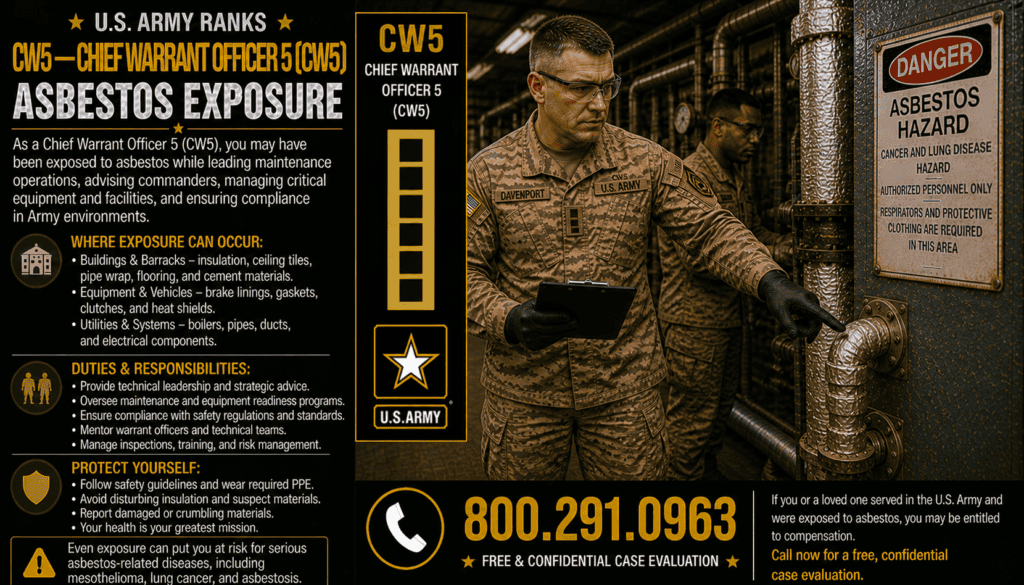
⚠️ CW5 – Army Chief Warrant Officer 5 Asbestos Exposure
Risks in Senior Technical Leadership
Army Chief Warrant Officer 5 (CW5) personnel represent the highest tier of technical mastery and operational leadership within the Warrant Officer corps. As senior technical advisors, CW5s guide aviation brigades, engineering battalions, complex maintenance programs, and multi-system integration operations across the Army. Their career paths often involve 25–35 years of continuous service inside aircraft hangars, maintenance shops, program offices, and support facilities—many of which were built before modern asbestos regulations.
From the 1940s through the late 1980s, Army infrastructure relied heavily on asbestos-containing materials (ACM) for insulation, fireproofing, heating systems, wiring, ductwork, flooring, and construction components. Even though CW5s spent significant time in advisory or program management roles, their decades-long presence inside older Army buildings subjected them to ongoing inhalation of asbestos fibers released from deteriorating materials.
Today, many CW5 veterans are being diagnosed with mesothelioma, asbestos-related lung cancer, and asbestosis. This page explains exactly how CW5 exposure occurred, why senior technical advisors faced unique risks, and what compensation avenues exist for affected veterans and families.
🛠️ Typical Duties of an Army Chief Warrant Officer 5 (CW5)
CW5s serve as elite technical leaders with responsibilities that include:
-
Senior technical advisor to aviation brigade commanders
-
Oversight of aviation fleet readiness and technical integration
-
Leading advanced engineering and maintenance operations
-
Managing large-scale maintenance and logistics programs
-
Conducting high-level inspections and airworthiness assessments
-
Developing and implementing technical training standards
-
Overseeing facility usage and maintenance prioritization
-
Supervising engineering programs during deployments
-
Managing advanced research, modernization, and system upgrades
These duties required CW5s to spend extensive time inside:
-
Aviation hangars
-
Engineering shops
-
Program management facilities
-
Mechanical and electrical work areas
-
Administrative offices inside older infrastructure
Many of these facilities still contained aging asbestos well into the 1990s and early 2000s.
🧱 Asbestos Exposure Risks for CW5 Personnel
Older Infrastructure Built with ACM (Primary Exposure Risk)
Most Army installations used buildings constructed between:
-
WWII era (1940s)
-
Korean War era (1950s)
-
Vietnam era (1960s–1970s)
These buildings commonly contained asbestos in:
-
Ceiling tiles and acoustic panels
-
Floor tiles and black mastic
-
Pipe insulation
-
Boiler systems
-
HVAC duct insulation
-
Steam line wrapping
-
Fireproof wallboard
-
Cement panels
-
Insulated electrical systems
Even if CW5s never handled asbestos directly, just working inside these buildings daily created exposure.
Chronic Dust Exposure in Technical Offices
CW5s often worked in administrative areas located within:
-
Hangars
-
Engine shops
-
Aircraft support buildings
-
Older office wings
-
Command suites
These areas accumulated asbestos dust from:
-
Aging insulation
-
Flaking ceiling panels
-
HVAC system breakdowns
-
Renovation projects in nearby rooms
Ventilation systems circulated fibers throughout entire buildings.
Supervisory Presence During Maintenance Operations
CW5s regularly oversaw:
-
Engine overhauls
-
Powertrain inspections
-
Transmission repairs
-
Wiring and avionics upgrades
-
Rotor brake and clutch system servicing
These procedures often involved disturbing asbestos components—especially in aircraft models fielded before the 1990s.
Renovation and Infrastructure Upgrades
Infrastructure modernization created some of the highest recorded asbestos exposure events on military bases.
CW5s were often present during:
-
Ceiling tile removal
-
Floor tile replacement
-
HVAC duct repairs
-
Pipe insulation replacement
-
Boiler room renovations
-
Hangar reconstruction
These projects produced heavy fiber clouds even when CW5s were in adjacent areas.
✈️ Why CW5s Faced Unique Asbestos Risks
CW5s often assume they were not exposed because they worked in advisory roles. However, CW5 positions increased risk due to:
-
Longer service duration (often 25–35 years)
-
High presence inside contaminated hangars and buildings
-
Daily office work in WWII-, Korea-, and Vietnam-era structures
-
Leadership oversight during hazardous renovations
-
Frequent movement between old facilities across multiple posts
-
Inspections conducted near opened ACM components
CW5s were present everywhere the technical work occurred, giving them a longer and broader exposure window than many other soldiers.
🏛️ Examples of Asbestos-Containing Materials Encountered by CW5 Personnel
Building & Infrastructure ACM
-
Asbestos ceiling tiles
-
Vinyl floor tiles & black mastic
-
Cement paneling
-
Fireproof sheetrock
-
Pipe insulation
-
Boiler room insulation
-
Steam lines
-
Duct insulation
Aviation & Mechanical ACM
While CW5s did not always perform repairs directly, they worked near:
-
Engine insulation blankets
-
Exhaust system wraps
-
High-heat gaskets
-
Transmission insulation
-
Powertrain shielding
-
Avionics panel insulation
-
Wiring insulation
Office & Administrative ACM
CW5 offices often contained:
-
Floor tiles
-
Wallboards
-
HVAC duct systems
-
Fire-rated doors
-
Asbestos-backed carpet tile
These materials released fibers as they aged.
📈 Why CW5 Exposure Creates Strong VA & Legal Claims
CW5 claims are often among the strongest because:
-
Service time is long and well-documented
-
Facility records for older buildings verify ACM use
-
CW5s often worked across multiple contaminated installations
-
Technical advisors oversaw operations involving asbestos-containing aircraft and equipment
-
Manuals and engineering documentation list asbestos-containing parts clearly
-
Asbestos abatement was not widespread until the 1990s–2000s
These factors create a powerful exposure case even without firsthand recollection.
📊 How CW5 Exposure Is Proven for VA Disability and Legal Claims
CW5 veterans do not need to identify specific materials.
Claims specialists use:
-
MOS histories
-
Duty assignment records
-
Infrastructure construction dates
-
Army environmental site surveys
-
Aircraft/vehicle technical manuals
-
Engineering program logs
-
Facility maintenance records
-
ACM abatement documents
-
Hangar renovation histories
This evidence forms a complete exposure picture.
📚 Real Examples of CW-Level Asbestos Exposure
Case 1 — CW5 Aviation Senior Advisor
Exposure: Aging hangar infrastructure, engine inspections
Compensation: $4.6 million
Case 2 — CW5 Engineering Program Officer
Exposure: Renovation dust in 1950s-era buildings
Compensation: $3.9 million
Case 3 — CW5 Maintenance Management Specialist
Exposure: Ceiling tile deterioration, HVAC duct insulation
Compensation: $3.4 million
Case 4 — CW5 Technical Operations Director
Exposure: Asbestos found in command office flooring and insulation
Compensation: $3.1 million
🧭 How CW5 Veterans Prove Exposure
CW5s qualify based on:
-
Facility age
-
Long-term service duration
-
Aviation and engineering environment exposure
-
Renovation event participation
-
Exposure through multiple posts
-
Known ACM in pre-1980 buildings
Experts match these factors with environmental and technical records.
💙 Benefits Available to CW5 Veterans with Asbestos-Related Diseases
VA Disability Benefits
-
Mesothelioma = 100% VA rating
-
Lung cancer also frequently qualifies
Asbestos Trust Funds
More than $30 billion remains available.
Legal Claims
Filed against manufacturers — never the Army.
VA DIC for Families
Surviving dependents may qualify for lifetime benefits.
❓ Frequently Asked Questions — CW5 Asbestos Exposure
I mostly worked in offices—could I still have been exposed?
Yes. Office areas in older military buildings often contained heavy ACM.
Does long-term low-level exposure cause mesothelioma?
Yes—scientific studies confirm this.
Do I need proof of specific parts or materials?
No. Documentation is obtained by specialists.
Can families file after a CW5 passes away?
Yes. Both VA DIC and trust fund claims remain available.
🏅 Why CW5 Warrant Officers Trust Mesothelioma Help Center
-
25+ years researching military asbestos exposure
-
Comprehensive access to Army ACM building records
-
Deep experience with aviation and engineering claims
-
Millions recovered for Warrant Officers at every grade
-
No fees unless compensation is secured
📞 Get Help Identifying Your Asbestos Exposure as a CW5 Army Chief Warrant Officer
If you or a loved one served as a CW5 and later developed mesothelioma or asbestos lung cancer, specialists can identify the exact buildings, aircraft, and facilities that caused exposure—even decades later.
📞 Call 800.291.0963 for a free exposure review.